


Hello,
Welcome to Edition 13 of The Reading List — your fortnightly antidote to the noise. Every two weeks, I share my favourite reads across crypto, finance, technology, culture, and beyond. I also share what I’m watching and reading.

What I’m Watching and Reading
I am on a book break this week. I have not quite found the next one yet, and I would rather wait than begin something out of obligation.
I did finish I Will Find You, the eight-episode mini-series. It moves quickly and, unusually for an adaptation, does not feel like it is merely borrowing a book’s reputation. It knows when to keep things moving. If you want an easy-yet-thrilling watch, I’d strongly recommend watching this one on Netflix.
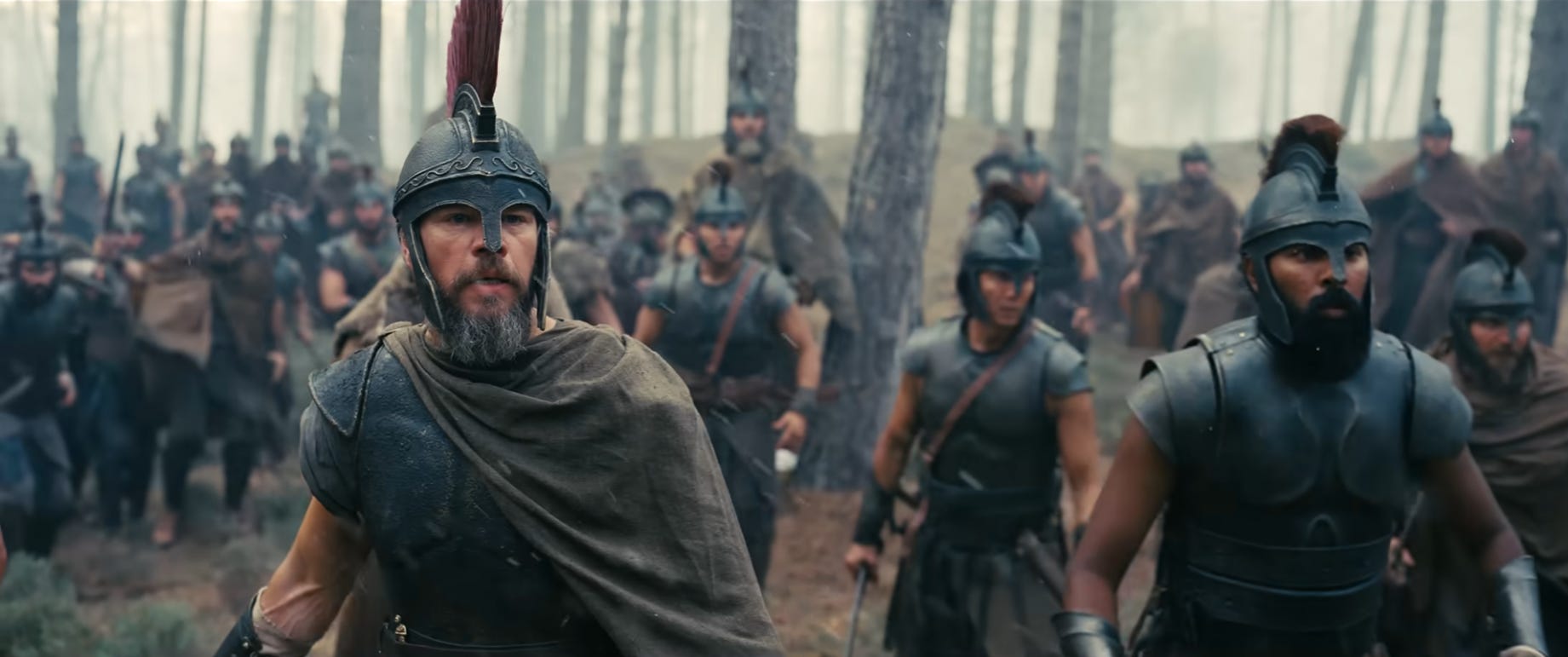
This weekend is for Christopher Nolan’s The Odyssey. Nolan remains, in my view, one of the few filmmakers whose intellectual ambition is matched by control over the actual filmmaking. The film was shot entirely with IMAX cameras, which makes the absence of a proper IMAX screen near me especially annoying. But who knows? I may travel 300 miles at the end of the month to watch it again on the screen it was made for.
Got any recommendations for nice watches or reads? Write to me?

The Fortnight That Was
The past fortnight followed a grim, but familiar rhythm. The fragile US–Iran ceasefire gave way to another round of American strikes, Iranian retaliation against US-aligned Gulf states, and renewed anxiety around shipping through the Strait of Hormuz. The seesaw continues; the difference is that markets are no longer treating each headline as a fresh apocalypse.
A new strike only matters when it threatens oil movement, damages regional infrastructure, or makes shipping through the Hormuz less predictable. That is why crude has remained the only expression of the conflict. WTI is up 18.9% in the past fortnight, while Bitcoin is up 2.1%, the S&P 500 is down 0.7%, and the dollar is broadly unchanged.
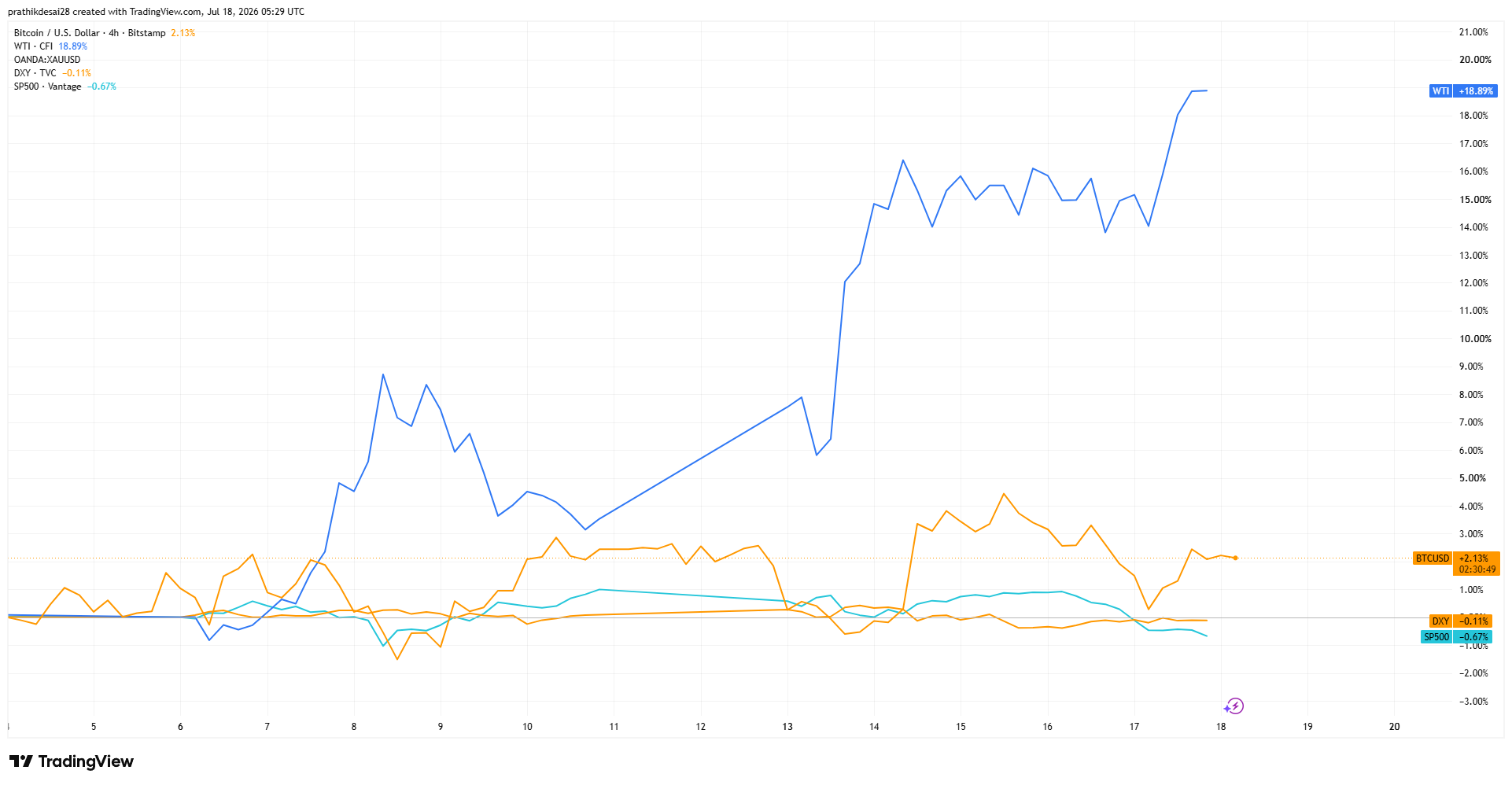
Zooming out gives a better picture. Since the start of the conflict on February 28, Oil is up 27%, the S&P 500 gained 8.3%, while Bitcoin is 5.5% in the red.
Nevertheless, our team at The Token Dispatch has been monitoring the infrastructure progress underway despite all the global macroeconomic drama.
What We Wrote Last Fortnight
Over the past fortnight, most of our stories focused on one specific question: when an asset, a network, or a financial product becomes more useful, who controls the infrastructure around it and who captures the value?
Vaidik’s two-part series on compute followed that question from the GPU itself to the market being built around it. In Part II, he looked at the uneasy logic of lending against hardware that depreciates faster than the debt used to finance it. In Part III, he mapped the emerging pricing, clearing, verification and settlement layers that may eventually turn compute into a real capital market.
I wrote about Robinhood’s attempt to build a financial supermarket, where the chain is not really the product and serves as connective tissue among its dozen existing businesses. In Making Capital Reallocate Faster, I explored what changes when capital can move and reprice faster than the institutions designed to contain it.
We also examined the ownership question from two directions. What Does a Token Holder Own? asked whether token holders retain any meaningful claim once crypto protocols begin raising conventional equity. The Aladdin Playbook looked at the other side of that bargain: how BlackRock’s BUIDL is becoming increasingly load-bearing collateral for on-chain finance, and what that does to crypto’s claims of independence.
Thejaswini took a sceptical look at the incentive systems behind two very different networks. The Intelligence Arbitrage asked whether Bittensor’s capital allocation mechanism rewards useful AI work or simply whichever subnet can sustain the strongest token bid. And Aave’s Extraction examined the price users may be willing to pay for convenience: a fixed yield, fewer decisions, and a familiar interface.
We have got more lined up in the coming weeks. Until then, here’s a reading list to give you good company.
Crypto & Tech
Robinhood’s Chain and Digital Asset Strategy: Insights4vc breaks down Robinhood’s push to build its own chain and tokenised-asset stack.
Dear Robinhood, Please Do Not Build: Artemis argues against the app-chain land grab, making the case that Robinhood should plug into existing rails rather than fragment liquidity with its own chain.
Is trade.xyz Existential to Hyperliquid?: A close look at whether the emerging venue trade.xyz genuinely threatens Hyperliquid or whether the incumbent’s liquidity and network effects hold.
The Always-On Economy: Pantera argues that programmable, 24/7 on-chain markets are quietly rewiring finance into a system that never closes.
TradFi Doesn’t Want DeFi, It Wants Blockchain: a16z crypto argues incumbents are adopting blockchain rails while sidestepping DeFi’s permissionless ethos.
How Financial Systems Become Fluid: On how tokenisation and interoperable rails dissolve the settlement frictions that keep today’s financial system siloed.
Inference in Capital Markets: Galaxy maps how AI compute — GPU futures and inference capacity — is being financialised and brought on-chain as a new crypto-native capital market.
Privacy Tokens: Chamath makes the case that privacy is becoming core financial infrastructure rather than a fringe feature (behind paywall).
Securitize Jumps After Partnering With Cantor: Securitize shares popped after the tokenisation firm tied up with Cantor Fitzgerald, another sign of TradFi leaning into on-chain assets (behind paywall).
The Decade Ahead: Delphi Ventures lays out the three macro forces it’s betting on for the next decade, from synthetic intelligence undercutting labour to the US unwinding the order it built, with crypto positioned as the parallel system (behind paywall).
Finance & Economy
How Artificial Spotify Streams Broke a Kalshi Market: How manufactured Spotify plays distorted a prediction market on streaming numbers, a case study in how thin the line between market and manipulation can be.
Citrini on surviving a drawdown: Ahead of CPI, Citrini offers important advice on treating the portfolio as its own position, knowing your tilts, not averaging down just to fix your cost basis, and using an early drawdown to study how you react rather than fighting your own psychology.
The Ozempic Economy: How private markets are repricing food, fitness and pharma around GLP-1 drugs, and where the capital flows next.
The Everything Chart: Pieter Levels stitches the macro trends he thinks explain almost everything into a single, attractive one-glance chart.
Circle and Coinbase’s Stablecoin Squeeze: JPMorgan warns that USDC’s economics face a “prisoner’s dilemma” as distribution deals like Hyperliquid’s siphon reserve income away from Circle and Coinbase (behind paywall).
Why China Got Rich and India Didn’t: David Oks argues China’s miracle rests less on freeing markets than on decades of hard social modernisation and human-capital investment that India never underwent.
AI & Innovation
Apple Sues OpenAI: Ben Thompson reads Apple’s trade-secret suit against OpenAI as less about stolen secrets than about a company furious at losing talent and unnerved by an AI shift that threatens the iPhone.
The Workers Left Behind by China’s Robot Drive: A dispatch from China’s factory floors on the workers displaced as the country races to automate (behind paywall).
XPeng Aims for 1,000+ Robots a Month: The EV maker plans to mass-produce humanoids and roll them out globally, another sign the humanoid race is accelerating (behind paywall).
The AI Superforecasters Are Here: Scott Alexander weighs fresh evidence that AI models can now match or beat expert human forecasters, and what that means for judgment work.
Robotics: Leveraging Human Labour: ARK sizes the shift from fixed-task automation to general-purpose humanoids at a ~$26 trillion opportunity as robots learn to generalise across tasks.
Latent Space as a New Medium: Kevin Kelly reframes an AI model’s latent space as a creative medium in its own right.
Culture & Beyond
What Is Web 2.0? Tim O’Reilly’s 2004 essay that coined the term for a paradigm shift is worth revisiting as we argue over what the next one (call it Web 2.5) really is.
People Reading Was Actually a 500-Year Glitch: Priyanka Desai argues that post-literate is really pre-literate. As AI drops the cost of flooding the zone to zero, deep reading collapses, and a small “clerical class” that still reads inherits a priest-like authority over everyone who delegates it.
The Postliterate Age: The Atlantic’s cover story on a deepening reading crisis and what a society that stops reading deeply stands to lose (behind paywall).
The Decline of Deviance (Part 1): Adam Mastroianni on why people seem to break fewer rules and take fewer risks than they once did.
The Decline of Deviance (Part 2): The follow-up on what a more conformist culture costs us, and whether the trend can reverse.
Boomermaxxing: The Lost Art of Being Unforgettable: A playful argument for the older-generation habits that make a person genuinely memorable in an age of frictionless, forgettable interaction.
Ancient Egyptian Princesses Were Powerful Weapon Users: A new analysis suggests that royal women in ancient Egypt were trained in arms, complicating longstanding assumptions about who wielded power.
Permanent Daylight Saving Is Bad for Your Health: Scientific American on why the science favours permanent standard time over permanent DST for human health.
A Super-Earth’s Leaking Helium: Helium escaping a super-Earth exoplanet could be the first hint of a surprisingly complex atmosphere.
Silicon Valley Has a Science Fiction Problem: Ali Rıza Taşkale argues tech titans claim sci-fi inspired them while stripping out its politics and grafting their own worldview onto stories that imagined better futures.
That’s all for this fortnight. Catch you in the next edition.
Until then, happy reading!
Prathik
P.S.: Want to recommend interesting literature? Write to me, and I shall include them in the next edition 👇🏾
Token Dispatch is a daily crypto newsletter handpicked and crafted with love by human bots. If you want to reach out to 170,000+ subscriber community of the Token Dispatch, you can explore the partnership opportunities with us 🙌
📩 Fill out this form to submit your details and book a meeting with us directly.
Disclaimer: This newsletter contains analysis and opinions of the author. Content is for informational purposes only, not financial advice. Trading crypto involves substantial risk - your capital is at risk. Do your own research.
Thanks for reading! Subscribe for free to receive new posts and support my work.