


Hello,
Welcome to Edition 14 of The Reading List — your fortnightly antidote to the noise. Every two weeks, I share my favourite reads across crypto, finance, technology, culture, and beyond. I also share what I’m watching and reading.

What I’m Watching and Reading
I spent the past two weeks prepping for moving cities. So cardboard boxes and last-minute checklists got all my attention. I haven’t read nearly as much over the past month as I usually do. But I did make one trip to the cinema (cannot miss that for sure).
I watched The Odyssey a little over a week ago and gave it 4.5.
Christopher Nolan’s storytelling is top-notch and the single biggest reason to watch it in theatres. Matt Damon and the rest of the cast are breathtaking in places, carrying the emotional weight of a journey whose scale could easily have overwhelmed its characters.
I found dialogue delivery and visuals slightly lacking by Christopher Nolan’s standards. Some stretches appeared dull and too monochromatic for a film built around one of literature’s most expansive journeys.
Ludwig Göransson compensates for much of that. He does with the music what only he seems capable of doing. Even when the film seems to be lost in the dullness of the visuals, Ludwig keeps the film alive and moving.
Between watching The Odyssey, packing up one home and attempting to make another feel like one, I have had a relatively quiet month of reading. But I promise to be back with some interesting reads over the coming fortnight.
Despite my thin reading list, the macro events kept the calendar full
Got any recommendations for nice watches or reads? Write to me?

The Fortnight That Was
In the final two weeks of July, US inflation cooled marginally (at least for now), while the US–Iran conflict refused to reach a durable conclusion.
US consumer prices rose 3.5% in the year to June. The Federal Reserve’s preferred Personal Consumption Expenditures index subsequently eased from 4.1% in May to 3.7% in June. Overall, inflation is slowing, but it remains too high for the Fed to feel comfortable.
US real GDP expanded at an annualised rate of 1.5% in Q2, slowing from 2.1% in the first quarter. Consumer spending, investment and exports increased, but lower government spending dragged on the headline figure.
Despite slower growth and inflation still above target, the Fed kept interest rates unchanged at 3.5%–3.75%. The 9–3 vote was divided, with a trio voting in the opposite direction for the first time since 2019. Economic activity is holding up, but the war-induced energy shock has made the path back to 2% inflation more difficult.
By the end of July, the pause in the US-Iran war looks less like a settlement and more like another interval between escalations. Iran said it had stopped or turned back vessels attempting to cross the Strait of Hormuz, while attacks on shipping and US-linked facilities revived fears of a wider regional conflict. Brent crude ended July roughly 22% higher.
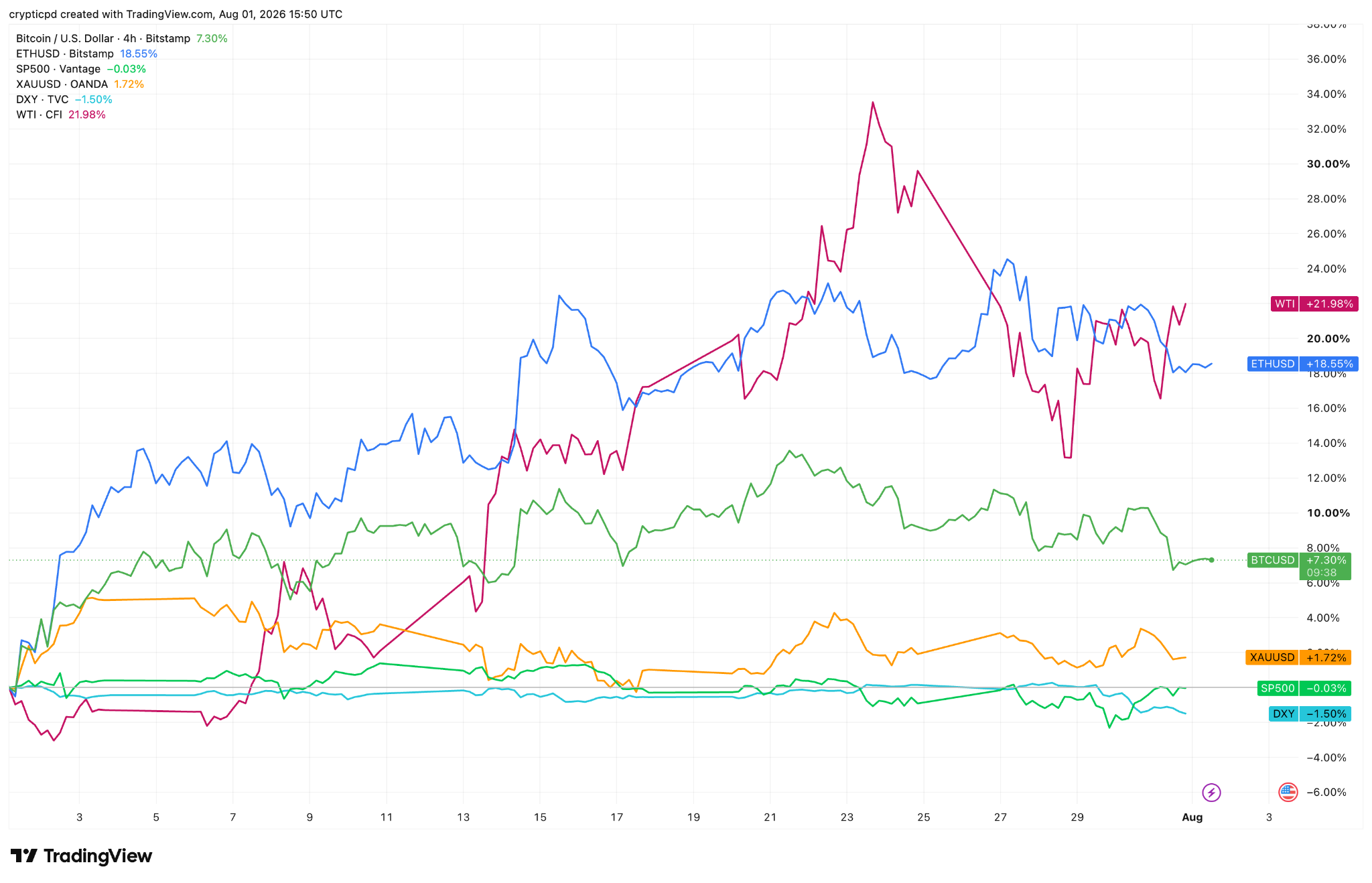
The markets reflected all this uncertainty.
Bitcoin was the only major asset in the chart to end the fortnight meaningfully lower (-1.6%). Ether outperformed BTC with 1.3% gains in the fortnight. However, both ETH and BTC ended July in the green with 18.6% and 7.3% gains.
Underneath these price movements, we kept observing and writing about the same structural change across crypto, AI, fintech and capital markets.
Creating a financial asset, issuing a token or building a model is becoming easier. The more valuable layer is increasingly the one that provides product distribution, financing, liquidity, and a place inside the wider economy.
That was also the thread running through the stories we published at Token Dispatch over the past fortnight.
What We Wrote Last Fortnight
With Is Crypto VC Dying?, Vaidik examined why specialist investors such as Paradigm and Framework Ventures are broadening their mandates into AI, robotics and aerospace. The shift does not necessarily mean crypto has failed. It may instead signal the maturity of the technology, meaning the informational advantage once held by crypto-only investors matters less. Crypto founders must now compete for capital and attention inside portfolios increasingly dominated by AI.
In Equity Learns to Borrow, I explored why raising corporate debt is routine while issuing equity remains a ceremony involving bankers, roadshows and substantial fees. Tokenised issuance could widen the geographic pool of buyers and allow companies to distribute shares more continuously, making equity issuance behave a little more like tapping a debt programme.
That drove me to write further about the thesis of crypto transforming into fintech. DTCC, SWIFT, Visa and other financial infrastructure operators are beginning to use blockchains to move securities, deposits and collateral. Crypto’s biggest impact may come from becoming the infrastructure they use behind the scenes. Crypto companies that once hoped to defeat Wall Street are increasingly invoicing the traditional financial companies by offering them tailor-made crypto infra solutions.
Vaidik then challenged one of the industry’s favourite interpretations in Is Crypto Money Fleeing Crypto?. The growth of tokenised real-world assets is usually presented as evidence that traditional institutions are arriving on-chain. Yet much of the identifiable demand comes from crypto protocols and DAO treasuries converting volatile reserves into tokenised Treasuries and dollar yield. The RWA boom may currently be more about crypto dollarising itself.
Finally, in Robinhood’s Bigger Baskets, I looked at how Robinhood is increasing the amount each existing customer does within its ecosystem. Funded customers grew 7% year-on-year in the second quarter, but average revenue per user climbed 24%. Robinhood Chain and its forthcoming social feed may matter less as standalone businesses than as connective layers that encourage the same customer to trade, borrow, save and invest across more products without leaving the platform.
Across a majority of our stories, we focused on one recurring theme: crypto is making issuance easier. Distribution, financing and integration are becoming the moat.
We have plenty more coming over the next two weeks. Before we get there, here is some literature that should keep you in good company.
Some of these could be behind a paywall. Sorry!
Regulation & Policy
Republicans Are Stuck in 2020. Maybe We All Are.: An argument that pandemic politics, election denial and anti-science grievance fused in 2020 into a coalition that continues to define the American right.
Resist the Technocrats: A critique of international institutions that disguise political choices as neutral expertise, and a case for restoring democratic disagreement without rejecting knowledge itself.
Crypto & Tech
The Machiavellian Case for Decentralized Networks: Omid Malekan argues that decentralisation matters not because distributed systems are flawless, but because they constrain how much power any single institution can accumulate.
One Human, Once: A deep dive into proof-of-personhood systems, comparing centralised biometric databases with identity systems built around passport chips and zero-knowledge proofs.
Onboarding the Next Generation: Binance Research examines how younger users are entering crypto, what they use it for and which products could turn early experimentation into durable adoption.
Lending Markets Are the New Kingmakers: As issuing stablecoins and tokenised assets becomes easier, lending protocols may decide which versions matter by setting collateral caps, LTVs, liquidity, and borrowing utility.
The Broken Link Between Protocol Revenues and Token Value: A useful reminder that a successful company or protocol does not automatically make its associated token a good investment, as Ripple’s equity and XRP increasingly demonstrate.
I Believed…: A reflection on crypto’s retreat from its 2021 utopian promises and its maturation into a more regulated industry built around stablecoins, tokenisation, perps and prediction markets.
The Changing Shape of Onchain Ownership: Noelle Acheson explains how BNY’s onchain transfer-agent service could make tokenised funds more useful by allowing legal ownership to move alongside the token itself.
Finance & Economy
In Defense of Markets That Sometimes Close: A case for nights and weekends as natural circuit breakers that give institutions time to negotiate rescues, reorganise risk and stop financial stress from compounding continuously.
An SPV of an SPV of an SPV: A map of the hidden fees, ownership ambiguity and exit risks inside layered private-market SPVs, followed by a plea for boring but enforceable investor protections.
Singapore’s Average Wealth Is Climbing, but There’s a Catch: Singapore ranks far higher in average wealth than median wealth, exposing how gains from financial assets disproportionately accrue to richer households.
What Would It Look Like If the AI Bubble Popped?: Matt Stoller traces how an AI bust could travel through retirement funds, universities, utilities, private equity and public budgets without necessarily resembling the 2008 crisis.
Information Timing and Release: The Gaming of Guidance: Aswath Damodaran connects corporate reporting with central-bank guidance and argues that more frequent information is not necessarily more useful information.
The Situation Deteriorated: Matt Levine uses the unwinding of Situational Awareness’s leveraged AI trades to show how a long-term thesis can be right while its short-term funding structure still destroys the trade.
Elevators Won’t Repair Themselves: A look at independent sponsors and search funds through a basic private-equity question: does value come from financing the acquisition or operating the company afterwards?
AI & Innovation
Why Compute Might Get 10x More Expensive: Dwarkesh Patel argues that increasingly valuable AI output could make demand for compute grow faster than supply, concentrating frontier intelligence and pricing out lower-value uses.
Inference Market—and Micro—Structure: A framework that treats AI-inference providers like market makers competing through quotes, latency, compute inventory and token-level economics.
Culture & Beyond
The Writing Habit That Saved My Brain—and My Future: Dan Koe presents writing as a system for thinking clearly, learning faster and gradually building a body of work that compounds into opportunity.
Overthinking Hates a Moving Target: George Mack recommends walking, sketching and speaking thoughts aloud as practical ways to make vague worries concrete and interrupt rumination.
Streamlining Addiction: An essay on how mobile gambling and prediction markets remove the physical and social friction that once limited addiction, repackaging vice as seamless trading.
Extreme Heat Is Costing Us Hours of Lost Sleep: Three charts show how hotter nights are reducing sleep worldwide, with the heaviest burden falling on people living in warmer and lower-income regions.
Humanity’s Golden Age of Language May Have Occurred 2,000 Years Ago: New modelling suggests humans may once have spoken many times more languages before empires and large states accelerated linguistic homogenisation.
How Art Invented Humanity: A philosophical argument that art was not merely produced by an already formed human mind, but helped create human self-awareness and cognition.
Propaganda I’m Not Falling For: 21 short provocations rejecting familiar scripts around careers, hustle, retirement, constant news consumption, passion, talent, legacy and luck.
How the Creator Economy Took Over Media: Scott Galloway examines a barbelled media economy where a handful of creators capture enormous value while most struggle to convert attention into a sustainable livelihood.
Why Talented People Outside the US Keep Losing Roles They Should Win: An essay on how proximity bias, self-promotion and cultural discomfort with workplace politics can make capable remote and international workers invisible to the institutions evaluating them.
That’s all for this fortnight. Catch you in the next edition.
Until then, happy reading!
Prathik
P.S.: Want to recommend interesting literature? Write to me, and I shall include them in the next edition 👇🏾
Token Dispatch is a daily crypto newsletter handpicked and crafted with love by human bots. If you want to reach out to 170,000+ subscriber community of the Token Dispatch, you can explore the partnership opportunities with us 🙌
📩 Fill out this form to submit your details and book a meeting with us directly.
Disclaimer: This newsletter contains analysis and opinions of the author. Content is for informational purposes only, not financial advice. Trading crypto involves substantial risk - your capital is at risk. Do your own research.
Thanks for reading! Subscribe for free to receive new posts and support my work.