


In February 2025, traders were pulling gold out of the Bank of England’s vaults to ship it to New York ahead of expected US tariffs. The wait to withdraw bars rose from a few days to four to eight weeks, and all existing withdrawal slots were booked.
Dave Ramsden, the Bank’s deputy governor for markets, told reporters that getting into the building that morning had been trickier because a lorry was in the bullion yard.
The London gold market typically trades ownership records, while the physical metal remains securely in vaults. But during those uncertain times, accessibility changed the price. Bank of England gold became cheaper because it was stuck in a weeks-long withdrawal backlog. Commercial vault gold became more expensive because buyers were willing to pay a premium to access and move it immediately.

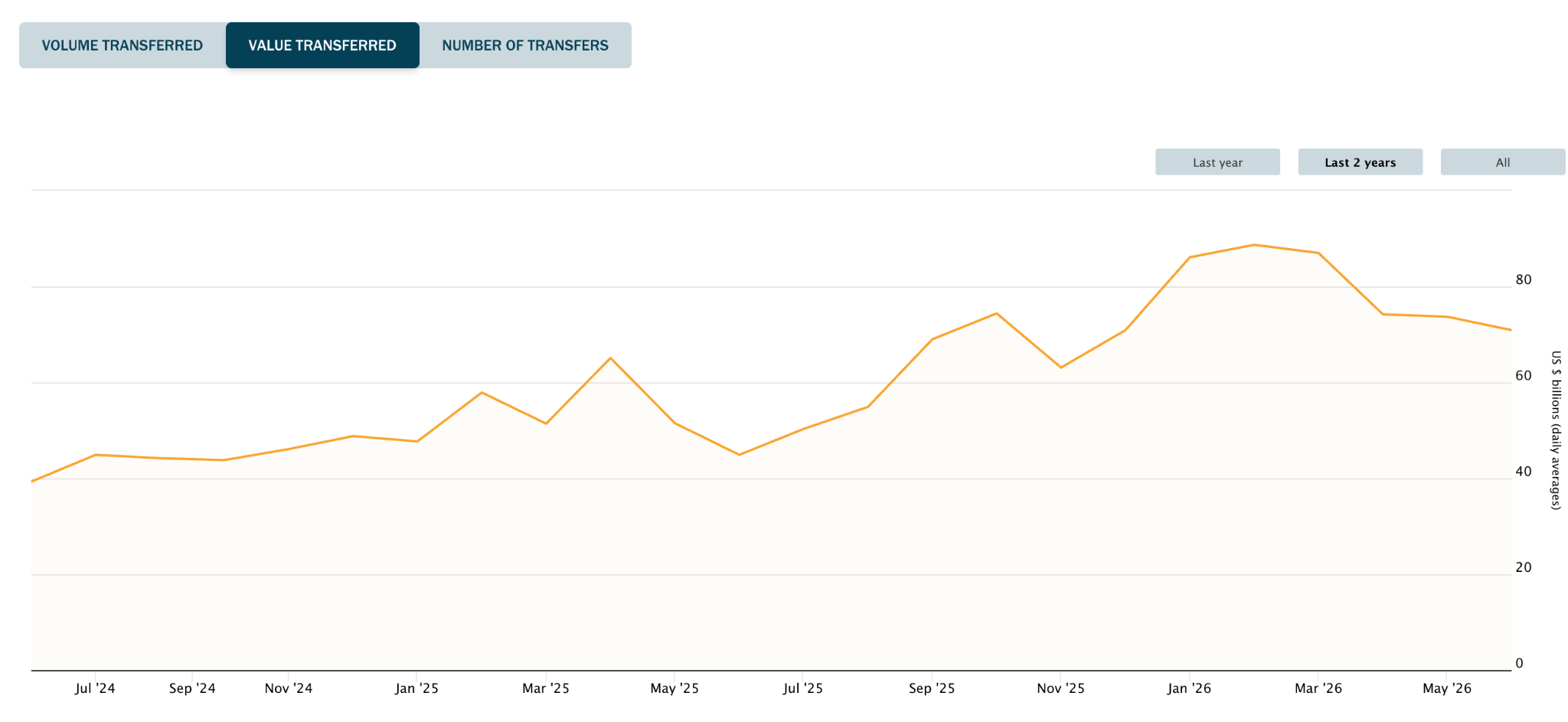
On an average day in May, the banks handling London’s gold clearing traded $73.7 billion worth of the metal among themselves without physically moving it. By the end of July, London vaults held 9,534 tonnes of gold valued at $1.2 trillion, roughly 762,000 bars. The clearing company says this is how the system is meant to work, since moving physical gold is a costly security risk.
Today, we are discussing why the Financial Conduct Authority (FCA) is writing rules for tokenised gold and how those regulations focus entirely on the ledger.

London is the centre of global gold trading. The London Bullion Market Association (LBMA) is the trade body and standard-setter. The final reconciliation of who owes what to whom runs through four clearing banks. HSBC. ICBC Standard Bank. JPMorgan. UBS. The electronic matching and clearing company operated by the banks is LPMCL (London Precious Metals Clearing Limited / AURUM).
The FCA has been talking to banks about how to regulate tokenised gold and whether it can be used as collateral in wholesale markets. This follows a joint paper published on 18 May 2026 by the FCA, the Bank of England and the Prudential Regulation Authority, which named tokenised gold as possible collateral for uncleared over-the-counter derivatives. There is already a precedent.
An FCA policy statement in April confirmed that a range of money market funds, including tokenised versions, can qualify as collateral for uncleared trades under UK EMIR.
Right now, 16 firms are actively testing tokenisation in the UK’s regulatory sandbox. The government thinks this could add £33 billion a year to the economy by 2035. We should see the first tokenised government bond by early 2027, right around the time the Bank of England updates its collateral systems, with digital ledgers linking up to digital sterling by 2028.
You will often hear that London is tokenising gold because it is scared of losing business to Asia. The reality is that the tech was homegrown by one of London’s own clearing banks. In late 2023, HSBC broke down standard 400-ounce bars in its London vaults into tiny digital slivers so institutions could trade them. They eventually rolled out a retail version in Hong Kong that processed $2.2 billion in trades, but the innovation itself started in London.
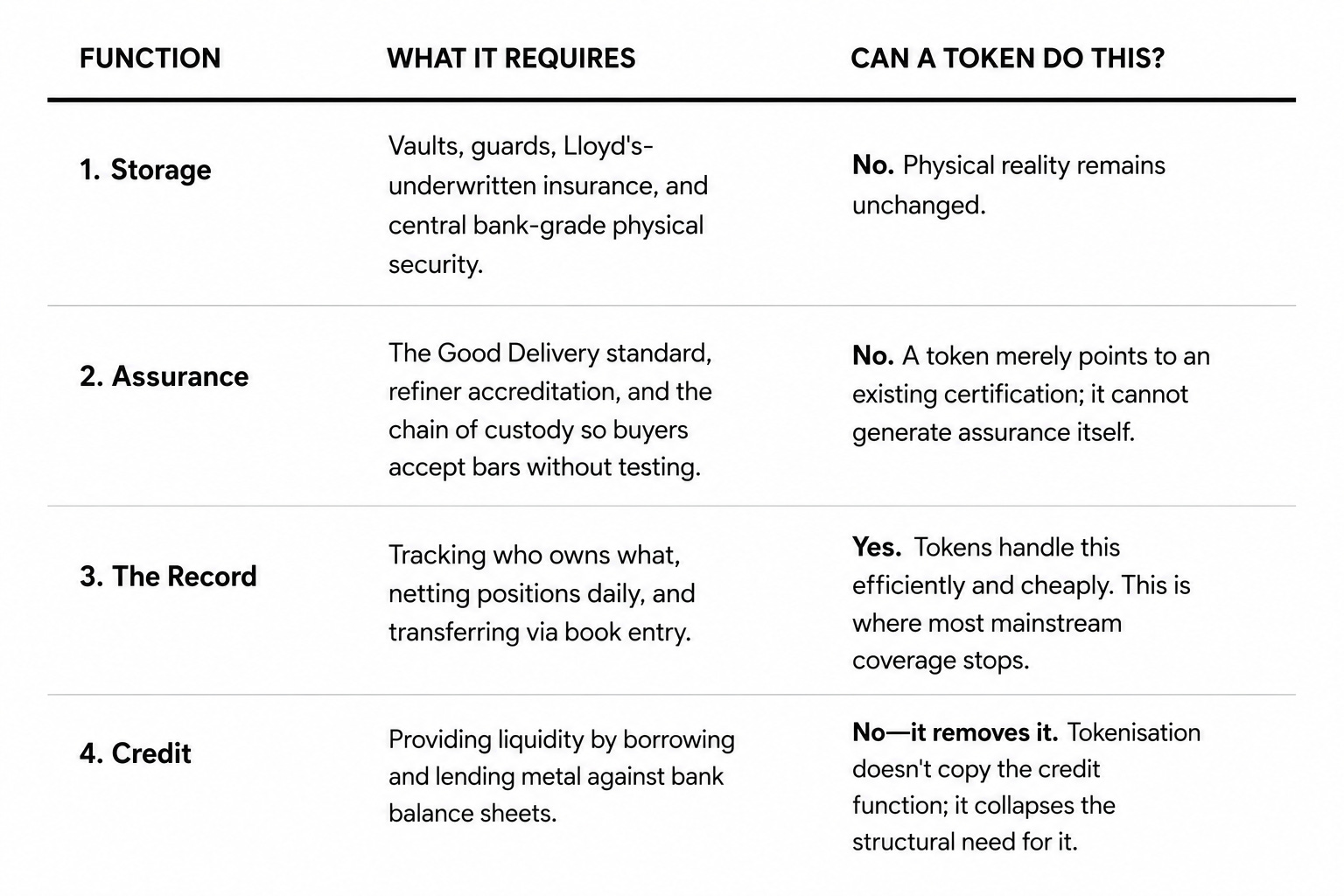
London gold market handles four specific jobs.
The first two are physical storage (vaults and guards) and quality assurance, which means proving the gold is legit so buyers don’t have to melt it down to check.
A token obviously can’t do either of those; it just piggybacks off the physical world’s legwork. The third job is keeping the record of who owns what. Tokens handle this part incredibly well, and for cheap, we know that.
But the fourth job is credit, and this is the catch. Tokenising gold actually makes the banks’ credit system obsolete. When you can instantly transfer ownership of physical gold with a token, you don’t need to lend your metal to the bank in exchange for trading convenience.
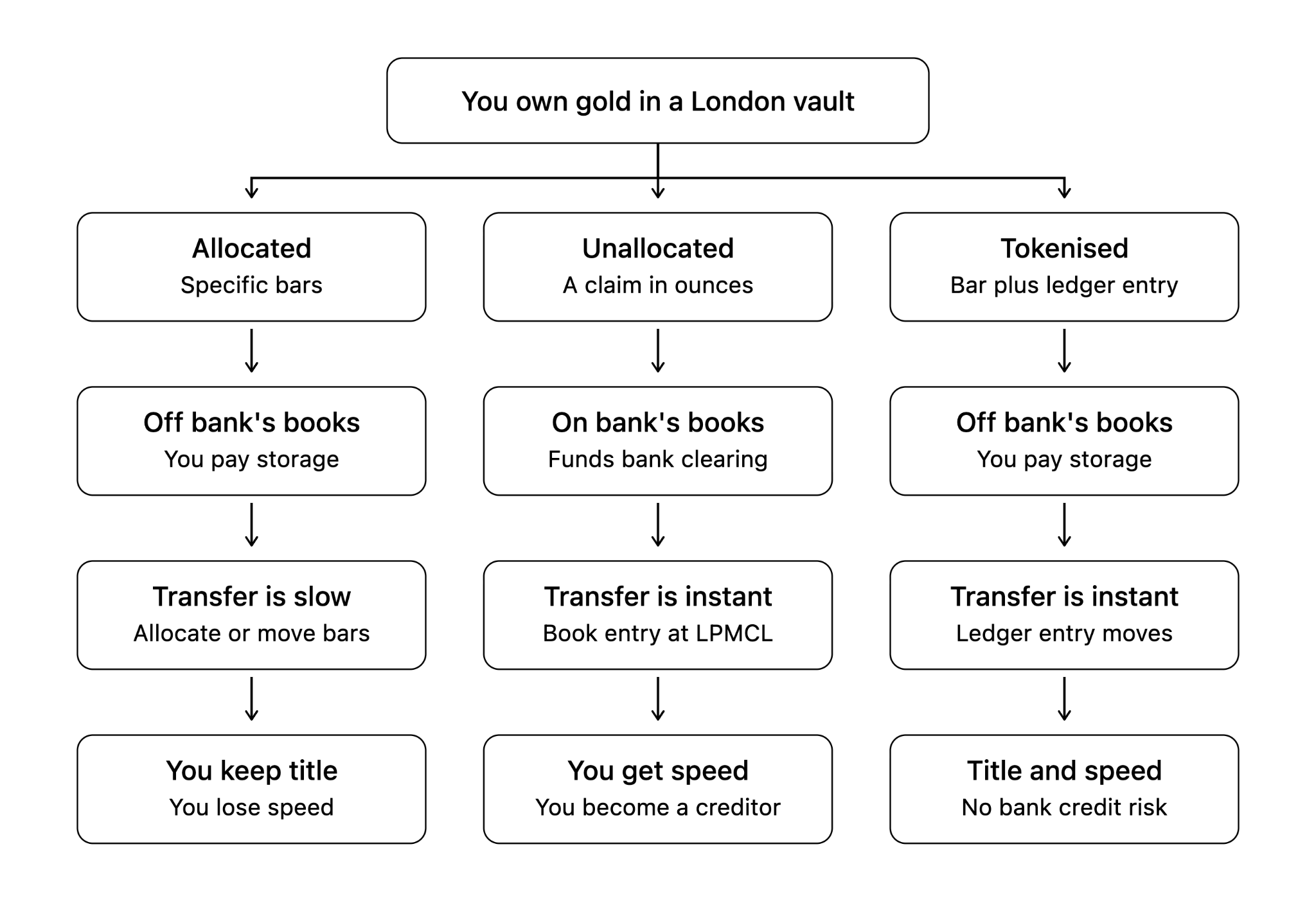
Most London bullion is held and traded on an unallocated basis. The customer does not own specific bars. They hold a general entitlement to a quantity of metal. The LBMA describes the arrangement as working like a bank deposit denominated in ounces. The customer is an unsecured creditor of the clearing member. That gold in the vault works for a living too. The banks pool it together on their balance sheets to keep the whole trading system moving. It allows them to instantly credit and debit accounts the second a trade happens, buying them a couple of days to sort out the actual physical delivery in the background.
Buyers have two options. You can claim specific, physical bars, which means paying storage fees and dealing with slow transfers. Or, you can hold unallocated gold, essentially an IOU from the bank. You take on a small amount of their credit risk, but you can trade instantly. The majority chooses the second route. The average transfer in February was about five bars’ worth of gold, and thanks to this setup, the metal never actually had to leave the vault.
What happens when it’s a token instead? It gives you the speed of an IOU with the hard ownership of a specific bar. When you can have both, there’s zero reason to take on bank credit risk. London is already fully electronic, so updating the settlement tech isn’t the big win.
The FCA chose to target collateral over trading because collateral is entirely dictated by speed. You have hours to meet a margin call, and the traditional plumbing for gold just moves too slowly. This leaves $1.2 trillion in gold sidelined, forcing institutions to use cash or gilts instead. Regulators know that putting that gold on a blockchain ledger removes the problem. Ownership can change hands instantly and in precise fractions, and all that vaulted metal can be used as top-tier collateral.
The securities world is already doing this. HQLAX allows heavyweights like BNP Paribas, Clearstream, and JP Morgan to trade ownership of their collateral without physically moving the underlying assets an inch. The SEC even gave it a green light in May 2026, allowing US broker-dealers to jump on board for a 36-month run.
This whole shift actually started long before crypto. Strict banking rules came first. When global regulators introduced Basel III’s Net Stable Funding Ratio (NSFR), treating unallocated gold as an illiquid asset requiring an 85% stable funding buffer, the London bullion lobby fought back hard, warning that clearing banks would abandon the market. Now, tokenisation is finishing what Basel III started.
My only problem with this is that it’s being rolled out by the very banks that tried to protect the old system.
Locking 12.5 kg gold bars in a vault sits outside the FCA’s remit, yet holding the tokens will soon require full regulatory authorisation.
The legal landscape shifted back in February when Parliament signed off on the new crypto framework. It means the FCA is finally policing crypto custody and trading platforms. Businesses have a five-month window starting September 30 to get their applications in before the whole system becomes legally binding in October 2027. It’s still a work in progress. The FCA is refining its rules for holding client assets, and lawmakers are trying to extend traditional market exemptions to cover the token world.
The physical gold does absolutely nothing new. The vaults, the insurance policy, and the guards just go on with business as usual.
When you change the ownership record to a token, the activity immediately enters regulated territory. That is where regulators actually draw the line. They monitor the legal rights to the gold. Because a token transfers those rights in an entirely new way, the FCA has to step in and establish new regulations.
If software makes record-keeping practically free, value flows straight to physical scarcity. In London, the vault scene is an exclusive club with four clearing banks and three security carriers. Nobody has joined this group in over a decade. Tokens won’t disrupt these guys because code can’t replicate a fortress. If anything, it makes them more essential, because you still need real-world custody to back every digital claim. These firms will just adapt their business model, switching from making money on customer deposits to charging clean fees for storage, audits, and collateral plumbing.
The idea of tokenised London gold has been around the block. Paxos and Euroclear attempted it in 2016, only to shut it down 13 months later. The setup works differently today because the clearing banks are the ones driving the ship. An external startup is no longer trying to force the tech in.
HSBC, for instance, built its own in-house system that handles every single trade. They created a walled garden to control how the transition unfolds. The ultimate fate of this market rests with the FCA. Regulators have to decide whether an HSBC token can be traded outside HSBC’s walls. If they say yes, the market changes. If they say no, the old banking model survives under a new name.
How will we know if tokenisation is actually taking over? You can easily track this transition through the LBMA’s published data.
The LBMA publishes two sets of numbers: how much gold is being traded (trading volume) and how much gold is officially changing hands on the old central books (clearing volume).
If people start using tokens, trading volume will remain high because they will continue to buy and sell. The clearing volume will drop. Because when you trade a token, the transfer happens instantly on the blockchain, completely bypassing the old London clearing system.
Right now, the old system is still doing a massive volume. Every single day, about 20 million ounces of gold change hands on the clearing ledgers, while roughly 306 million ounces just stay completely still in the vaults. That means roughly 1 in 15 ounces of gold is traded on paper daily without a single physical bar budging.
We invented mathematics, cryptography, and global networks, yet they all lead back to a hole in the ground where we stare at gold, eh?
Token Dispatch is a daily crypto newsletter handpicked and crafted with love by human bots. If you want to reach out to 170,000+ subscriber community of the Token Dispatch, you can explore the partnership opportunities with us 🙌
📩 Fill out this form to submit your details and book a meeting with us directly.
Disclaimer: This newsletter contains analysis and opinions of the author. Content is for informational purposes only, not financial advice. Trading crypto involves substantial risk - your capital is at risk. Do your own research.