


Hello,
Credit is one of the hardest problems in finance. Every loan is a bet on a person or organisation’s future behaviour and needs a system to ensure the bet is well measured and risk is minimised. Lenders need to verify identity, check past records and put in place a recourse if things go wrong.
On the demand side, credit helps money reach the people who need it the most. This keeps the liquidity moving in the economy. But here, too, the cost of borrowing needs to be set in a way that makes credit inclusion in nature.
These problems are difficult but unavoidable.
For almost a decade, on-chain lending has struggled with solving many of these problems. One of the biggest is overcollateralisation, where you have to deposit $150 to borrow $100. This defeats the purpose for someone who needs $100 and doesn’t have it.
Every once in a while, we see attempts to fix the on-chain lending landscape. Many who dared faced the same sad fate. Yet few others persist. Today, I analyse some recent attempts to address on-chain credit.
On to the story…


TOKEN2049: The Largest Crypto Event
For two days, Singapore’s premier waterfront district will turn into a pop-up capital of all things finance. Rooftop conversations, harbour views, deals over dinners and more!
TOKEN2049 will host one of the highest concentrations of financial decision-makers - all at one venue. Over 25,000 attendees, 300 speakers, 500+ exhibitors and 1,000+ side events will light up Singapore’s Marina Bay Sands for a week.
This October, everyone you follow in crypto will be at TOKEN2049. Will you?

If payments, settlement, custody, or yield is the language you speak, then there’s no better place for you to be than here!
October 7-8. Marina Bay Sands. Singapore. All you need to do is show up.
To sweeten the deal: an exclusive 10% discount for you!
Ever since decentralised finance began offering credit, it has relied on overcollateralisation. Pseudonymity and privacy on-chain left no trace of borrower identity. For an industry built on decentralisation, this left no option but to resort to overcollateralisation to avoid bad debts. But collateral that requires you to deposit more than what you need doesn’t make sense. Yet over 90% of on-chain lending is overcollateralised today. This makes credit exclusionary for those who need it most.
But who needs on-chain credit anyway?
If you have a bank account and a decent credit score, on-chain credit offers nothing new. Your credit card already offers an unsecured, revolving line of credit. The card also includes fraud protection and chargebacks that on-chain credit doesn’t offer. At first glance, borrowing is also more expensive on-chain. 3Jane pays its depositors 7.2% to 13.42%, so it charges borrowers more than that.
But some groups of people still aren’t served by the current credit system.
The World Bank’s Global Findex 2025 found that roughly 1.3 billion adults lack financial accounts. Without on-chain credit, this group’s alternatives are to borrow from local usurers or do nothing. Another group with wide unmet credit demand is small businesses. The IFC estimates the financing gap for micro, small and medium enterprises at $5.7 trillion.
For all of them, the mainstream credit from the banking infrastructure is missing or insufficient. That’s because the economics don’t work for the banks. A crop of crypto projects attempted to fix this problem, but they failed.
A Bitter Pill from the Past
One core pillar of a reliable credit system is measuring trust. Credit scaled historically when the industry built systems that standardised and measured trust. We verified identity, shared records, and used courts to support both.
The world of DeFi lenders skipped this entire chapter.
Maple Finance, once the largest lending protocol, had replaced collateral with “pool delegates”. These credit professionals decided who could borrow and who couldn’t. That was the biggest vulnerability.
In late 2022, one borrower, Orthogonal Trading, defaulted on $36 million across eight loans after misrepresenting its FTX exposure to the pool delegate. Maple ended the cycle with about $54 million in bad debt. It survived by abandoning unsecured lending altogether and pivoting to overcollateralised institutional loans.
Goldfinch also faltered, making a contrasting play. It lent over $100 million to real-world lenders in emerging markets, underwritten by a decentralised community. About $18 million went bad.


Both of these failures had similar problems. They removed collateral without replacing it with another mechanism that ensured enforcement.
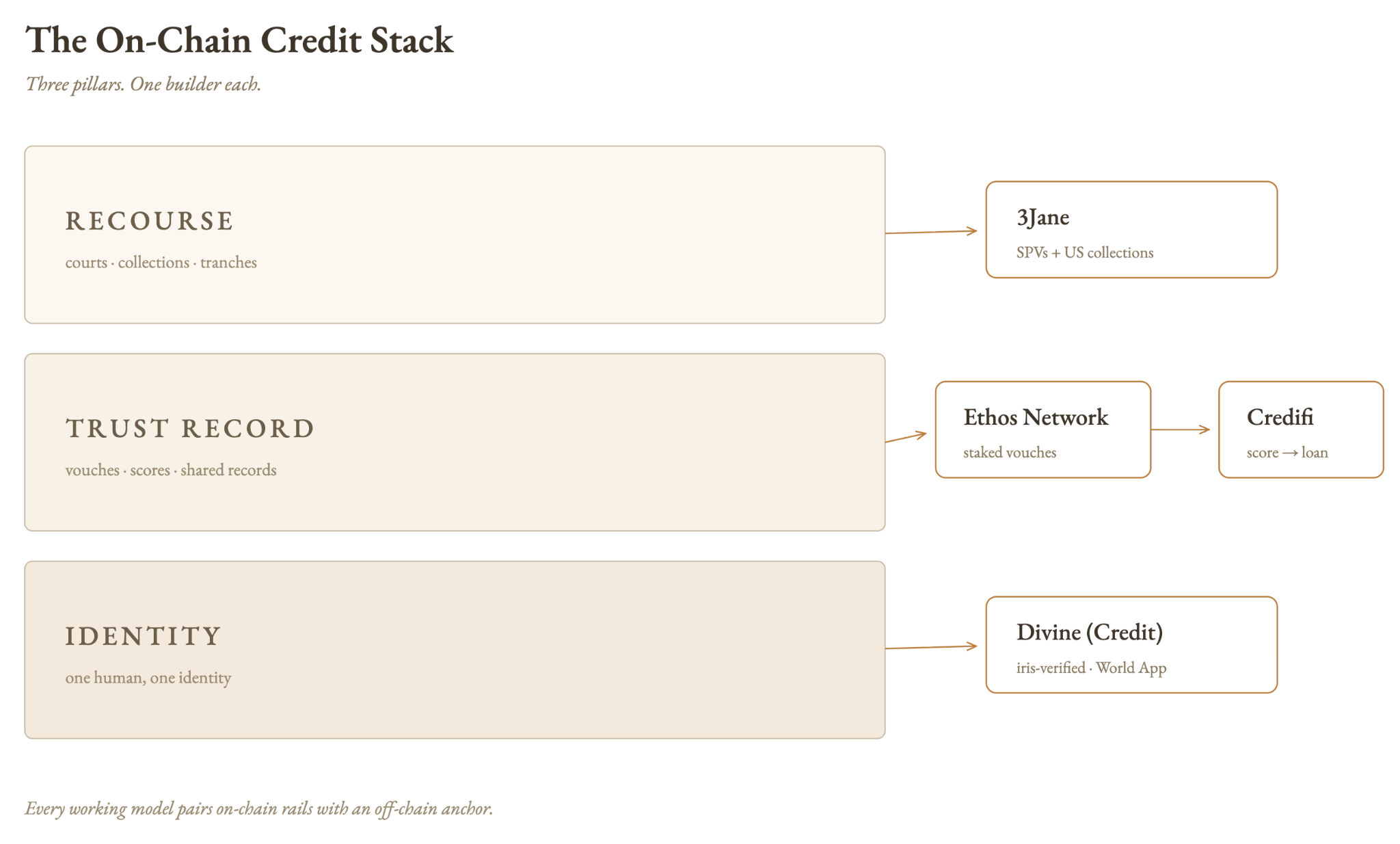
Newer on-chain projects are rebuilding the credit stack by focusing on elements the older ones ignored. These are the same ones that made Tappan’s system work — verified identity, a shared record of trust, and courts.
Rebuilding the Stack
One ingredient in a healthy credit system is tracking identity. On a blockchain, identities are free. A defaulter can open a fresh wallet and borrow again as a stranger. No credit system can survive this.
Divine Research fixes this with its product, Credit, which runs inside the World App. Using its scanning technology, Divine lends only to humans verified by an iris scan. It offers unsecured loans of up to $1,000 through a ‘progressive trust’ mechanism. You start with a small limit, repay on time, and grow your borrowing limit toward $1,000.
This directly addresses overcollateralisation. Borrowers need to submit zero collateral, but the trade-off is their privacy via iris scans.
Since December 2024, it has issued almost $4 million in loans to almost a million borrowers. These loans were taken out predominantly by individuals in Argentina, Nigeria, and Colombia, mostly for groceries, medicine, and transport. This is the excluded group that I referred to earlier in the piece.
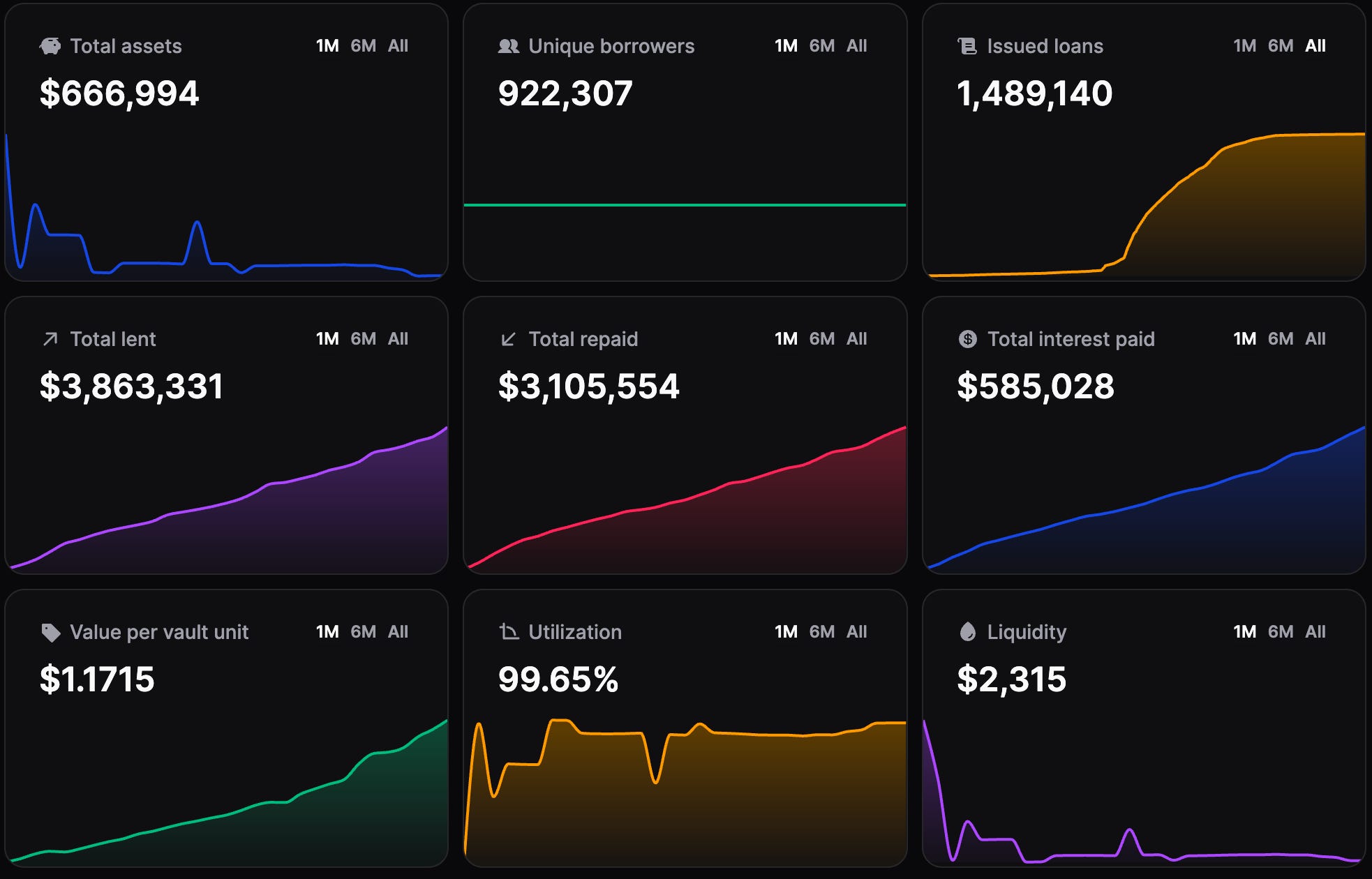
But the model lacks a solid recourse. Nothing stops a verified human from keeping the money. The system is built to disincentivise defaults and not avoid them altogether. The borrower can take $80 today and walk away with it or build toward a $1,000 credit limit gradually.
While it serves excluded groups, the high cost of doing business without collateral is a hard ceiling. If it can’t lend above $1,000 without collateral, it means its interest income is also capped and scales slowly.
The second ingredient in a healthy credit system is a good trust record.
Ethos Network is rebuilding this layer as a portable, public reputation score built from reviews and vouches. It lets users stake their own ETH to support a person’s credit reputation. This staked ETH is slashable if that person misbehaves. Random reviews are gameable. But when people have skin in the game by investing their money, they are less likely to manipulate.
Credifi, a lender on Base, has attached money to Ethos’ reputation scores. An Ethos score above 1,800 unlocks up to $3,000. No need for collateral or KYC.


If someone defaults on a loan, their credit reputation score on Ethos Network gets permanently downgraded. This hurts their chances of accessing credit across the Web-3 ecosystem. The person who vouched for the defaulter’s credit reputation also faces a downgrade in their score and a possible penalty deduction from their staked ETH.
Credifi also runs a second lending track where U.S. borrowers can borrow by verifying their bank accounts. The reputation track builds their presence in the informal, non-US, and on-chain markets. The bank-led approach helps it scale faster because of lower default risk and existing risk systems.
The third ingredient is recourse.
A year ago, 3Jane pitched unsecured credit lines to individuals. Back then, it underwrote the borrower’s on-chain history and extracted your VantageScore and bank data through cryptographic proofs that verify without exposing details.
Its infrastructure ensured defaulted loans were sold to licensed US collections agencies and losses hit a junior tranche before senior capital. It solved recourse with courts.
This recourse-first design helped 3Jane pivot from issuing unsecured retail loans to giving out direct credit lines. 3Jane’s recourse-first design helped it originate about $8 million in loans in just seven months to 60 U.S.-based prime/superprime yield farmers at 376 bps over Aave borrow rates. The pool achieved 100% in monthly payments, zero defaults and zero principal impairment to the staked capital. The pool ran clean through the October 10 liquidation event, some of the worst stretch of the DeFi market in recent times. Careful underwriting of individuals might not scale fast, but helps build a disciplined customer base.
In May, 3Jane launched Fintech Credit Conduits, a standing funding infrastructure that channels its stablecoin deposits into short-duration Small- and Medium-sized Business (SMB) and consumer loans. Other U.S. fintech lenders originate these loans and already have borrowers and underwriting models but can’t access securitisation markets.
The individual credit lines stay live on one track, while these conduits, with a $60 million pipeline, become the growth engine to scale. The model is a strategic marriage between the best of both worlds. On-chain lending provides the capital, settlement speed, and a transparent loan book. Off-chain brings in borrowers, underwriting, and the courts. It is the least crypto-native of the three, yet the one I’m most bullish on.
Can They Troubleshoot On-Chain Credit?
For credit to work, all the pillars that hold it upright need to be stable. A lender needs to know who the borrower is, what their credit history is and how to keep the bad actors at bay.
On-chain-native builders in the credit industry need to understand that blockchains don’t replace off-chain credit; they just make credit more efficient. The chain moves capital faster, settles instantly, and keeps the loan book transparent. But the underwriting itself — verifying who is borrowing, judging whether they’ll repay, and enforcing when they don’t — is work the off-chain system spent two centuries perfecting. A complete on-chain system that targets the underserved has to merge the two: blockchain infrastructure for capital and settlement, and proven credit practices for underwriting.
Verifying identity, building a tested trust record, and putting reliable enforcement in place are the most obvious and inevitable ingredients of building a healthy credit market. Once that is achieved, borrowers wouldn’t care less if the lending platform is completely on-chain or off-chain.
Along with those three ingredients, builders in this industry need to track defaults closely in the first few months and have a business plan that earns money in the medium- to long-term.
The measures the above companies have adopted, including the reputation score and slashing of staked ETH, are merely conduits for discipline. While they may not solve the over-collateralisation problem from day one, I believe they can kick off a directory of reputations for credit-seeking participants in on-chain markets. We might still be years away from a reliable directory the entire on-chain lending ecosystem can rely on. But it is still a start that the industry absolutely needs and cannot do without.
That’s it for today. I will be back with the next one.
Until next time, stay curious,
Prathik
Token Dispatch is a daily crypto newsletter handpicked and crafted with love by human bots. If you want to reach out to 165,000+ subscriber community of the Token Dispatch, you can explore the partnership opportunities with us 🙌
📩 Fill out this form to submit your details and book a meeting with us directly.
Disclaimer: This newsletter contains analysis and opinions of the author. Content is for informational purposes only, not financial advice. Trading crypto involves substantial risk - your capital is at risk. Do your own research.