


Hello,
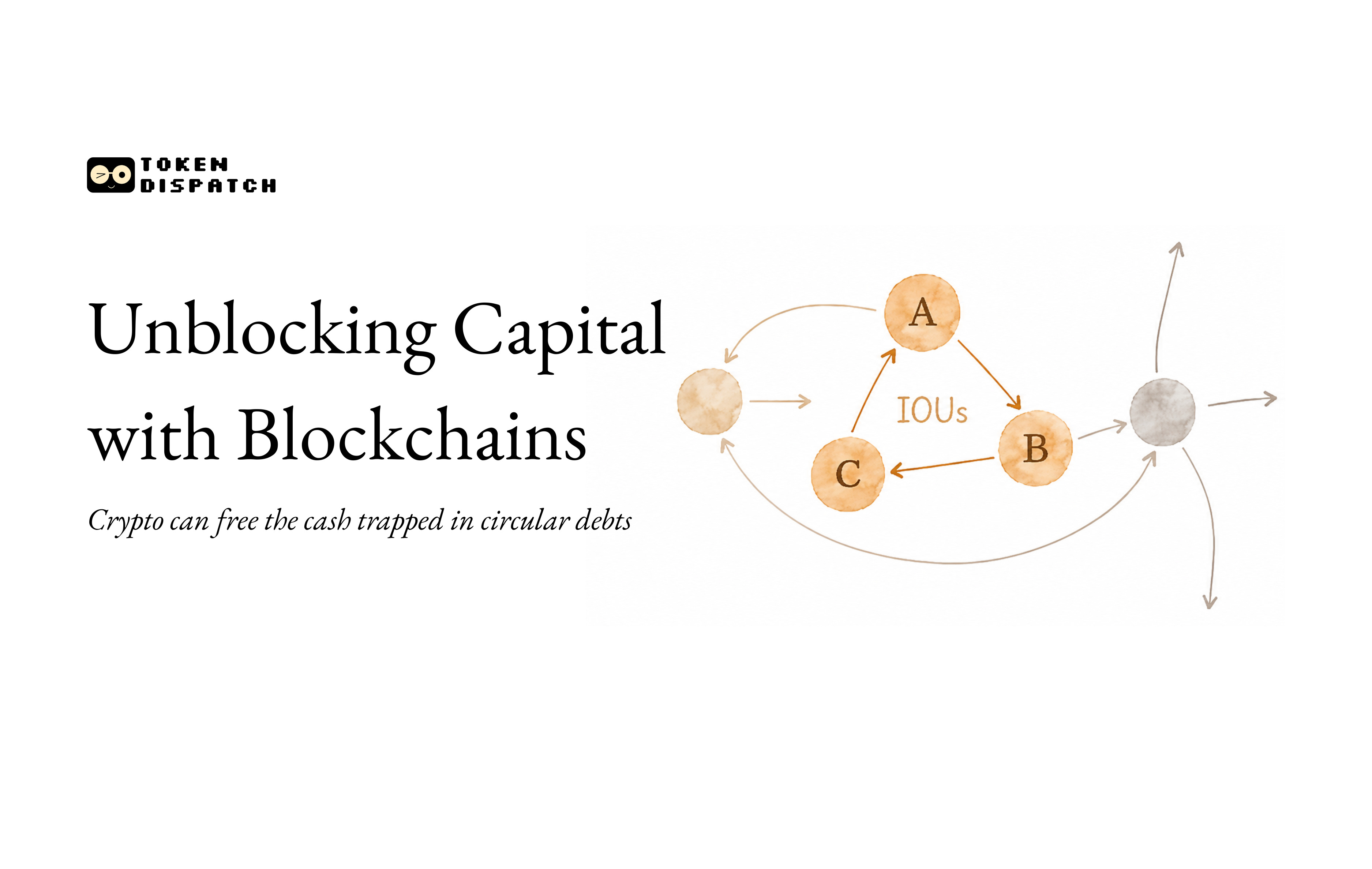
Money that doesn’t move is the worst kind. The global economy has lots of money like that that doesn’t need to be blocked. Consider a scenario where Jane owes Sally $100, Sally owes Maria $100, and Maria owes Jane $100. These three debts could cancel out, but the problem is that Sally doesn’t know Maria owes Jane $100. So each of them needs to hold $100 or set aside that amount, assuming they intend to clear their dues. In real life, the debts might not match perfectly, but they can still be simplified to free up extra money they need to hold.
Among individuals, the problem might not add up to a significant amount, but when you stack it among businesses, it could swell to the size of national economies.
In 2019, U.S. non-financial firms carried about $4.5 trillion in trade credit, which includes the 30-, 60-, and 90-day IOUs suppliers extend to customers. That sum alone would rank trade credit 4th among the largest economies. The figure was more than three times the aggregate loans these non-financial firms owed banks - $1.1 trillion.
This is a real problem because each firm must set aside money to pay its obligations when they are due. This requires high-level treasury planning and management. It can lead to delayed payments, disputes, and, worse, bankruptcies—all of which can be avoided.
In today’s story, I will explain how blockchains can help unlock more working capital and reduce avoidable bad debts and bankruptcies.

An Invisible Web
In 2025, Atradius, a global provider of trade credit insurance, found that 43% of credit-based B2B sales are overdue, primarily due to customer cash flow pressures. Creditors also spend more money chasing these overdue payments. The European Payment Report 2023 found that European businesses spend 29% of the working year (74 days) chasing late payments. It adds up to €275 billion a year in costs, far more than the entire GDP of Finland.
Working capital is the most expensive money most companies can cut. What stops businesses from optimising it is a lack of visibility into the circular network of debts.
In most industries, a web of circular debts exists. Often the web transcends multiple industries. For instance, a cargo ship business may owe the shipmaker for the components. The ship manufacturer might owe iron and steel suppliers for raw materials. In turn, the iron and steel makers may owe the shipmaker for shipping iron and steel to their customers. These debts form a loop, where they might overlap. Only if someone could zoom out, look at the network of debts, and see all three obligations at once can the debts, or at least a portion of them, be cleared without moving a single dollar.
But the problem is that each firm only knows its part of the obligation. There’s a clear incentive to keep the loop hidden. Companies won’t be comfortable sharing their supplier and customer lists with the world.
Nevertheless, this bottleneck makes company treasuries set aside a lot of money. Liquid money that’s set aside for short-term payments is dead money. It earns little interest. The cost of doing business compounds when the creditor awaiting a late payment is forced to fund its own operations using a credit line.
A 2025 report by The Hackett Group analysed the top 1,000 U.S. publicly traded non-financial companies and found that $1.7 trillion remains trapped in excess working capital.
The problem gets worse for smaller businesses. A delayed account receivable could become a matter of survival.
But is this problem even solvable?
An Existing Precedent
We have solved this exact problem for different groups of people.
The Splitwise mobile app has been my saviour on every friends’ trip, untangling who paid for dinner, who covered the fuel, and who paid the car rental deposit. The app simplifies debts by netting the circular who-owes-whom.
At a larger scale, banks have commercialised this idea more than 60 years ago. When Wall Street choked on its paperwork and trading volumes, it came up with a fix to stop settling every trade individually. Instead, it began netting them all through a central clearinghouse. Today, the Depository Trust & Clearing Corporation (DTCC) nets roughly 98% of the value of daily US securities settlement.
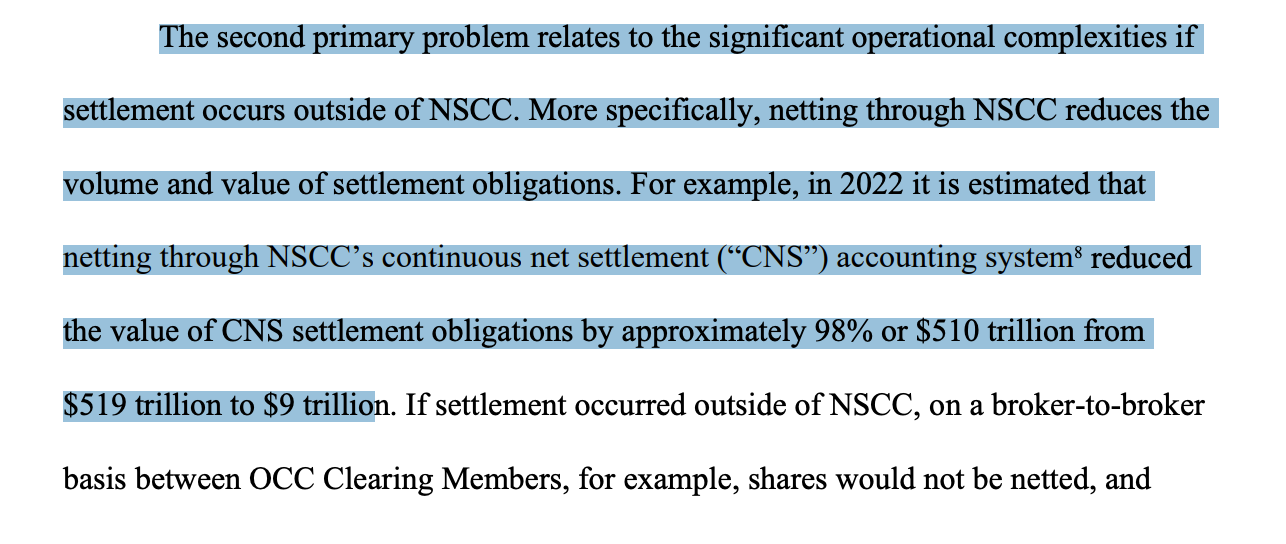
The lesson is that a large fraction of what businesses owe each other is structurally redundant and can be avoided if you map the entire network of debts.
But if this idea has worked for more than half a century, then why haven’t we replicated this for businesses? That’s because aggregating stock exchange trades on a centralised clearing platform is different from companies publicly disclosing their suppliers and customers and giving away their competitive edge.
This is where blockchains come into use.
How Blockchains Help
Netting off debts in a loop only works if everyone in it settles at the same instant. All parties in the loop must agree to list their obligations on the network and intend to clear them around the same time.
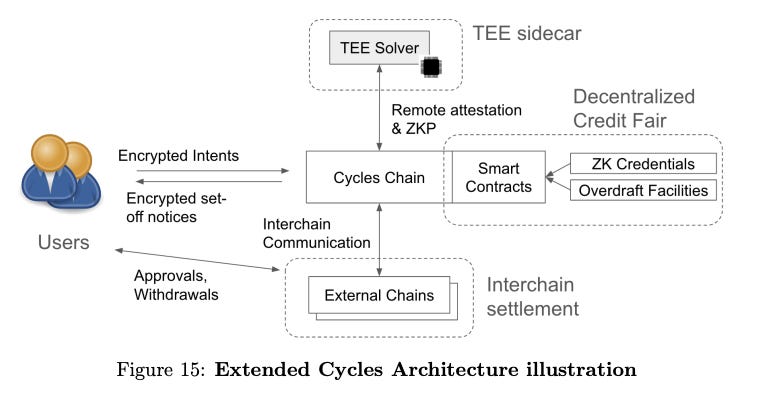
Blockchains and modern cryptography address both. The disclosure problem we spoke about is handled by cryptographic privacy. A trusted execution environment, or TEE, is a sealed compartment inside a computer’s processor that can hold sensitive data without letting the machine’s owner, or anyone else, see what’s inside.
To simplify circular debts, the obligation map can be encrypted and the looped debts are found within the sealed enclosure. Zero-knowledge proofs, or ZKs, complement this by letting the system mathematically prove that the settlement is accurate and that the party’s consent was acquired before settlement.
The blockchain underneath ensures that every leg of a looped debt settles together atomically, or, if there aren’t enough matching loops, it stalls the settlement altogether until enough looped debts are found.
Cycles, an open peer-to-peer electronic clearing system, is building something similar. The protocol was spun out of Informal Systems, a firm known for building core infrastructure in the Cosmos ecosystem, and is backed by ~$8.7 million from investors including Coinbase Ventures and Blockchange. Its algorithm models the economy as a graph of obligations and hunts for the settlement flow that discharges the most debt with the least money. It does this without inserting itself as a middleman or shifting anyone’s risk onto a central counterparty - unlike in the case of the DTCC, where it becomes the buyer to every seller. Cycles nets the loops and retains every relationship as it was.
Cycles has built its first product for crypto trading firms since they have a dense, tightly interconnected cluster. That’s a perfect ecosystem for finding the thickest loop and is optimal for netting.
It uses ZK proofs and TEEs to keep obligations private on-chain.
Protocols like Huma Finance work in adjacent domains. It has processed over $17 billion by advancing cash against tokenised invoices to finance receivables. But it still doesn’t net obligations. The clearing-specific approach adjusts the overlapping obligations first and finances only the remainder. This maximises the savings in financing costs and working capital. This is where the value accrues in this domain of operations.
The payoffs from simplifying circular debts vary by scale.
An individual business that joins the network could find a slice of its payables and receivables cancelled against another obligation on the network. This could happen without any cash movement and without having to chase any customer. This could lower working capital needs and reduce dependence on expensive factoring and overdrafts.
As the number of participants on the network swells, the payoffs also amplify. It could ripple through the broader economy. It could help address the late-payment epidemic to some extent.
Intrum found that 62% of businesses pay their own suppliers late because their customers paid them late. Circular debt could propagate down the chain and distress businesses. Clearing overlapping debts could sever the looping obligations at the source.
Less gridlock means fewer solvent firms tipped into insolvency by a cash-flow gap that nets to nothing. As more firms join the network, the entire web becomes more valuable for those already there, because it increases the likelihood of finding a matching obligation one’s debt could be netted off against.
While crypto fixes the netting and privacy problems, two bigger constraints prevent these attempts from taking off. Ironically, both of them are related to us - humans.
A clearing network is only as good as the density of firms inside it. If only a few companies submit their debts, the probability of looping debts is lower. But if the entire trading community, or groups of small or medium businesses, jump on the bandwagon, the likelihood of finding adjustable obligations goes up.
Another problem is that joining the debt network requires businesses to trust a relatively new cryptographic technology they barely understand. The only way to ease their fears is to convince businesses that a competitor can’t really reconstruct their supplier list and that a cancelled debt is legally settled in their jurisdiction.
Almost all recent attempts to solve this problem have ended up in a graveyard.
Over the past decade, Marco Polo, we.trade, Contour, TradeLens and a bank-led blockchain trade-finance consortium have all collapsed or needed restructuring. The fact that almost none of them failed because of the poor technology reveals where the problem lies. They failed because a handful of companies drove a thin list of obligations.
Nothing dismisses the problem or the possible solution. But whether the solution will work depends on open protocols like Cycles’ ability to coax the world’s businesses onto the debt map.
That’s it for today. I will be back with the next one.
Until next time, stay curious,
Prathik
Token Dispatch is a daily crypto newsletter handpicked and crafted with love by human bots. If you want to reach out to 170,000+ subscriber community of the Token Dispatch, you can explore the partnership opportunities with us 🙌
📩 Fill out this form to submit your details and book a meeting with us directly.
Disclaimer: This newsletter contains analysis and opinions of the author. Content is for informational purposes only, not financial advice. Trading crypto involves substantial risk - your capital is at risk. Do your own research.