


Hello,
When you own a share of a company, you have a residual claim on whatever is left after the company pays everyone else. The company pays off employees first, bondholders and lenders next, then creditors, taxes, and preferred stock. Then comes equity, which is owned by the shareholders.
But that residual claim comes with exclusive privileges too. You get a vote on who runs the company, a share of any dividends the company distributes, and a claim on anything left over if the company is sold or wound down.
For a long time now, a token holder in a crypto protocol has been offered a similar deal, at least in language. If you held a token, you could participate in the network’s decision-making and get a share in its eventual success and earnings. But the deal has always been one-sided. Nobody in crypto admitted it all this while because they didn’t face the conflict. Except until now.
While crypto protocols have found a way to keep their token holders happy due to the lack of regulation, the passage of the CLARITY Act (which is underway) could close that leeway. Some crypto protocols that issue equity shares, even while having a class of investors holding their tokens, have further exposed the distinction between shareholders and token holders.
In today’s story, I will explain what could change for token holders of crypto companies that choose to issue equity.
On to the story…
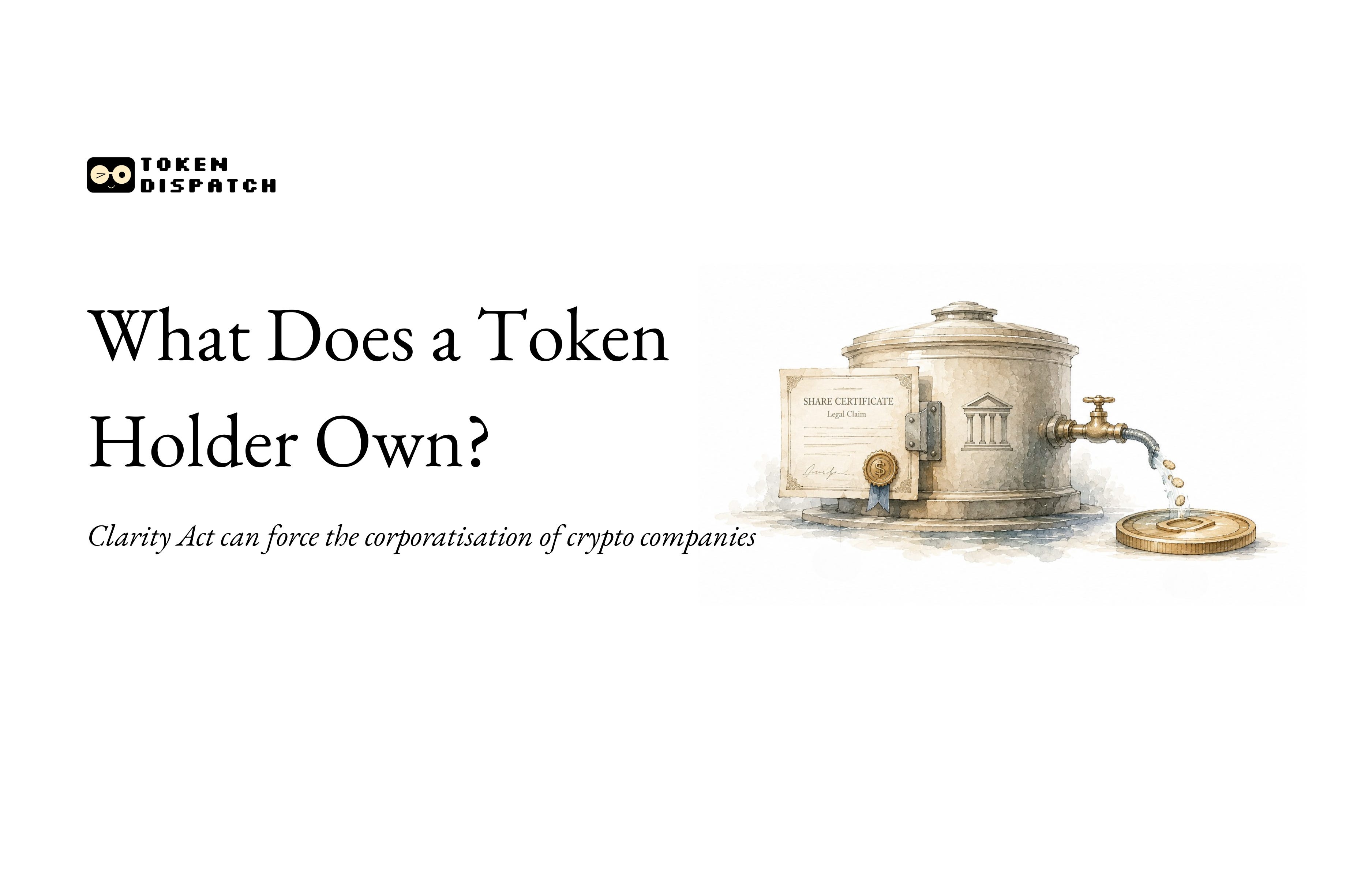

What Ownership Entails
It’s not the return that makes equity the most durable financial instrument. Bonds often outperform equity with higher returns and lower volatility. Yet, equity is attractive to many because of its structure. It is a contractual claim to own a part of the company. If the company earns a profit, the board may pay a dividend, and shareholders receive it. If the board refuses, shareholders can vote for a new board. If a majority want to sell the company, they can. None of this solely depends on the CEO’s goodwill.
Over the past century, the corporate world has continually adjusted the extent of shareholders’ control over a company’s operations. Yet, the right to economic claims has largely remained untouched.
Google’s 2004 IPO gave founders Larry Page and Sergey Brin and then-CEO Eric Schmidt 10 times the voting power of public shareholders by creating two classes of equity shares. Yet, the economic rights these public shareholders had were on par with those of founders and insiders. Snap Inc., the maker of Snapchat, issued shares with no voting rights in 2017. Berkshire Hathaway has run dual-class shares since 1996.
Although each of these experiments changed how classical shareholding was defined, they all preserved the part that makes equity equity - the legal, court-enforceable claim on the residual value of the business.
A token holder in a crypto protocol has none of this. They have neither a right to receive dividends nor a residual claim on the proceeds of the company’s sale. It is the whole difference between owning something and being told you own something. Every legal system built around ownership assumes the owner can enforce the claim. A token holder cannot enforce anything. All they have is a token whose price the protocol tries to support by using some portion of revenue to buy back the token on the open market and burn it. What’s worse? Even this isn’t set in a contract. The protocol can change it, pause it, or stop it without any board approval. You cannot call a lawyer if you are aggrieved.
But why are we talking about this now? This gap in the nature of ownership and rights was always there. But it didn’t matter for most of crypto’s history because there was no separate class of owners to compare against. The token was the only one that existed. All this while, the incentives of everyone who holds tokens, be it the community or the founding and leadership teams, are aligned in the same direction.
But that’s changing now.
When successful crypto protocols begin to operate like companies, actual revenue, product, and users begin to matter much more. Sooner or later, they will need more capital to scale, and the best way to raise serious money is still to seek it in wider markets. Just like how Google and Snap did when they went public, or like how Tesla and SpaceX did before they went public.
On July 1, Venice AI closed a $65 million Series A round led by Dragonfly and Coinbase Ventures, valuing the company at $1 billion. Investors got 8.98% equity plus a token grant. This changes how the ownership structure works. It exposed a structural flaw crypto has been ignoring for a decade, just because nobody decided to point it out.
Before the raise, Venice had one class of owners. Now it has two. First are the equity investors with contracts, board rights, information rights, anti-dilution protection, and a legally protected claim on 8.98% of the company. Second are the VVV (Venice’s native token) holders, with a burn programme the company runs voluntarily and can stop whenever it wants.
The fundraise puts an official price on Venice’s equity. When the company grows from here, the equity shareholders capture the growth through a legal, contractual mechanism. None of that directly accrues to the token holders. They benefit only if Venice keeps choosing to buy back and burn its tokens. This means that every dollar of future revenue has to be split between the two, that is, if Venice’s leadership decides to be fair to both classes of shareholders. They can always choose not to buy back.
Venice isn’t the only one. Aave routes 100% of protocol income into AAVE buybacks. Hyperliquid runs the largest buyback in crypto, with over $1.2 billion of protocol revenue allocated to HYPE, 97% of fees, and roughly 5-6% of market cap annually. None of these protocols has done a Venice-style equity raise yet. But all of them face the same underlying question. The buyback mechanism sits at the team’s discretion. Nothing prevents Hyperliquid’s team from redirecting the Assistance Fund.
For a small example of how this ends, Sol Strategies acquired Houdini Swap for $18 million in May 2026. The acquirer paid the founders and equity holders. Token holders of Houdini Swap’s LOCK received nothing. The token’s chart flatlined at zero.
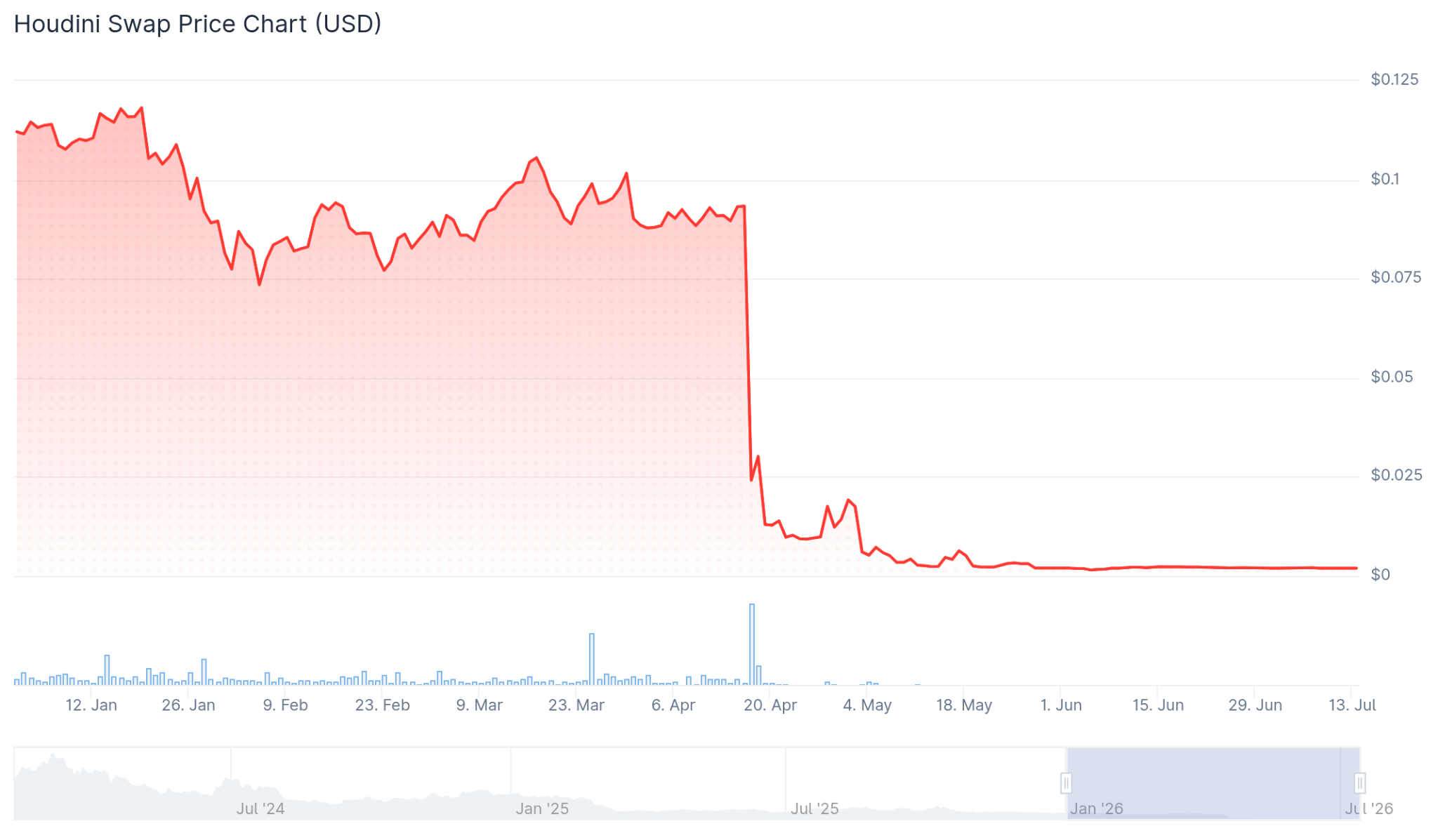
In each case, the mechanism meant to protect token holders’ interests turned out to be one the protocol controlled. This meant that what they expected from holding tokens was just at the mercy of the protocol’s management changing its mind.
This is what happens when the acquirer isn’t legally required to buy anyone else.
The Legal Bind
The CLARITY Act, passed by the US House in July 2025 and stalled in the Senate as of July 2026, is likely to make this conflict even more pronounced by using its legal teeth. The legislation plans to sort every crypto token into one of two boxes. Digital commodities will be overseen by the CFTC, the agency that regulates oil, wheat, gold and other commodities. Under investment contract assets, the token will be categorised as a security and will be regulated by the SEC, the agency that regulates stocks and bonds. Almost every protocol wants its token to be in the first category because it allows the token to trade freely on public exchanges. The second would collapse liquidity and impose compliance costs that most tokens can’t survive.
The problem arises when you look at what comes bundled with each category.
The bill explicitly allows commodity tokens to have governance rights, staking rewards, and value that rises with the extent of use of the underlying protocol. It doesn’t allow any issuer to grant its token holders a legal claim to the issuer’s revenues, profits, assets, or debts. It means a token can capture value from the network, but cannot capture the value from the company that runs the network.
This doesn’t stop a protocol from designing a token whose value accrues based on trading activity. But the token cannot be designed to have its value accrue based on the revenue generated by the corporate entity behind the protocol. Buybacks and burns fall in this grey zone. So far, the SEC hasn’t clarified which side of the fence it falls on. But nothing forces the SEC to draw a line in favour of the token holders.
In the status quo, protocols existed in a legal fog where they could claim tokens were something like informal shares. It’s a case exploiting the absence of clarity. But wait, would you even call it exploitation where there is no law yet? There’s no CLARITY Act right now to outlaw the story that protocols continue telling their token holders. But once the Act comes into force, it will make it legally impossible to offer ownership rights to token holders while keeping it in the commodities category.
Some protocols are already trying to bridge the gap without crossing the line. Aave activated Aavenomics 3.0 on June 27, replacing its committee-directed buyback with an automated, non-discretionary on-chain mechanism that routes 100% of protocol and GHO (Aave’s decentralised, overcollateralised stablecoin) revenue into open-market AAVE purchases.
Stani Kulechov, Aave’s founder, called the mechanism immutable and automated. It is probably the farthest any DeFi protocol has gone to make a promise on record.
But Aavenomics 3.0 is still just code doing the job a contract ought to do. Aave’s governance team can still vote to halt the mechanism. An aggrieved token holder cannot sue for breach of promise. At best, it is a policy that most holders trust the governance team to uphold. Every protocol that has tried to build value accrual without securities registration is likely to face the same restraint imposed by the CLARITY Act.
In fact, Aave is also about to face the question Venice just faced. In late June, reports emerged stating Kraken’s parent, Payward, is negotiating a 15% equity stake in Aave Group at a $385 million valuation. But Kulechov disputed the consideration involved in the deal.

However, he didn’t deny that talks were underway. If this deal closes, Aave becomes the second major protocol to add a real equity class on top of a live token.
Is there any way crypto protocols can justify these dual structures?
The industry’s standard defence is often tokens that hold some genuine utility. Venice’s DIEM, a mint credit that buys a dollar of daily AI compute, is an example of a utility token. Fee tokens on trading venues are another example. But the problem here is that tokens whose value is linked to utility cannot appreciate. It’s like the chips a casino sells you so you can use them to play and cash out when you're done. Even if someone chose to hold these chips, they cannot serve as a store of value beyond their utility for playing in the casino. A DIEM that buys a dollar’s worth of compute should also be treated similarly. It can gain temporary value due to demand being higher than supply, but that cannot compound over time.
But the moment the primary pitch for selling a token is that the protocol will use its earnings to make the token more valuable, then it is nothing more than a pseudo-equity. And this instrument will be unable to evade CLARITY’s excluded categories.
The better alternative for protocols is to choose. They should accept that the token is a commodity and stop marketing it as a claim on the company’s success. The other option is to issue actual economic rights to token holders, register the token as a security, and bear the compliance cost.
For a decade, the capital asset framing worked because nobody insisted on reading the fine print. But it worked so long as everyone in the room was at peace with how it worked. Once equity shareholders arrive with signed papers, the act will stop. Aave’s automated buyback could be one of the best ways to reassure the tokenholders. But that will only last until the governance decides to change the rules they play by. That moment is just one term sheet away.
That’s it for today. I will be back with the next one.
Until next time, stay curious,
Prathik
Token Dispatch is a daily crypto newsletter handpicked and crafted with love by human bots. If you want to reach out to 170,000+ subscriber community of the Token Dispatch, you can explore the partnership opportunities with us 🙌
📩 Fill out this form to submit your details and book a meeting with us directly.
Disclaimer: This newsletter contains analysis and opinions of the author. Content is for informational purposes only, not financial advice. Trading crypto involves substantial risk - your capital is at risk. Do your own research.