


Hello,
In January 2026, USD.AI, a lending protocol that enables GPU-backed lending, approved a debt facility of up to $500 million to Sharon AI, a leading neocloud company in Australia. Nine months down, Sharon signed its inaugural GPU-backed loan of $356 million from conventional lenders at a fixed 9.95%. Its public disclosures don’t tell us anything about receiving any money from USD.AI.
That’s not a one-off story. It’s part of a larger trend we see in how GPU-backed lending is evolving. The initial lenders to any new asset always charge extra. They want to cover the highly uncertain risk that comes with an industry that few understand. The AI-backed capital markets are getting more predictable and driving out the premium that those who lent to the industry could once command.
Nvidia now guarantees some borrowers’ income, big banks are lending, and chip rents are becoming a traded price. This is changing where GPU-backed lenders make their buck from and how they do business. USD.AI has started selling its loans to investors instead of holding them through maturity.
In this piece, I explain why the premium existed once, what is killing it, and if USD.AI’s new strategy will work for the industry.
On to the story…


StablesReward: Your AI Agent Spends, You Earn
AI agents can surf the web, read reviews, and book hotels for you. All these tasks cost money. But what if these tasks could earn you back something?
StablesReward does just that. Once you connect your agent to an MCP endpoint, it gives your agent a menu of paid tools. Every call your agent pays for earns you miles or stocks. And this is in addition to the rewards you earn anyway on your own spending across 800+ merchants.

Every purchase pays you back. The best part is that you can choose how you’d like to be rewarded. Transfer miles to airlines and hotels, or let your stocks build a portfolio from the spend you were making anyway.
Launching soon. Free to join.
The Knowledge Premium
In GPU-backed lending, an AI cloud company, or a neocloud, first buys Nvidia chips and rents them out by the hour or multi-year contracts. But since the chips are expensive to start with, the neocloud borrows. The same chips act as collateral for the lenders. These chips are owned in the books of a newly created special purpose vehicle. The neocloud services the loan using the rental contracts that fetch its income. If the borrower fails, the lender takes both.
Lending like this is uneconomical without scale. A lender has to check the chips, the data centre lease, the customer contracts, and the legal structure. That work costs roughly the same whether the loan is $20 million or $500 million. Approvals often take three to six months. Chips cannot afford to wait that long.
So mid-sized borrowers got a thin market. Morgan Stanley estimates $2.9 trillion of global data centre spending between 2025 and 2028, of which hyperscaler cash flows cover about only $1.4 trillion. The rest has to be borrowed or raised elsewhere, and mid-sized operators were nobody’s first call.
That gap is filled by protocols like USD.AI. It took stablecoin deposits from crypto investors and lent those digital dollars against GPUs, typically in deals of $50 million to $250 million.
Well-structured loans in this segment carry the same protections as deals backed by investment-grade customers. Yet they pay 400 to 600 bps extra in interest. That’s the premium to bridge the gap between people who understand compute and people with capital.
But this lack of awareness is temporary. As people get more aware of an industry, the premium charged to bet on it compresses.
Even the solar energy went through a similar cycle. In November 2013, SolarCity sold the first securitisation of rooftop solar contracts. The deal was inked for $54.4 million at 4.8%, rated BBB+. Less than two years later, its Class A notes were priced at 4.18%. The product was the same old panels But lot around the panels industry had changed. Once investors could see homeowners pay their bills year after year, they stopped charging for not knowing.
This anecdote is directionally helpful, except that GPUs are much more time-sensitive. A solar panel can last 25 years, but the GPUs can’t afford to wait for a decade to learn this lesson. So the industry bridged the knowledge gap and compressed the premium on its loans sooner.
In 2023, CoreWeave, the largest neocloud, borrowed $2.3 billion against its chips at a floating rate of around 15%. In March 2026, it closed an $8.5 billion loan at SOFR plus 2.25%, roughly 5.9% fixed. Moody’s rated it A3, making it the first investment-grade loan secured by GPUs.
What flipped in the last three years? The chips business became safer as customers became more reliable. Borrowers are now backing their loans using contracts with giants like Meta. So, the lenders lending to CoreWeave price the deal with Meta based on the latter’s reputation, and not the former’s chips.
But not all compute operators have a Meta. Nvidia decided to fill that gap for the small operators. In mid-2026, the chipmaker began guaranteeing a minimum rental income for selected neoclouds, renting back unused capacity at a fixed price in exchange for a share of revenue above the floor. Sharon AI was its first partner, for up to 40,000 GB300 chips over six years.
In the past few months, Wall Street has followed suit by bridging the knowledge gap gradually.
In August this year, Nvidia announced a financing platform with Apollo, BlackRock, Blackstone, Brookfield, Goldman Sachs, and KKR, targeting more than $500 billion. Nvidia retained an option to guarantee up to $125 billion.
CME Group listed futures on hourly H100 and B200 rental prices, scheduled to start trading on October 5. A lender valuing a three-year loan can now look at a three-year price curve to hedge their position better.
But there could be other factors that influence risk. Let’s go back to CoreWeave’s deals. In May this year, it borrowed $3.1 billion at SOFR plus 4.50%. A couple of months later, in August, it borrowed $2.6 billion at SOFR plus 5.50%, with the same ratings. Here, the market was pricing the risk higher. Why?
The difference was that the customer contracts behind the August loan averaged about three years, against a loan of about five. Lenders charged an extra percentage point for the chance that those contracts might not renew.
This happens across the industry. Nebius, an AI-native cloud and infrastructure provider, says its long contracts earn $20 million to $25 million per megawatt a year, just half of what their short deals of up to six months can fetch.
So, the chip industry is not witnessing a straightforward haircut in the premium on lending. Instead, the premium is being split and pulled in different directions by the factors influencing it. The premium paid for lack of awareness about the industry is vanishing as the ecosystem around it matures. But the part that prices renewal risk and resale value of the chips is still around.
Even as we speak about all this, the guarantee coming from the top is also wobbling. In under a month after announcing its financing platform, Nvidia reportedly paused parts of its backstop programme.
The squeeze on the premium also comes from the stablecoin holders. They seek yield above what on-chain money markets pay, and GPU loans have been one of the few places where they can find that. Bullish, the NYSE-listed crypto exchange, committed $100 million to USD.AI in August. As more lenders chase the same borrowers, they compress the spreads further.
From Lender to Broker
For a lender in this position, holding loans is no longer the most optimal proposition. They earn a shrinking premium for knowledge, retain the risk on their books, and hope it doesn’t materialise in the three years when they strive to get their money back.
Protocols like USD.AI have another challenge. Its depositors can ask for their money on a 30-day cycle. So there’s an asset-liability mismatch. Its loans run for three years, while the money could be called back in 30 days. Celsius’s case serves as a cautionary tale, where the idea to borrow short and lend long came back to bite the company.
USD.AI manages the gap with a redemption queue and refuses to dump loans to meet withdrawals. Yet, a queue is a buffer and not a foolproof solution.
Its deposit history adds pressure. Much of the early money came to farm points for USD.AI’s token airdrop. Data shows deposits peaked near ~$700 million when barely $1 million was lent out. The capital that stayed now funds about $311 million of GPU deployments: $177 million in active loans and $134 million in escrow, waiting for chips.
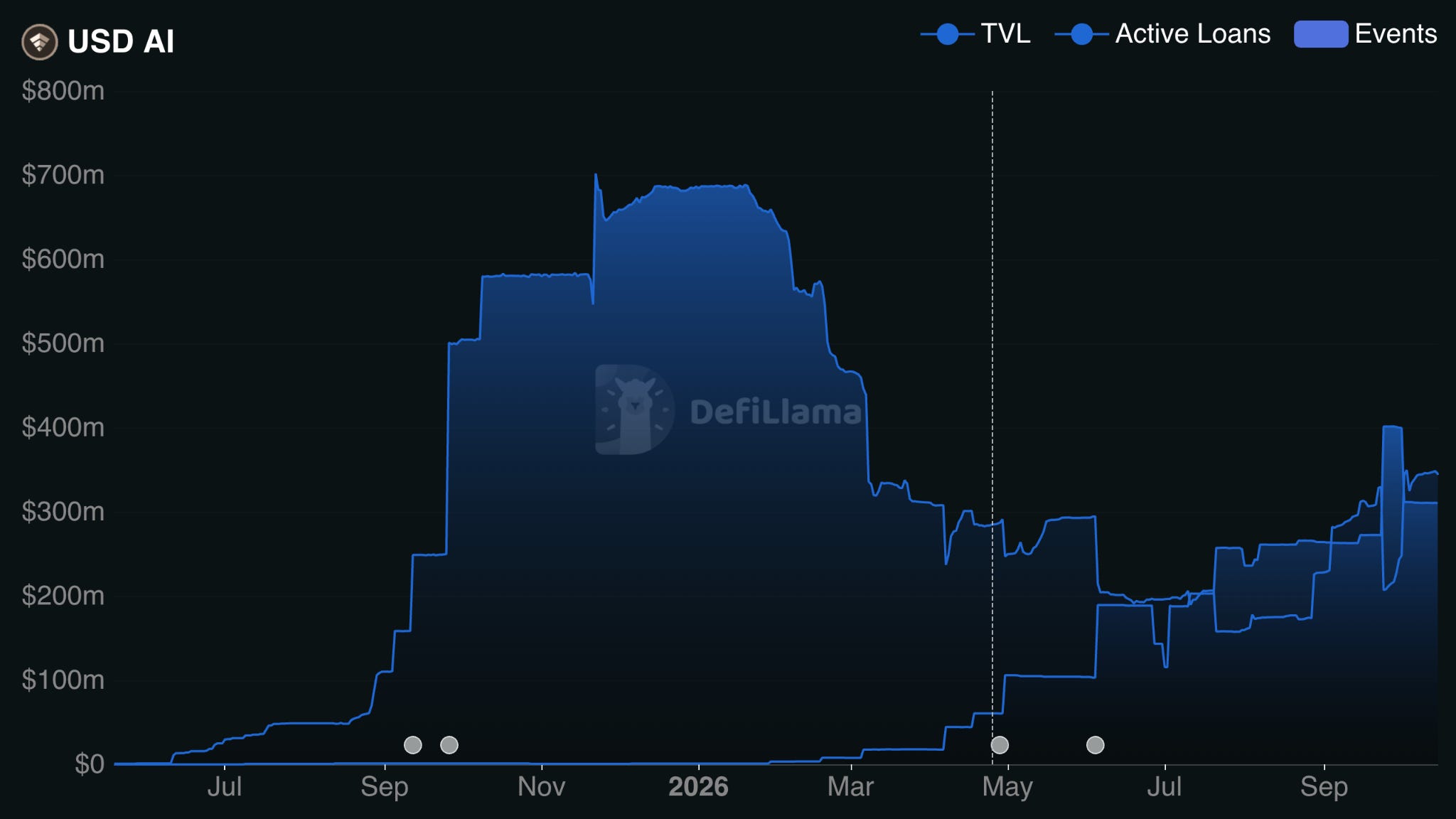
On October 1, USD.AI launched the GPU Loan Exchange (GLX) and a model ‘season-and-sell’. In this, depositors fund a loan while the servers are built, shipped, and installed. Once the chips are running and payments flow, the loan is sold to an institution that wants a steady multi-year asset. The cash returns to depositors for the next loan.
Crypto money funds the short-term funding requirement, while the patience and institutional capital is tapped into for the long-haul capital requirements. It’s an interesting idea because it mimics what made mortgage lending work for decades.

USD.AI has already completed its first execution under the season-and-sell model. The company had lent $98.1 million to Duos Edge AI in June for 2,304 B300 chips. On September 30, SEC filings show Axe Compute bought the cluster and repaid about $87.8 million of its debt.
For USD.AI, almost its entire capital came back in under four months.
Who Gets Paid Now
Season-and-sell splits a GPU loan into two different layers.
At the top sits Nvidia - the chipmaker. It makes its primary revenue by making and selling the chip. Additionally, wherever it backstops a neocloud’s revenue, it also takes a cut of what the chip earns after it steps outside the manufacturing floor.
In SemiAnalysis’s model, that cut averages about 18% of the neocloud’s rental revenue under a 40% revenue share.
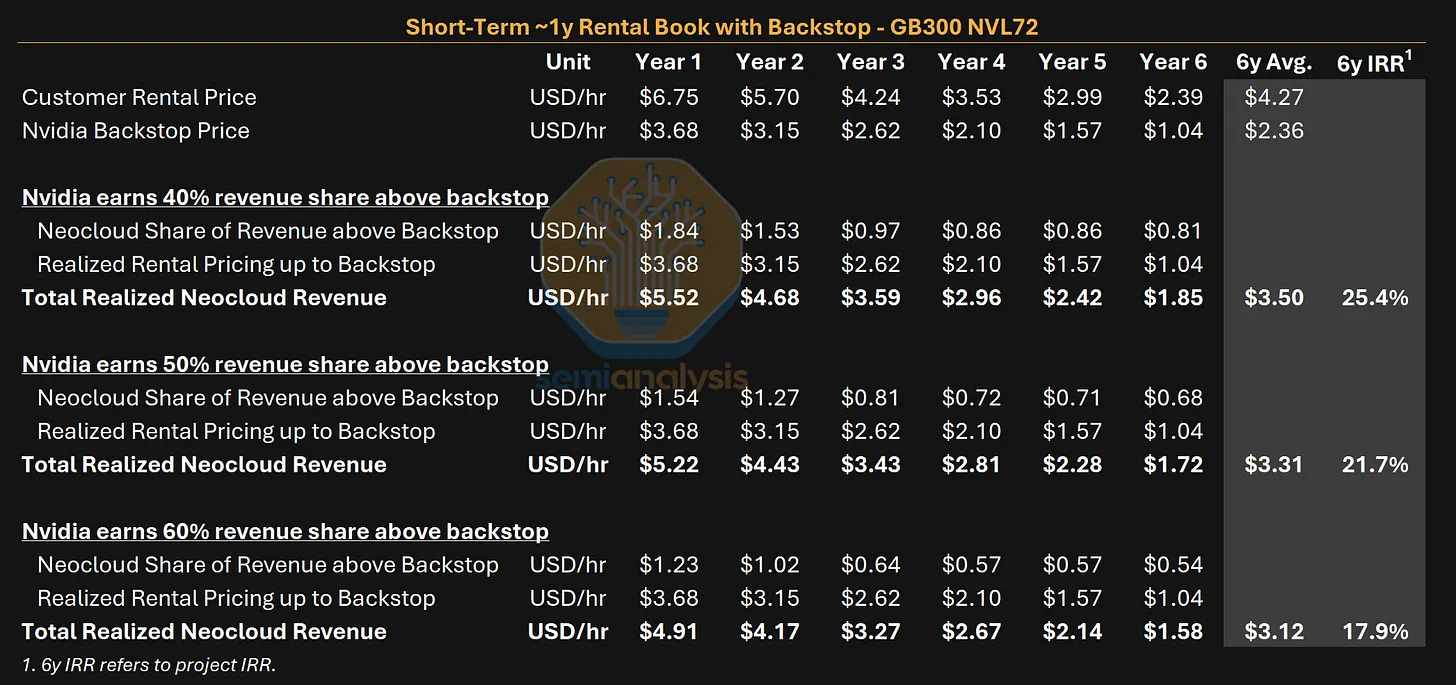
Along with being a supplier, Nvidia now also gets to earn a rent by insuring the fate of its downstream customers.
One layer below this, the neoclouds capture the value. How much value depends on the contracts they sign. Nebius’s short deals fetch $40 million to $50 million per megawatt a year, and long ones half that. But short contracts cost more to finance. CoreWeave paid a full percentage point extra when its contracts ran shorter than its loan.
Further below the neoclouds are the lenders. Now, even this stack is split in two.
The first lender funds the initial build. In USD.AI’s case, depositors’ money earns around 6.5% to 7% in escrow while servers ship and get installed. It steps up once the loan starts earning, and USD.AI’s active loans average about 11%. This is the riskiest period in the life of a loan, when it hasn’t yet proven to be worth anything yet.
The second lender buys the seasoned loan. By then, it is already a performing, multi-year asset with a payment record. Insurers, private credit funds and banks love this kind of steady income.
The gap between what the build-phase lender earns and what the final buyer accepts is where the new stream of value is created. Whoever sources the borrower, must check the chips, write the legal structure and sell the loan. That first lender then earns from that gap and the fees in facilitating the transaction. All these new layers, where value accrues, make holding loans an unattractive business proposition.
A holder of the loan earns a single spread for three years while carrying the resale risk. But the loan originator can turn the same capital over several times a year and earn on every round of originating the loan, albeit a smaller ticket value.
Figure Technology has shown how this plays out in home-equity lending. Its blockchain marketplace handled 65% of its second-quarter volume. Although it earns less per dollar passing through its system, it still ties up far less of its own capital in that process.
What USD.AI’s New Model Achieves
USD.AI wants to operate where GPU loans are made and sold, and not where they simply hold these loans on their books. That changes how the protocol makes money. A lender that holds a loan ties up each dollar for three years (or the tenure of the loan) and earns a single spread. On the Duos deal, USD.AI’s money came back in under four months. At this pace, the same dollar can fund three loans a year and earn USD.AI a fee on each of the loans. It makes the capital work more efficiently.
At a time when USD.AI claims to have more than $25 billion of inbound loan demand against the $311 million deployed in active loans currently, recycling the same capital is the only way to close that gap.
Selling loans also makes USD.AI a pricing venue for GPU loans, something it could never be by holding these loans. Every loan that trades on GLX shows what a performing GPU loan is worth for a given chip, borrower, and contract length. An “exchange” quite literally. Those who own the data on the pricing of GPU loans will end up setting a market for everyone.
Buyers get access to a market they couldn’t reach otherwise. Insurers and credit funds want steady multi-year income without a full-fledged investment team that could vet tens of millions of dollars in loans to small cloud operators. GLX lets them skip both the vetting and the riskiest months, and buy a loan with a payment record.
For borrowers, a lender that gets its money back in months instead of years can say yes to the loan more often.
It also creates jobs that only exist when loans trade. Someone has to collect payments and enforce the loan after it’s sold. In mortgages, that is a large business of its own, called servicing. Someone has to value the chips when the loan ends, and the Silicon Data index and CME’s rental futures are the first tools for that.
The season-and-sell strategy also enables pooling. When hundreds of seasoned loans across dozens of operators are bundled into one bond, it can create another asset class of pooled GPU loans.
The fact that all these loans and transactions will be recorded on-chain ensures that an entire repository of how GPU loans are made, repaid and priced is open for any buyer, rater or lender to check.
While tokenised private credit already makes up 54% of on-chain real-world assets, most of it wraps loans that lenders like Apollo made first. Crypto ends up buying what was born on Wall Street. USD.AI reverses this. Stablecoins originate the loan, earn the fees, and then sell it to the same institutions that have been around for decades, if not more.
That’s it for today. I will be back with the next one.
Until next time, stay curious,
Prathik
Token Dispatch is a daily crypto newsletter handpicked and crafted with love by human bots. If you want to reach out to 165,000+ subscriber community of the Token Dispatch, you can explore the partnership opportunities with us 🙌
📩 Fill out this form to submit your details and book a meeting with us directly.
Disclaimer: This newsletter contains analysis and opinions of the author. Content is for informational purposes only, not financial advice. Trading crypto involves substantial risk - your capital is at risk. Do your own research.