


Hello,
Lending is more complicated than knowing the yield you earn on a loan. Especially when money is lent at floating rates.
Lending makes credit available to those seeking capital and earns a yield for those funding it. A treasury that is borrowing at a floating rate today will have no idea what its payment obligation will be in three months. Traditional finance addressed this with derivatives around lending products that let borrowers swap floating-rate products for fixed-rate ones.
By wrapping a predictable instrument around an existing primitive like lending, a borrower can fix the cost of capital, cap the downside and budget cash flow needs accordingly.
But such a market doesn’t exist yet for DeFi lending. If DeFi lending wants to graduate from a looping casino to mainstream business adoption for funding capital needs, the industry needs a derivatives market.
In today’s guest op-ed, Mike, co-founder of Schema Research, explains how the derivatives market can help DeFi lending become usable in day-to-day finance beyond crypto-native circles.
On to Mike’ story,
Prathik

DeFi lending made collateralised credit available on demand, but it did not make its cost predictable over time. Borrowers see today’s rate, not the cost of holding debt for 3 or 6 months. Lenders see today’s APY, not the return they will earn over the same period. DeFi has deep lending markets, but their rates still lack a liquid term market.
The Rate behind DeFi Returns
Lots of DeFi strategies earn one rate and pay another. A user supplies an asset, borrows against it and deploys the borrowed capital elsewhere. The return on equity comes from the income on the supplied asset and the destination strategy, minus interest on the debt. Once the position is opened, a floating borrowing rate keeps changing that final line.
Pooled lending markets were built for immediate access to liquidity. Deposits sit in a common reserve, borrowers enter on demand, and the rate adjusts with utilisation. Aave’s variable-rate model uses a gentler slope below optimal utilisation and a steeper slope above it. Higher rates attract liquidity and discourage new borrowing when a reserve becomes scarce. The quoted rate describes the pool now. It does not price 3 or 6 months of financing.
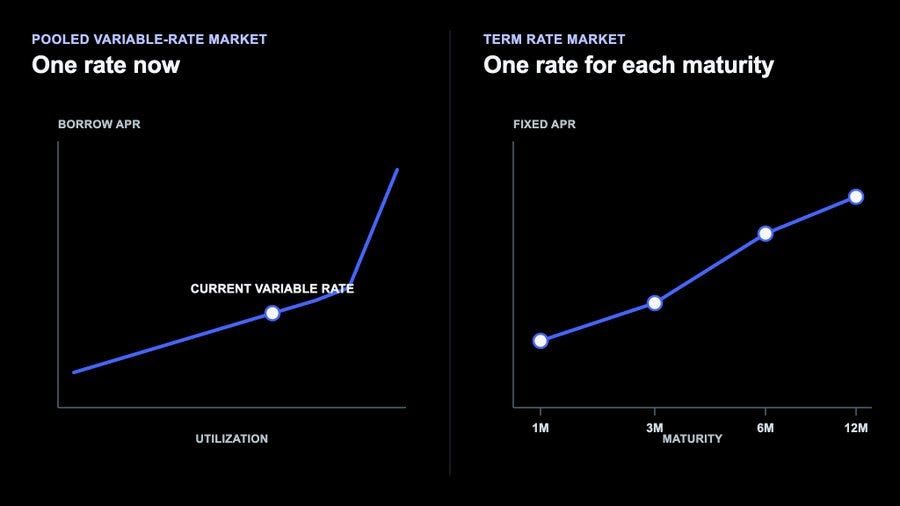
A fund offering a quarterly target return needs a cost of capital before choosing position size. Lenders face the same budgeting problem on the income side. They can see today’s supply rate, yet their realised return depends on the average rate over the full holding period. A term quote lets both sides decide whether the spread is wide enough before the trade starts.
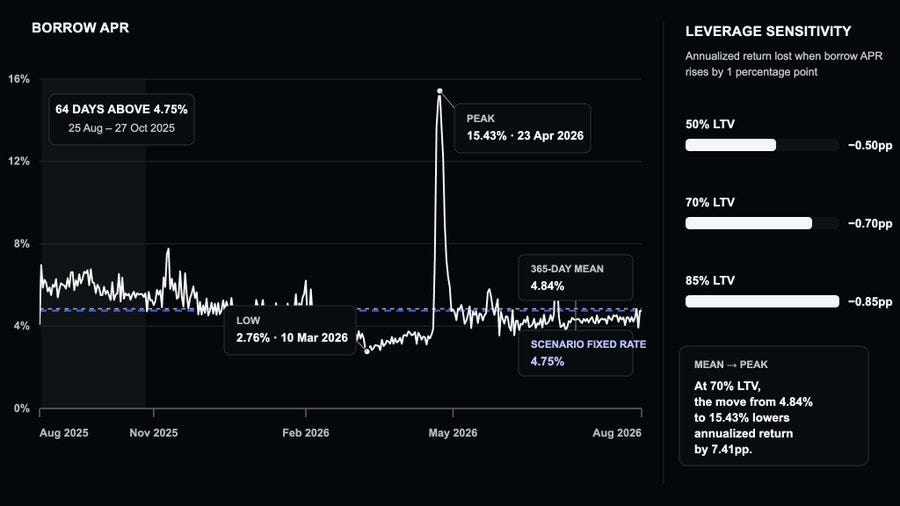
The rate path in Aave shows why a spot quote cannot do that work. Across the 365 days, the Ethereum Core USDC borrow APY averaged 4.84% and ranged from 2.76% to 15.43%. During the largest event in the sample, it rose from 3.15% on March 24 to 15.43% on April 23. A strategy opened against the first number still had to fund itself at the second.
Traditional rate markets separate the loan from its financing terms. The BIS measured $7.9 trillion of average daily turnover in OTC interest-rate derivatives, with overnight index swaps accounting for $5.1 trillion. Crypto’s perpetual funding markets show how a recurring onchain cash flow can also be priced and traded on its own.
Two Rate Markets, Two Different Risk Drivers
Perpetual futures turned a recurring cash flow into a market instrument. It is the established crypto-native rate cash flow that can be separated from the underlying position and traded directly. Boros makes the future stream tradable through Yield Units (YU). A long YU pays a fixed APR and receives the funding rate of a named perp market, and a short YU receives fixed and pays funding. The position is margined and settles against the funding index without requiring the matching perpetual position.
But a perp funding rate and a lending rate are not interchangeable underlyings. Perp funding responds to positioning and the gap between a perpetual contract and its spot index. A money-market borrow rate responds to available liquidity, loan demand, utilisation and the curve chosen for that reserve. A crowded long trade can push funding higher while a stablecoin pool remains well supplied. A large stablecoin borrow can drive a pool beyond its utilisation kink even when perpetual positioning is balanced.
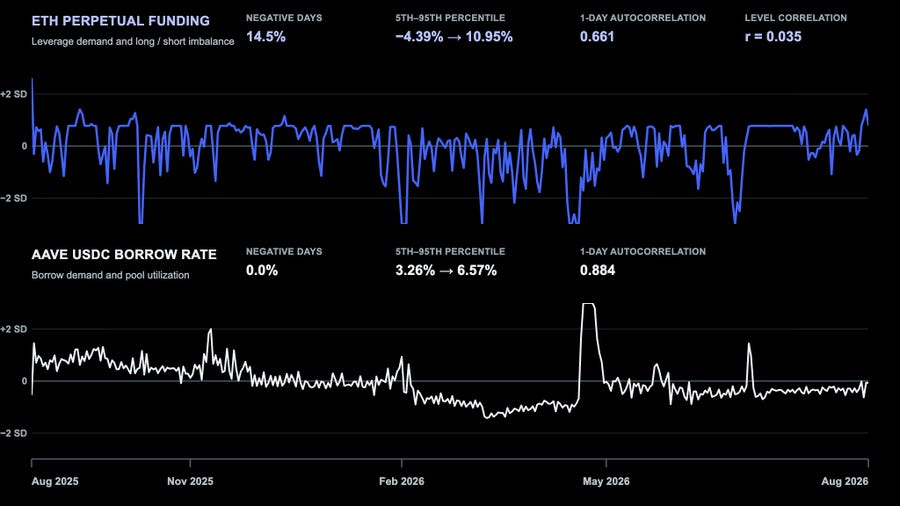
The two series behaved differently over the common 365-day sample. Annualised Hyperliquid ETH funding averaged 6.13% and was negative on 14.5% of days. Its 5th-to-95th percentile range was -4.39% to 10.95%. Aave USDC borrowing stayed positive, with a 3.26% to 6.57% range across the same percentiles. One-day auto-correlation was 0.661 for funding and 0.884 for lending. Their level correlation was 0.035.
Basis is also venue-specific. A Binance funding swap does not settle against Hyperliquid funding. Lending creates the same issue at pool level. Relative to Aave Core WETH, Aave Prime WETH and the sampled Morpho weETH/WETH and wstETH/WETH markets showed mean absolute gaps of 46 to 49 basis points. The gaps exceeded 100 basis points on about 9% of days, and the largest observations were above 500 basis points.
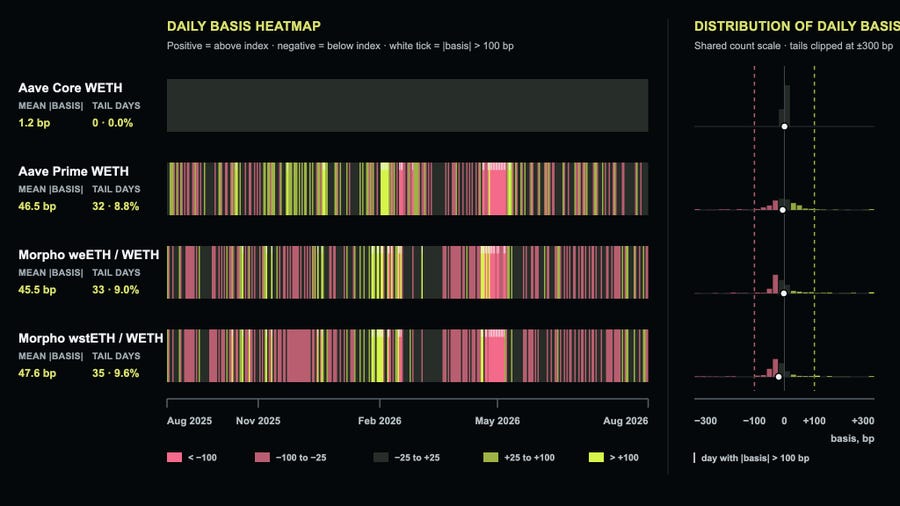
Funding derivatives price demand for perpetual leverage. It cannot lock the realised Aave borrowing cost without leaving a basis position. Lending-rate exposure therefore needs its own index, liquidity and settlement record.
Who Needs to Trade Lending Rates
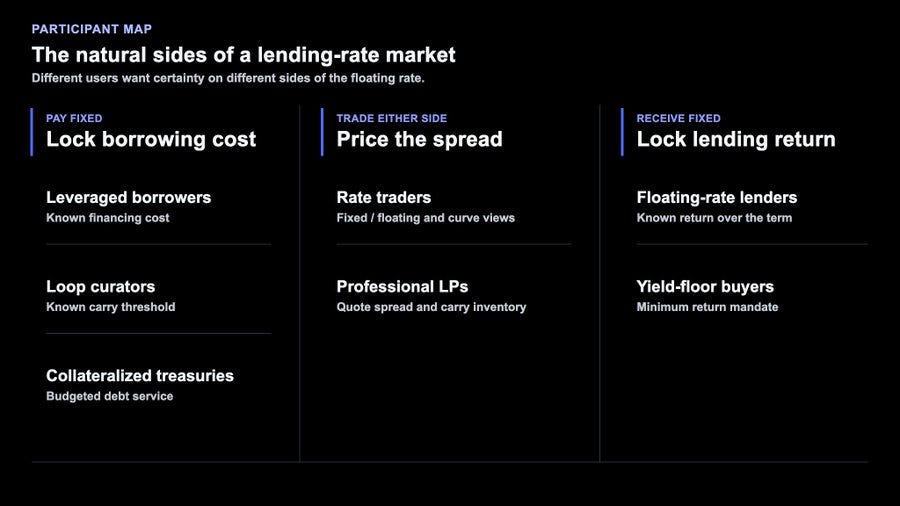
The most obvious fixed-rate buyer is a leveraged borrower. A loop manager, a delta-neutral basis book, or a treasury that borrows stablecoins against ETH is short the borrowing rate: its economics deteriorate when financing rises. Paying fixed and receiving the referenced floating index changes that moving cost into a hurdle rate for the chosen term.
High rates can come from a change in the pool’s state and a change in the rate curve itself. Exploits, depegs, liquidation waves, large supplier withdrawals, reserve freezes, oracle mistakes and expiring incentives can remove available liquidity or create urgent borrowing demand.
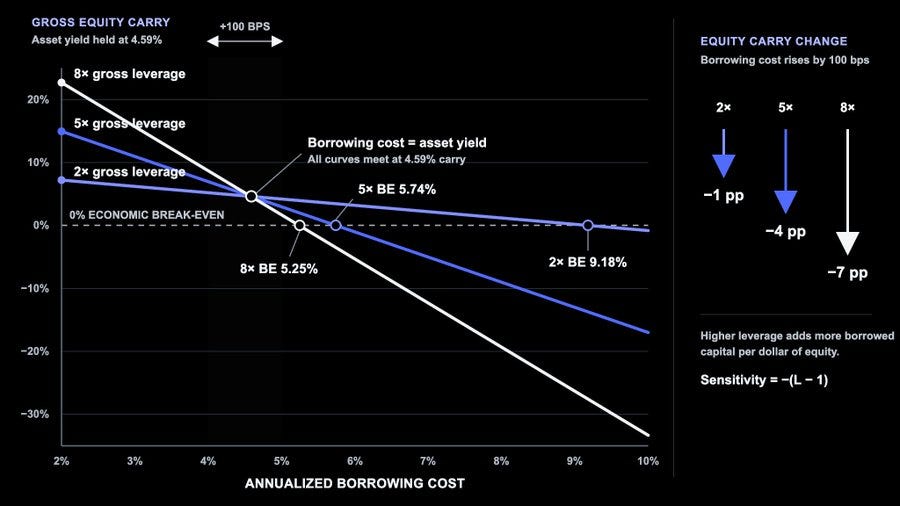
A fund manager deciding between 2x and 8x leverage needs a financing assumption. If that assumption can change by several hundred basis points after deployment, the manager must either size conservatively, hold idle liquidity for an unwind or accept that the target return is fragile. For a strategy manager, a fixed quote preserves the financing assumption used to size the expected spread. The position still carries the protocol, collateral and market risks that caused the dislocation.
Lenders provide the opposite natural flow. Receiving fixed and paying the referenced supply index converts uncertain lending income into a term yield floor. Fund managers can then support a target return with an executed rate while continuing to disclose credit, liquidity and protocol risk.
Curators can use the same instruments across portfolios of lending venues, collateral types and incentive programs. They can adjust a financing or income component without moving every underlying loan. This is useful when principal is slow to reallocate, secondary liquidity is thin or a mandate requires the credit position to remain in a specific venue.
Rate market makers absorb imbalances between borrowers seeking to pay fixed and lenders seeking to receive fixed. A trader may receive fixed when it expects the realised floating rate to settle below the quoted rate, or pay fixed when it expects floating rates to remain higher. Similar positions can express differences across lending venues or maturities. Market makers quote both sides, earn the bid-ask spread and hold the remaining rate exposure until offsetting flow arrives.
Maturity is the coordination problem. Campaign capital may need one month, strategy leverage a quarter and treasury allocations six or twelve months. Too many dates divide liquidity. One date forces users to roll at the wrong horizon. Initial markets need a small set of repeatable maturities that match recurring allocation cycles.
How DeFi Currently Creates Fixed Rates
DeFi reaches a fixed rate through several different transactions. A protocol can originate a fixed-term loan, auction principal, tokenise a maturity claim or swap a floating index. Each route fixes a different cash flow and leaves a different mix of credit, collateral, margin, liquidity and roll risk.
Early request-for-loan systems struggled to match borrowers and lenders. Shared pools reduced that coordination problem and allowed entry or exit on demand. The current fixed-rate designs try to add term pricing while retaining some of the liquidity and composability created by pooled markets.
Morpho Midnight by Morpho creates isolated fixed-rate, fixed-maturity credit. Lenders buy credit units and borrowers sell debt units. Each unit maps to one loan token at maturity. Makers publish signed offers and takers execute them on-chain. Tenor (@TenorFinance) adds market and limit execution, plus renewal and migration between Midnight and variable-rate markets. Principal funds a credit position, with collateral, liquidation and bad-debt risk inside the market.
Term Finance (@term_finances) originally matched overcollateralised term repos through sealed-bid, single-price auctions. Successful borrowers and lenders clear together, collateral is locked for the repo and lenders receive Term Repo Tokens redeemable at maturity. Term V2 adds order markets and routes supporting external capital at execution, allowing maker capital to remain productive until an order fills. Maturities still divide liquidity and concentrate repayment or refinancing around term end. The August 2026 governance exploit affected Term Strategy Vaults, a separate pooled product, rather than the repo markets described here.
Maturity-token markets fix the purchase yield on a future claim. Pendle (@pendle_fi) separates a yield-bearing asset into a principal token, redeemable at maturity, and a yield token that receives yield until that date. TermMax uses a fixed-rate token and complementary X token, while a Gearing Token records collateral and debt. The underlying asset must enter the tokenised structure, and liquidity is split across assets and expiries.
Rate derivatives leave principal on its original venue. A lending-rate swap exchanges the realised supply or borrow index for a fixed stream on a matched notional. That keeps the loan or deposit inside the lending market and adds a separate margin account, settlement process and basis position. A change in loan size or maturity after entry creates a mismatch between the two legs.
Fixing the rate does not diversify the underlying credit exposure. In fixed-term credit and maturity-token structures, principal or the redemption claim remains exposed to the contracts, collateral rules and bad-debt mechanism of the platform that holds or issues it. A rate swap leaves the deposit or debt on the selected lending venue and adds a separate margined derivative exposure. The architecture determines where credit and protocol risk sits, not whether it exists.
XCCY (@xccy_finance) rate swap does not originate or pool the underlying loan principal. The user keeps the lending position at a chosen venue, the vAMM prices its rate and the Collateral Engine manages margin and settlement.
Because the swap is separate from principal, it can also be packaged with a floating-rate deposit or debt to create synthetic fixed-rate products. LockYield combines a floating deposit with the rate swap to produce a fixed-yield position, while LockBorrow combines floating debt with the opposite swap direction to produce a fixed financing cost.
Fixed-term credit sets the terms of new principal, maturity tokens fix the purchase yield of a redemption claim, and rate swaps change the rate attached to an existing deposit or debt.
XCCY as Infrastructure for Predictable Yield
XCCY (@xccy_finance) separates the lending position from the rate hedge. The APR Oracle records the cumulative supply or borrowing rate of the connected venue. The vAMM discovers the fixed rate, while the Collateral Engine acts as the exchange’s risk and settlement layer. It custodies margin, records positions, checks solvency, supports liquidations and settles matured swaps.
Direct rate LPs provide inventory by allocating margin to maturity-specific pools and quoting across a fixed-rate range. As trades move through that range, LPs accumulate the opposite fixed and floating exposure and earn trading fees. Their margin supports rate-market exposure inside the Collateral Engine, it does not fund the referenced loan.
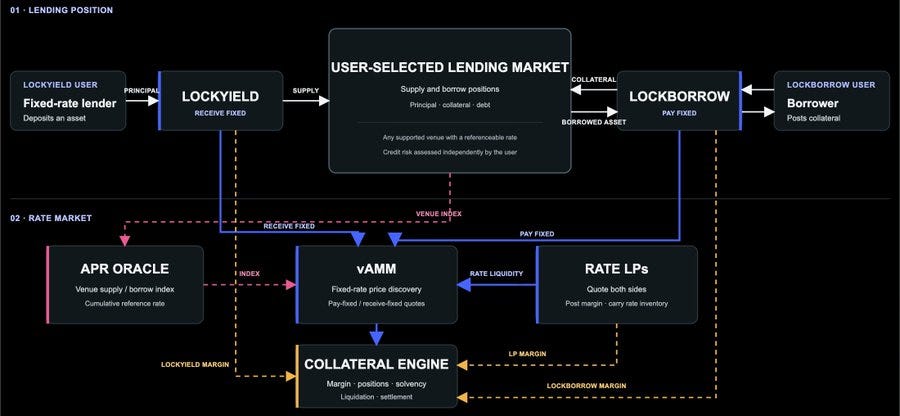
LockBorrow pairs floating-rate debt in a supported lending market with a pay-fixed, receive-floating swap on the same notional. The floating leg offsets the referenced financing cost leaving the fixed leg as the rate applied through maturity.
LockYield supplies the asset and trades its future floating income for a fixed rate on the same notional. Direct IRS trading exposes the two legs without packaging them into a loan or deposit. Rate LPs earn trading fees for quoting ranges and carrying the other side of flow. On Ethereum, XCCY contracts are transparent upgradeable proxies so upgrade administration remains part of the protocol risk.
Case study 1: Fixed sUSDe loop
On April 19, 2026, the Aave sUSDe/USDe loop had a positive entry spread. The native sUSDe yield was 3.88% and the USDe variable borrow rate was 2.92%. At 8x gross exposure, those rates implied a 10.61% annualised return on the allocator’s equity before transaction costs. The calculation still depended on every future USDe rate update.
The position starts with $1 million of equity. Repeated borrowing and resupply build $8 million of sUSDe collateral against $7 million of USDe debt. That is an 87.5% debt ratio with a 90% maximum LTV and a 92% liquidation threshold, so the position has little room for a change in the collateral-to-debt price or additional debt accrual.
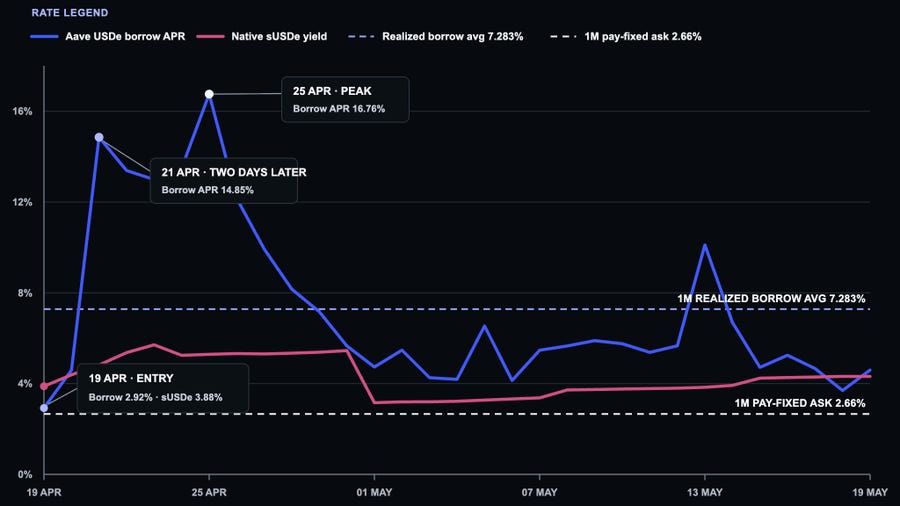
USDe borrowing moved above the asset yield within two days. The daily Aave rate reached 14.85% on April 21 and peaked at 16.76% on April 25. USDe borrow rate across the one-month cohort ending May 19 was a 7.3% realised average. Native sUSDe yield averaged 4.3% over the same case-study window.
The floating position therefore earned $28,036 on its $8 million gross sUSDe balance and paid $41,902 on $7 million of USDe debt. Net income for the 30-day period was negative $13,866. Expressed against the original $1 million of equity, that is a negative 16.87% simple annualised return.
The fixed comparison uses a 2.76% all-in borrowing rate for one month. It is a scenario input calibrated to the term curve available at entry. The asset side remains unchanged at the realised 4.26% sUSDe yield. Financing falls to $15,900, leaving $12,136 of net income, or a 14.77% simple annualised return on equity.
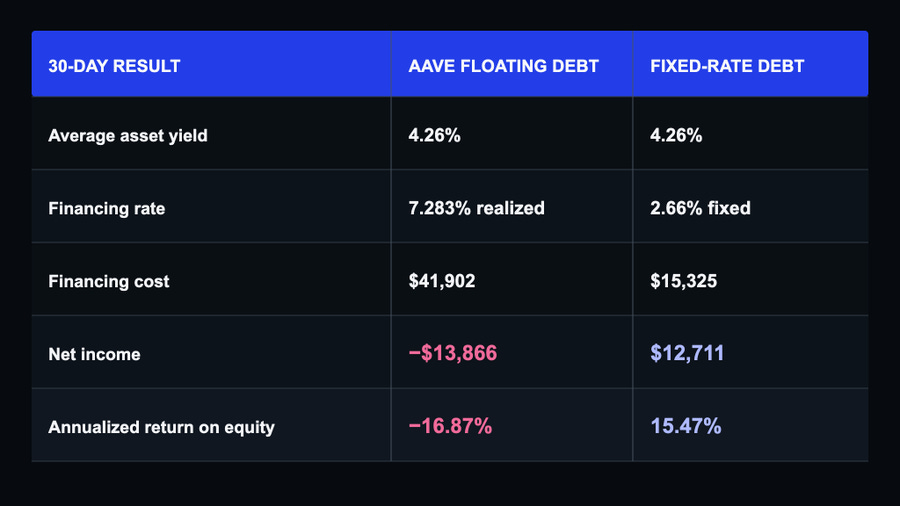
The financing choice changes the one-month result by $26,002. The difference equals the 4.5194 percentage-point rate gap applied to $7 million of debt for 30 days. At 8x exposure, every 100 basis-point change in the borrowing rate moves annualised equity return by seven percentage points. The loop entered with a positive spread in both versions and the floating version lost that spread when utilisation repriced USDe debt.
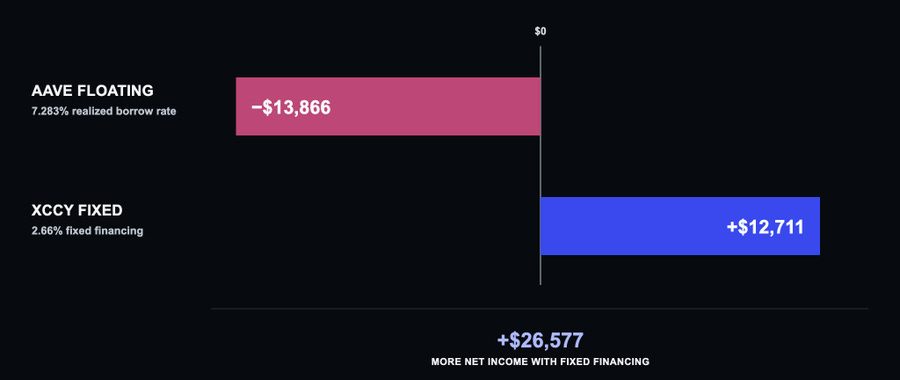
LockBorrow would pair the Aave debt with a swap that receives the referenced floating borrow index and pays fixed on the matched notional. When the index, term and notional line up, the variable swap receipts offset the variable interest added to the Aave debt. The allocator can then size the loop against a known financing rate before deploying capital.
Case study 2 : Locking Yield Before Rates Normalise
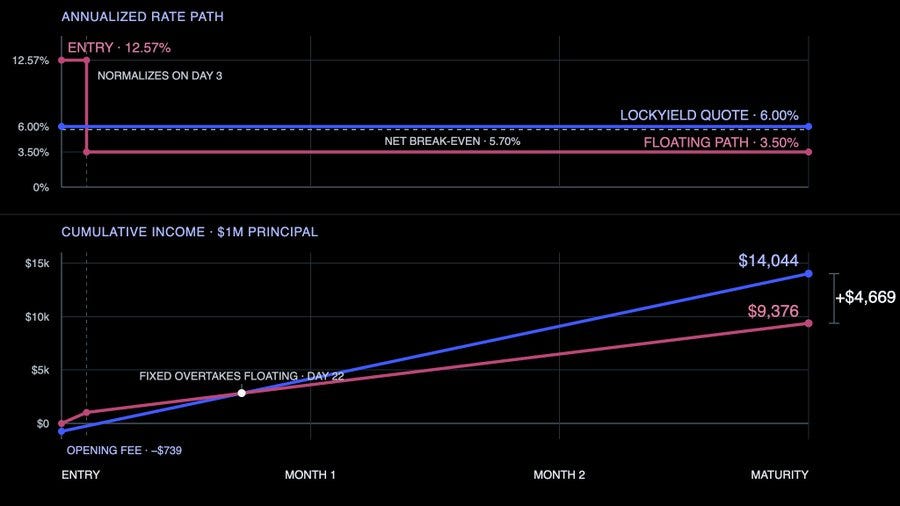
On August 25, 2026, Aave posted a yield of 12.57% with a utilisation rate of 99.98%. Later that same day, Aavescan’s current yield stood at 3.78% with a utilisation rate of 92.41%. Aave’s 30-day and 1-year averages were 3.55% and 3.56%, respectively. Consider a $1 million allocation for 90 days. The modeled floating path uses 12.57% for three days and 3.50% for the remaining 87. The three-day spike is an assumption as the live rate normalised faster. On a simple 90/365 basis, the path produces a 3.80% average APR and $9,376 of income.
The fixed scenario assumes that LockYield fills at 6.00%. At a 0.30% annualised opening fee, the contract reserves a $740 fee buffer and supplies and swaps $999,260. The fixed leg accrues $14,784; the fee on the traded notional is $739, and the unused $0.55 of the buffer is returned at settlement. The resulting maturity payout is $1,014,044.
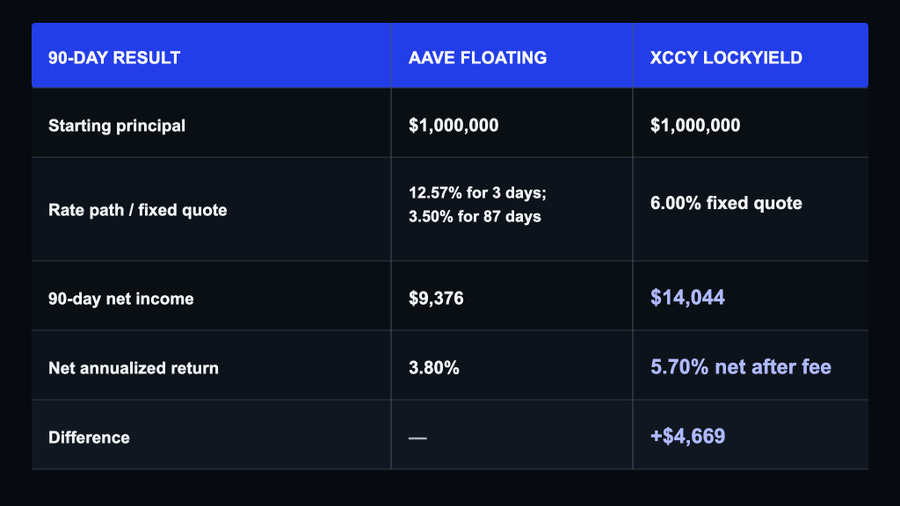
Net income is $14,044, or a 5.70% simple annualised return on the original principal. That is $4,669 above the modeled floating path. Floating supply would need to average 5.70% over the full 90 days to produce the same net income after the assumed fee.
This scenario isolates rate income. The 6% quote and the three-day normalisation path are assumptions, and an executable pool quote is required before publication. The calculation excludes transaction costs and the risks of maintaining or exiting the margined swap. These include limited market depth, liquidation and index basis.
What Makes a Lending-Rate Market Work
Settlement starts with a precisely defined reference index. It must specify the venue, pool, asset and whether the swap references the supply or borrowing rate. The index must then preserve a cumulative record through maturity.
The swap should also match the notional and term of the underlying position. Repaying debt, borrowing more or withdrawing supplied capital after execution leaves part of the exposure unhedged.
Liquidity should concentrate in a few maturities that match common allocation horizons. Too many dates fragment market-maker inventory, while too few force users to roll at the wrong time. A term curve only becomes useful when borrower and lender demand returns often enough for the same maturities to be quoted repeatedly.
Fixed quotes also require capital willing to absorb rate risk. Market makers price expected floating rates, index basis, adverse selection, mark-to-market volatility and the cost of margin. Their spreads must compensate them for holding that exposure until maturity.
Before users and LPs commit capital, they must accept the smart-contract and upgrade risk of the margin and settlement layer. Market quality is then visible in executable size by maturity, spread and slippage at a stated notional basis to the referenced loan and the record of matured positions.
Conclusion
Lending-rate derivatives do not replace pooled credit but they add a tradable term price to exposures that already exist. For allocators, that changes the decision from forecasting every future rate update to comparing an upfront fixed quote with the remaining risks of the strategy.
XCCY applies that structure to Ethereum lending through separate index, execution and margin layers. Its progress can be measured through executable depth, repeat flow and settled positions across a small set of maturities.
That’s it for today.
P.S.: This piece was first published here.
P.P.S.: We will be featuring good writing and writers we love from time to time. If you have recommendations, send them our way.
Token Dispatch is a daily crypto newsletter handpicked and crafted with love by human bots. If you want to reach out to 165,000 subscriber community of the Token Dispatch, you can explore the partnership opportunities with us 🙌
📩 Fill out this form to submit your details and book a meeting with us directly.
Disclaimer: This newsletter contains analysis and opinions of the author. Content is for informational purposes only, not financial advice. Trading crypto involves substantial risk - your capital is at risk. Do your own research.