


Hello,
When the first commercial websites launched in the 1990s, the obvious model was to charge users directly — a few cents per article, a small fee per search, and pay for what you use. However, there was a major issue: no system to collect such small amounts. Credit card processors charged minimum fees that made sub-cent transactions uneconomical for merchants to accept. Bank transfers were built for amounts large enough to justify the overhead. The smallest practical unit of internet payment was roughly a dollar, which meant anything priced below that could not be sold at all. So the websites did the only thing that worked: they made the content free and sold ads against it instead. One workaround, scaled for thirty years, is how global ad spending reached $1 trillion in 2025.
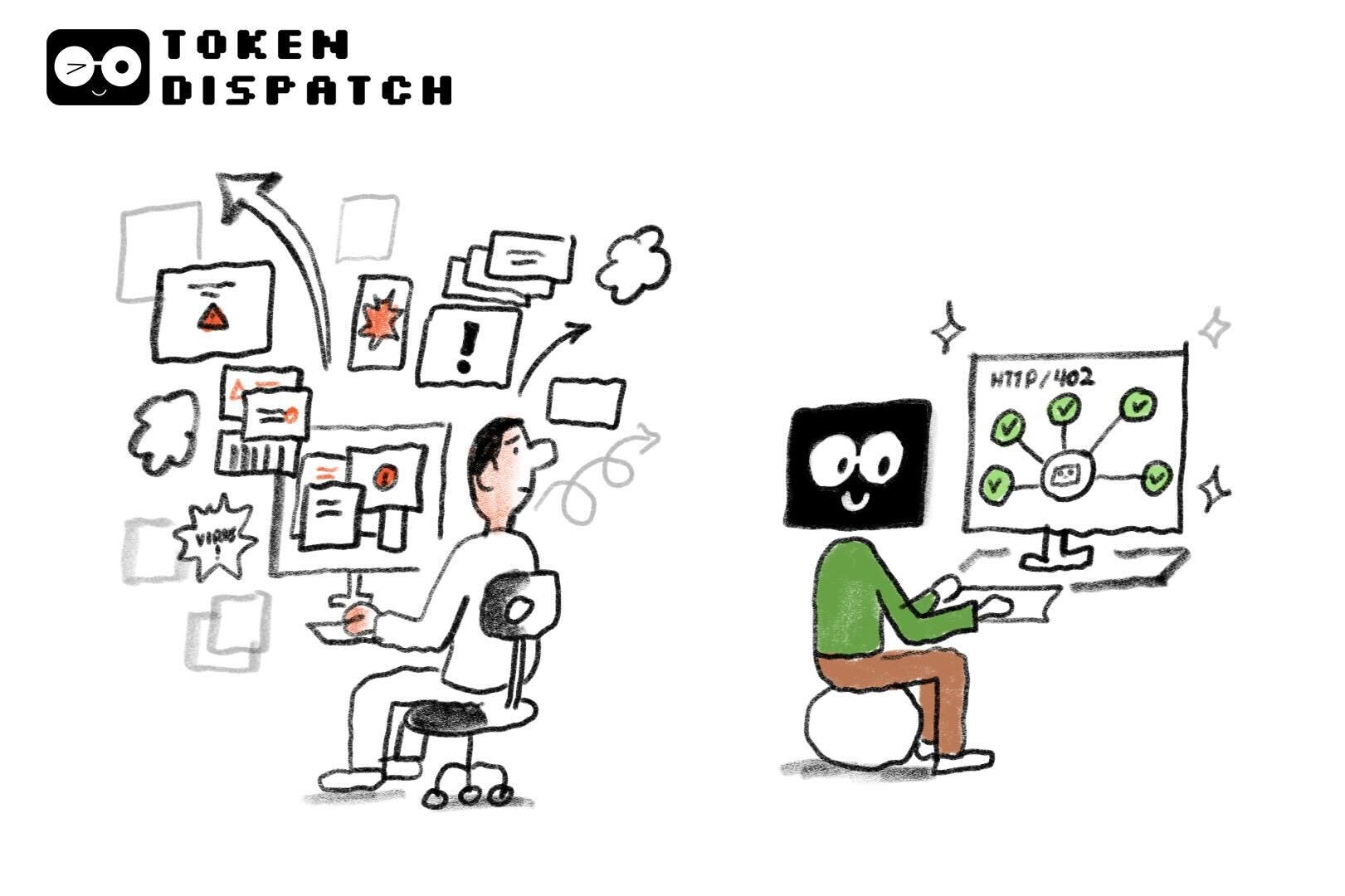
The engineers who designed the web knew about this problem. They even reserved an HTTP status code for it, 402 “Payment Required”, but it sat unused for nearly three decades because the infrastructure to honour it did not exist. We covered how x402 finally activated that code and made pay-per-request a live standard. What that piece did not address is what this means for how the internet gets paid for, who captures the value when it scales, and why AI agents are the reason this moment is different from every previous micropayment attempt.
AI agents have started doing the work that humans used to do on the web – searching, comparing, pulling data, calling APIs, at machine speed and machine volume, for amounts that are often fractions of a cent each. Circle’s Nanopayments now make those fractions of a cent economically viable to settle. This innovation fundamentally alters the way the internet gets paid for.
The $0.000001 Payment
Micropayments have been tried before. Flattr, launched in 2010, allows users to voluntarily tip content creators tiny amounts. BitPass tried something similar in 2003. Both failed, so did a dozen others in between. The standard explanation is that transaction fees were too high. But that explanation stops short of the real problem.
The reason every previous micropayment system failed is that humans are bad at making thousands of small decisions about money. Even when the fee is $0.001, there is cognitive overhead to every “should I pay for this?” that kills the behaviour. Nick Szabo described this in 1999: the mental cost of evaluating whether a piece of goods is worth a fraction of a cent often exceeds the fraction of a cent itself. You can engineer the fee to near zero and still lose the customer, because the act of choosing is what breaks the behaviour. We explored this in depth here, and the follow-on piece on payments in the agentic economy covers where this leads next.
AI agents do not have this problem. An agent executing a research task pays for an API call the same way it calls a function. Payment is part of the execution, and not a separate decision. There is no evaluation of whether the cost is worth it. The demand side of micropayments has fundamentally changed, and it changes what is possible on the supply side too.
Circle built Nanopayments to solve the supply side. The core problem has always been that every blockchain transaction costs gas. On even the cheapest chains, the gas fees run at least a fraction of a cent per transaction, which means paying for something worth $0.000001 would cost many times more in gas than the payment itself. Sub-cent on-chain payments were just expensive to process; they were practically impossible because the overhead always exceeded the value being transferred.
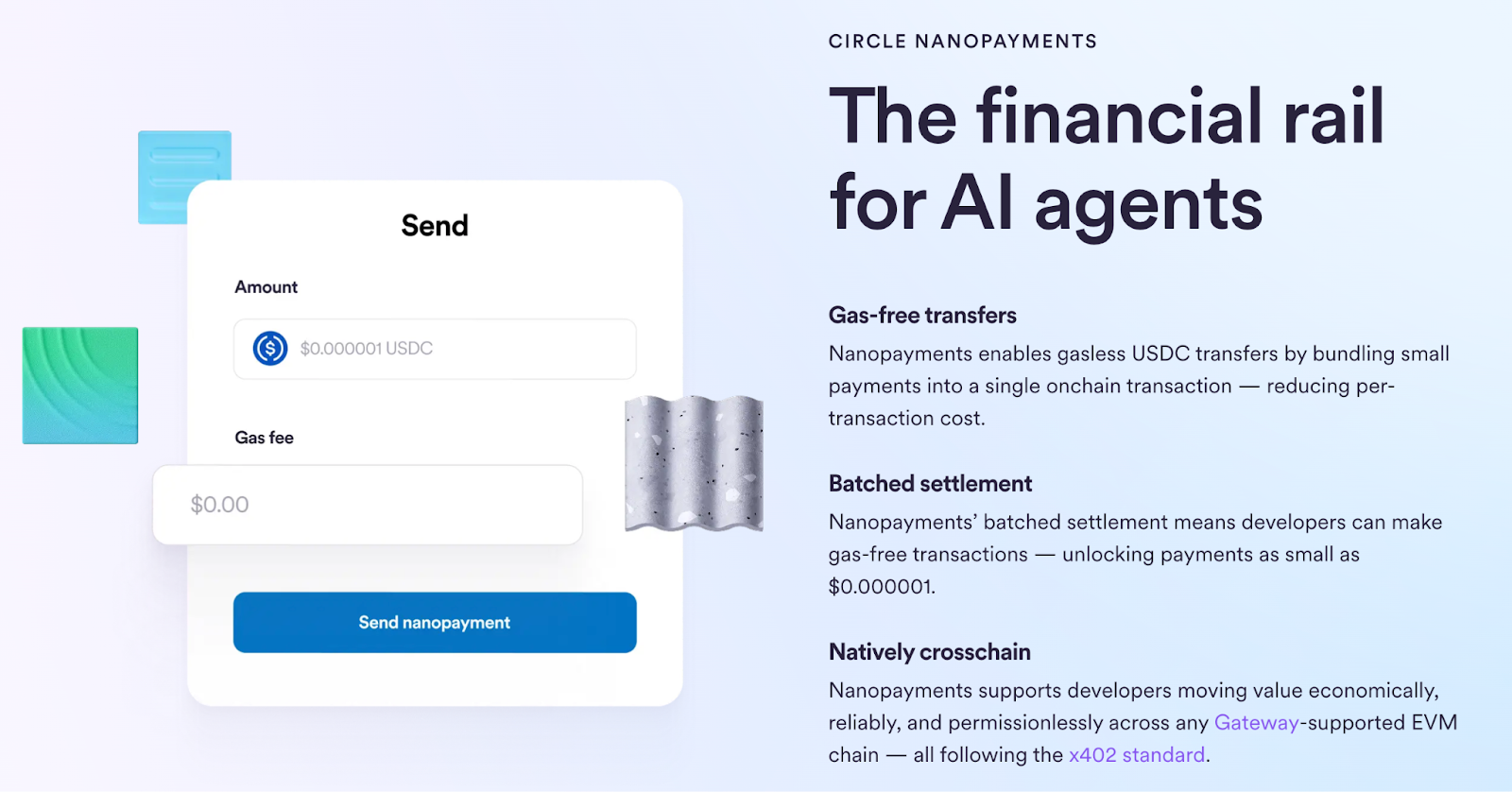
Circle’s solution is batching. A buyer deposits USDC once into a Gateway wallet smart contract, a single on-chain transaction. After that, every individual payment is an ERC-3009 TransferWithAuthorisation, a cryptographic signature created locally on the buyer’s device with no gas cost at all. That signature basically says, “move this specific amount to this address, and this authorisation expires at this timestamp. The buyer attaches this signature to an HTTP request. The seller verifies the signature and serves the resource immediately, before anything settles on-chain. Gateway collects thousands of these signatures over time, computes the net balance changes across all participants, and submits a single on-chain transaction that applies to all of them at once. By batching, the gas fee is split across thousands of transactions, reducing the minimum payment from $0.01 per transfer to $0.000001.
There is also a fine detail in how the batching runs. Before a batch goes on-chain, the entire settlement computation runs inside an AWS Nitro; it’s basically a clearinghouse built by Circle for machine payments, where the operator cannot unilaterally tamper with the settlement. The settlement is verified in tamper-proof hardware before it touches the blockchain. That means two AI agents with no prior relationship and no trust in Circle can transact through the gateway with mathematical assurance that no one in the middle falsified the outcome. Instead of relying on the operator, the system verifies the settlement before it goes through.
What happens if the seller or the API doesn’t serve your agent? Well, every ERC-3009 signature makes the payment void if the API doesn’t respond within 500 milliseconds. Neither our banks nor our cards can replicate this function. There’s no need for escrow or a dispute mechanism. The conditional payment is built into the cryptographic signature itself.
How does Circle make money from this?
Everyone covering the payments space often frames the revenue question around transaction fees. But that’s the wrong lens to look from.
When you operate a clearinghouse that processes machine-to-machine payments across the internet, the fees are the least interesting part of the business. The interesting part is the behavioural data. Every x402 call that flows through Circle’s gateway produces a record: which agent bought what, from which service, at what price, how frequently, and at what time of the day. At scale, that is the most granular map of the digital economic activity ever assembled. Human transactions on card networks are noisy, full of personal spending, cash, and offline behaviour. Machine transactions tell you exactly where the economic value in the agent economy is flowing.
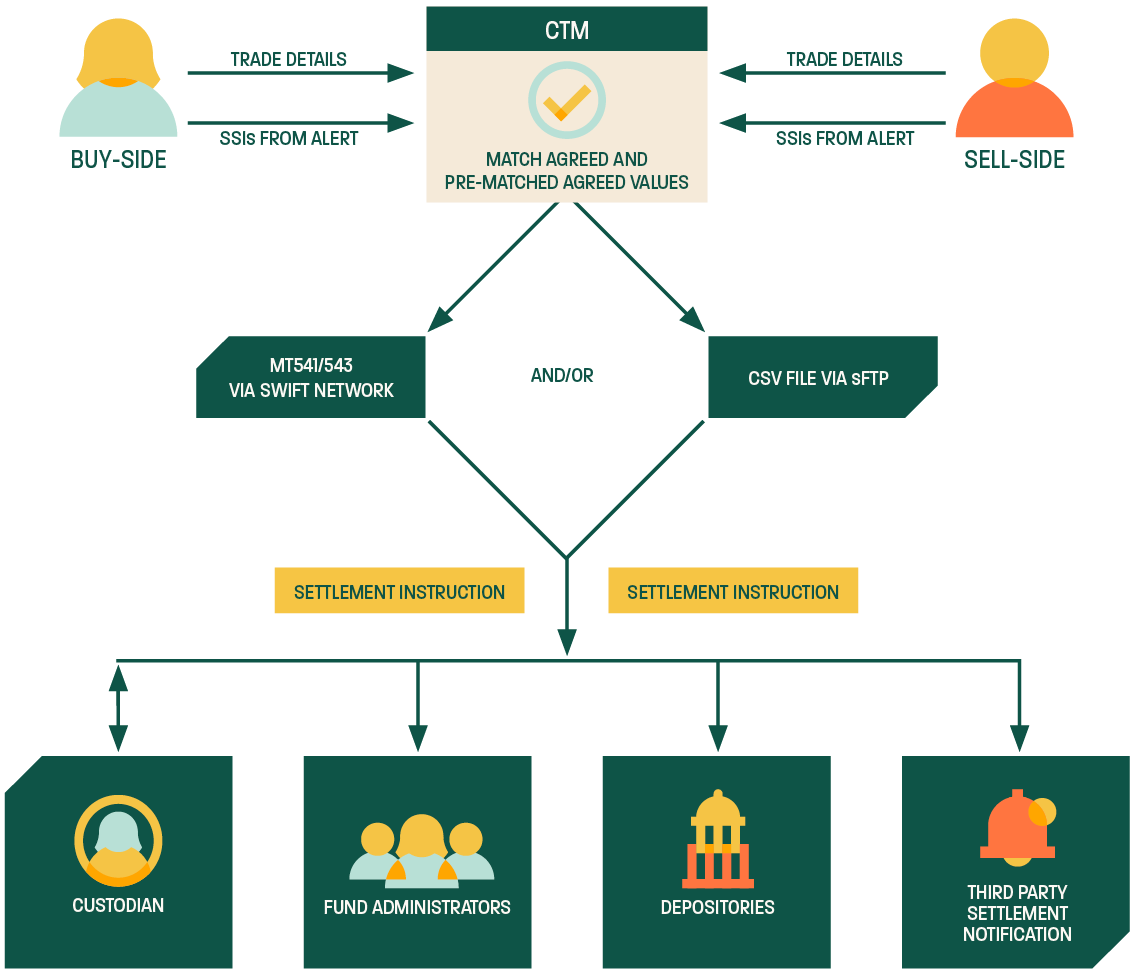
This is what DTCC (Depository Trust and Clearing Corporation) did for equities. DTCC clears roughly $2.4 quadrillion in securities annually, and its real moat is not the clearing fee; it is being the single truth for who owns what after every equity trade in America. The data is worth more than almost any fees.
Just to give an idea, what the data reveals is the pricing fiction at the heart of the SaaS industry. Right now, a company selling a data API for $10,000 a month has a straightforward business: fifty enterprise clients, predictable churn, $6M ARR, valued at eight times that. What the subscription obscures is the actual usage. Some of those fifty clients are querying the API thousands of times a day. Some are querying it twice a week. The contract does not distinguish between them, so the price does not either.
When agents start paying per call, that ambiguity collapses. Clients who are underusing the product will not pay $10,000 a month for something their agent uses for the equivalent of 80 hours a year. They will pay the actual usage price, which might be $200. CAC approaches zero because agents discover and pay without any sales process, which sounds good until you see the other side, where there is no stickiness either. Every API becomes a spot market. The business that survives the transition will be the one whose actual per-unit value justifies the per-unit cost, and a lot of current SaaS pricing will not clear that bar once usage becomes visible.
The same selection is running beyond software, in any part of the economy where agents need to interact with vendors. Andrej Karapathy framed the agent economy in three zones: A fully digital world, where agents operate today with almost no friction, the physically autonomous world, still years from meaningful agent autonomy, and the interface between them, where agents need to commission data collection, source physical goods, hire contractors, and verify real-world states. That interface is largely unbuilt, and it is where most of the economic growth will come from.
At that interface, vendors who expose APIs and accept programmatic payments get inbound from every agent-driven company in the world automatically. Vendors who require phone calls, manual quotes, and net-30 invoices become unreachable to agents entirely, because agents cannot interact with a workflow that requires human intervention. Any supplier that builds an API-accessible, x402-payable service is making itself available to a rapidly growing share of commercial activity. Any supplier that does not is becoming invisible to it, the same way businesses without a website became invisible through the 2000s, just faster.
When the Real Value Accrues
Every company building payment infrastructure for the agent economy – Circle, Coinbase through x402, Stripe, through its $1.1 billion acquisition of Bridge, or Skyfire, is positioning for the same underlying prize. The fee revenue is real, but it’s not the business. The data and trust position of operating the settlement layer creates the business.
Circle generated $2.78 billion in 2025, almost entirely from interest on the dollar reserves backing USDC. That is a good business while rates are elevated and USDC supply is growing. But it is not a durable moat. The genuinely durable position is the one that Skyfire’s CEO, Craig DeWitt, named directly: attestation.
In a world where agents pay other agents to perform tasks, the most valuable service is proving that the work happened. A research agent pays $0.50 to a data agent for a market analysis. The payment clears in milliseconds. But did the data agent actually produce valid research, or did it hallucinate a response and pocket the fee? The agent that commissioned the work has no way to verify this without a third party that can attest to the quality and authenticity of what was delivered. That attestation service, a cryptographic proof of work completion, is signed by a trusted verifier and is paid for by the buyer as a part of the transaction, either bundled into the task price or charged as small verification fees. In many cases, it’s worth more than the payment itself, because it determines whether the payment should exist at all. It effectively becomes the court of record for the machine economy. And whoever builds that layer first and gets it embedded into the standard payment flow ends up owning something close to a monopoly on the trust infrastructure of autonomous commerce.
The scale of what is at stake becomes clear when you look at where today’s internet revenue actually lives. Google’s search advertising generated $237 billion in 2024. That entire business runs on humans doing the discovering and seeing the ads. By 2025, automated traffic already accounted for 51% of total web activity, and AI-driven traffic to retail sites grew 4,700% year over year. As more of that activity shifts to agents calling APIs directly and paying per call through x402, the ad impression simply does not occur.
The stablecoin network that would settle those transactions already processed $33 trillion in volume in 2025, up 72% year over year. Most of that is still institutional and financial flows. The commercial machine-to-machine layer has barely started. When it does scale, every service that adds an x402 endpoint makes the network more valuable for every agent, which draws more agents, which draws more services. That is the same loop that made card networks impossible to displace after they hit critical mass.
The infrastructure is here. x402 is live and being integrated by major players like Cloudflare, AWS, Anthropic, and Coinbase. The next stop is determining which clearinghouse and attestation layer will dominate this new landscape.
That’s it for today. See you next week.
Until then, stay curious!
Vaidik

Token Dispatch is a daily crypto newsletter handpicked and crafted with love by human bots. If you want to reach out to 200,000+ subscriber community of the Token Dispatch, you can explore the partnership opportunities with us 🙌
📩 Fill out this form to submit your details and book a meeting with us directly.
Disclaimer: This newsletter contains analysis and opinions of the author. Content is for informational purposes only, not financial advice. Trading crypto involves substantial risk - your capital is at risk. Do your own research.
The root cause framing here is exactly right. Ads didn't take over the internet because they were the best product, they won because micropayments were economically and technically impossible with card rails. x402 doesn't just fix a payment problem, it potentially fixes the entire incentive structure of the internet by making it viable to charge fractions of a cent for content, data, or compute.
The counterargument worth considering: even if x402 works perfectly, adoption by publishers and content creators will be slow because the ad-supported model is deeply entrenched and switching costs are high. Users are also conditioned to expect free content. x402 enables a different economic model, but it doesn't guarantee anyone will switch. The real test will be whether AI agents consuming content at scale create enough pull to tip the economics, since they don't have the same aversion to paying that human users do.