


We’ve all booked the cheap flight. You just see the ticket that costs less than dinner in the city. You could bask in the glow of a good bargain for a while. Some of us take a little longer to realise that the airport is two hours from the city it’s named after.
By the time you reach the hotel, the flight could be the smallest thing you paid for.
Sending money abroad is kind of the same story. Crypto made the crossing itself very cheap, and you’d think that would be the end of the story, but no.

Banks don’t publish what they make on an international wire, so three Harvard Business School researchers checked their own transfers.
In a paper published by the Bank for International Settlements, they looked at eight international transfers sent through large banks and found that customers paid about 2% to 4.7% extra through the exchange rate. This is before the banks even added a transfer fee.
In a separate study, researchers at the Bank of Italy used services available to ordinary customers to send 200 USDC between Italy and five other countries. They measured how much it cost and how long it took from start to finish.
The big numbers make stablecoins look the hero. IMF staff checked 270 routes, and Tobias Adrian, speaking for himself, presented the results at a BIS conference in June. On routes that could be matched with World Bank data, sending $200 by stablecoin cost roughly 1% against 5.8% the traditional way, so about $2 instead of nearly $12.
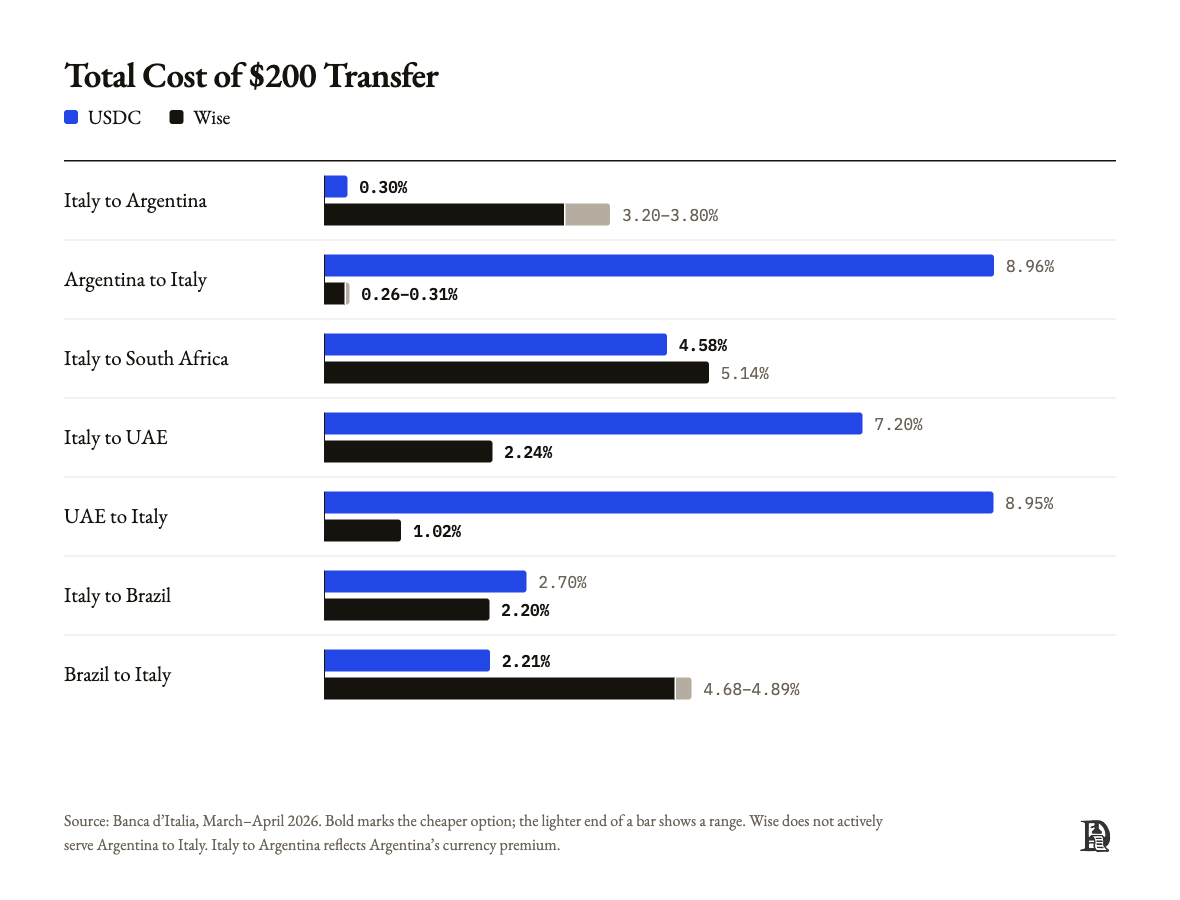
The Italians came back with a bit of bad news too. They compared their USDC transfers with Wise, the money transfer app and one of the cheaper ways to send money. Total costs ran from 0.30% to nearly 9%, which on $200 is about 60 cents on the best route and almost $18 on the worst. USDC beat Wise on three routes and lost on four, so it wasn’t reliably cheaper. The funny part is that the blockchain itself averaged only about 0.4% of the transfer, or roughly 80 cents. Most of the bill came from getting in and out of crypto.
Stablecoins look cheap next to the average money transfer. They have a harder time beating a good fintech service like Wise.
On October 29, a Hong Kong company called PhotonPay announced a $40 million Series C led by Blockchain Capital. If the blockchain leg was never the expensive part, I wanted to know what these investors think they are paying for.

StablesReward: Your AI Agent Spends, You Earn
AI agents can surf the web, read reviews, and book hotels for you. All these tasks cost money. But what if these tasks could earn you back something?
StablesReward does just that. Once you connect your agent to an MCP endpoint, it gives your agent a menu of paid tools. Every call your agent pays for earns you miles or stocks. And this is in addition to the rewards you earn anyway on your own spending across 800+ merchants.

Every purchase pays you back. The best part is that you can choose how you’d like to be rewarded. Transfer miles to airlines and hotels, or let your stocks build a portfolio from the spend you were making anyway.
Launching soon. Free to join.
On June 26, 1974, German regulators closed a bank called Herstatt, which had lost heavily betting on currencies. The timing made it famous. They shut it in the middle of the German business day, before US markets opened. Banks that had traded with Herstatt had already paid it in German marks and were waiting for dollars in return. The dollars never came, because New York was still asleep when the doors closed. Several institutions were hurt, and a major US payment system shut for 24 hours.
Payments people still call this Herstatt risk, and it taught them that a cross-border payment is two payments in two time zones. The money can finish one half of the trip and get stuck before the other. A late wire today is a far smaller problem, but money still crosses a border in stages, and each stage can stall.
A normal international payment hops. Your bank rarely has a direct link with a bank in Brazil, so the money passes through a chain of banks. Each of them keeping foreign currency parked so it can pay out. Each is able to take a fee and run its own compliance checks.
Fintechs like Wise and Remitly changed this by keeping money in local accounts. They could pay recipients without sending every transfer through a chain of banks. When you send dollars to Europe, Wise often pays from euros already there, so nothing crosses the border at that moment.
Stablecoins speed up a different step. A token can move even on a day when the banks are closed.
There can still be a wait at the other end. SWIFT says about 90% of its international payments reach the recipient’s bank within an hour. Much of the delay comes after that, while the bank checks the payment or waits to process it alongside other transfers.
The Italian test saw the same thing. Where instant systems like Brazil’s Pix existed, the whole transfer took under 20 minutes, and South Africa took one to two business days because of ordinary bank transfers on its end.
Plenty of cross-border companies have the working capital they need, sometimes in the wrong currency or country. For a business this is a big cost. A supplier who hasn’t seen the deposit won’t start the order, so the month’s stock runs late.
Atta Addo, a University of Surrey researcher, studied Lagos Computer Village, a market of more than 5,000 small businesses. He described a young trader paying a supplier in Guangzhou for 500 smartphones. Five years earlier, he’d have queued at a bank with foreign exchange forms and could have waited 7-21 days for clearance. Prices there can shift overnight, so a late payment could mean paying more, or getting your stock after everyone else has restocked. Now he sends USDT from his phone, and it reaches China within minutes.
Ads are the harshest case, because Meta pauses campaigns when it can’t collect payment. The money was there and so were the customers, and the ads stopped anyway.
What is Photonpay?
In its funding announcement, PhotonPay put annualised volume at $65 billion in August, up from more than $30 billion in January. It also reported over 200,000 business customers, 34 licences and authorisations, and 4.4 million cards issued in a year.
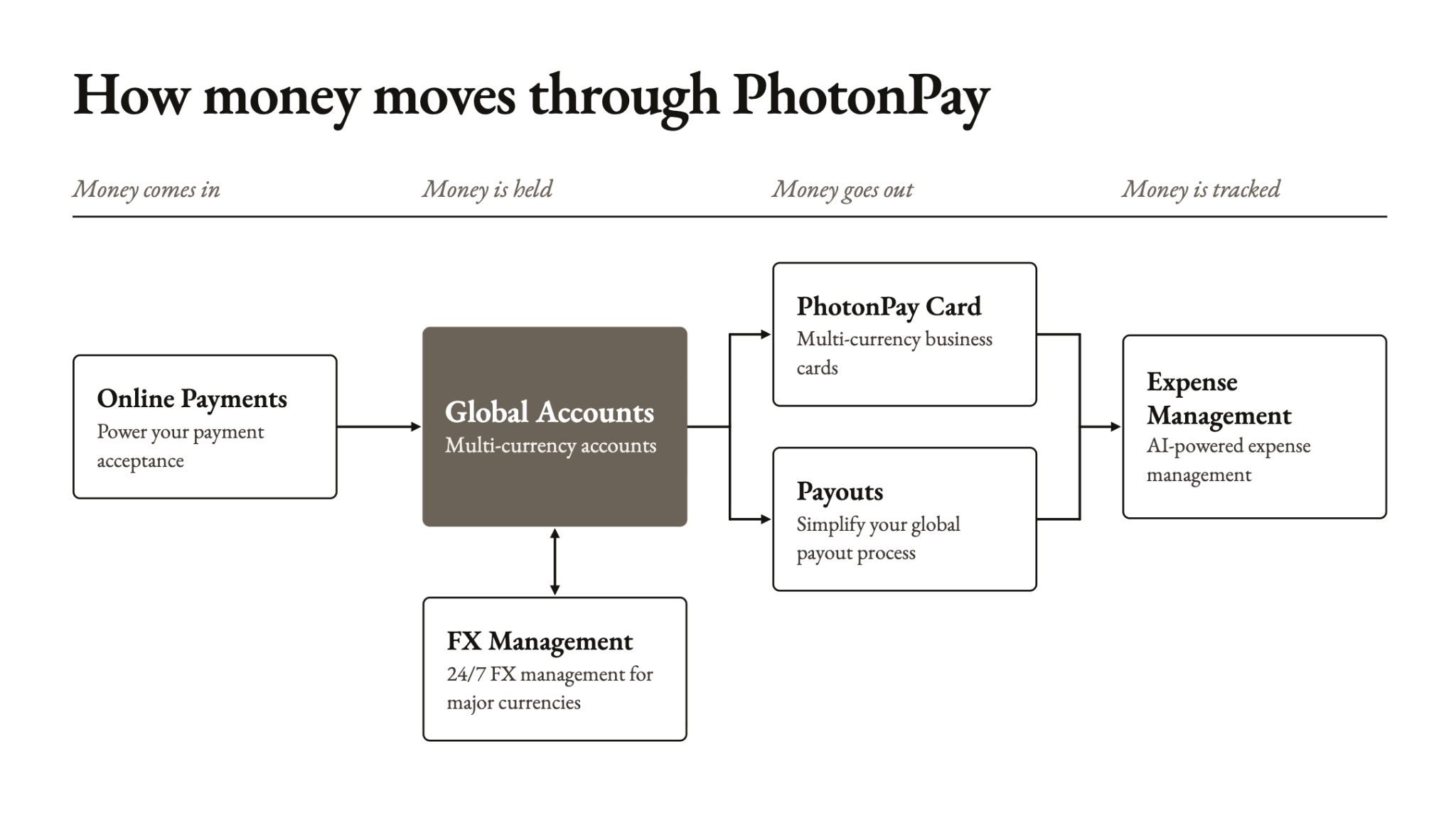
PhotonPay is trying to bring these arrangements into one service.
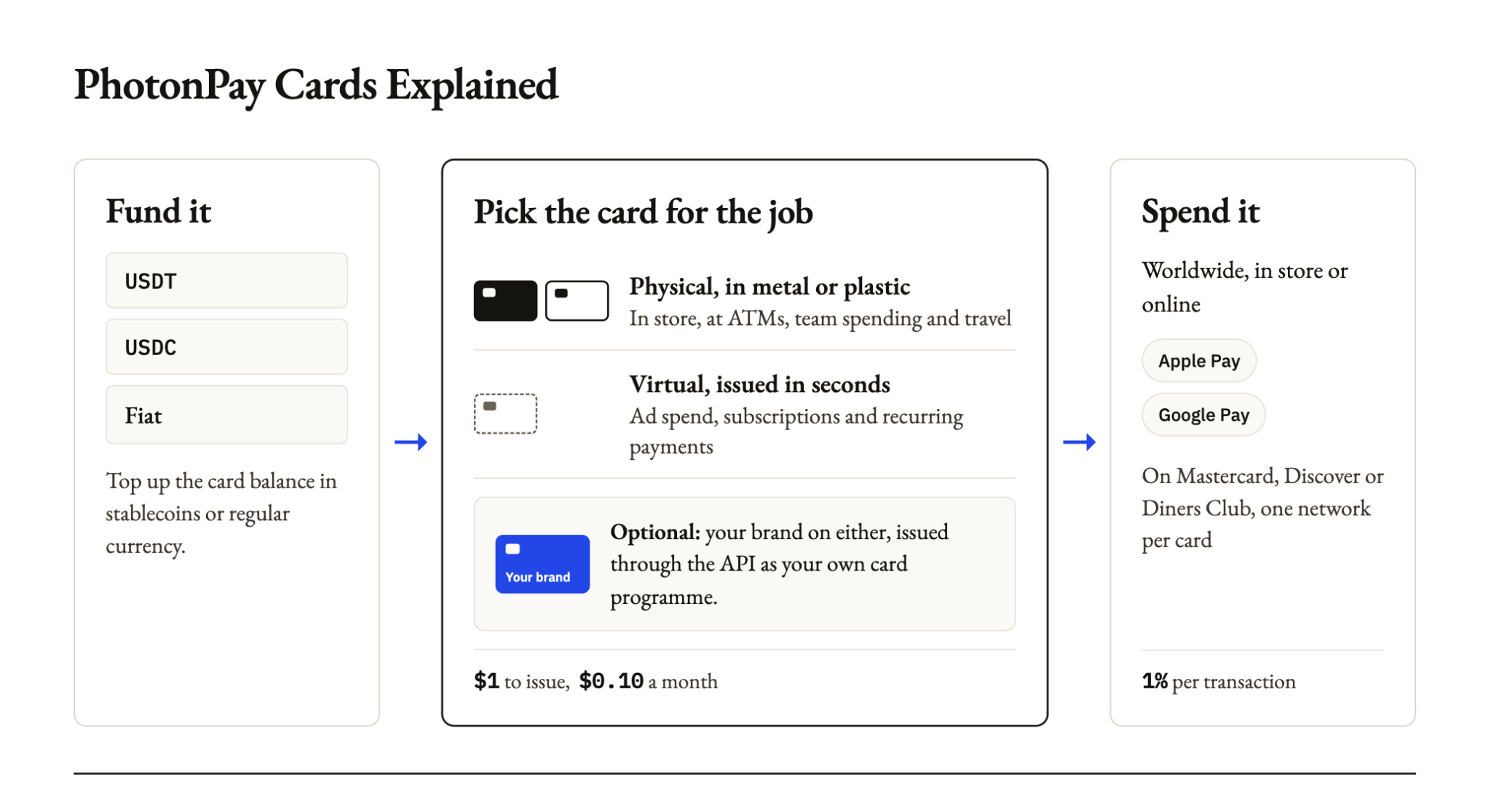
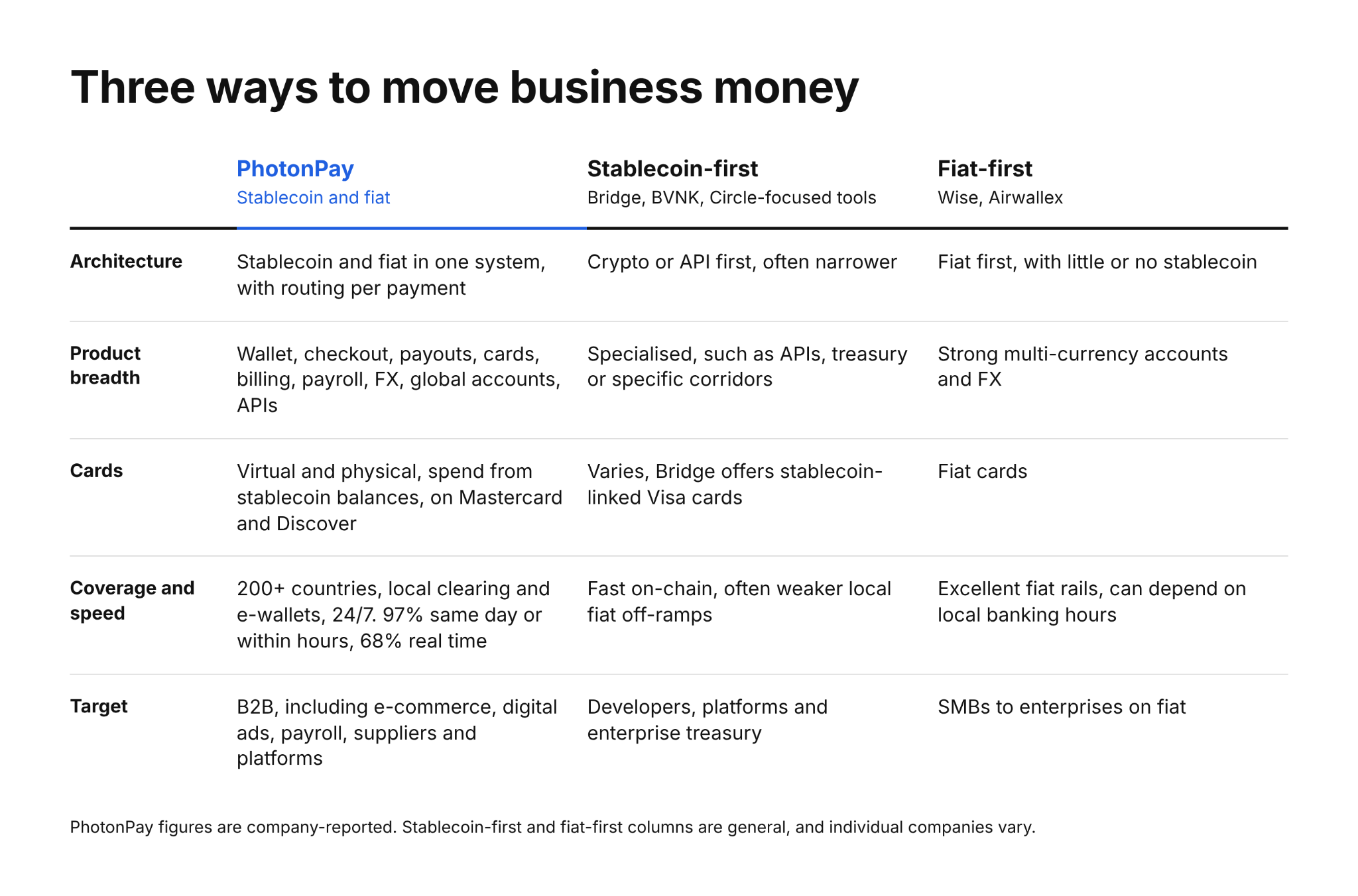
PhotonPay is a payments company that helps businesses collect, convert and spend money across countries. An online seller can receive payments in a local account, hold the money in different currencies and use it to pay a supplier or fund a card. The wallet holds USDC and USDT, on seven chains, next to fiat balances. A business can swap them into 17-plus currencies at any hour, then pay a bank account or load a card. The options depend on where the business operates.
It offers virtual cards, physical cards(plastic and metal) and custom branded cards too. The card is useful when a business holds stablecoins but needs to pay a bill in local currency. An advertiser can fund a virtual card with USDC and use it to pay for ads while the ad platform just think of it as a regular card payment. Some PhotonPay cards need to be topped up separately, while others draw from a shared balance. An agency running several campaigns can use that shared balance instead of leaving spare cash on each card.
PhotonPay holds 34 financial licences and regulatory authorisations. Those permissions cover different activities in different markets. The company says it will use the new funding to expand its wallets, issue more cards and build out the local payment networks it uses to deliver money.
Luban, an advertising platform under BlueFocus Media, shows why this matters. Its clients buy ads on platforms like Meta, Google and TikTok. According to PhotonPay’s case study, conventional cross-border funding could take up to two business days, making it difficult to adjust budgets while campaigns were running.
PhotonPay hasn’t split its $65 billion between stablecoins and traditional payments. From what I can see, the stablecoin here buys time and access more than it buys a better price.
The company earns small charges along the way. Its price list shows 0.3% to receive funds, $3 for a local transfer, $15 or $45 for a SWIFT wire and 1% on card transactions. At list price, receiving $100,000 and spending $10,000 by card costs about $400 before any currency conversion.
January’s Series B release promised yield on idle funds and credit lines as well.
PhotonPay hasn’t shared its revenue. For scale, Airwallex reported about $1.3 billion in annualised revenue on $287 billion of volume, or about 45 cents of every $100.
PhotonPay’s $40 million is small next to everything around it.
Mastercard closed its purchase of BVNK in August for up to $1.8 billion, after Stripe paid $1.1 billion for Bridge. Kraken’s parent agreed to buy Hong Kong’s Reap for up to $600 million. OpenFX raised $94 million, and Airwallex raised $320 million at an $11 billion valuation.
Wise owns its pipes. It has plugged directly into eight domestic payment systems and moved $243.5 billion across borders last fiscal year at a 0.52% take rate, down from 0.58%. Airwallex looks closest to PhotonPay, with accounts, cards and spend tools for businesses. Airwallex has about 80 licences and its CEO argued last year that stablecoins did little for payments between major currencies, and it has since co-led a seed round for blockchain startup Metal and put USDC payouts in early access.
Bridge sits a layer lower. Developers use it to move stablecoins and launch their own dollar tokens, so it sells to the company that sells to the ad agency. Corridor specialists like Zynta between Europe and Africa, or Conduit in Africa and Latin America, work where moving between dollars and local money is the hard part. That’s also where stablecoins have their clearest edge. PhotonPay’s version is an Airwallex-style bundle with stablecoin balances already in the wallet and a tilt towards ad buyers and online exporters. Reap, also in Hong Kong, sells a similar mix.
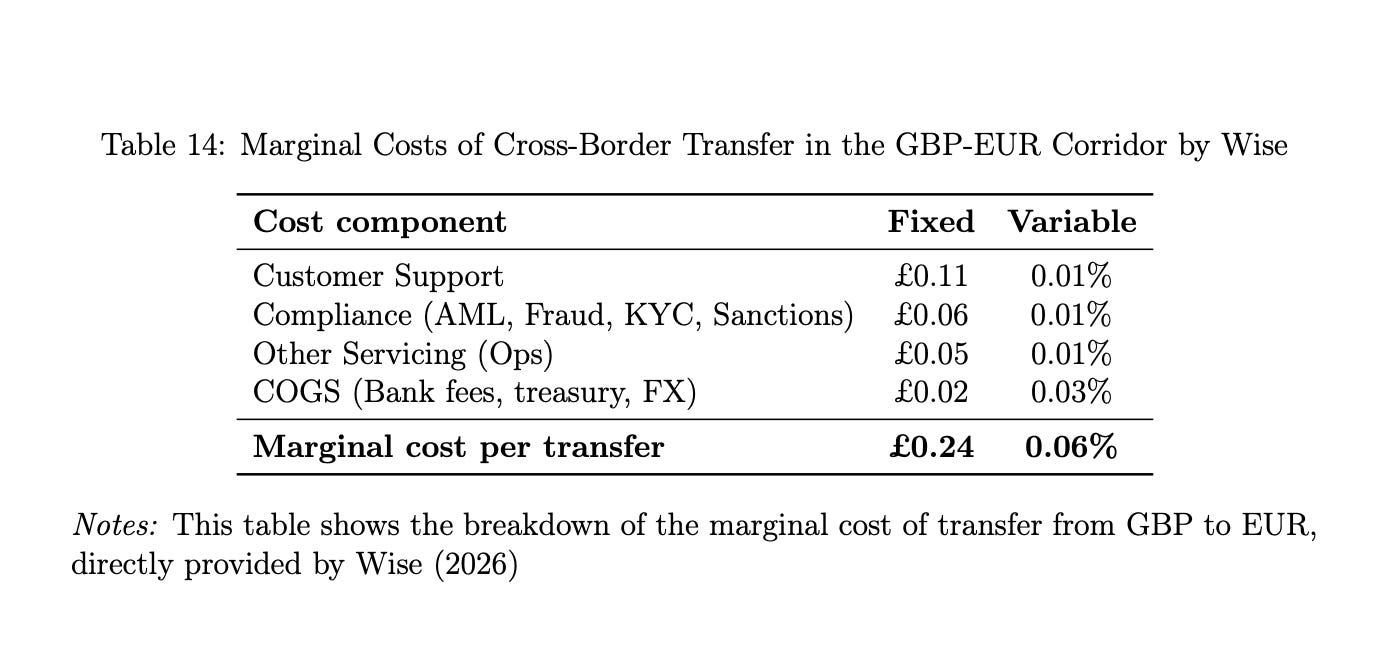
PhotonPay spent a decade building “the banking relationships, licenses and local payment infrastructure” to be that. TBlockchain Capital partner Yuanhan Li gave the investor’s answer. Businesses “want one provider,” and he numbers behind this sit in Going back to my favourite table of the whole Harvard paper. Wise gave the authors its costs for a pound-to-euro transfer. Wise spends 24p to process a transfer. Of that, 22p goes toward helping customers, running required checks and keeping the service running. The remaining 2p covers bank fees, managing cash across currencies and exchanging the money.
If you ask me who holds the strongest hand among blockchain access, licences and customer relationships, I’d say customers. Blockchain access is the easiest to buy, because Bridge and BVNK exist to sell it. Licences take years, but they only get you in the door. Wise holds 80-plus and still had its US trust bank application denied in July, and it plans to reapply. Customers are the hardest to replace, and even PhotonPay shares some of them.
Luban keeps the relationship with the advertiser, and its guide also lists PingPong, Payoneer and WorldFirst for funding its wallet.
You can see this in where revenue comes from. Almost half of Wise’s net revenue now comes from outside cross-border fees, through interest, cards and other lines. Airwallex says more than 90% of its revenue comes from customers using more than one product. Both are becoming the place a business keeps its money.
The price advantage in emerging markets is also shrinking. Stablecoin rates for rupees beat the benchmark by about 5.5% in 2021-24 and 2.9% in 2025-26. The paper puts these gaps down to capital controls, the rules that limit money moving in and out of a country, so that edge lasts only as long as the rules do.
Margins are the bigger worry. Consumer fintechs already charge about 0.4-0.6% on transfers above $10,000 to developed markets, and Wise keeps cutting its price. The fat sits in emerging markets, where the one B2B platform in the BIS sample averaged over 3%, and about 6% on reais. It’s a small sample, but I’d expect everyone above to go after that spread. If transfers turn into a commodity, the defence is selling things that aren’t transfers.
What does this mean for PhotonPay?
PhotonPay and companies like Airwallex and Reap are solving problems that banks leave behind. The economics of those problems explain why investors keep paying for them.
The first problem is fixed cost. Checking a customer and answering the phone cost about the same on a $2,000 payment as on a $2 million one, and Wise’s numbers showed those jobs are most of the bill. A bank makes far more on the big payment for the same work, so the small one is easy to drop. Between 2011 and 2022, the Bank for International Settlements counted about 34% fewer active correspondent banks in Africa and about 50% fewer in South America.
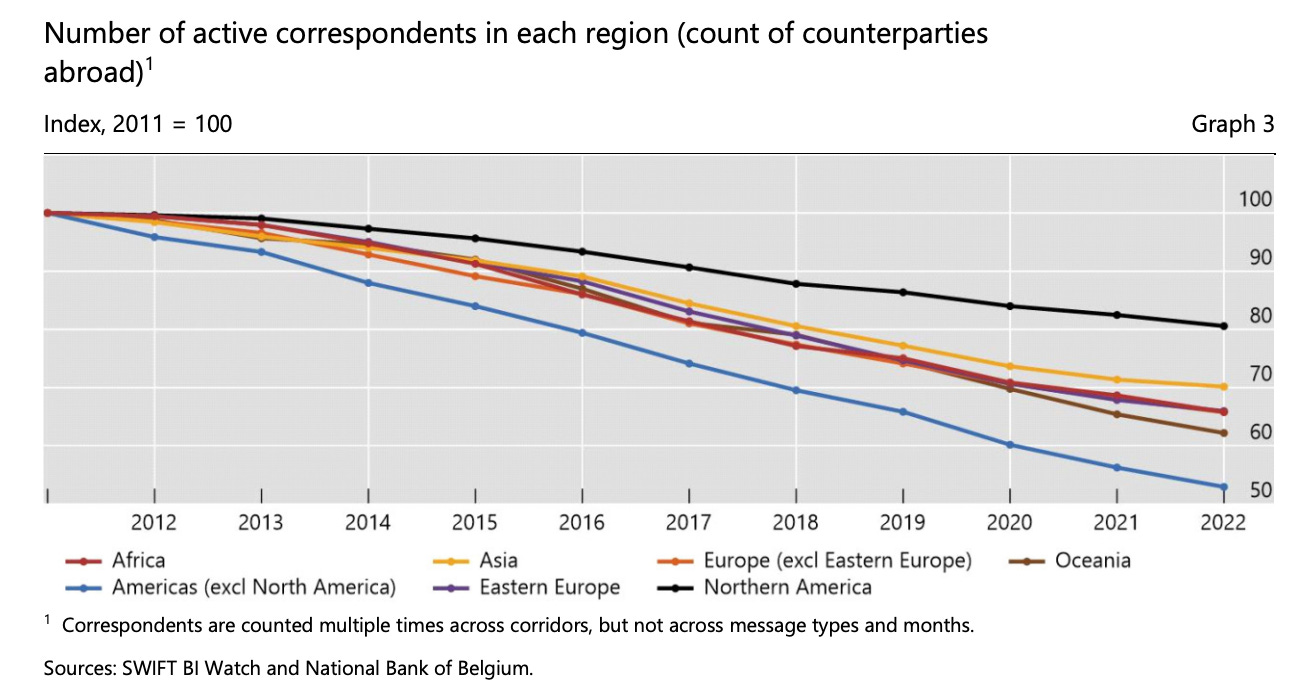
These are the banks that carry payments for other banks. A company like PhotonPay pays for its licences and bank links once and spreads the cost across 200,000 customers. You can call that economies of scale, and it’s how a small seller gets a service no bank would build for her.
The second problem is time, which we can price as opportunity cost, meaning whatever you gave up by waiting. Say a seller’s $1,000 of ads would bring in $3,000 of sales. A 1% card fee costs $10. A cheaper transfer that arrives too late for the ads to run costs the $3,000. That’s why a business will skip the cheapest route and feel fine about it.
The other scope is credit. Sellers often need money before their sales come in, to pay for stock or ads. Banks are slow to lend to them, because a small exporter abroad is hard to judge. When buyers can’t tell good from bad, good sellers get treated like bad ones. The Asian Development Bank put unmet demand for trade finance at $2.5 trillion in 2025. A company that sees a seller’s money come in and go out every week knows how that business is doing, so it can lend with more confidence. The company earns interest, which doesn’t depend on transfer fees. PhotonPay said in January that it plans to offer credit, and Reap already sells credit cards.
When one part of a business gets cheap and easy to copy, the money often moves next door.
Clayton Christensen and Michael Raynor had a long name: the law of conservation of attractive profits.
In cross-border payments, the transfer is the part getting cheaper. That opportunity may be becoming the account a business uses every day also, card they use to spend it
A payments company can earn a share of the fees when that card gets used. It also has a chance to handle the seller’s next payment because the money is already there.
So when investors put money into a payments company, I think they’re betting on a company that customers would have to reorganise their working day to replace.
Token Dispatch is a daily crypto newsletter handpicked and crafted with love by human bots. If you want to reach out to 165,000 subscriber community of the Token Dispatch, you can explore the partnership opportunities with us 🙌
📩 Fill out this form to submit your details and book a meeting with us directly.
Disclaimer: This newsletter contains analysis and opinions of the author. Content is for informational purposes only, not financial advice. Trading crypto involves substantial risk - your capital is at risk. Do your own research.