


Goldman Sachs agreed to pay up to $2.25 billion for NEOS Investments, which runs 19 options-based income ETFs holding $30 billion.
There’s a trade strategy that has existed in traditional finance for ages, as long as options have. Covered call. An investor holding an asset wants cash in hand today rather than waiting for potential upside tomorrow. So, they sell the right for someone else to buy that asset later at a fixed price. A cash premium is paid upfront. If the asset spikes above the strike price, it gets handed over at the agreed cap. If it flatlines, that upfront cash stays right with the options seller, and they are free to write the same option again next month. The entire payout (the premium paid by the buyer) hinges on expected volatility.

That’s why utility stocks pay very little here, while bitcoin pays much more.
Can we blame the “big money” again for making the best out of whatever is left? Let’s see if we can.

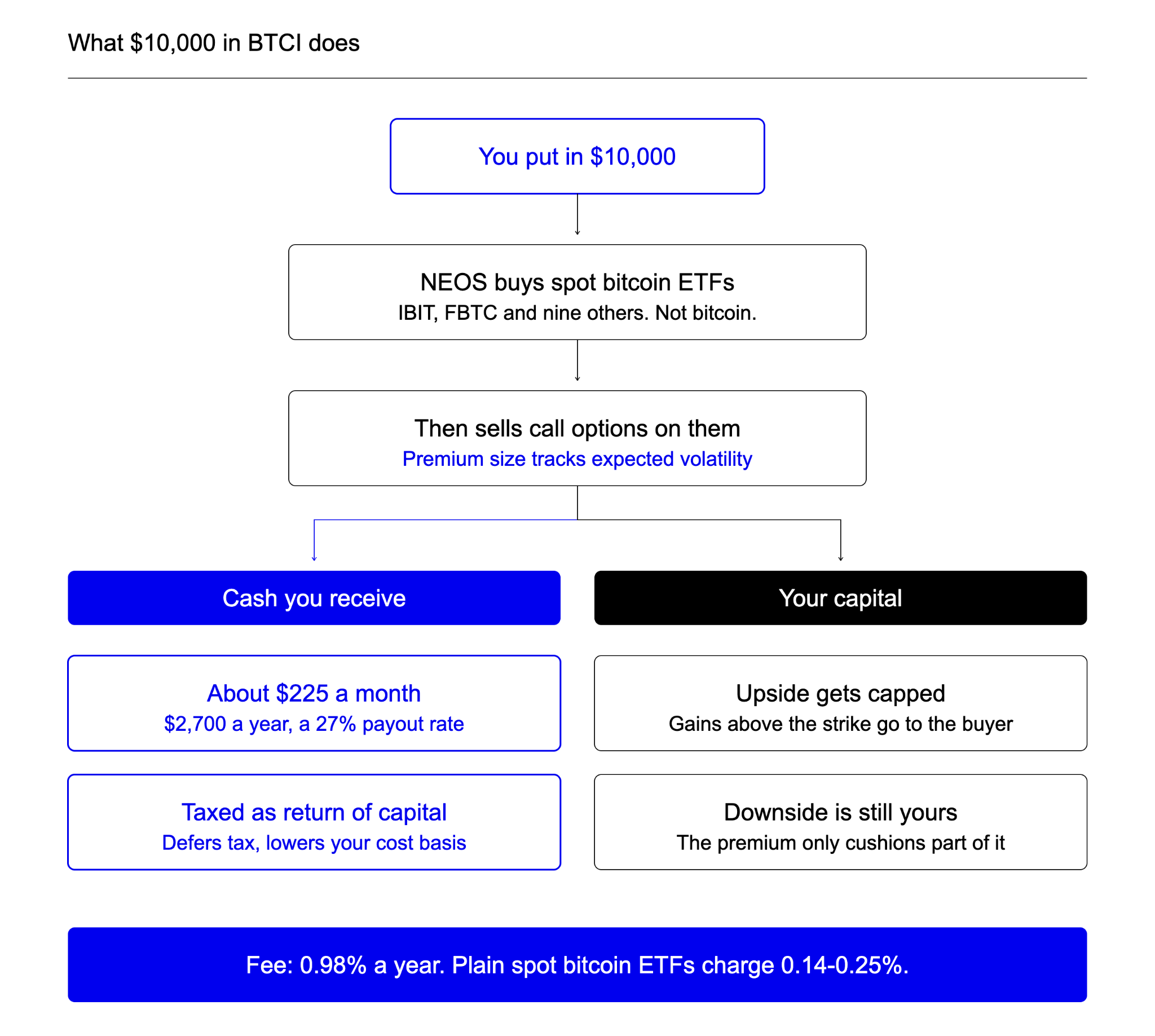
BTCI is one of the many options-based income ETFs managed by NEOS. It holds spot bitcoin funds and sells call options on those holdings. Right now, BTCI has $1.11 billion in assets and charges a 0.98% fee, which is what you pay the asset manager to run the fund.
This is also the same product Goldman wanted to build on its own, for which it filed four months earlier. Rather than building the product from scratch, they ended up buying the incumbent.
Instead of custodying bitcoin, BTCI buys shares of existing spot bitcoin ETFs like BlackRock’s IBIT or Fidelity’s FBTC. They have capital in 11 different bitcoin ETFs, and they sell call options against that exposure. Buyers pay a premium for that option because they expect bitcoin to climb. If bitcoin goes up, BTCI has to sell the shares at the agreed cap, sacrificing the extra upside. If bitcoin stays flat, they keep the shares with them. Either way, they pocket the upfront premium fee.
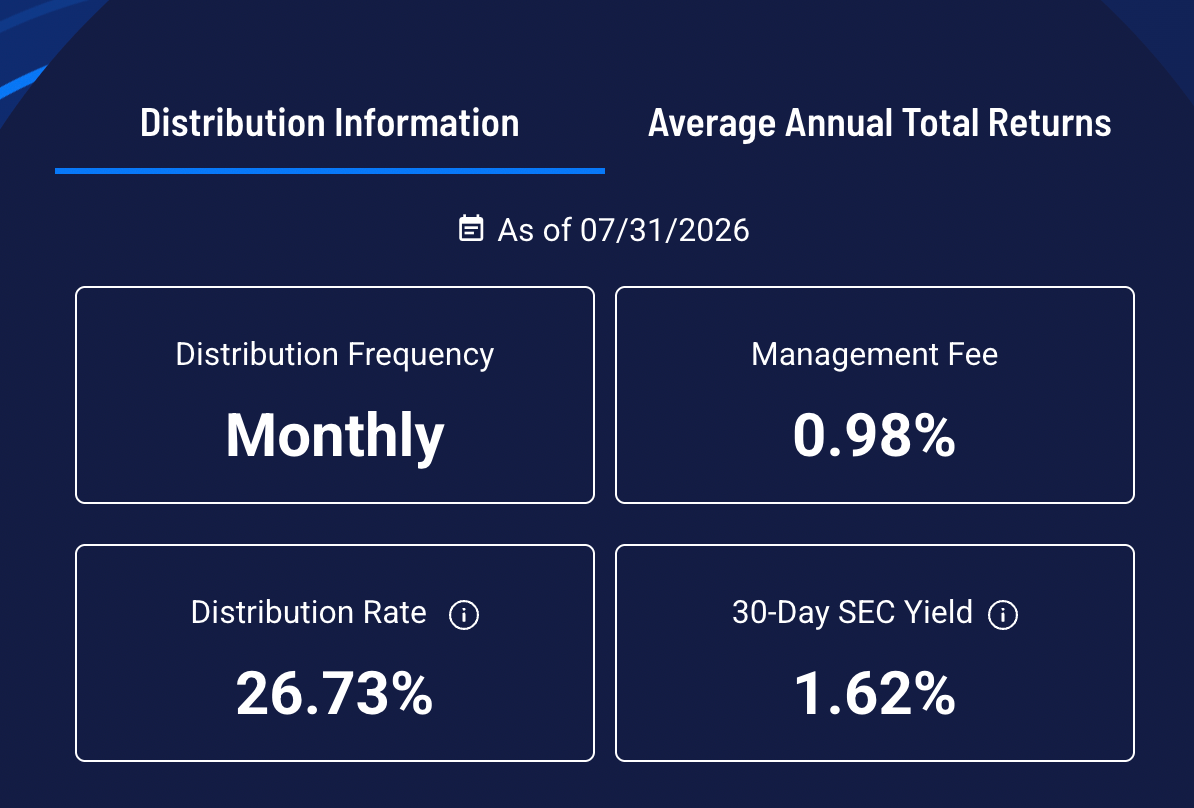
BTCI distribute the fees every month to BTCI shareholders. Because BTC is volatile enough to make those fees very high, the monthly payout currently stands at $7.75 per share, which is a 27% annual yield.
So, with BTCI, you still suffer the painful drops, and you miss out on the absolute highest peaks of a bull run. It’s not insurance on the price drop. The trade-off is that you get that 27% cash yield deposited into your account along the way.
NEOS says that the fund’s distributions have been classified as “return of capital”, and may include option premiums, dividends, capital gains and interest. What return of capital does is defer your tax and lower your cost basis. In simpler terms, yield is not pure profit from the trade, it also includes your capital sometimes.
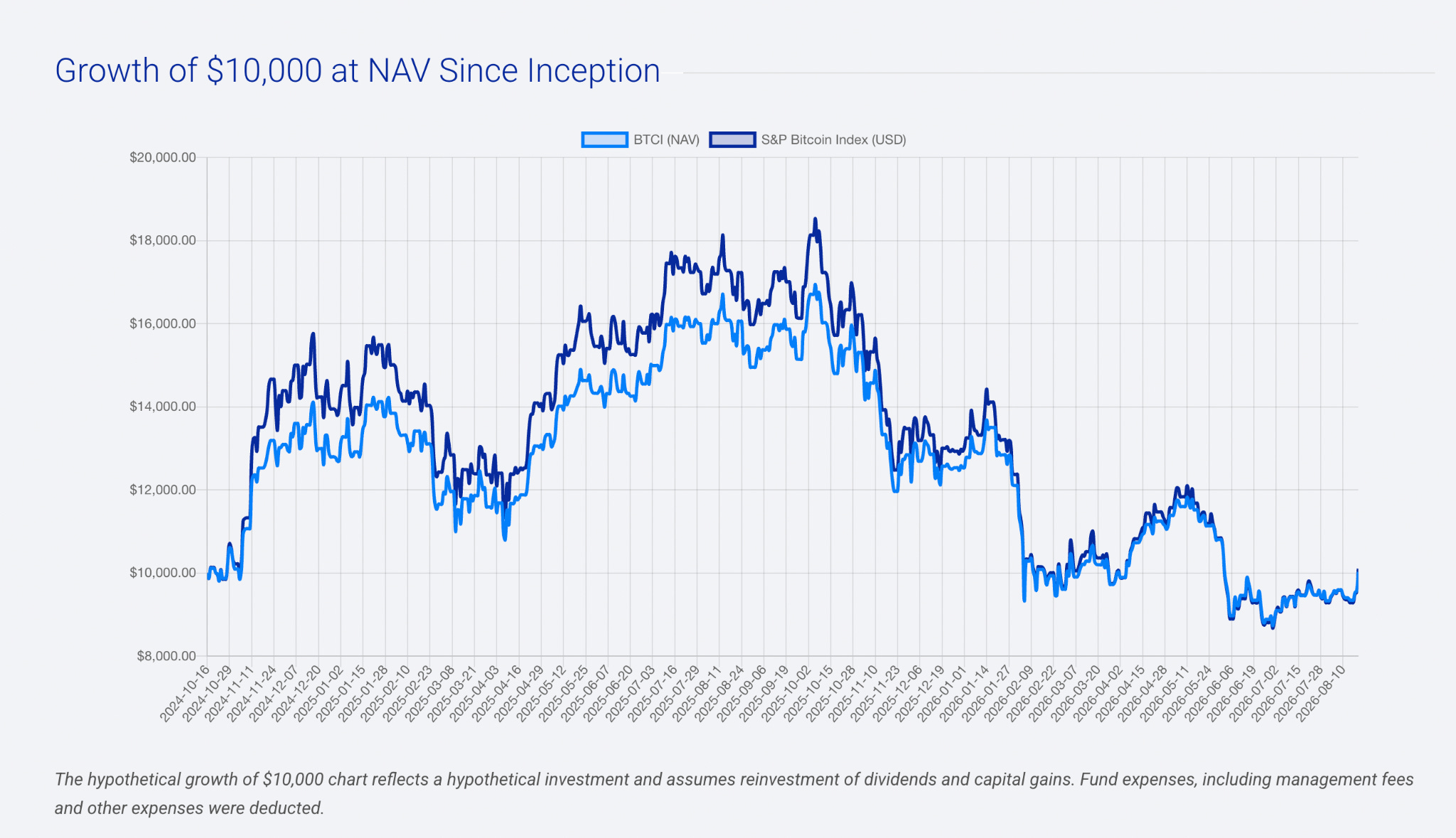
BTCI is down 25.4% this year and 40.9% over twelve months. Bitcoin fell from about $124,000 last October to around $63,000. The fund agreed to miss out on profits if a bull run ever happens, in exchange for upfront cash to survive the current bear run.
Goldman Sachs is buying NEOS for ~2.25 billion, paid with cash and company stock. Goldman already has $40 billion running the option-based ETFs on TradFi. With this new acquisition, that number becomes $80 billion, making them the 8th-largest company to do so.
In April, they had already spent $2 billion to acquire Innovator Capital Management. Innovator runs the Buffer ETF, a trade designed around a fixed one-year window. It limits both financial risk and potential reward over the set time period. The fund imposes a strict cap on profits. You will not realise any gains beyond that limit, even if the market goes higher. On the other hand, you get protection against market declines since the fund absorbs a set percentage of initial market losses, typically 9% or 30%, measured over a 12-month outcome period. So basically, you are trading the potential for a big win for the chance of preventing a big loss. The fund was valued at over $31 billion when Goldman took over. Now the investment bank has $61 billion in assets that generate revenue from selling volatility.
Derivative income ETFs hold about $180 billion and have compounded at more than 70% per year since 2021. They pulled in $7 billion in July alone, taking 2026 flows to $40 billion.
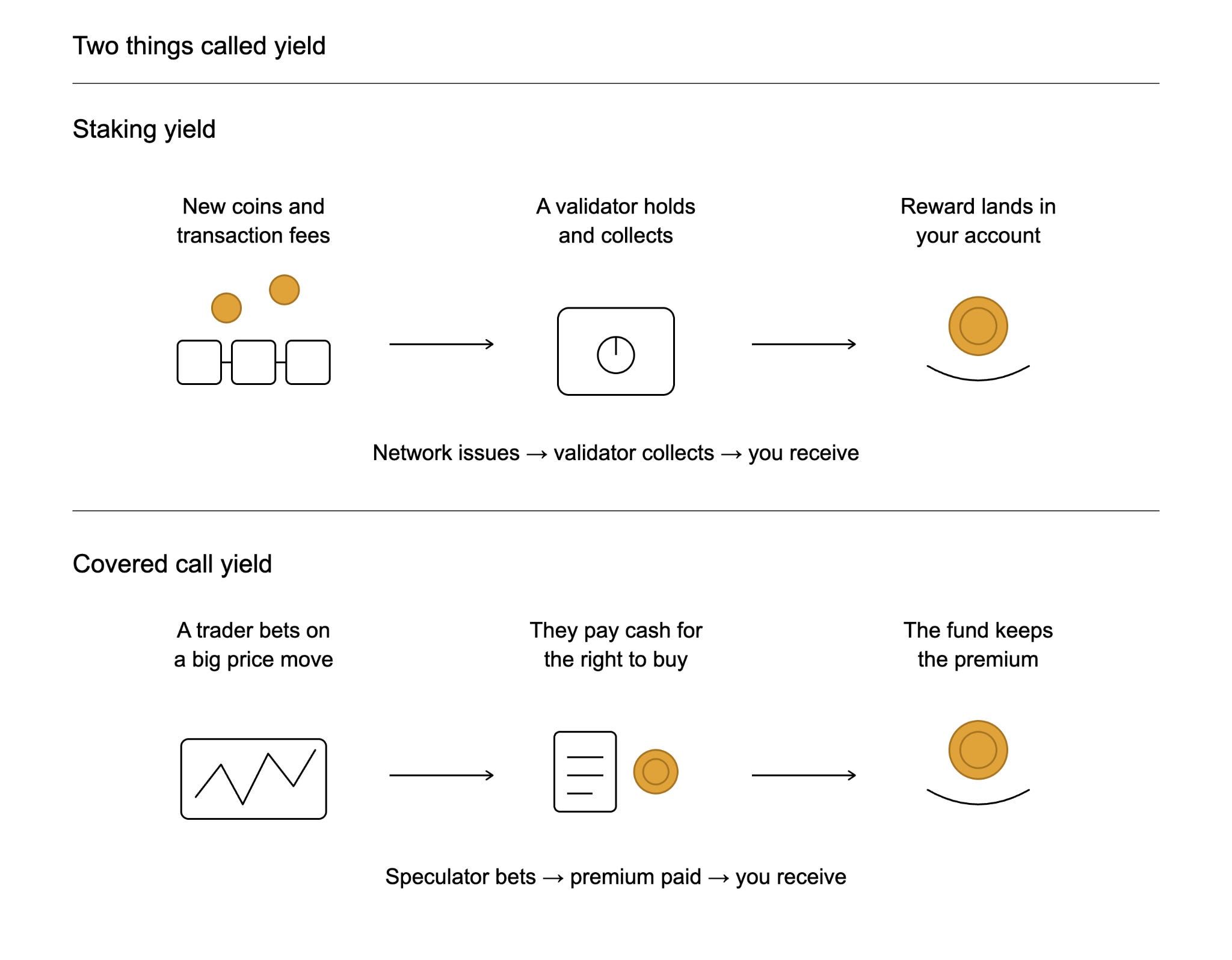
Not just Options, wall street is aggressively packaging every native crypto yield they can find, stripping the cash flow away from the underlying asset risk.
Fidelity filed an amendment on July 24, allowing its $900 million Ethereum fund (FETH) to stake 100% of its ETH. Validator nodes are run by Blockdaemon, Figment, and Galaxy Digital. Fidelity’s custodians keep control of the keys. From whatever the staking reward is, Fidelity takes 15% of the rewards across sponsors and node operators, while the other 85% goes to shareholders quarterly.
Grayscale was the first US spot crypto product to pay staking rewards, distributing $0.083178 per share in January 2026, totalling about $9.4 million. 21Shares turned on staking for its Ethereum fund in October 2025 and takes a 25% cut of gross rewards, while waiving its 0.21% management fee for a year. BlackRock built a separate vehicle, the iShares Staked Ethereum Trust, and listed it on Nasdaq.
Morgan Stanley’s Ethereum and Solana trusts opened on NYSE Arca at 0.14% on July 28. Roughly 95% flows to shareholders as monthly cash. MSSE targets 50-80% of its ether staked, with an 80% cap. MSOL intends to stake all of its Solana.
In March 2026, JPMorgan’s Kinexys platform began allowing institutions to use bitcoin and Ether as collateral for dollar loans. Due to volatility, the haircuts range from 30% to 50%. So, $100,000 in pledged crypto unlocks just $50,000 to $70,000 in cash. (US Treasuries take just a 1% to 5% haircut.)
JPMorgan has also filed bitcoin-backed structured notes tied to BlackRock’s IBIT, offering leveraged returns of up to 1.5x with a payout capped near 16% if IBIT hits certain levels by December 2026. While traditional giants lock in guaranteed fees and structural cushions, who actually bears the downside when the market turns?
Bitwise had over $15 billion in client assets in February. By April 1, it was $11 billion. By August, about $9 billion across more than 70 products. BITW, the flagship index fund, lost 31% of its net assets in seven months. Last week, the firm cut 25 people, taking headcount from about 180 to 155 in February.
If the asset falls, the percentage fee falls with it. Morgan Stanley’s 16,000 advisors oversee $9.3 trillion of client money and can push a new fund into portfolios.
Bitwise wasn’t slow either but agility doesn’t protect you from structural disadvantage. They tried to add staking to their Ether fund first, but they gave up in September 2025. Then Grayscale figured it out a month later. Meanwhile, BlackRock didn’t start until March, and Fidelity waited until July. Bitwise even bought Chorus One in February, which gave them $2.2 billion in staked assets and validator coverage across around 30 PoS networks. Then they launched a spot Avalanche product with in-house staking in April. And yet they had to lay off and lose their numbers.
In early June 2026, US spot bitcoin ETFs experienced their largest outflows since launch. Then came the strong jobs data in late May which delayed expectations for interest rate cuts. All this kept the 10-year Treasury yield high. Investors moved money into bonds. Because holding a non-yielding asset like bitcoin is not attractive when traditional assets offer stronger returns. Bitcoin relies entirely on price appreciation to make money.
Adding yield to crypto through staking or covered call options changes this dynamic.
Advisors rank reliable income as their top priority for clients. On March 30, the Department of Labour proposed a rule to create a safe harbour for fiduciaries adding alternative assets, including digital assets, to 401(k) plans. These funds have historically avoided these assets due to legal liability risks. If this rule is finalised, crypto products that generate yield will likely be added to retirement plans before even spot crypto ETFs, as 401(k) menus are focused on generating predictable income.
“We’ve said it is not an investment asset class. If you think about it, it doesn’t generate cash flows. It doesn’t generate earnings. It’s not a portfolio diversifier. It doesn’t dampen volatility. You could go through all the different reasons. So, it’s still not an investment asset class, but it is a trading speculative asset. And so, if people want to speculate, then they should. But it’s not something we recommend. Because there’s no way of knowing if the current price is a good price. There’s no way of actually assigning value to something.”
Sharmin Mossavar-Rahmani, chief investment officer of Goldman Sachs Wealth Management, said this in January 2025.
Bitcoin has not fixed itself since then. It still doesn’t generate cash flows or earnings. It fell 49% from the high. That’s not dampening exactly. Her description still holds up and will probably keep holding up for a while yet.
Goldman’s 2020 client deck said, “does not constitute a viable investment rationale, “ because of volatility. They now benefit from the volatility staying intact.
But no big deal; they’ve all done the flip, and we have talked about this a lot. Dimon called bitcoin a “pet rock”; JPMorgan now handles it as collateral. Vanguard warned it was toxic, they have ETFs on the toxins anyway. Fink called it money laundering; now runs the biggest bitcoin fund on earth. And of course, not to forget the guy who wanted to make crypto great again out of nowhere one day.
Evolution happens, clients ask for things, so we skip philosophical debate entirely. The problem is that none of those needs the price to go up. They are long on crypto market activity rather than on the asset itself. Without direction-agnostic market makers and structural lenders providing liquidity, the market collapses. Because they provide a vital service, they extract their toll, letting conviction absorb the price risk while fee structures collect the yield.
Crypto loans are heavily discounted. When you use bitcoin as collateral, JPMorgan cuts its lending value by 30% to 50%, forcing you to over-pledge your assets so the bank never takes a loss. The price of bitcoin can drop by half before the loan faces any risk of default. Automated price feeds continuously track market movements, triggering margin calls that require additional collateral as prices fall. Throughout this downturn, the bank remains fully protected and continues to collect its interest payments.
Traditional investment funds collect a steady annual fee. Morgan Stanley’s 0.14% fee is charged every year as a distribution charge on assets held.
Options-based funds make their money by selling contracts to investors. Even when the underlying crypto assets drop in value, the incoming cash from these fees and option contracts keeps flowing in uninterrupted.
Native crypto-focused firms are entirely exposed to market sentiment. When bitcoin or other tokens crash and investors panic, clients pull their money out of these crypto funds to cut their losses. Because these firms charge fees based on a percentage of total assets under management, those capital withdrawals directly shrink the fund’s size, and instantly slash the company’s revenue. Wall Street dilutes risk by managing trillions across bonds, cash, equities, and commodities.
The loophole was that Wall Street don’t even have to believe in the future of this industry to conquer it. Because if you believe, you take a side. Taking a side means taking a risk. They simply engineered a system where retail investors take all the directional risk while institutional fee schedules extract guaranteed returns.
Token Dispatch is a daily crypto newsletter handpicked and crafted with love by human bots. If you want to reach out to 170,000+ subscriber community of the Token Dispatch, you can explore the partnership opportunities with us 🙌
📩 Fill out this form to submit your details and book a meeting with us directly.
Disclaimer: This newsletter contains analysis and opinions of the author. Content is for informational purposes only, not financial advice. Trading crypto involves substantial risk - your capital is at risk. Do your own research.