


Hello,
For the longest time, stablecoins have been pitched as the fix for the slow and expensive movement of money across borders. The guaranteed way to move money cheaply and faster is by cutting out the middlemen and compressing the overall fees.
But the overall fees aren’t a single item. It’s split across a stack of several layers, where multiple players take a cut for the layer they operate in. Stablecoins are very good at gutting some of those layers. The trouble is that a cost you squeeze out of one layer rarely reaches the customer. More often, it just pools somewhere else in the stack.
So if we really want to make stablecoins the magic pill to solve money movement problems across the globe, we need to ask the right questions. And “Do stablecoins make money movement cheaper?” isn’t the right one. The better question is “What kind of stack do stablecoins make possible and where does the value accrue in this new stack?”
Jonah, an investor at Blockchain Capital, explains this in his guest essay today.
On to Jonah’s story,
Prathik
P.S. Jonah originally published this on X.


TOKEN2049: The Largest Crypto Stage
Over 25,000 attendees, 300 speakers, 500 exhibitors and 1,000 side events will come together at TOKEN2049 to rewrite the future of finance. And you are invited!
TOKEN2049 Singapore is just over three weeks away. The global crypto industry meets at Marina Bay Sands, 7-8 October, for the world’s largest crypto event.
Book by Wednesday, September 23, to lock in the current rate of $539 ($599) and get the exclusive 10% discount before the price goes up next week.

Everyone says stablecoins are better for cross-border payments. Is it true?
Stablecoins are a great cross-border solution when you’re sending to someone who wants stablecoins. You can send them 24/7 for (basically) free, and they settle instantly.
The harder problem, and the focus of this article, is the cross-currency case. What happens when dollars go in one side and a foreign currency (e.g. pesos) comes out the other side? Most crypto talking heads would argue that stablecoins uniquely cut speed and cost here. What the bulls fail to mention is that fintechs already do this fast and cheap, without stablecoins. So what are stablecoins solving?
We’ll walk through how the legacy correspondent banking system works and how a modern fintech like Wise innovated on the model, which will help clarify what stablecoins are actually solving.
Correspondent Banking
Say Alice in the US wants to send her friend Bob in Mexico some pesos. Their banks have no presence in each other’s countries, so they can’t pay directly. Instead, their banks connect through a bigger bank (i.e., a correspondent bank). Alice’s bank keeps dollars parked at such a bank, let’s call it GlobalBank, which in turn holds pesos at a Mexican bank, which we’ll call BancoMX. When Alice pays, her bank debits her and instructs GlobalBank, which draws $100 from the dollars Alice’s bank parks there, converts at its own rate, skims the spread, and tells BancoMX to credit Bob, minus its own fee. SWIFT is used to coordinate this (and charges for the messages).
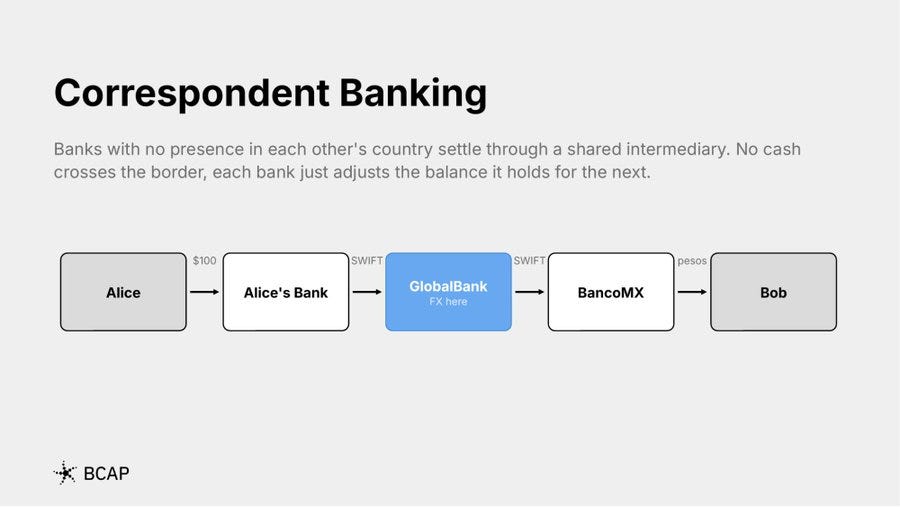
This plumbing is super expensive and slow, mainly because it is layered with rent-seekers. The average cost of using correspondent banking is ~15% (the transaction fee plus the FX spread baked into the exchange rate, measured on a typical consumer-sized remittance). Not to mention that a transfer typically takes one to five business days, since each middleman needs some time to take their requisite steps.
The Modern Fintech Fix
In 2011, two friends in London had mirrored needs: one was paid in euros but needed pounds to live there, the other was paid in pounds but owed a mortgage in euros back in Estonia. So they cut the banks out and paid each other locally, pounds into a London account, euros into an Estonian one. Neither payment ever crossed a border. Later, this system became Wise. The friends believed that you could match offsetting flows like these at scale, and it worked. Many other fintechs landed on the same idea.
Let’s run the Alice and Bob example again, but this time using a Wise-like system. Alice would pay into the fintech’s US account; the fintech would pay Bob from pesos it already holds in Mexico. Nothing crosses a border. The transfer Alice thinks she made is really the fintech paying out of one pocket and collecting into another. Because of this, the payment feels instant. The fintech takes on the balance-sheet risk of holding all that currency.
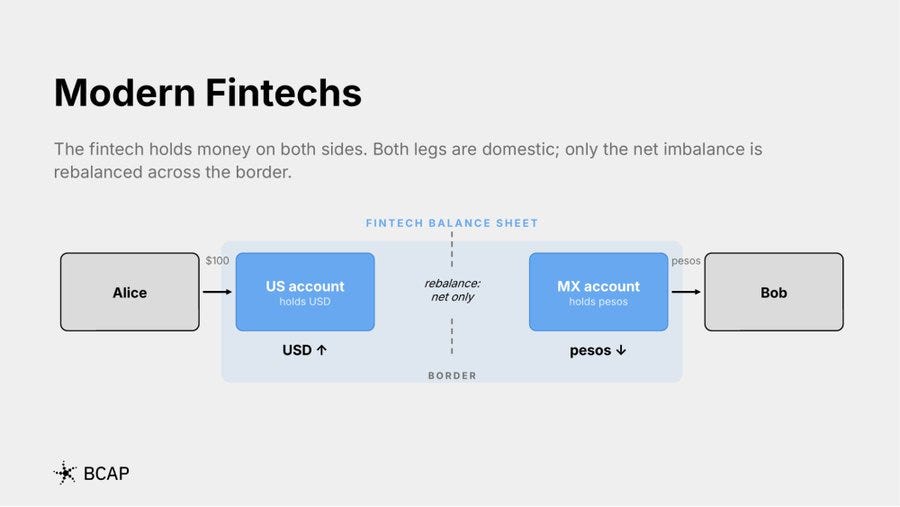
To avoid touching the legacy system, fintechs will try to “net” the transactions. For example, others might be sending pesos back the other way, too, so the fintech can cancel the two flows internally. If the currency pool gets too imbalanced, they can lean on the traditional system. Under the hood, fintechs use a patchwork of partner banks and licenses, with a local partner standing in wherever it lacks its own.
If all works properly, this beats the legacy system. Wise takes a small upfront fee, passes the real mid-market rate with no hidden spread, and still lands at a take rate of just 0.52% (it doesn’t publish an FX-only rate, so that blends in some same-currency transfers). The World Bank pegs the typical digital money-transfer service at around 3.5%, so Wise sits at the cheap end.
The Stablecoin Sandwich
So Wise and fintechs like it are already providing a fast, cheap alternative to the legacy system for cross-border transfers. What do stablecoins do differently?
Let’s run the same scenario with stablecoins. Alice on-ramps $100 into 100 USDC. The USDC is sent via blockchain to Bob in Mexico within seconds and for less than a penny. Bob then off-ramps the USDC to his local bank, receiving pesos in the process. People call this the stablecoin sandwich.
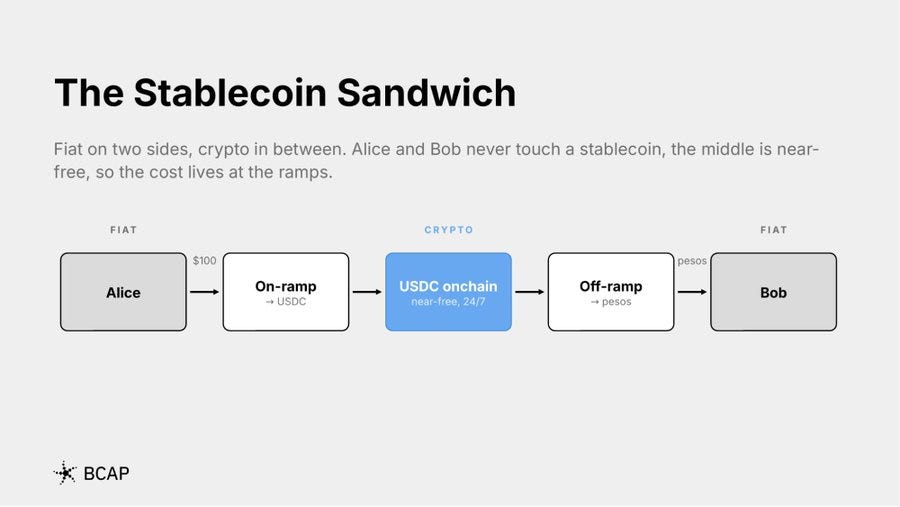
From Alice and Bob’s perspective, it’s hard to say this is a better experience than Wise. From a cost perspective, stablecoins are not obviously cheaper. Moving the USDC is nearly free and instantaneous, and even the on-ramp leg is becoming nearly free with on-ramping fees compressing toward zero. But the off-ramp leg remains a point of friction as the local FX spread from dollars to pesos can get costly. ¹
What Stablecoins Actually Unlock: Open Competition
Building a network like Wise’s is so hard that only a handful of firms have ever pulled it off. Stablecoins knock the barrier down. You no longer need a global network to run a cross-border business, just a good on-ramp on one side and a good off-ramp on the other. You could say that stablecoins unbundle the fintech and turn what were previously closed networks into an open market. Instead of one provider capturing the whole spread on a corridor, local off-ramps can compete for each conversion, driving costs down in the long-run.
The cost savings arguably show up most in the long-tail corridors. Once you no longer need a global network, regional specialists can pick a slice of the world and own it instead of trying to cover the globe. Yellow Card does exactly that across African countries (a BCAP portfolio company).
Unbundling leads to market fragmentation, which enables the competitive dynamic that pushes costs down for consumers. You might argue that this won’t last, that there are already a ton of stablecoin orchestrators stitching these pieces together, that the largest players are integrating vertically again. Perhaps the market re-consolidates and the advantage is lost.
But an open rail is… open. It is hard to monopolisze. If a middleman starts making too much profit off the spread, a local off-ramp can undercut it. Everyone can play the game.
As the take rate gets compressed out of cross-border payments, the surplus that was once captured by rent-seeking middlemen should end up with consumers and businesses, manifesting as cheaper money movement.
If you’re a founder building around cross-border payments, we’d love to hear from you.
Appendix
¹ In terms of how much the stablecoin sandwich actually costs, I struggled to find credible numbers online. Almost everyone quotes the middle of the sandwich, the near-free cost of moving the stablecoin itself, and very few quote the all-in cost once you include the ramps. That is a tell unto itself: either the people quoting these numbers are doing so promotionally while leaving out the full cost, or they have misunderstood where the cost in these transfers actually sits. Either way, it is much of the reason this article exists. Anecdotally, from what I have heard from top cross-border executives, on major corridors like US to Mexico stablecoins are at best as good as the fintech alternatives; on long-tail corridors like US to Africa, they can be more favourable. If you have up-to-date, all-in, end-to-end numbers here, please comment. Would love to see them!
Disclaimer: The content provided herein may include information regarding past and/or present portfolio companies or investments managed by Blockchain Capital or its affiliates and are provided for illustrative purposes only. The views expressed in each blog post are the personal views of each author and do not necessarily reflect the views of Blockchain Capital and its affiliates.
P.S. This piece was first published here. For full disclosure, refer to the original piece.
P.P.S.: We will be featuring good writing and writers we love from time to time. If you have recommendations, send them our way.
Token Dispatch is a daily crypto newsletter handpicked and crafted with love by human bots. If you want to reach out to 165,000 subscriber community of the Token Dispatch, you can explore the partnership opportunities with us 🙌
📩 Fill out this form to submit your details and book a meeting with us directly.
Disclaimer: This newsletter contains analysis and opinions of the author. Content is for informational purposes only, not financial advice. Trading crypto involves substantial risk - your capital is at risk. Do your own research.