


Hello,
Tokenised stocks have grown five times in the last 12 months, yet people still debate how real or synthetic they are. Critics often point out how these tokens are just price mirrors and don’t represent actual shares. Others question how dividends and custody work. But one of the biggest points of contention is around the voting rights, or the lack of them.
An actual off-chain share gives the holder not just a claim on the company’s profits but also a right to influence its direction. Each share confers a vote at the company’s annual meeting, where the shareholder can voice their opinion on who runs the board and whether the company should sell itself to another.
When you strip out that decision-making power, all that you are left with is a bet on the company’s share price. While that works for investors content with price exposure, legal ownership matters to others. And that could often make or break an investor’s interest in buying a tokenised stock.
Integrating voting rights is the last missing piece in the evolution of tokenised stocks. The crypto industry may have a solution that could widen the total addressable market by bringing the traditional investors into the fold.
Let me explain.

TOKEN2049: The Largest Crypto State
Over 25,000 attendees, 300 speakers, 500 exhibitors and 1,000 side events will come together at TOKEN2049 to rewrite the future of finance. And you are invited!
TOKEN2049 Singapore is just over three weeks away. The global crypto industry meets at Marina Bay Sands, 7-8 October, for the world’s largest crypto event.
Book by Wednesday, September 23, to lock in the current rate of $539 ($599) and get the exclusive 10% discount before the price goes up tomorrow!
Retail rarely votes. I wrote about this in July, here.
“Research by the Harvard Law School Forum found that only 12% of the average firm’s retail accounts vote. For global traders who want exposure to blue-chip stocks like Nvidia, Google, SpaceX and Tesla, giving up a vote they would never cast is not a matter of concern.”
A little over 1 in 10 retail shareholders actually vote. The instinct is therefore not to see the lack of voting rights in tokenised stocks as a concern.
But that’s just the retail shareholders. Institutions care. A pension fund or an index manager has a fiduciary duty to act like an owner, which includes voting on important business matters. For a fund that holds a stake in a company for decades, voting is crucial. Business performance and fundamentals heavily determine the decisions of fund houses around holding, buying, and selling the stock. For such institutional shareholders, shares stripped of their voting rights make little sense.
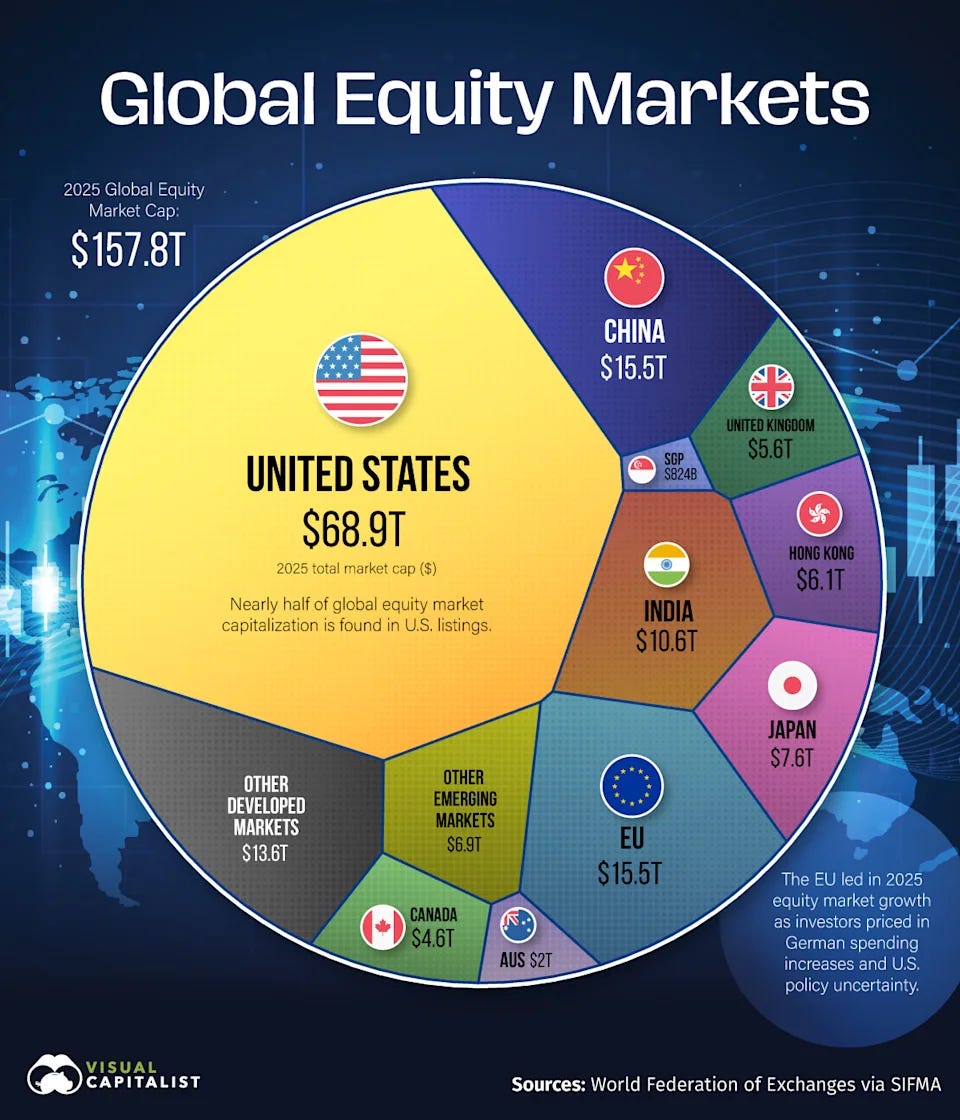
To many, a vote is also a moral reassurance that the share is a genuine asset on your books. It acts as a receipt of your membership in the company’s shareholder book. It’s what separates a budding industry from a ~$158 trillion global equity market.
How Big Is the Opportunity?
Tokenised stocks are still at a minuscule $3 billion, less than 0.002% of the global equity market. But the industry has grown by five times in just the last 12 months. So, it shows what the industry can evolve into. Citi puts tokenised securities at $5.5 trillion by 2030.
While most retail investors who are interested in buying tokenised stocks don’t care about the voting rights, that’s the one aspect institutional investors like asset managers cannot do without. The portion of the global equity market these institutions hold is ridiculously large to be ignored. An OECD report in December 2025 found that the largest 20 asset managers hold $56 trillion (38%) of assets globally.
So, whoever can build a credible gate to offer tokenised stocks integrated with voting rights can collect a toll on every stock that is tokenised through that route.
The toll gets collected at every layer. The platform that tokenises the stock and casts the actual votes becomes the default gate for everyone routing through it. The proxy-infrastructure provider earns a fee for processing each vote. The transfer agent monetises the registration that makes the vote enforceable. None of them is betting on price exposure. Yet they make money by selling the plumbing that lets institutions treat a token like a real share.
The bigger prize is the demand all this unlocks. First, a tokenised stock with an enforceable vote is the only version the $56 trillion asset-management pool can legally touch. Once you solve voting, you open the door to a customer base many times larger than the retail traders buying tokenised stocks today.
Solving the Voting Dilemma
There are two ways to integrate voting into tokenised stocks. Either route the vote through a conduit or delete the middleman holding the share.
Broadridge is building the infrastructure for the first fix. It is integrating voting for tokenised stock holding by building on top of its legacy infrastructure that enables proxy voting for more than half the world’s public companies. In 2026 alone, it processed over 600 billion shares across more than 4,000 meetings.
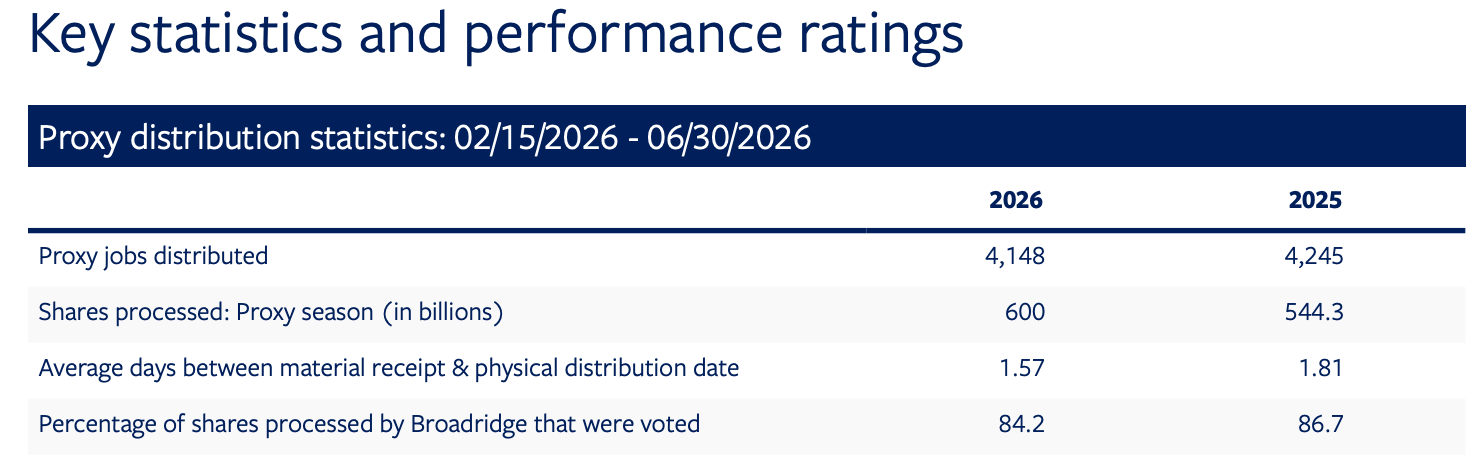
Extending that machinery to tokenholders costs Broadridge almost nothing to build. Every tokenised vote it processes is an incremental margin on the infrastructure it already owns. That’s why it moved fast, striking deal after deal rather than waiting to be disrupted.
In 2026, it partnered with Ondo in April, Galaxy in May, Alpaca in July, and Kraken’s xStocks in August.
Backpack takes the other road. Its tokens are security entitlements built to be redeemable for the actual stock. Dinari registered as a transfer agent and broker-dealer and put the entire S&P 500 on-chain for eligible US investors, with voting attached to the token itself.
How the Proxy Vote Works
Consider Ondo, the largest tokenised-stock platform with roughly 70% market share and over $700 million locked across more than 250 tokenised stocks and ETFs.
In April this year, Ondo enabled voting through Broadridge. A tokenised shareholder could connect their crypto wallet to Broadridge’s ProxyVote platform, review the company’s filings, and submit a preference. This preference is multiplied by the number of tokens they hold, aggregated with the votes of traditional shareholders, and then Ondo, the legal owner of the underlying shares, casts the actual votes. The whole path is recorded on-chain.
But there is a huge caveat here. The footnote mentions that proxy voting is only an expression of preference. These preferences are aggregated and then conveyed to the issuer of the stock who beneficially owns the underlying shares. In this case, the eventual decision might still differ from the aggregated preferences of the tokenised stockholders.
A cleaner, more direct expression of voting rights comes from the second model, where the middleman is completely removed.
Galaxy Digital tokenised its own stock so that each token is legally one Class A share carrying one vote. At its annual meeting in May, holders on the April record date voted through Broadridge’s system, connecting a wallet and cryptographically signing their ballot, recorded on a dedicated Avalanche chain and reconciled against Galaxy’s registered and beneficial holders in a single view. This system mimics a real corporate vote, cast from a wallet, accepted, and counted. About 13,404 tokenised shares were eligible to vote, out of 191.85 million Class A shares outstanding.
Both approaches aim to bridge the voting rights gap between tokenised shareholding and traditional shares. But the integrity with which they execute the whole idea is what will decide if the attempt will be successful or not.
Most of what has been shipped so far is disguised as a voting power in the name of preference. But that will betray the trust of investors who intend to hold shares with full voting and ownership rights.
A voting right in an equity share cannot be a right to suggest what should and shouldn’t be done for the company to do good business. An equity share shouldn’t just get a ticket to be a spectator to the company’s affairs. It should buy you a seat at the annual meeting where you have a proportionate voice to recommend the best course of action for the company that you are invested in, figuratively and literally.
Worth the Prize
The whole point of a tokenised stock shouldn’t be an ideological one. The investor buying a tokenised share over an off-chain dematerialised one doesn’t do so merely because it’s on the blockchain. They prefer the tokenised form because it has material and quantifiable benefits over the traditional one.
A tokenised share can be posted as collateral against a loan outside market hours. It can be lent, split, bundled into an index, or wired into a lending market as easily as a stablecoin, and all of this settles in seconds, any day of the year. The traditional share held by a custodian in their ledger needs to wait for market hours to be put to use. The tokenised share, with its rights intact, works while you hold it.
But none of these benefits can make the investor adopt the tokenised format by trading off the non-negotiable aspects of a traditional share. The tokenised share still needs to be able to offer the same claim on profits, dividends, and say in the company’s direction.
Composability of a token is a catalyst to turn inefficient financial instruments into more efficient ones. The voting right is what lets the institutions in to adopt tokenised stocks at a mass level. Composability lets them do with their tokenised stocks what they can with any other asset.
This won’t likely swing retail investors who were never enthusiastic about voting in every annual meeting. The investor in a country where a US brokerage account was never on offer could still buy the price exposure and not care about the ownership. But only once a voting right is integrated not merely as a preference but as an enforceable, auditable vote, it will bring tokenised shares at par with traditional shares in the true sense.
That’s it for today. I will be back with the next one.
Until next time, stay curious,
Prathik
Token Dispatch is a daily crypto newsletter handpicked and crafted with love by human bots. If you want to reach out to 165,000+ subscriber community of the Token Dispatch, you can explore the partnership opportunities with us 🙌
📩 Fill out this form to submit your details and book a meeting with us directly.
Disclaimer: This newsletter contains analysis and opinions of the author. Content is for informational purposes only, not financial advice. Trading crypto involves substantial risk - your capital is at risk. Do your own research.