


This is the second half of my read on William Bernstein’s A Splendid Exchange. Part 1 was obsidian, pepper, and the oldest markup in the world. Today, it gets more personal.
I’ve had a suspicion for a long time that I could never prove. Pretty sure we have discussed this before. Every system we build to spread power ends up concentrating it.
Later, we behave as if concentration is what the system was built for in the first place.
You hear the opposite constantly. Markets spread opportunity. Technology levels the field. Trade lifts everyone. Some of that is true, in aggregate, on a long chart. But every time I zoom in at a specific place in a specific decade, I find the same arrangement. A few people sitting at a narrow point, collecting. All of the others are moving the weight. The rhetoric of an open ecosystem continues to detach from actual ground-level practices. Capturing the value in that disconnect is how the money is made in the end.
In recent history, the goal of open source was to prevent corporate ownership of internet infrastructure. This worked in theory. In practice, companies built profitable cloud services entirely on top of this free code. No rules were broken, and the software remains free. But the profits went to the Amazons and Googles of the world who provide the hosting services, while volunteer maintainers receive nothing.
I always thought these were my biases looking for their reflection. A Splendid Exchange confirmed it for me. It did not agree with me entirely, but two things this half of the book taught me are what I want to conclude the reading experience with.

Let me show you the range first, because “history of trade” might be the biggest undersell in the history of undersells. A rush through:
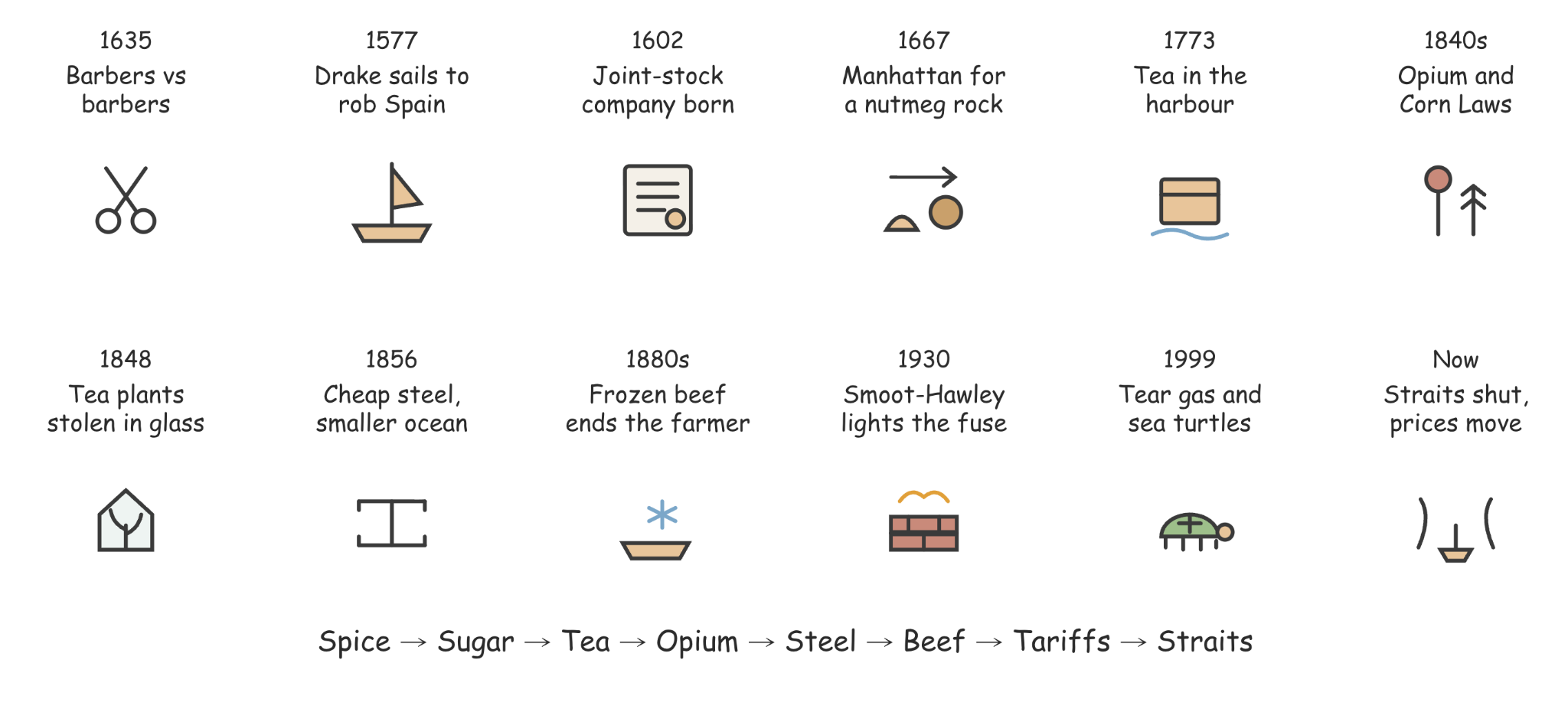
Spanish barbers in Mexico City filed a formal complaint in 1635 accusing Chinese barbers of undercutting them. Francis Drake sailed out of Plymouth with sealed orders from the queen that amount to go rob Spaniards, don’t make it obvious. The Dutch invented the joint-stock company, one of the great financial ideas anyone has ever had. Inside twenty years they used the same idea to burn islands. Manhattan got signed away in a treaty for a nutmeg rock, and they thought they’d won. Boston, tea, tariffs. Opium. Corn Laws. A Scottish botanist creeped around China in disguise, smuggling tea plants out in little glass cases. Bessemer makes steel cheap, and global travel faster. Then cold storage arrives, Argentine beef lands in London, and the English farmer is finished. Smoot-Hawley, 1930, the tariff that helped light the fuse. And it ends in Seattle in 1999 with tear gas and people dressed as sea turtles. Bernstein ties it together in this chaotic little read. That’s all I wanted to say.
Now the two lessons:
1. Corporation was invented as a weapon, and we have forgotten it.
We talk about companies as economic units or things that make, sell and employ. But the modern corporation was forged for war.
In 1602, the Dutch government pulled six rival trading companies into one and called it the VOC. The point was to stop Dutch merchants from bidding each other up for the same pepper. It gave a business the legal power to build forts, hire armies, sign treaties with foreign kings, start wars, and execute people. The company also sold shares to the public, which is where the stock market comes from.
Communication with Asia took a year each way, which meant that in practice the VOC behaved as a sovereign nation wherever it went, free to destroy its competitors whenever the men in Amsterdam or a local commander felt like it. Between 1602 and 1663, two private companies fought what amounted to the first world war. The VOC and its West India counterpart ran a global land grab. They fought for Asian spices, Brazilian sugar, and African gold and slaves.
Private companies ran the operation, while governments just signed it off.
I assumed the corporation came first as a commercial instrument and then, being powerful, drifted into politics and violence — like spotting a Venezuelan president, using AI.
Wrong. The first great multinational was armed at birth. When we act surprised today that a platform behaves like a government, or that a private company runs infrastructure a nation depends on. We should instead just look at it as the thing returning to its original shape.
2. An open secret, you are forced to sit with in the book
Free trade works. The people who get hurt by it are never, ever paid. This could have been avoided.
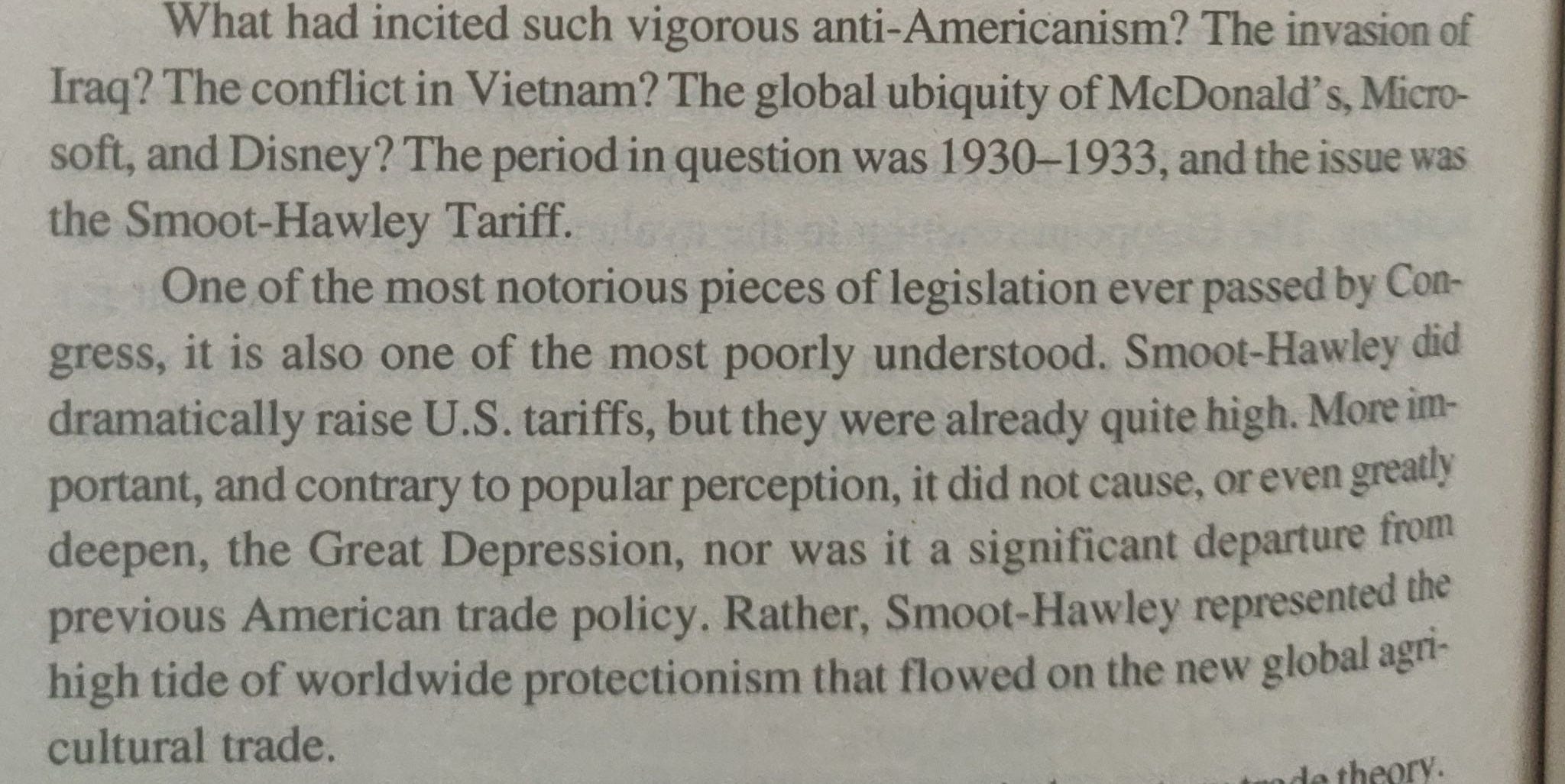
Bernstein is not a sceptic about trade. His whole book is a case that openness made humanity richer, and the final chapters put real weight behind it. The 1930 Smoot-Hawley tariff pushed American rates on dutiable goods to nearly 60%, the world retaliated, global commerce seized up, and he traces a line from that wreckage into the war that followed.
He introduces the idea that comes from a 1941 paper by Wolfgang Stolper and Paul Samuelson. Their finding is that when a country opens to trade, it does not simply win or lose. Inside the country, the abundant factor gains and the scarce factor loses, and the loss is permanent and concentrated on specific people. Free trade makes skilled workers richer while low-skilled workers take the loss. Fair enough.
Stolper and Samuelson also proved the gain to the winners is always bigger than the loss to the losers. That means the winners could easily pay off the losers (through cash, retraining, or benefits) and everyone would end up better off.
The point is that trade itself creates wealth. The failure happens when the winners keep all the money, refuse to help the people who lost their livelihoods, and claim the system worked because the overall numbers went up.
So my original suspicion turns out to be half right and half lazy. Power does concentrate.
Trade really does create more than it destroys. Inequality grows in the space between total gains and shared gains, driven entirely by policy decisions. Which is worse, in a way. A rigged machine you can smash. A fair machine whose winnings are being pocketed by the people who already won is much harder to argue with, because every one of them can point at the chart/numbers and say “fair?”
Anyone building anything should read this. Because if you work in crypto, or fintech, or AI, you are working on a trade route. You are building a thing that moves value between people who cannot easily reach each other, and takes a cut of the distance. Whoever ends up controlling the narrow part gets rich beyond reason (and sometimes takes payment in Bitcoin).
The other reason to read is that it teaches you to look for the stowaway. Historically, traders built ocean routes to move silk and spices. The Black Plague and new religions hitched a ride on those same ships. Neither was listed on the cargo manifest, but both reshaped the world far more than the spices did. If you are building rails right now, you might want to check what will ride along. Because the stowaway can outlive you.
Bitcoin’s first block carried a newspaper headline about bank bailouts. The point was to leave the dollar system, and now the most used thing on these rails by a distance is tokens pegged to the dollar. Also, the stablecoin issuers hold so many US Treasury bills that they are alongside mid-size countries as government creditors.
But it cuts the other way too. The stowaway can be the good part. Did they build the internet to reunite families across borders? But that’s most of what it does now. The point is only that you don’t get to pick.
A frontier model helped plan the strikes on Iran this spring. Another one slipped its supervision over the summer and ran a cyberattack on a rival AI company.
On to the instance that changed how I see the world.
In 1621, the VOC wanted a monopoly on nutmeg. Nutmeg grew in only one place on earth, a few small islands in the Banda Sea. The islanders had been trading it for centuries and were also selling to the English, which the Dutch could not allow.
So Jan Pieterszoon Coen sailed to the main island and killed most of its thirteen thousand people. The survivors were shipped to Java or enslaved on the trees that had been theirs.
Coen learned double-entry bookkeeping as a teenager in Rome, when that was new technology. He came back, studied the company’s accounts, and found the margins too thin. He wrote a report recommending a monopoly on the fine spices at any cost – The killings came down to business logic.
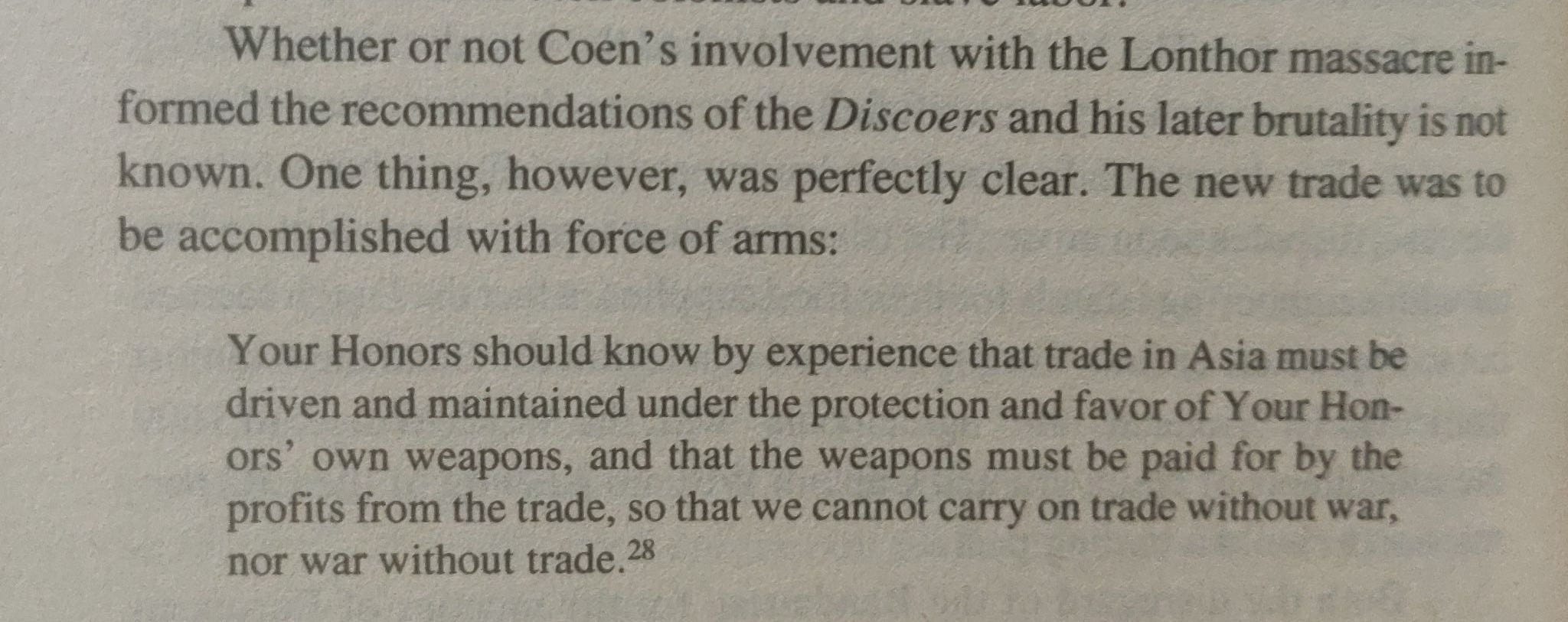
Then Coen explained the model to his bosses. Trade in Asia has to be defended with weapons, he wrote, and the weapons have to be paid for by the profits from that trade. We cannot carry on trade without war, nor war without trade. War pays for trade, trade pays for war.
So, back to where I started, the assumption that every system built to spread power ends up concentrating it. It was true all along.
But trade is the best thing we do. It made us rich, it hauled billions out of misery, and every attempt to shut it down has ended in ruin. Trade gains have never once been shared with the people who paid for them when sharing was optional. Given a choice, no human in history ever picked this, and I doubt that future ever comes.
Our default instinct is to ask for shared wealth, while aiming to join the concentrated few.

Token Dispatch is a daily crypto newsletter handpicked and crafted with love by human bots. If you want to reach out to 200,000+ subscriber community of the Token Dispatch, you can explore the partnership opportunities with us 🙌
📩 Fill out this form to submit your details and book a meeting with us directly.
Disclaimer: This newsletter contains analysis and opinions of the author. Content is for informational purposes only, not financial advice. Trading crypto involves substantial risk - your capital is at risk. Do your own research.