


Hello,
There’s a problem with how dividends accrue for tokenised stocks. When you tokenise a share of Pfizer on Robinhood Chain, its dividend doesn’t accrue as cash. Instead, the dividend is reinvested into more of the stock. A multiplier attached to the token ticks up, so each token now represents slightly more of a share. Your token balance doesn’t change; the dividend shows up as each token being worth more. There’s no separate dividend you can point to and trade.
This becomes a problem if a shareholder wants to trade the dividend aspect of a share separately from the principal. For decades, traditional finance has allowed treasury bonds to be separated into principal and coupon instrument where each piece can trade on its own. So why will investors settle for tokenised shares that don’t allow them to do the same?
PARE protocol on Robinhood Chain lets you cut the dividend aspect out of the share and trade it separately. It lets you deposit one tokenised Pfizer share and get back two tokens: one that is the stock with the dividend stripped out, and the other is the dividend stream.
Earlier this week, I wrote about tokenised stocks getting their vote right back. Integrating the right into a share lets the $56 trillion asset-management pool treat a token like a real share. That makes the share feel whole again.
In today’s piece, I will discuss how the tokenised share also needs to be divisible and tradeable separately for it to be treated at par with traditional shares.
On to the story…


Sharpen Your Investment Research with Amsflow
Wall Street and crypto used to run on separate screens, logins, and research stacks. That gap is closing everywhere else. Why not yours too?
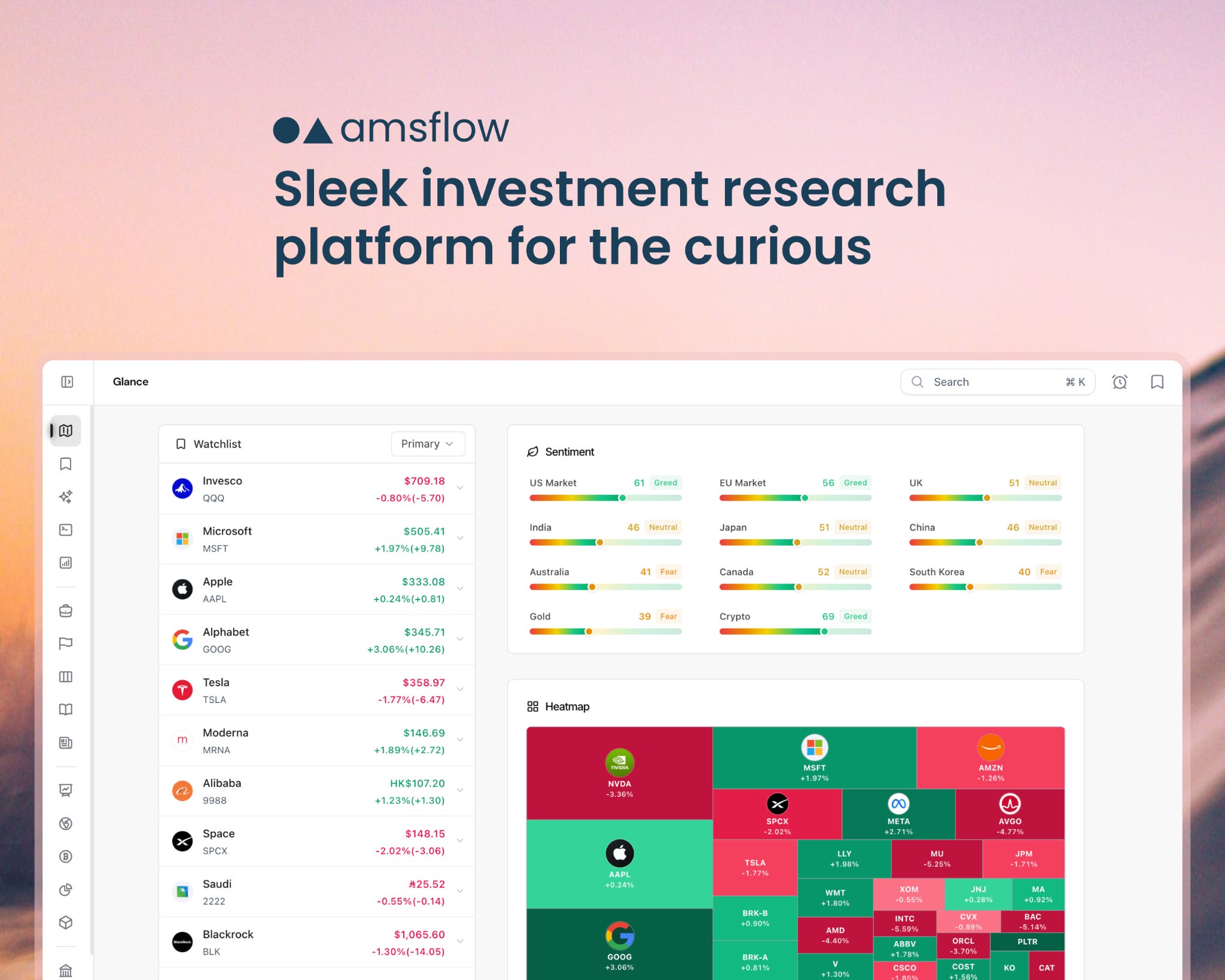
Enter Amsflow - an all-in-one intelligence platform for investment research, covering every major global equity market, commodities, and deep crypto analysis, all in one place. Sentiment reading from Wall Street to the EU, India, Japan and China - down to gold and crypto.
Amsflow lets you run a Screener across 70,000+ securities with 550+ metrics. Track your Portfolio with real factor attribution, not just a P&L line. Watch entire industries rotate over a decade of history with Rotation, scrubbing through time instead of squinting at a static chart. Built sleek and clear, for anyone curious enough to look past the ticker.
You’ve been among Token Dispatch’s most loyal readers, so here’s an offer just for you - 20% off your Amsflow subscription, every month, for six months.
Use code ‘TOKENDISPATCH20’ at checkout for 20% off.
Back to the Future
Separating an asset from its income stream is not a new idea. We have done it for decades.
Since February 1985, the US has let dealers separate Treasury bonds into principal and coupon instruments and trade them in parts. The principal-only strip trades at a discount and redeems at par. The Separate Trading of Registered Interest and Principal of Securities (STRIPS) programme still runs to this day and is a multi-trillion-dollar market.
There was an equity version of this, too. From 1983, the Americus Trusts took blue-chip shares like AT&T, Exxon, Coca-Cola, and issued two claims against each. One was PRIME, which carried the dividend aspect, and the other was SCORE, which carried the price appreciation. Both could be recombined into a single share. It enjoyed great demand until it died of an adverse tax ruling in 1992.
PARE protocol does something similar. It splits a tokenised share into claims of ERC-20 tokens that are tradeable separately. One is the principal token, or PT, that will trade at a discount on the spot price of the underlying stock. The other is the yield token, or YT, that will trade at a price that captures every dividend reinvested until fixed maturity. The collective price of PT and YT will always equal 1 and can be merged anytime for free.
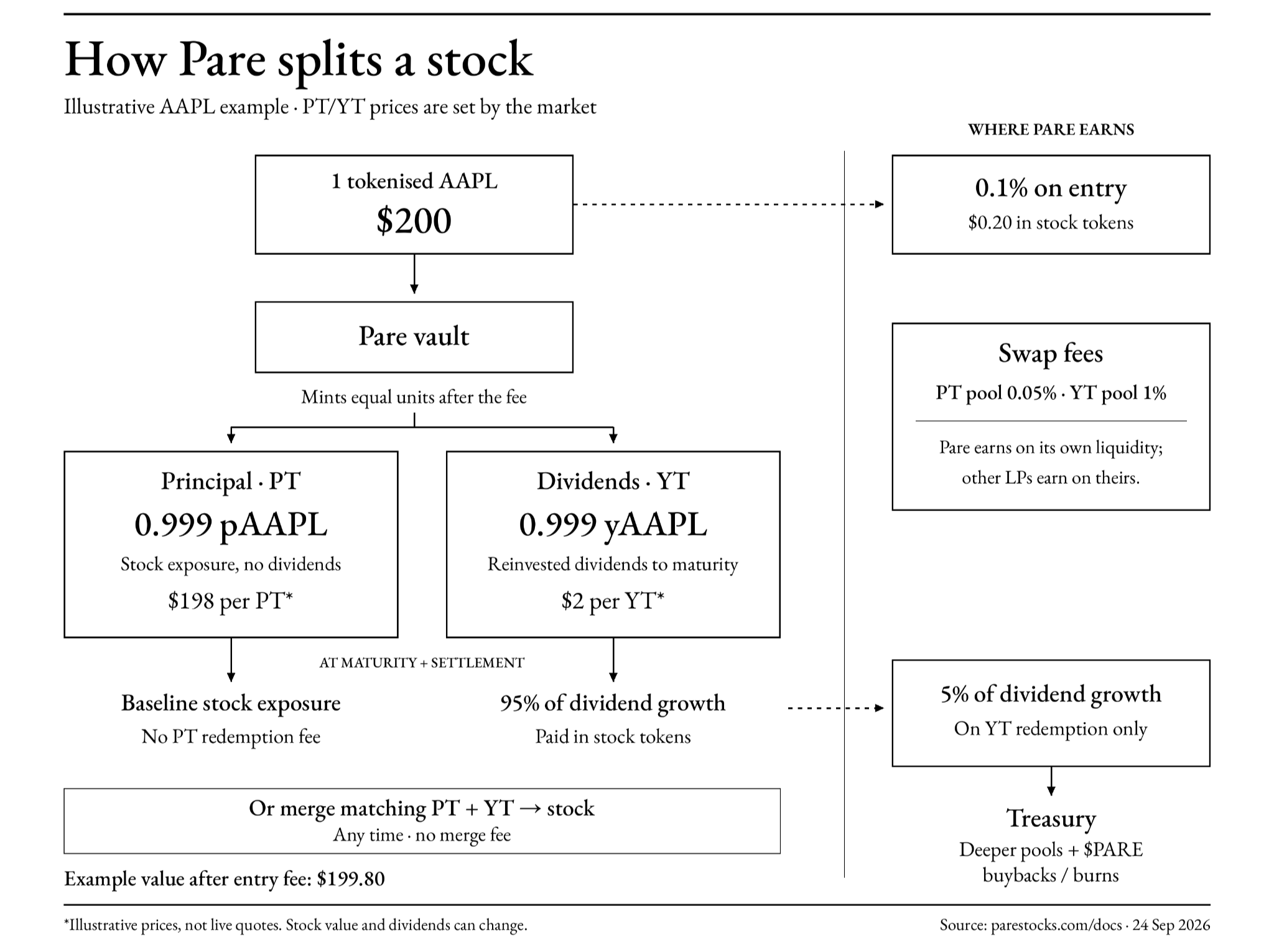
What PARE enables is a friction-free version of all that the Americus Trusts already did decades ago. The on-chain version of splitting a tokenised share into its principal and dividend aspects removes the need to have a trust company and makes splitting and trading possible outside traditional market hours.
Who Are the Buyers?
Every equity share has always been a mix of two products - the principal part of the stock that reflected the price movement and the dividend part that reflected the yield from the company. A bundled share discouraged the buyers who wanted to trade the two parts separately.
Consider a buyer who wanted just price exposure to Apple Inc’s stock. The company’s annual dividend yields under half a percent, but swings the price of the share. Once the dividend part is stripped, a buyer can trade the principal token at a discount on spot and redeem it for a full share at maturity. This trade is perfect for someone who wants the equity at a discount and wants a known payoff date. This system mimics a zero-coupon bond in the disguise of a stock.
On the other hand, some traders want to trade an income stream without assuming the risk that comes with price fluctuations of a stock. A YT gives them an exposure to every dividend the share will pay until maturity, for a fraction of the share price and with no liquidation risk. The splitting of traditional shares that Americus Trusts enabled four decades ago was available only through an institutional desk. PARE makes this accessible for any trader through a token you can buy 24/7 on the blockchain.
Neither the income-averse buyer nor the income-hungry buyer was served well by holding the whole share. With the split, each buyer can now trade an instrument that is tailored to their needs.
There is also a third market that this split enables. The principal token split from the dividend is a better collateral than the combined share. A lender who accepts a raw stock token has to price around a dividend that could be announced any quarter. These dividend payouts could swing the balance upward. The plain vanilla principal token is immune to such surprise moves. The PT behaves closer to the nature of the collateral that a lender expects it to.
The Opportunity
Even on-chain, PARE isn’t doing something totally new. It’s doing for traditional stocks and dividends what Pendle started doing for crypto tokens and yields more than five years ago. Pendle allowed traders to split a yield-bearing cryptocurrency into PT and YT, and let each trade on its own.
It launched in 2021 into a market that had never seen something like this on-chain before. The total value locked (TVL) in Pendle went up from $6.7 billion in June 2024 to $13 billion in September 2025.
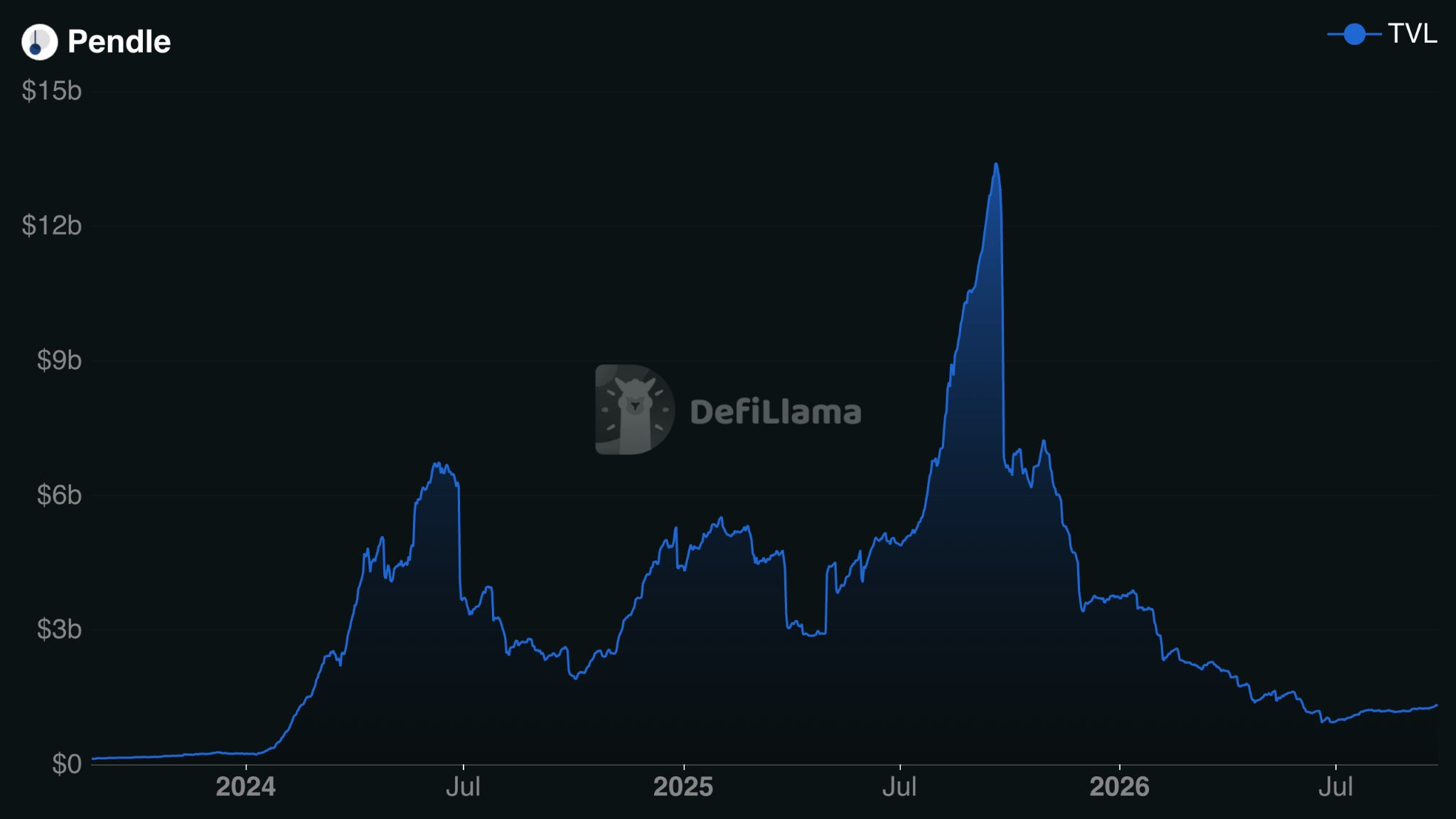
PARE has a multi-billion-dollar precedent in Pendle to show that the model works. Except that PARE’s momentum is being built on tokenised stocks, which is a much larger market than what Pendle ever had.
Tokenised equities grew five times from $600 million last year to over $3 billion this year. Robinhood Chain TVL shot up to $1.4 billion in a quarter from its launch. Pendle had to wait for two years for liquid staking to help it find significant demand. PARE is launching a product in an ecosystem that is already riding a peaking momentum and has a lot of room for growth.
Pendle’s ceiling is crypto yield and is bounded by how much yield-bearing crypto exists. Meanwhile, PARE’s ceiling is equity income in a $158-trillion traditional equity market. It unlocks a market for dividend futures and dividend swaps, while the strip trade on equities is built on top of the entire dividend-paying stock market. Citi puts tokenised securities at $5.5 trillion by 2030.
PARE doesn’t need to worry about finding demand for its product. The problem is in the competition it faces. Pendle already has live markets on Robinhood Chain, where it has started a fixed-income and yield-trading layer. The company has spent five years proving the split model and currently holds $1.3 billion.
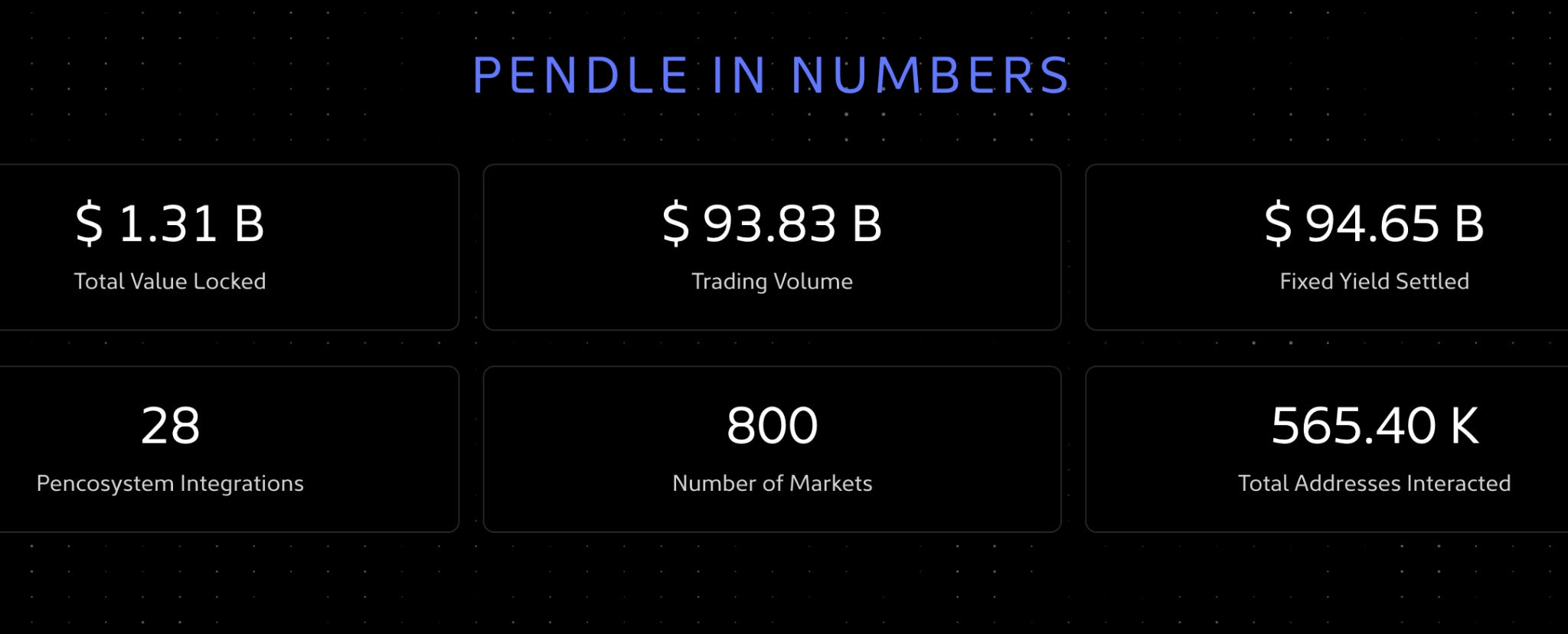
The same wave that PARE is betting on can also benefit Pendle. Moreover, the latter already has a captive audience that trusts its product.
So what does PARE have that Pendle can’t copy?
Pendle was built for a world where yield is predictable and where the underlying asset is a stablecoin. Equities break this assumption. Dividends are lumpy and quarterly, and don’t accrue smoothly. The underlying carries price risk that can’t be done away with. PARE quotes its pool of split tokens against the underlying stock itself - pAAPL/AAPL and yAAPL/AAPL.
On Robinhood Chain, a dividend and a stock split look the same. Both move the token’s multiplier. So if you’re a lender looking at someone’s token balance, you can’t tell whether the number went up because the company paid a dividend or because it did a 2-for-1 split. This prevents anyone from safely lending against a stock token. You can’t easily trust the price. PARE fixes this with an on-chain bookkeeper that tracks every multiplier change, decides whether it’s a dividend or a split, and gives a cleaner snapshot of the market. That accounting mechanism is PARE’s biggest advantage over Pendle.
Investors don’t buy stocks purely to hold them in their portfolios. They need to be composable across the financial universe. A tokenised stockholder should be able to use it as collateral to borrow funds against. PARE’s accounting makes the same tokenised shares more reliable as collateral than Pendle’s.
The major problem for PARE is to build the distribution from scratch.
Across all its markets, PARE currently has split around $48,000 of stock. The token meant to capture all of this is valued at roughly $6 million. Pendle has an established market, but lacks a clean system that can split and track the value of dividends and principal. PARE has a mechanism, an oracle, four markets, but a shallow lending pool.
For PARE to build a sustainable business, it needs to make the oracle robust and gradually build up the volume. The volume growth will follow as long as it can enable capital flow through borrowings against principal tokens. On the other hand, if it can create a reliable pricing market for dividends, it can capture consistent value on every redemption it services for dividend tokens.
The derivatives around dividends have always craved for a market to trade. We saw that in the traditional sense four decades ago. As long as on-chain protocols can replicate that with fewer frictions and more efficient capital movement, there will be enough value for players to capture.
That’s it for today. I will be back with the next one.
Until next time, stay curious,
Prathik
Token Dispatch is a daily crypto newsletter handpicked and crafted with love by human bots. If you want to reach out to 165,000+ subscriber community of the Token Dispatch, you can explore the partnership opportunities with us 🙌
📩 Fill out this form to submit your details and book a meeting with us directly.
Disclaimer: This newsletter contains analysis and opinions of the author. Content is for informational purposes only, not financial advice. Trading crypto involves substantial risk - your capital is at risk. Do your own research.