


Hello,
Last year, a single company settled about $4.7 quadrillion in securities transactions. That’s more than 35 times the global GDP. This month, that company - the Depository Trust & Clearing Corporation (DTCC) - began using blockchain to process these transactions.
One of the biggest upgrades happening in global finance right now involves an infrastructure swap. The clearing house isn’t the only one. Messaging cooperatives that connect more than 10,000 banks globally and card networks that reach 200 million merchants are all rebuilding the infrastructure that moves assets with blockchains as the central part of this upgrade.
Crypto’s rails are being adopted faster by some of those very industries that spent a long time dismissing them.
In today’s story, I explain why they are warming up to using crypto as their backend and the role crypto companies are playing in this upgrade.
On to the story…

The Cost Problem
A share of Microsoft you pay for today on the New York Stock Exchange (NYSE) will still take a full day to legally be handed in your name. That’s because the infrastructure that moves share ownership was designed for an era involving paper certificates. Humans have spent over 60 years dematerialising shares and speeding up everything in a stock market. Yet, the part where money and assets change hands is still designed around the infrastructure that existed from the paper era.
It’d be naive to presume that this is just a convenience problem. Delays in processing asset and cash movements always incur a financial cost.
Consider a cross-border bank payment. Most global banks pre-fund accounts in different countries and currencies so that payments can clear in other time zones. They use local deposits and central bank reserves to settle cross-border transactions without waiting for real-time funding during different local business hours.
Even when stock market traders post collateral, that money sits idle and earns nothing. Settlement stops on Friday evening and resumes on Monday, following office hours, even when humans function and live their lives on weekends. Although none of this was initially intended to be an inconvenience, we all continue to pay a tax for using this infrastructure, even as faster and cheaper alternatives have emerged.
Meanwhile, exchanges are responding by expanding their trading hours. The London Stock Exchange just announced LSE 24, a venue that will trade for 23.5 hours from Monday to Friday starting from H1 2027. CME took its crypto futures 24/7 in May. Nasdaq has also planned to enable 23-hour trading days later this year.
Although trading is expanding its office hours, settlement of these trades still lags behind. This further punishes the trader by blocking capital.
This tax has grown to the point where it accounts for more than a fifth of global GDP.
Global corporates alone transferred over $30 trillion in cross-border payments last year. They incur transaction costs of more than $120 billion per annum.
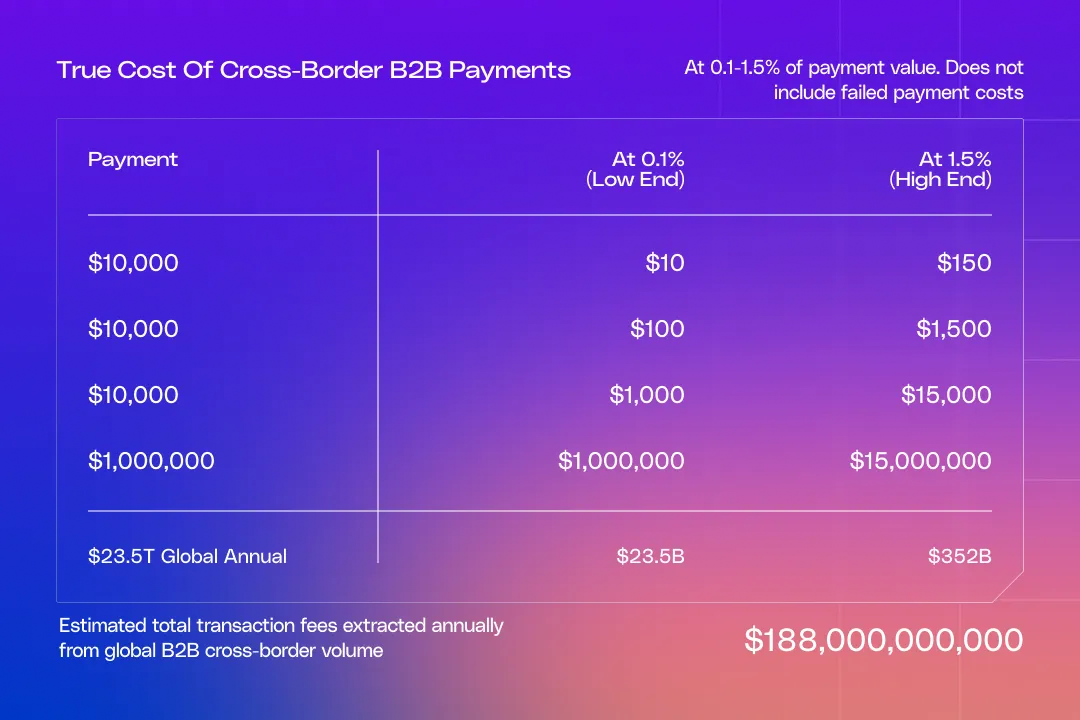
This is the cost of this problem that the operators of the legacy financial infrastructure are beginning to take notice of.
In July 2026, they began taking first concrete steps to replace the legacy infrastructure with crypto rails.
The Infra Swap
On July 15, the DTCC, the backbone of the U.S. financial markets, ran its first live production trades of tokenised securities. The trades involved tokenised versions of the original underlying listed company shares, Treasuries, and ETFs.
As part of DTCC’s first on-chain trades, JPMorgan converted holdings of the Invesco QQQ Trust (QQQ), one of the world’s most actively traded and liquid ETFs, into tokenised form and posted them as margin at CME. Goldman Sachs, BlackRock, Vanguard and the NYSE were among more than 30 firms in the room. These tokens moved through repo, collateral pledges, securities lending and clearinghouse margin on production infrastructure.
This comes just months before the scheduled launch of the DTCC Tokenization Service in October 2026.
This single infrastructure move gives us a quantifiable magnitude of the economic benefit more efficient systems could bring to capital markets. In May 2024, US equities moved from settling in two days to settling in one. That single day cut in the settlement cycle reduced the margin that members must park at the clearinghouse by $3 billion, or 23%, from a three-month average of $12.8 billion in the T+2 cycle to $9.8 billion in the T+1 cycle.
If one day saved in one country’s equity market could free $3 billion in collateral, the value of collapsing settlement to minutes across equities, Treasuries, repo and FX, across borders and over weekends can blow up exponentially.
This is what blockchains commoditise. A stablecoin transfer settles in seconds for a few cents in cost, at any hour, on any day. On the other hand, a tokenised security can change hands and simultaneously serve as collateral without waiting for the infrastructure to open on Monday.
This is why operators of legacy infrastructure are warming up to the idea of using crypto rails as their backend. Because if they don’t, they risk losing business to their competitor who offers its clients the same services at much lower prices and faster speeds.
Crypto infrastructure allows customers to put their money to work more efficiently by eliminating idle time. A security that settles tomorrow cannot be used as collateral today. A tokenised security can be pledged and lent in minutes, around the clock. Collateral mobility is the difference between capital working in parts and capital working continuously.
Nine days earlier, SWIFT, the cooperative whose messages coordinate payments between more than 11,500 institutions, said 17 banks from six continents, including Citi, HSBC, UBS, Standard Chartered, and MUFG, are preparing to pilot tokenised deposits on its new shared ledger.
Tokenised deposits are bank money sans time barriers. Blockchains move funds overnight and on weekends while still remaining as a claim on a regulated bank. This is the perfect alternative for those who avoid bank-issued stablecoins due to the lack of FDIC coverage. Tokenised deposits give users the same convenience as stablecoins, while keeping their money within their own regulatory perimeters.
I wrote about this last month, in Defending the Deposit.
Even card networks like Visa are adopting crypto infrastructure.
On July 16, Cuy Sheffield, Head of Visa Crypto Labs, announced the launch of a platform that lets banks mint, move, and redeem stablecoins within the treasury systems they already run, hiding every key, gas fee, and chain from the client.


The biggest appeal for traditional finance giants in adopting crypto infrastructure as their backend is the ability to pass on cost and time efficiencies across their wide distribution. Roughly 15,000 financial institutions and more than 200 million merchants already sit on Visa’s network.
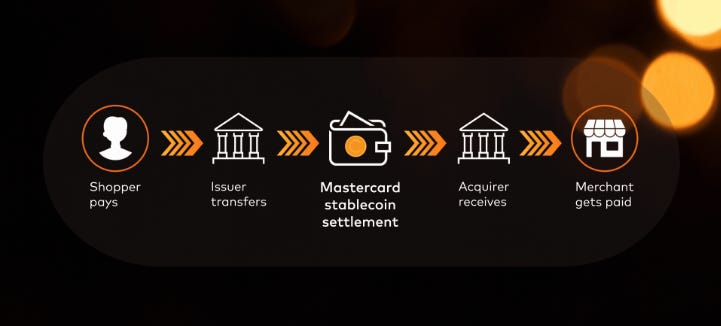
Its competitor, Mastercard, has built on its earlier pilots and initial live deployments by expanding stablecoin settlement options for banks across six regulated stablecoins.
Mastercard now supports settlement across Circle’s USDC, Paxos’s PYUSD, USDG and USDP, Ripple’s RLUSD and SoFi’s SoFiUSD. These stablecoins will be enabled across a range of supported blockchain networks including Arbitrum, Base, Canton, Ethereum, Polygon, Solana, Tempo and XRPL.
The proof that this class of infrastructure works at scale already exists inside a bank. JPMorgan’s Kinexys has processed over $4 trillion in cumulative volume and now moves more than $7 billion a day, every day, including on days when the rest of the financial sector is closed.
Those still unconvinced and resistant to crypto infrastructure need to look no further than how money market funds have adopted blockchains. BlackRock’s BUIDL, a tokenised Treasury fund with roughly $2.5 billion in assets, is now accepted as collateral for derivatives at major venues. Standard Chartered and OKX, a fintech and crypto trading platform, came together to build that framework.
This is the real-world utility of adopting crypto as a backend. It has enabled collateral to earn Treasury yields while posted as margin.
This is the strongest pitch I’d make to anyone who asks “Why should anyone choose crypto rails?”
The single most important job of any new financial innovation should be to help you move, grow and store your money more efficiently.
By enabling these innovations, incumbent crypto companies are finding new roles.
Joining Them, Instead of Fighting Them
Instead of replacing traditional financial companies, as many crypto ideologues had envisioned, crypto companies are becoming the builders of the infrastructure that traditional companies demand.
Half a dozen crypto companies came together to make the DTCC’s July a reality. Chainlink wired the networks together; Digital Asset’s Canton network carried the Treasuries; Fireblocks and BitGo supported custody; and Circle and Ondo designed the service for the entire working group.
Some of these firms spent a decade building for a parallel financial system, but are now supporting traditional financial companies in building faster, cheaper infrastructure to move money and assets. Their revenue model has changed from replacing Wall Street to invoicing its companies.
These invoices are also stretching halfway across the globe.
On July 16, Ondo Finance, the largest tokeniser of equities, announced a partnership with Japan’s SBI Group to tokenise Japanese stocks. The tokenised equities will be distributed across SBI’s ecosystem and settled with JPYSC, SBI’s yen stablecoin.
SBI manages over $250 billion in assets. If it had to build tokenisation capability in-house, it’d have to start from scratch. Instead, it just procured the technology from a vendor that already runs on blockchains and paid rent for its expertise. Ondo already accounts for more than 70% of the tokenised equity issuer market and has a distribution arrangement with Deutsche Börse’s Clearstream in Europe.
Securitize plays the same role by supporting the issuance of BlackRock’s BUIDL.
What Happens Next?
There’s a precedent for what follows.
In 1956, a trucker named Malcom McLean put cargo in a standard metal box. This reduced loading costs from $5.86 per ton to $0.16 per ton. World trade reorganised around the container. Ironically, the carriers who owned the ships captured almost none of the value. That’s because the container box became a commodity and freight became a price war. The riches went to the firms that rebuilt their operations around cheap, reliable shipping. The great beneficiary of the container innovation was the retail giant Walmart, and not logistics giant Maersk.
A similar format could repeat in fintech.
For the container innovation to transform the logistics industry, an entire ecosystem of cranes, ports, chassis and customs had to be rebuilt around it. Similarly, tokenisation works only once custody, compliance and interoperability are rebuilt around it. This is where the value accrues as the settlement layer in banks and financial institutions gets commoditised. It’s this precise ecosystem that Chainlink, Fireblocks and Digital Asset are now targeting.
Tokens or chains will no longer capture significant value. Instead, value will pool in two places.
The first is in the utilities that adopt the crypto rails. DTCC, SWIFT, and Visa will charge for tokenised settlement, deposits, and stablecoins, just as they do for traditional, non-crypto systems. But there’s larger value elsewhere to capture. There will be institutions that reorganise their operations around continuous, atomic settlement by running treasury intraday, making collateral work more efficiently, and offering round-the-clock access to working capital. Think of the BUIDL fund that lets you earn Treasury yields on collateral posted as margin.
Crypto has already spent more than 15 years building a parallel, better financial product. I think crypto builders with foresight will stop building such products. Because crypto’s bigger triumph is being the backstage protagonist that makes your money move more cheaply and faster.
That’s it for today. I will be back with the next one.
Until next time, stay curious,
Prathik
Token Dispatch is a daily crypto newsletter handpicked and crafted with love by human bots. If you want to reach out to 170,000+ subscriber community of the Token Dispatch, you can explore the partnership opportunities with us 🙌
📩 Fill out this form to submit your details and book a meeting with us directly.
Disclaimer: This newsletter contains analysis and opinions of the author. Content is for informational purposes only, not financial advice. Trading crypto involves substantial risk - your capital is at risk. Do your own research.
Well said! Crypto works best when it's invisible infrastructure, not just a visible asset.