


Hello,
Last Sunday, I wrote about the role of speculation in the evolution of finance. While working on it, I also pondered the evolution of the crypto industry itself.
Closer to home, a majority of my friends and family still don’t understand my work. They think I am shilling a coin or writing to persuade someone to throw away their life’s savings on some shitcoin. It’s sad they think so, but I don’t blame them. The initial ethos with which the crypto industry took off was aspirational, but also radical. Its marketing was problematic.
Many expected crypto to be the escape hatch from the current, problematic financial system. Even Satoshi Nakamoto had conceived Bitcoin as a parallel, peer-to-peer electronic cash system that was decentralised, permissionless and could route money around banks and third parties.
The problem began when enthusiasts built the crypto industry — much of which we saw rise and fall over the last 18 years — by swearing by decentralisation and permissionless as their core ethos. While I don’t have anything against these principles, ethos alone cannot build great businesses. The problem was that the builders expected a niche set of ethos to drive mass adoption and turn their hypotheses and ideas into successful, money-making businesses. An unpopular ethos doesn’t drive the masses to adopt a radical product. Even less so when that product could wipe away their life’s savings overnight without a warning.
Every niche product needs a familiar face to market it. Crypto, too, found its familiar marketer in the very thing the enthusiasts expected it to topple - the traditional finance industry.
In today’s piece, I explore how crypto and traditional finance feed off each other’s moats to build successful business models that don’t care a dime about the radical ethos on which enthusiasts expected crypto to be built.
On to the story…


Warming-up Masses to Crypto
What made crypto legible to Wall Street, my parents, your friends, and a layperson who never understood a private key was the financial instruments they were already using for other investments.
Bitcoin and Ether have been around as cryptoassets for 18 and 11 years, respectively. Yet they reached a broader base of holders only when the traditional finance industry wrapped them in an exchange-traded fund (ETF). The familiar traditional finance products have existed for almost four decades and are sold through the same brokerages that everyone already trusts. Think of BlackRock, Grayscale and Fidelity.
Those who bought a spot Bitcoin ETF did so because they believed bitcoin is an aspirational and emerging asset class. Few would have done so because they believed in permissionless money or to beat the centralised banking system. The ETF wrapper gave them exposure through the same brokerage account that routed their index funds and other investments. The wrapper also handled custody, since the underlying bitcoin was held by reputable names like Fidelity and Coinbase.
Familiarity was the marketing win that bitcoin needed. Once that part was taken care of by a trusted player, the underlying product didn’t matter whether it was crypto or otherwise.
The world’s largest asset manager, BlackRock, generated over $160 million in annualised fee revenue through its crypto ETFs in Q1 2026. In October last year, its spot Bitcoin ETF also became the company’s most profitable fund with $244.5 million in annualised fee revenue, surpassing an S&P 500 tracker that has been collecting fees for a quarter of a century.


Traditional finance learnt quickly that if it can borrow crypto’s products and wrap them in its existing, familiar instruments like ETFs, then its loyal customer base will be indifferent to the asset class being offered. Even those who barely understood how bitcoin worked and derived its value from, happily lapped it up.
Once BlackRock learnt that it had a native audience who was seeking exposure to the emerging asset class, its own chief had to walk back his words. After famously dismissing bitcoin in 2017 as an “index for money laundering”, CEO Larry Fink went on to build a $100-million ARR crypto fund within two years of its inception.
Traditional financial institutions no longer gain just passive price exposure. When Morgan Stanley listed a Solana Trust ETF in July, it charged 0.14% as a management fee but also staked that Solana to earn yield. It now passes roughly 95% of the staking yield straight through to holders.
The trend of traditional finance businesses profiteering off crypto derivatives and products also holds true the other way round.
Crypto Infra, TradFi Distribution
On July 1, Robinhood launched its own blockchain and allowed more than 30 million of its funded users to buy exposure to tokenised US stocks via blockchain infrastructure most of them had never heard of.
Within eight days of its launch, Robinhood Chain was doing $500 million in daily volume on Uniswap, the largest decentralised exchange in crypto. That was a 10-time jump from the day before, making it Uniswap’s second-busiest network after Ethereum mainnet.
Cumulative swap volume crossed $6 billion in ten days.
Since its launch on July 1, Robinhood Chain generated over $36 million of Uniswap’s $61 million in cumulative fees as of August 3. That’s about 60% of the protocol’s total fee revenue from July 1 to August 3. Ethereum mainnet and Base each made $8 million.
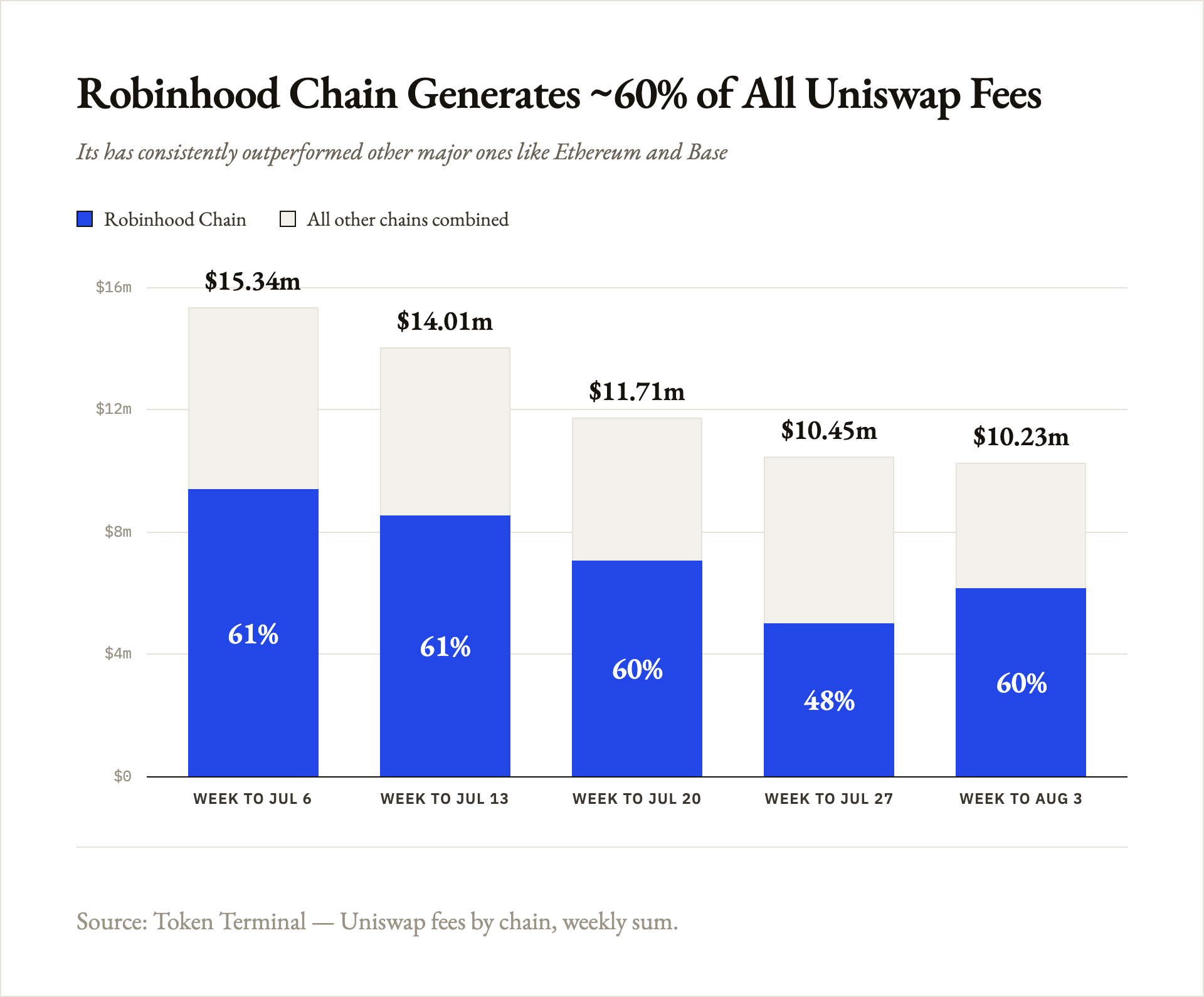
Since the launch of its chain, Robinhood has become the single largest contributor to Uniswap’s fee, beating crypto’s most established venues like Ethereum and Base chains by more than fourfold.
Here, Robinhood capitalises on the distribution muscle it has built with customers through its app, brand, and retail relationships over a decade. Although Uniswap runs the infrastructure, it was Robinhood’s chain that facilitated the trading activity. Early volume on the chain was dominated by memecoins, the kind of speculative retail flow that Robinhood has historically attracted.
Uniswap routed these protocol fees into buying back and burning its native token, UNI, and putting a share of its profits back into the hands of its holders.
Uniswap has bought back and burnt more than 1.36 million UNI tokens in the last 30 days. Out of that, fees generated from Robinhood Chain accounted for buyback and burning of 510,000 UNI tokens. Out of all the $UNI burns since July 27, Robinhood Chain contributed to over 50% of them.


Ironically, in Q2 2026, Robinhood’s own crypto trading revenue fell 38% year-on-year to $100 million — barely 13% of its transaction revenue, down from 53% two years earlier. Even as the fees Robinhood earns from its customers trading crypto on its app was shrinking, its chain was making a crypto DEX richer.
Meanwhile there’s a crypto protocol that now earns most of its revenue off oil and equity derivatives.
Hyperliquid’s perpetual futures, or perps, began trading on everything crypto. One could put a leveraged bet on the direction of bitcoin and Ether. But ever since October 2025, after the launch of deployer-run markets under HIP-3, perp contracts on non-crypto markets have been gradually picking up pace. Traders started listing perps on assets unrelated to crypto, from commodities like oil, gold, and silver to equity indices like the S&P 500 and Nasdaq, to foreign currencies and individual stocks like Nvidia and Tesla.
Real-world assets were 1.8% of Hyperliquid’s volume in the last quarter of 2025. By the second quarter of 2026, they accounted for 32.2%. In July, non-crypto trading crossed 52% of all volume across Hyperliquid.
Hyperliquid charges the same fee whether you trade a bitcoin perp or a crude-oil perp. Hyperliquid’s blended take rate on trading is 3.3 basis points, or 0.033% of volume. Every dollar made in fees flows back into buying and burning its native token, HYPE, via the Assistance Fund.
Although under HIP-3, Hyperliquid parts with half the fees, the protocol wouldn’t mind it, considering that deployer-run markets now make up the majority of Hyperliquid’s revenue.
Crypto rails, in short, have stopped caring where their revenue comes from. Hyperliquid doesn’t care whether its traders trade more traditional or crypto assets, or whether markets are up or down; as long as they trade, it keeps filling its coffers.
The Fintech Evolution
The pattern of decoupling revenue from the asset class isn’t unique to crypto and traditional finance. It’s recurred at every pivotal point in the evolution of financial markets.
Netflix began by mailing DVDs to a niche set of film buffs who were patient enough to receive a disc on rental by post to watch things that local stores didn’t have. Once Netflix built subscriber relationships and billing habits, and collected data on what people actually watched, it helped them expand their revenue by enabling streaming videos over the same infrastructure for a much larger audience. It then used the same distribution moat it had built to start making native content.
This is what happened on Hyperliquid, too.
Crypto perps appealed to a narrow, cyclical audience of leveraged traders. Once the platform proved its utility to that audience, it used the same infrastructure and interface to start perp contracts for something that was less cyclical than crypto. Oil, gold, FX, and pre-IPO stocks followed.
Robinhood followed the same playbook by using its initial commission-free stock trading as a wedge to build massive distribution. Now that it commands the attention of 30 million funded users, it can now sell options, prediction market contracts, and tokenised equities to the same audience and make money off it. Even if revenue from crypto trading falls, the same platform can keep making money off selling tokenised stocks and event contracts.
Both crypto and traditional institutions have now begun to acknowledge that the core question is “Where does the value accrue?” The answer is a common moat that has been a proven ingredient in building a successful business: distribution.
As long as there is massive distribution, any business - crypto or traditional - can cross-sell adjacent products, whether traditional or crypto, to their loyal user base. In all of this, crypto’s blockchain infrastructure does offer a cost-effective and faster rail to move money and assets. So whichever businesses use it can reduce their operational and logistics costs over time and pass some of that on to their customers for a better competitive edge.
Although this convergence of crypto and traditional finance is not the one crypto enthusiasts hoped for, it’s still the one that makes the most money. It’s also the one route that is in line with the trajectory of historical evolution. The efficiency of moving assets has always been the biggest motivator of every financial innovation. It matters much more than any other ideological principles. It always will.
That’s it for today. I will be back with the next one.
Until next time, stay curious,
Prathik
Token Dispatch is a daily crypto newsletter handpicked and crafted with love by human bots. If you want to reach out to 170,000+ subscriber community of the Token Dispatch, you can explore the partnership opportunities with us 🙌
📩 Fill out this form to submit your details and book a meeting with us directly.
Disclaimer: This newsletter contains analysis and opinions of the author. Content is for informational purposes only, not financial advice. Trading crypto involves substantial risk - your capital is at risk. Do your own research.