


“When the capital development of a country becomes a by-product of the activities of a casino, the job is likely to be ill-done.”
— John Maynard Keynes, 1936
Hello,
The crypto industry receives a lot of flak for being heavily driven by speculation. Some call it a casino devoid of any fundamentals. But what they don’t realise is that speculation often precedes market evolution. A room full of speculating people that respectable people disapprove of often assembles the liquidity that respectable things later get built on.
In today’s piece, I explore how this pipeline is evident in what we’re seeing in the crypto markets lately: a memecoin launchpad on a chain built for stocks, a perps venue turning into commodities infrastructure, a broker whose frog tokens might be funding its equity rails.
On to the story…


Speculation has many names in crypto: noise, froth and casino are some of them. What speculation is almost never considered is its role as a foundation for what gets built on top of it in a maturing industry.
But let’s be clear: I don’t think all froth becomes foundation. Froth that stays froth for an extended period dies fast. But the froth that finds products that can feed consistent activity can become a floor on top of which other things are built.
This is not a recent phenomenon. We have seen it happen in the evolutionary journey of finance.
Take the case of Chicago grains from the 1840s. The Chicago Board of Trade’s futures market was built so that farmers exposed to an unpredictable harvest could lock in a price months ahead and minimise losses. But for every farmer wanting to sell their crop forward, you also needed someone willing to buy it forward and carry the risk. Speculators filled that gap. The risk-transfer market only worked because speculative capital showed up to absorb the risk these farmers wanted to offload.
It’s the delinking of grain, a physical object, from the grain, a saleable commodity, that made the futures market possible. American historian William Cronon called this the abstraction of grain. Once the trade involving grains was reduced to a receipt, it could change hands easily and made speculators trade it ubiquitously. Their trading made the market liquid enough for a farmer to find a counterparty. The deep liquidity turned Chicago into the price-setting capital of wheat.
What’s interesting is that many hated and resisted this at the time. The Granger movement campaigned against Board of Trade speculators as parasites profiting off the farmer’s labour. Yet that mechanism became the price-discovery infrastructure the entire global agricultural economy now runs on. Without the speculators becoming the counterparties in 1870, the global wheat prices wouldn’t have a pricing infrastructure today.
English economist John Maynard Keynes is often credited for his thoughts on speculation. But his comprehensive thoughts further establish the role of speculation. Keynes split market activity into two parts: enterprise, which forecasts the yield of an asset over its life, and speculation, which forecasts what the crowd will do next. He feared that liquid markets let the second swamp the first.
But when you read deeper into his arguments, they expose a dual nature of speculation.
“Speculators may do no harm as bubbles on a steady stream of enterprise. But the position is serious when enterprise becomes the bubble on a whirlpool of speculation. When the capital development of a country becomes a by-product of the activities of a casino, the job is likely to be ill-done.”
Speculation could be dangerous when it floats free of any underlying, but the same speculation can become useful when it’s tethered to interesting underlying assets.
Even in Joseph de la Vega’s Confusión de Confusiones (1688), the first book ever written about a stock market, the author credited the Amsterdam exchange with drawing both investors and gamblers in equal measure. Most exchanges that exist today began the same way, but the story got diluted with time in a way that the serious purpose - purportedly investing - seemed like it came first. Except that it didn’t.
Back to the Future
On August 5, Uniswap, the largest decentralised exchange in crypto, shipped ‘Pools’ launchpad. The platform allowed people to launch and trade memecoins on Robinhood Chain. The namesake brokerage had primarily built the blockchain for its 30 million funded accounts to trade tokenised stocks.
That’s not all. The story gets more interesting when you realise that even before the launchpad officially opened, traders found the unreleased smart contracts and pushed more than $150 million through them. This forced Uniswap to support both the test and final versions at once and delay the launch. The top token, FRONG, which was named after the title of the frog video Uniswap used to tease the product, was minted six days early by the same contracts and carried 12,141 holders by opening day.


Make of all this what you can: About $150 million dollars moved through infrastructure that did not officially exist yet, to trade a token about a frog, on rails built for equities. Today, FRONG is the unofficial mascot for Pools. It’s difficult not to read the move as planned, to drive liquidity onto Uniswap’s newest v4 infrastructure. Even if it wasn’t planned, the volume on Uniswap v4 on the chain almost tripled from $86.2 million to $228.3 million in a single day.
But as I said at the beginning of this piece, I don’t think all froth and speculation help in building something sustainable. Instead, whether a speculative business survives depends on what it speculates about. Consider the case of pump.fun.
Over the years, pump.fun has sold speculation as its main product. Today it is the largest platform to launch memecoins. About 7 in 10 memecoins launched on its platform don’t last more than a day. Only one lasts longer than a month.
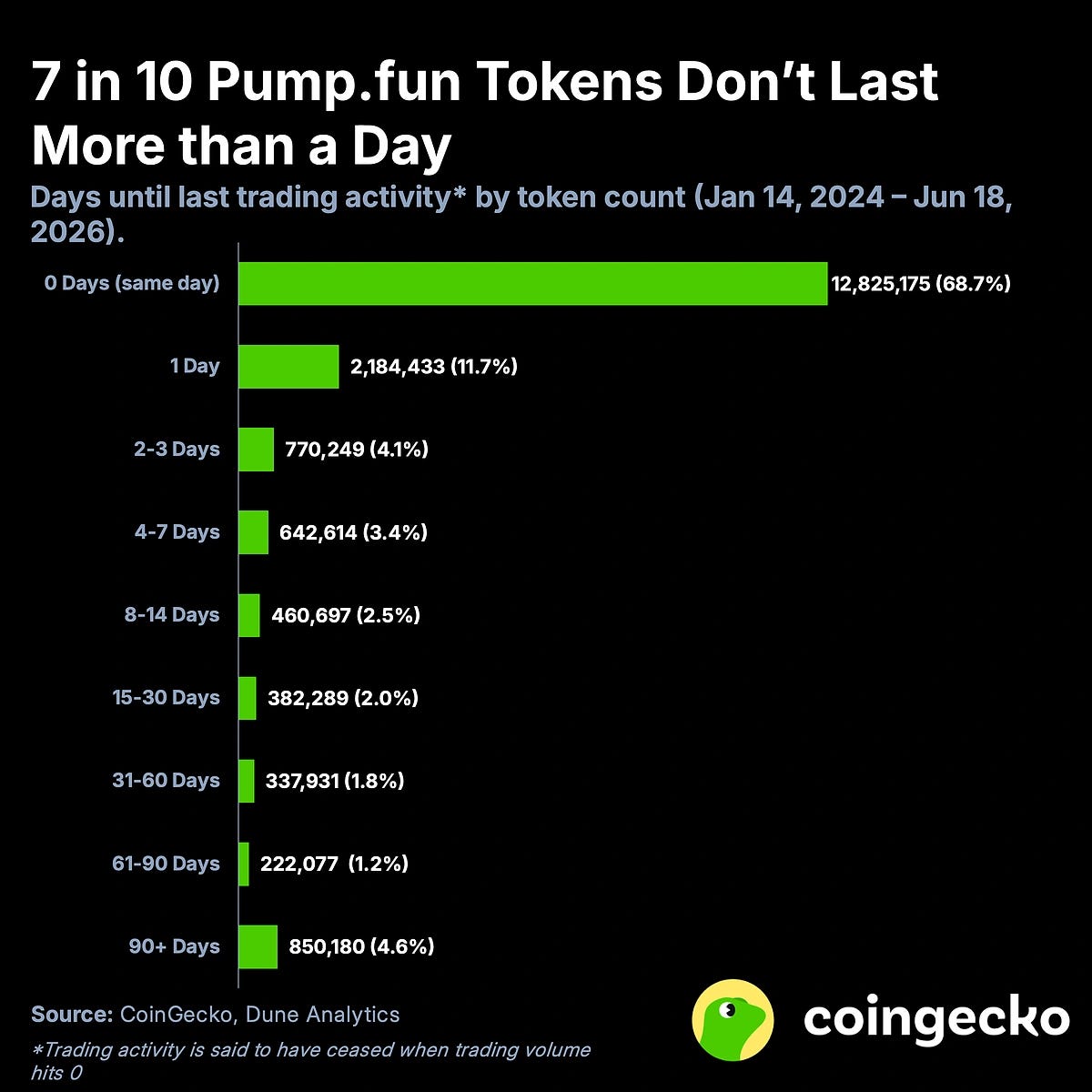
Its protocol fees between January and July 2026 almost halved from $420 million in the same period last year. Yet, it is one of the largest revenue-making protocols in crypto. It made $620 million in revenue and $584 million in earnings last year.
Another one from that league is Hyperliquid. It began as a platform that allowed crypto trading at high leverage. If you wanted to place directional bets, this was the venue that let you do it. Then it latched that leverage to assets that trade continuously and had nothing to do with crypto. Through its HIP-3 framework, it now runs perpetual markets on Nvidia, Tesla, a Nasdaq tracker, gold, oil, silver, stock indices and more. A trader can take a position in crude oil the moment news breaks on a Sunday, while the traditional market sits closed until Monday.
Read: Hyperliquid: House of Finance 🏦
In early July, real-world-asset perps out-traded crypto on the platform for the first time ever with 52% of volume.
Although Hyperliquid’s overall volume roughly halved from its 2025 peak, the RWA growth offset the decline in crypto pairs. This is what speculation can create. Hyperliquid translated the speculative leverage that fuelled crypto natives and redirected it onto gold, pre-IPO stocks and equity indices. What it created is a 24/7 pricing layer that traditional venues are now imitating.
We see Robinhood Chain follow the same strategy in real time.
Although the leadership team had dubbed the chain as the foundation for trading on-chain stocks, CEO Vlad Tenev embraced the attention the chain was getting from memecoin traders.

The chain then overtook Base on daily active users three weeks after launch, driven by memecoin trading. The memecoin volume is the seed capital that will eventually graduate into the equity rails.
None of this means speculation always graduates upward. Graduation is a direction the venue chooses.
Robinhood’s distribution powerhouse of 30 million funded users and more than a dozen businesses can help it graduate the traction it is witnessing in memecoin trading into equity rails. We saw how its prediction-markets revenue surged more than tenfold year over year in the second quarter to $156 million, 20% of its trading revenue.
Read: Robinhood’s Bigger Baskets
The Shape of Speculation
This is the part about speculation that many don’t understand. Speculation isn’t good or bad. When you strip it to its bare principles, speculation is just one of humans’ oldest impulses.
Speculation is the natural outcome when humans financialise their opinions.
Read: Built for Humans 🎰
In its rawest form, it is liquidity that is looking for something to price, and it will price whatever you point it at. It could be a bag of wheat, an Nvidia share, a frog video titled frog.mp4, the outcome of a football game or the odds of a presidential candidate.
It’s nature of the underlying asset that disciplines and directs the speculation’s trajectory. Once you take the underlying away, the same money can lead to nothing substantial or sustained. This trend has been recurring across the evolution of finance. Crypto is now part of that journey too.
Hyperliquid tethered leverage to gold and built a pricing layer in less than two years. Robinhood is capitalising on the unexpected traction it is witnessing for speculation on memecoins while it builds on-chain rails for trading equity wrappers.
Speculation will continue to build whatever the ground underneath will support.
That’s it for today. I will be back with the next one.
Until next time, stay curious,
Prathik
Token Dispatch is a daily crypto newsletter handpicked and crafted with love by human bots. If you want to reach out to 170,000+ subscriber community of the Token Dispatch, you can explore the partnership opportunities with us 🙌
📩 Fill out this form to submit your details and book a meeting with us directly.
Disclaimer: This newsletter contains analysis and opinions of the author. Content is for informational purposes only, not financial advice. Trading crypto involves substantial risk - your capital is at risk. Do your own research.