


Hello,
Do you know that buying a stock today has become instant, but everything that happens to it after, like dividends or stock splits, is still a ruckus.
When Netflix or Apple announces a dividend, the money doesn’t arrive to you directly; it goes through a fragmented process where each intermediary from DTC (Depository Trust Company) to your broker has to figure out your payout independently from their own records and then later sync with each other.
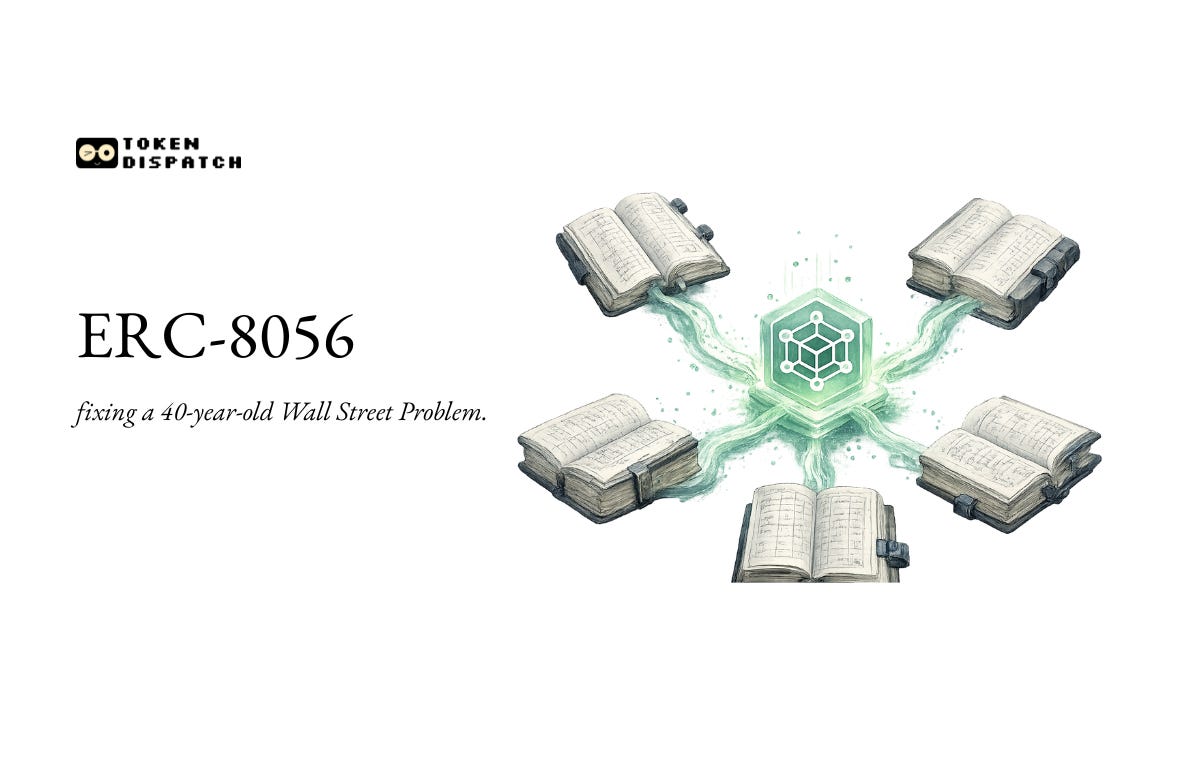
These events are called corporate actions, and the finance industry spends a staggering $58 billion a year to process them. Most of it is just reconciliation costs, making sure those separate leaders are actually synced and updated. This is a 40-year-old unsolved automation problem, but we now have new on-chain token standards that are trying to fix this permanently, so I went looking straight into it!

Why could they never fix it?
In my previous piece, I wrote about how, in 1968, Wall Street literally had to close on Wednesdays because nobody could keep up with moving paper certificates. Later on, DTC tried to solve this problem by creating a vault and turning trades into book-entry updates on a single ledger.
That was a brilliant fix for settlements, for sure. But corporate actions are very different. Settlement is a one-to-one action, meaning a seller is matched to a buyer and the transaction completes. But a corporate action like a stock split or dividend is one-to-many, meaning a single action hits every holder simultaneously. Now, because ownership is dispersed across an entire intermediary chain, from the transfer agent to the brokers at the bottom, each of these parties has to independently process the event from their own records and then reconcile again later.
Let me walk you through how it actually happens. Imagine Apple declares a 0.25$ per share dividend; that money doesn’t reach you, the shareholder, directly. The total payout is first wired to the transfer agent (a firm like Computershare that maintains the official shareholder register).
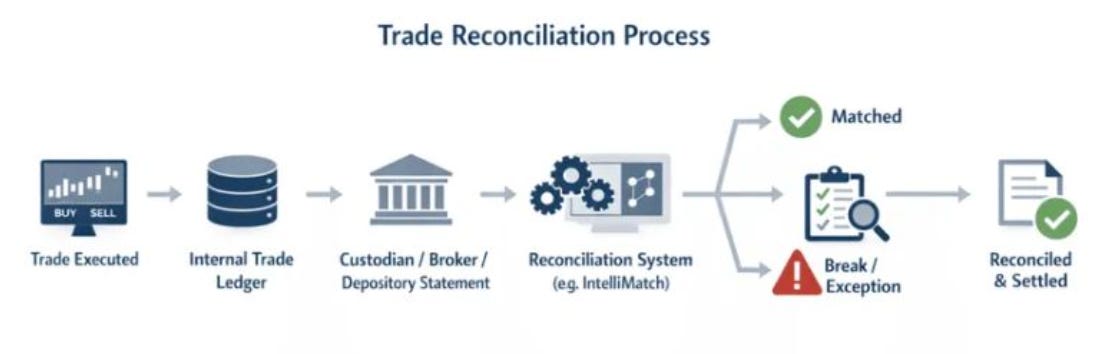
But as you know, the register doesn’t have your name on it, and all shares are owned by Cede & Co, the nominee entity of DTC; the transfer agent then pays the DTC instead of you. After that, the DTC looks at its own records to figure out how much each of its member firms (custodial banks like BNY Mellon) should receive, and credits their accounts.
Those custodian banks then check their own books to split it among the brokers they serve. And finally, your broker, say Fidelity, independently calculates your individual entitlement from its own records and credits your account. That is five entities trying to independently calculate the same allocation from their individual copies of that data.
And what’s even crazier is that their books don’t even sync at the same time. An investment manager executes a corporate action on the ex-date, but the custodian won’t actually distribute further until the pay date, which can be weeks later. During this period, your broker’s records falsely say you own shares you technically haven’t even received yet, and traders could even sell stock that the firm doesn’t have yet.
Now imagine the fact that there are roughly one million corporate actions globally every year, and each one propagates through this same fragmented chain, taking more than $58 billion in processing costs. The cost is also one of the reasons nobody even tries to bring it down.
The dysfunction originates from the data and who profits from cleaning it up. So when Apple announces that dividend, it files a form with the SEC and puts out a press release. The problem with that is it’s a free-form SWIFT text message, which is not machine-readable and thus cannot be auto-processed by the system. This is year 2026, ladies and gentlemen; today we settle trillions in equity volume in seconds, but corporate actions like dividends and stock splits still arrive in non-readable PDFs and copy-pasted messages.
And it’s not like we don’t have the tech to publish machine-readable announcements; the technology has been in existence for over a decade (XBRL tagged messaging). But currently, the process of filtering those messy press releases and extracting the clean data banks need is done by Bloomberg and S&P Global.
These firms have hundreds of analysts who spend their days scraping announcements and interpreting ambiguous language to push the result for downstream consumption. S&P Global alone manually validates over 1.4 million events a year across 170 countries. If Apple started publishing machine-readable announcements tomorrow, a significant portion of that business will go obsolete. These are the firms best positioned to lobby for better data standards at the source, and they are the last ones who ever would.
On the other side, Apple bears none of the processing cost. It files the paperwork and gets done with it. Every dollar of costs falls on the intermediaries downstream. In fact, the industry groups have asked issuers about adopting structured formats, but they said you need to provide us incentives to do that.
The problem with this problem is also that financial infrastructure seldom evolves through efficiency arguments. They always require a genuine crisis to override the inertia that keeps incumbent structures in place. And sadly, corporate actions have never had that crisis. The cost is immense in aggregation but diffused across enough participants that no single failure forces collective action.
ERC-8056: The New Token Standard
So if the problem can’t be fixed from within, the question is can it be bypassed entirely? This is where the new on-chain token standards enter.
ERC-8056 is a display multiplier for ERC-20 tokens that Robinhood shipped with Chris Ridmann from Superstate. The idea here is that instead of minting new tokens during a stock split, you update a multiplier that adjusts how every wallet’s balance displays. So if you hold, let’s say, 100 tokens, and a 4-for-1 token split happens, your wallet will be able to update it without the contract ever creating new tokens. And the underlying balance and transaction history will always remain intact without needing to perform transfers to process or reconcile.
This one smart contract update can actually replace all five entities independently recalculating balances from their own copies of data.
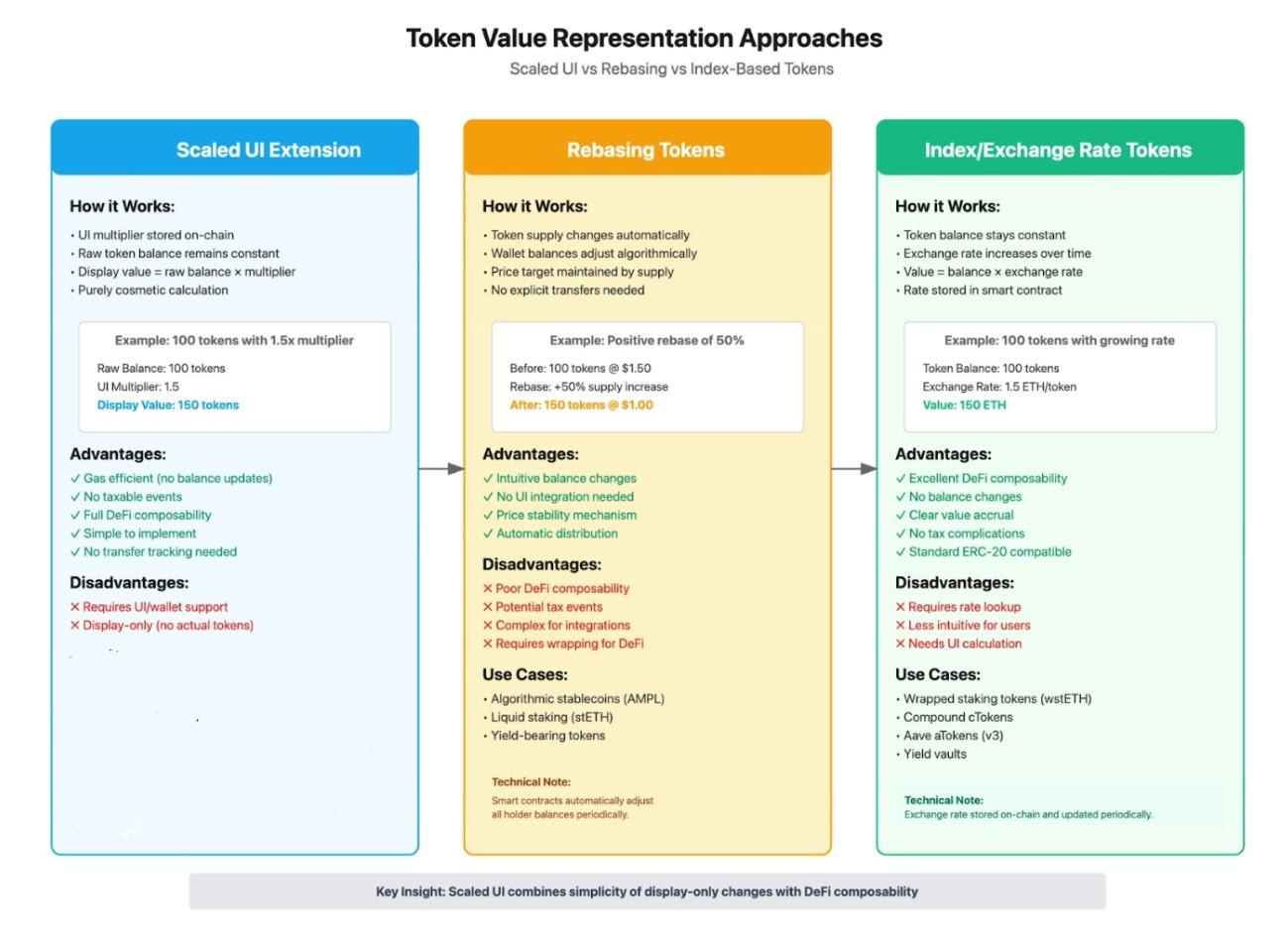
And this same programmability can be extended to every other corporate action the incumbents have been failing to automate. Dividends can become a single contract call that distributes to every holder on one ledger, instead of cascading through transfer agents and different books updating at different timelines. Rights offerings, proxy votes, all of these can be encoded as on-chain logic where the rules execute against one authoritative record of ownership. The only reason these corporate actions have stayed manual for forty years is that they had five different databases that had to independently process the same event and then reconcile with each other afterward. ERC-8056 collapses that entire value chain into a single programmable layer.
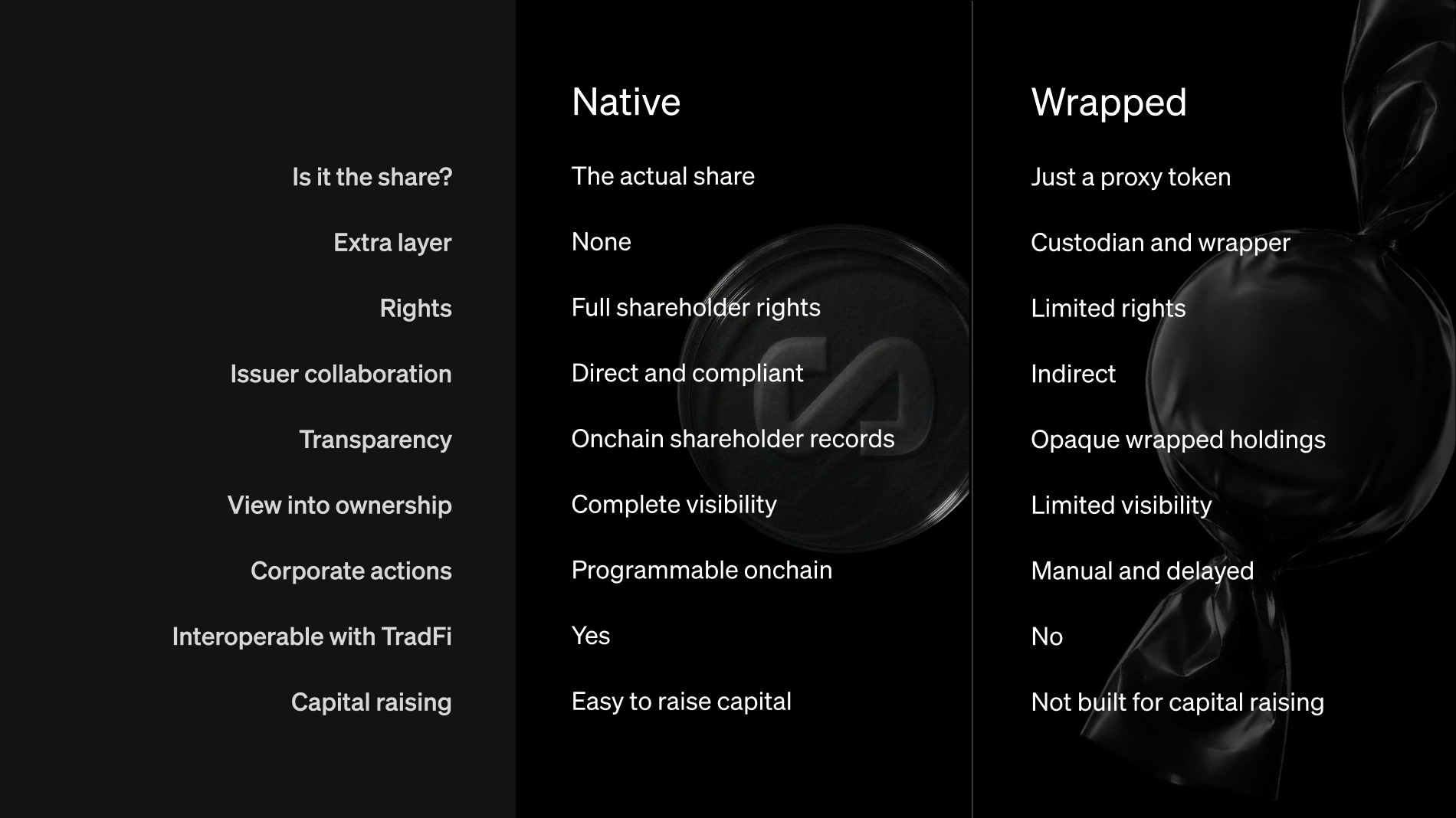
Another important thing to note is whether tokenising this model actually collapses the number of ledgers in the system, or just adds another one. Because right now, most tokenised equities are more digital twins of their origin. Like Robinhood tokenised stocks like Apple and Tesla, but when you look at the mechanism underneath, these tokenised stocks are backed by real shares held in a traditional brokerage account, and so the token is technically a sixth layer sitting on top of the same five I described in the section above.
xStocks on Solana is a similar arrangement but with even weirder design choices. They hold 93% of the tokenised equities market on Solana, but dividends get forcibly reinvested (holders can’t take cash), and the token contract includes a feature called Permanent Delegate that lets the issuer unilaterally seize tokens from any wallet at any time. So the ‘decentralised’ equity product actually gives the issuer more control over your holdings than a traditional broker ever could.
The only model that is actually solving the root problem is native issuance, which gives the blockchain the ability to become the shareholder register itself. One of those doing it is Superstate, they have registered with the SEC as a transfer agent, and instead of maintaining a separate internal database that periodically reconciles with the DTC, they record ownership directly on-chain.
Galaxy Digital recently announced plans to tokenise its actual equity on Solana using Superstate native issuance as its transfer agent. If that goes through, Galaxy’s shareholders will exist natively on the blockchain, and the dividend wouldn’t need to cascade through the intermediaries because the intermediary chain itself will collapse.
There’s a concept Ian Grigg wrote about in the early 2000s; it’s called triple-entry accounting, and it captures what native issuance is capable of doing really well. He proposed that when two parties transact, a shared cryptographic receipt creates a third entry that neither side controls but both can verify.
Double-entry bookkeeping has been the bedrock of financial recordkeeping since Luca Pacioli formalised it in 1494. What Grigg proposed, and what native issuance implements, is arguably the first upgrade to that system where one authoritative record that makes bilateral reconciliation unnecessary.
“Reconciliation is a function of deferred settlement. When settlement is instant, the discipline moves upstream.” - Lorna Mason
In the current system, you process now and reconcile later, and the reconciliation is where all the cost and risk accumulate. With instant settlement on one shared ledger, that entire step vanishes. Instead of reducing the cost, the process that creates it ceases to exist.
The good part is the regulatory machinery is actually moving to accommodate this faster than we realise. The DTCC, for example, issued a no-action letter in December 2025 clearing the path for tokenised securities within existing settlement infrastructure, and with Nasdaq getting approval for tokenised securities, the incumbent exchanges are building native issuance into their roadmaps.
I started this article saying corporate actions have been stuck for forty years because financial infrastructure reforms have historically required a genuine crisis. But this time we might not actually need one. If companies can issue equity natively on a blockchain where the transfer agent’s register is the ledger, they don’t need to fix the five-database chain.
They can make a workaround because the process that creates it no longer exists. Now how fast that transition happens depends on regulatory maturity and how many issuers are willing to make the jump.
That’s all for today!
Token Dispatch is a daily crypto newsletter handpicked and crafted with love by human bots. If you want to reach out to 170,000+ subscriber community of the Token Dispatch, you can explore the partnership opportunities with us 🙌
📩 Fill out this form to submit your details and book a meeting with us directly.
Disclaimer: This newsletter contains analysis and opinions of the author. Content is for informational purposes only, not financial advice. Trading crypto involves substantial risk - your capital is at risk. Do your own research.