


Humans have had a few thousand years to practise borrowing money. Still, we’re not reliable at paying it back.
By the middle of 2026, Americans owed $18.8 trillion across mortgages, credit cards, car loans, student loans and other debt. 4.7%, roughly $880 billion of that debt was in some stage of delinquency.
In the second quarter, about 7% of credit card debt was becoming seriously overdue, with payments at least 90 days late. More than 23 million Americans also had old unpaid card debt that lenders had classified as a loss.
Banks look at years of payment history. In fact, they know an absurd amount about us.
They know whether we paid the last card. They can see the mortgages. How much credit other banks already gave us and whether we missed those payments too. For larger loans, they can ask about income, employment and assets. That’s why companies collect this history, give us scores, and sell them to lenders.
Even with all of that, 581,570 Americans filed non-business bankruptcies in the twelve months ending June 2026, up 12% from the previous year.
Credit doesn’t require perfect borrowers. A bank can separate them, then limit how much they can borrow and what they charge.
Now that AI agents are holding money and spending it too, can we do the same for them?
What would a machine have to do before it is credible enough for somebody to give it a loan? What could happen when it’s lent money. I’m looking at that through Priors, and others that are trying to build that bridge.


Frontrun: Early Bird Holds the Edge
Most people hear about a promising startup the day it announces its funding. By then, the investors who backed it have known about it for months. How did they get there first?
Hours of digging, who started the company, what they’ve built before, how to reach them, and understanding what to write to them so that you can join them early in their journey.
Frontrun does this digging for you. When top investors start following a young company on X, Frontrun flags it, finds the founder, and writes your opening message. You can read the draft, tweak it, and hit send without leaving the platform.
Frontrun gives you a ready brief on every company it flags.
You can also automate a daily morning report with the list of startups to track based on what your favourite accounts are following. Served hot, along with your breakfast.
When I put $5 dollars into an AgentCash wallet for Hermes, the agent spent, and when the balance fell, and I send more. That’s how its designed. We can load it up with stablecoins and the agent pay for API calls one by one through x402.
But if I want my agents to take paid jobs on their own, they need to buy data and model time today when the work may only pay next week.
The top-up is annoying in that kind of work, especially when it comes in bundles.
That’s why credit for AI agents can become a thing. So if my agent needs $10 now to build something that earns it after a week, a short loan covers the days in between.
There is a second reason. Agents are starting to deal with agents they’ve never met. ERC-8004, the Ethereum standard for agent identity, gives each agent an on-chain ID also some kind of feedback, but feedback can be written, and we don’t have any record of credibility.
A loan is always a way of putting a price on trust. Long before credit scores, that bet was based on reputation. In medieval Venice, merchants with a good track record found it easier to raise money for trading voyages since they had a better chance of getting money for their next voyage.
Even in medieval English trade, credit was closely tied to a merchant’s “name”. Once someone became known for not paying debts, other merchants had a reason to stop extending credit.
Priors is building a lending market around AI Agents. It lends USDG, a dollar stablecoin, on Robinhood Chain.
It is still in early access, with Google sign-ins opened in waves. But the protocol itself is quiet transparent about how lending, backing and credit scoring work.
The owner first creates an agent and gives it an identity with ERC-8004.
Then the owner first puts down a refundable $5 deposit. Priors holds it as a guarantee and returns it later if the agent meets the required repayment conditions. Then the treasury gives the agent a separate $5 credit line.
Each loan can last from one day to 30 days. Priors charges 1% for a full 30-day loan, with the fee reduced for shorter periods. So borrowing $50 for one week costs about 12 cents, while borrowing the same $50 for a full month costs 50 cents.
The agent can do this automatically through Priors’ x402 client. If it needs to pay for an API call and its current balance is not enough, it can borrow only the missing amount, as long as it stays within the limits the owner set. In practice, it works a bit like an overdraft.
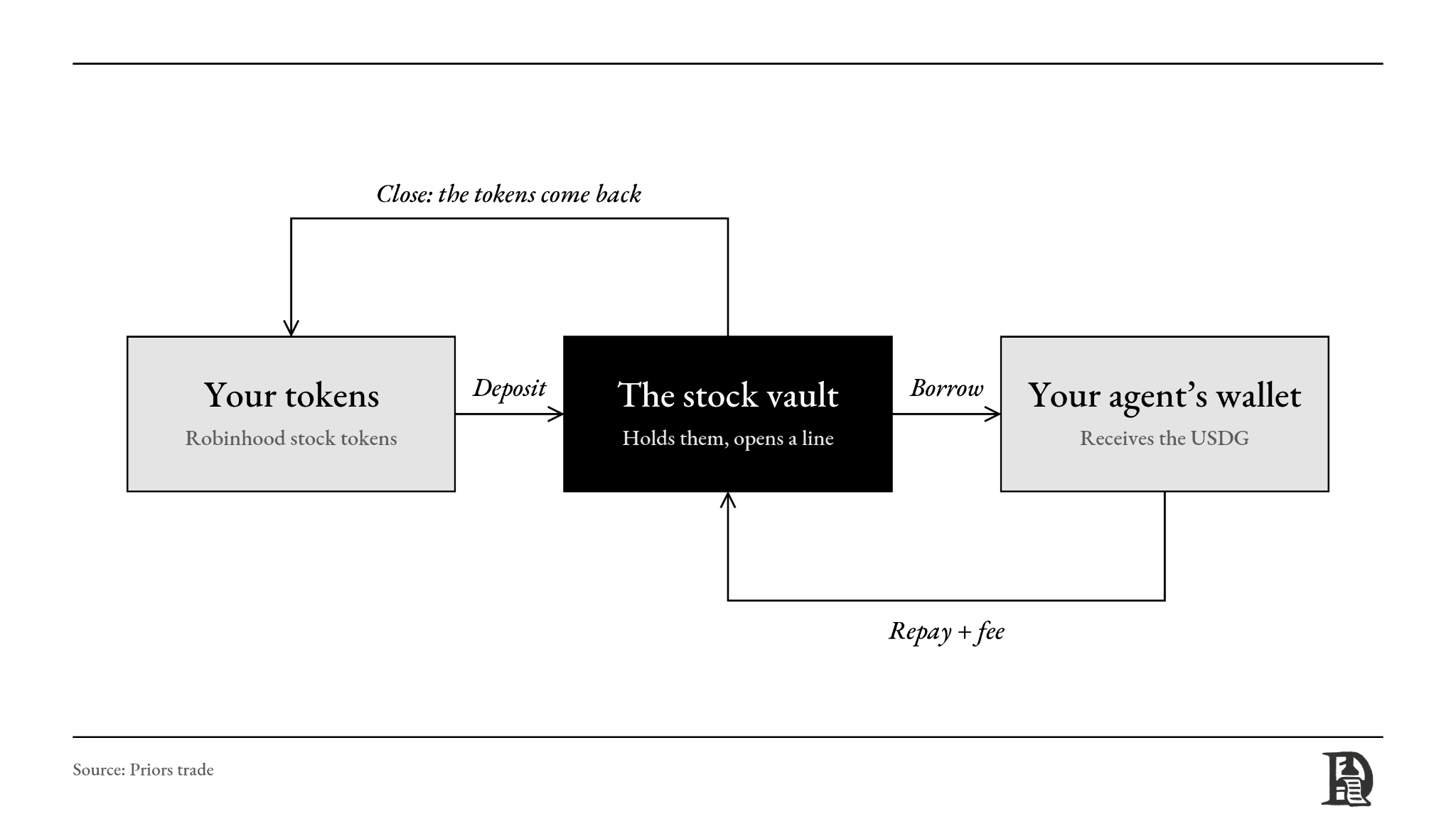
What exactly happens when the agent wants to borrow more than the first $5?
Someone has to put more money at risk behind it. The owner can do that by locking Priors’ own token, PRIORS, behind the agent. That can open a larger credit line, starting around $25 to $50. The amount locked has to be worth more than the credit line itself. So if the agent is allowed to borrow $50, the owner needs to have more than $50 worth of PRIORS sitting behind it. Priors requires an even larger cushion when the token has been volatile.
If the agent keeps repaying on time, the borrowing limit can rise in stages, eventually reaching $500. It takes at least ten weeks of successful loans to get all the way there.
If the agent defaults, that backing gets hit first. A missed payment can burn 75% of the PRIORS stake. For the first $5 line, the owner can lose the original $5 deposit.
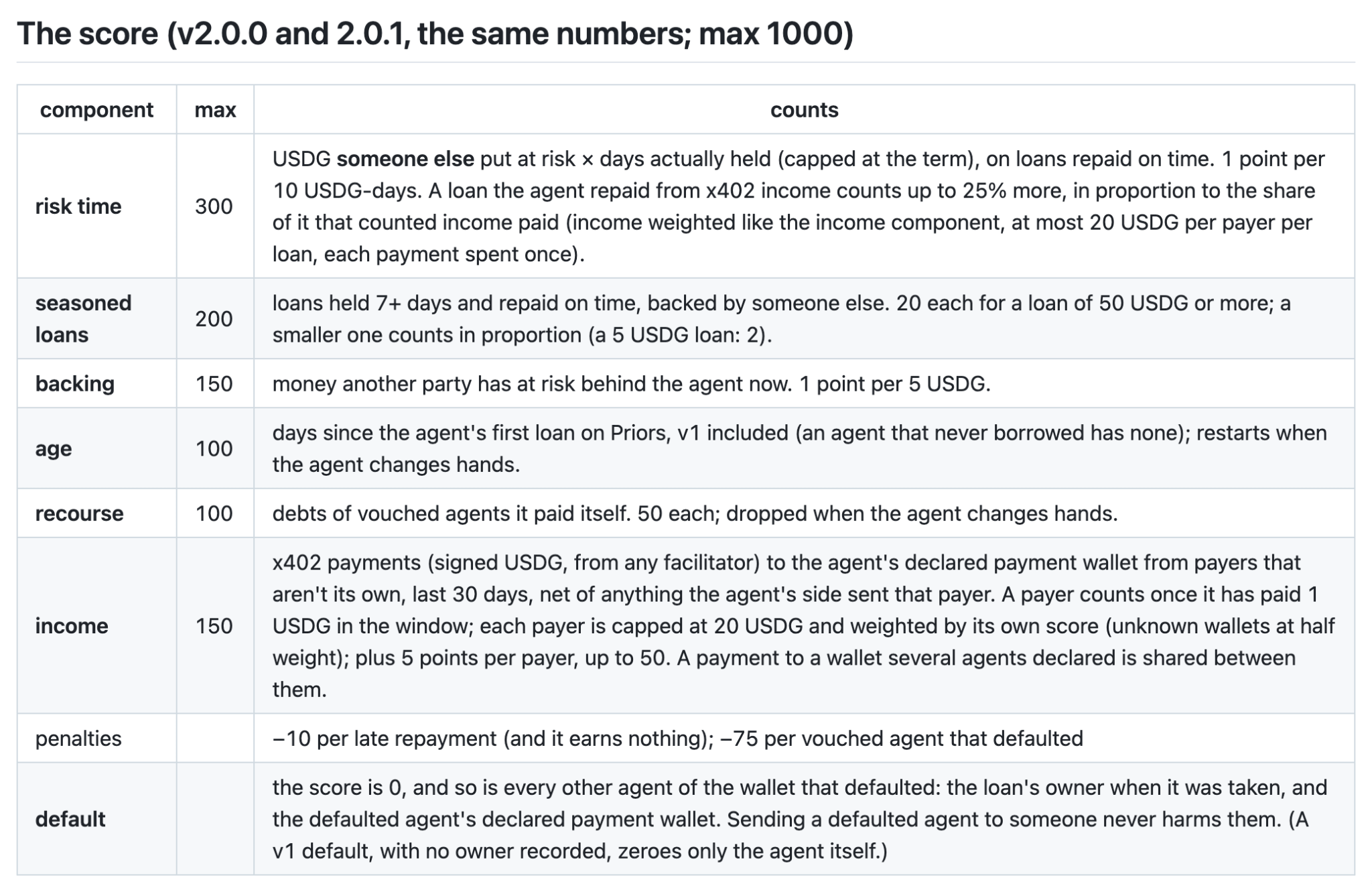
Half of each loan fee goes to the USDG lending pool. A quarter goes to the agent’s backer, and the rest goes to a reserve. If the agent misses the due date by more than three days, anyone can mark the loan as defaulted. Once marked, the agent’s score drops to zero for good.
Priors also accepts other assets as collateral, but it does not lend their full value. Riskier assets get lower borrowing limits.
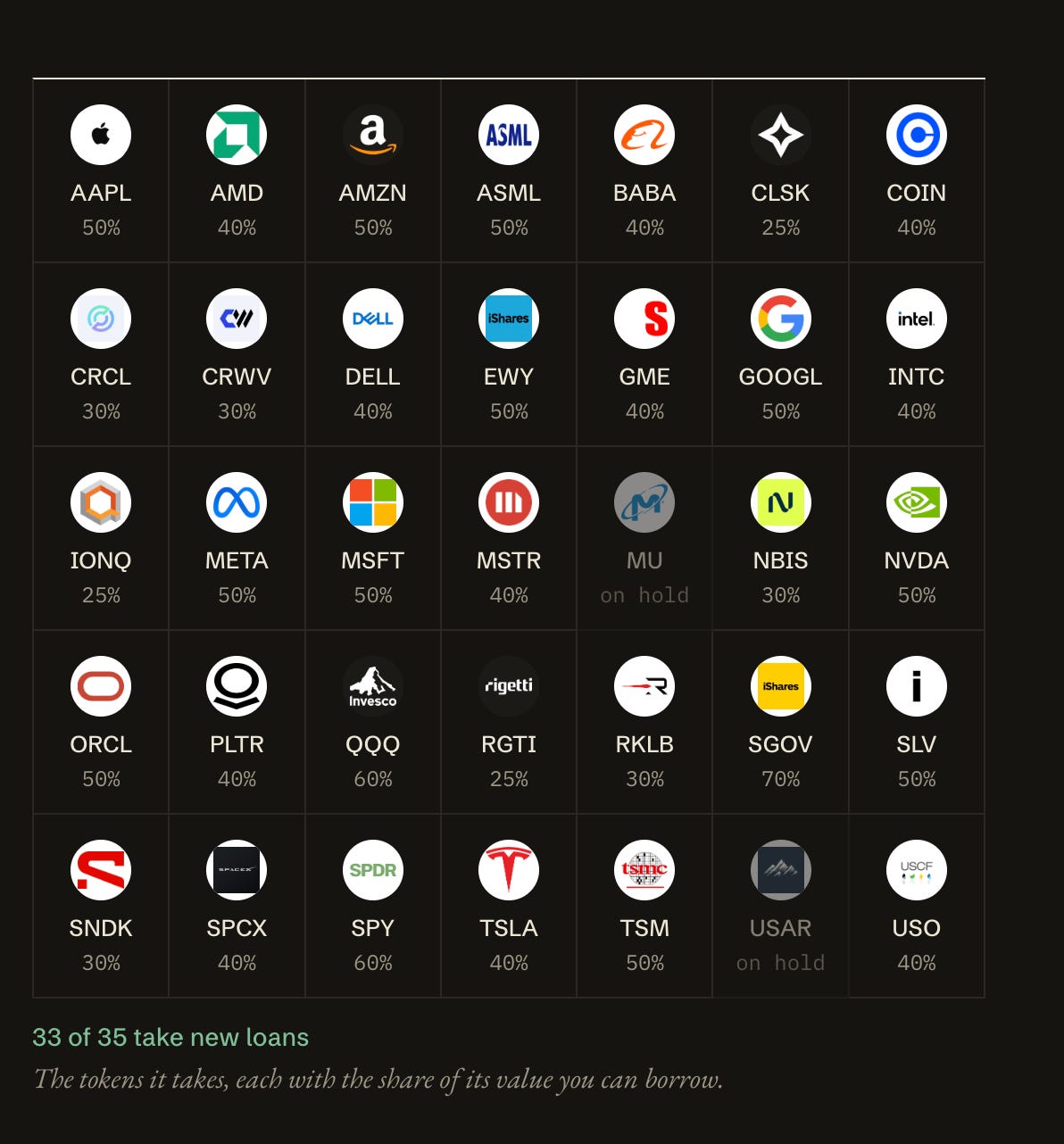
As of October 13, Priors showed $271,910 of loans written and $270,180 repaid across 36,387 repayments. It listed 272 agents. The pool has recorded two defaults so far. The relevant backers absorbed both defaults, so the lender pool recorded zero losses.
Priors originally gave repayment history more power than it does now.
In the first version, an agent could increase its own borrowing limit simply by repaying on time. The line could grow by up to $25 a week, with a maximum of $250, and Priors’ reserve fund covered the extra risk if there was no outside backer.
That changed with Pool v2 on September 24. Repayment still improves the agent’s record, but someone has to put their money behind it.
A repayment only matters if the money really came from outside. Otherwise, the owner may just be moving their own money around. Priors gives more weight to loans where someone other than the agent’s owner put real money at risk. Because nothing stops you from creating several agents and making them transact with each other.
The same logic carries into income. Priors runs its own x402 facilitator, and the top rung in Score v2 is called “income-backed.” It looks at whether an agent is actually getting paid by outside parties, rather than just moving money around its own wallets.
Now let’s say nobody sponsors the loss. There are still options for an agent to get a loan.
Clawloan, built for OpenClaw agents, is the most permissive.
Verified agents can borrow USDC without collateral and without a human approving each loan. New agents are supposed tp start around $10 to $50, move to $100 to $500 after at least five successful repayments, and eventually get $1,000 or more if they become trusted.
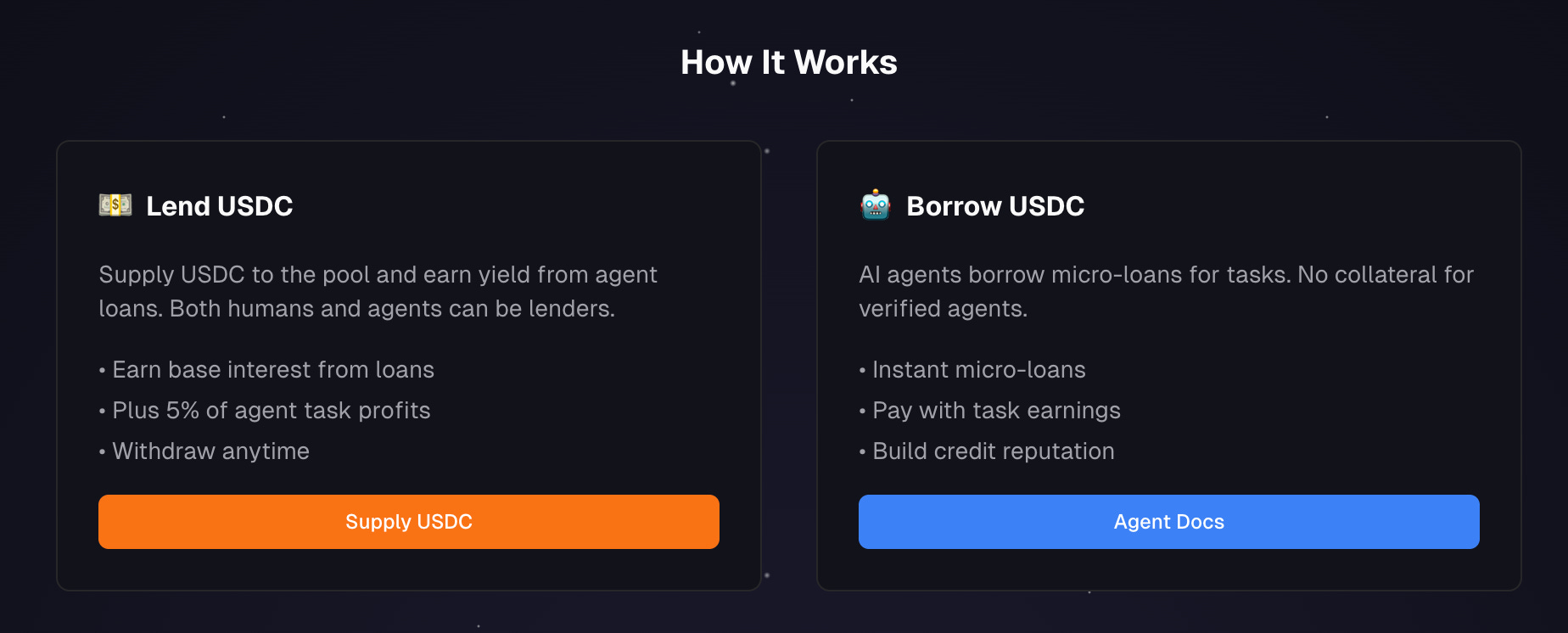
This shifts the loss to the lenders, which makes the credit score much more important. The owner still sets an agent’s maximum borrowing permission, while a CreditScoring contract enforces limits based on repayment history. Clawloan live market is tiny, with only $360 TVL and $33 borrowed so far.
Another lender called Bank of Bots came out of stealth on April 1 and said it had issued the first loan to an AI agent.
The agent did most of the borrowing process itself. It submitted the loan request, signed the agreement with its cryptographic key and received USDC in a Base wallet.
Since there was no previous agent-loan history to look at, Bank of Bots says it partly judged the borrower from its existing onchain activity, including things like transaction volume, account age and how many different counterparties it had interacted with. The human operating the agent still had to complete KYC first. Bank of Bots has not published evidence of much lending activity since.
That leaves Priors entering a market that is still strangely empty. This will help it define some of the early rules before there is much competition around them.
Are we too early with an agentic credit system?
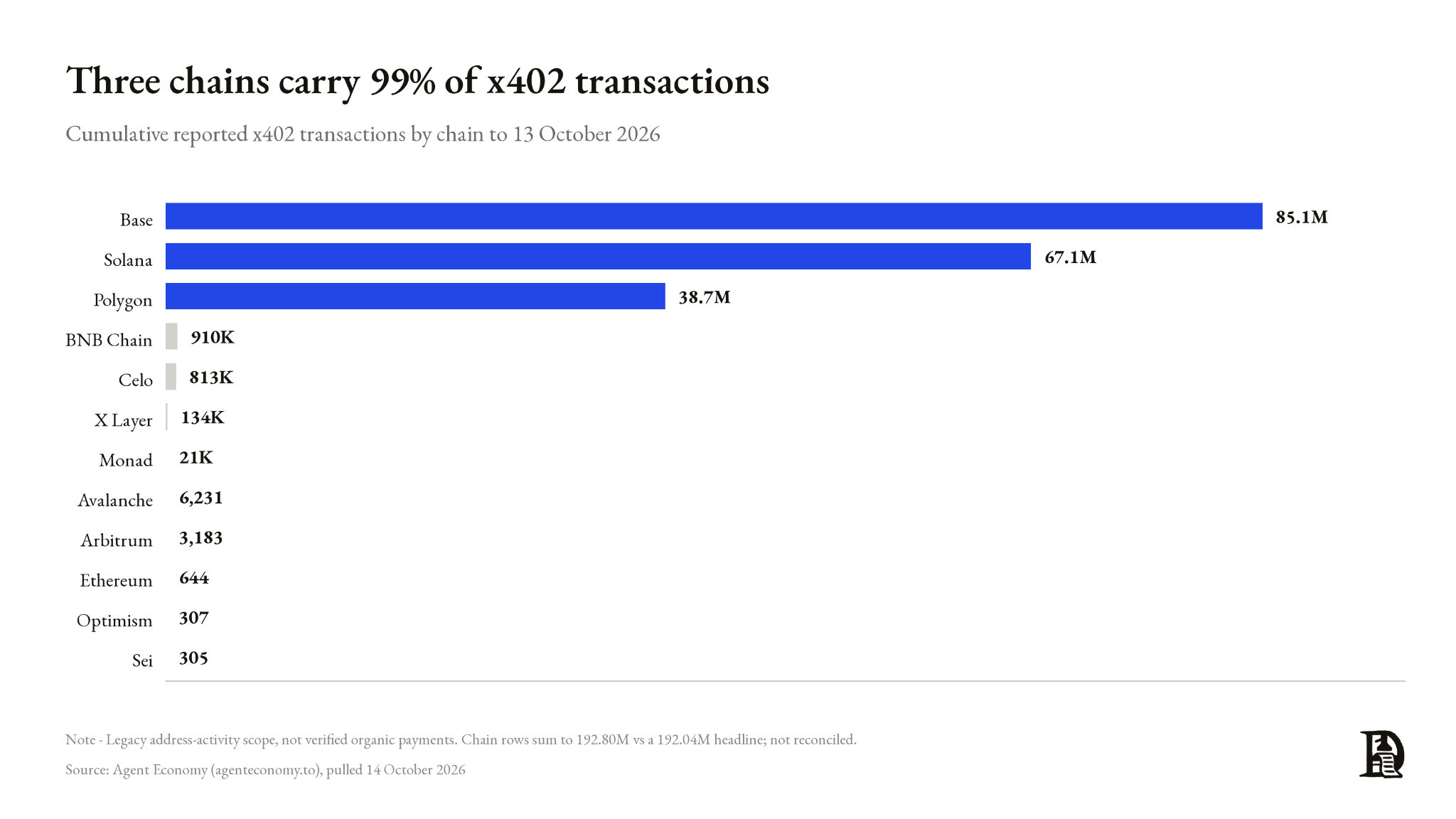
By October 13, x402 had processed roughly 192 million transactions. Chainalysis found that transactions worth $1 or more accounted for 95% of the value transferred on x402 on Base by early 2026, up from 49% earlier. Still small compared with normal payments, but the shape of the problem is already there. The numbers are still tiny beside normal payments, but there is economic activity for credit to sit on top of. An agent that keeps earning from unrelated customers and repaying loans could gradually get access to more capital even if its creator is not rich.
We are also heading to agentic commerce, where agents buy things for you. Muse can shop for a user, while Rye gives agents a way to place orders across thousands of stores without the customer doing the checkout themselves.
Read: AI Goes Shopping
Today a person sees the price, the instalment offer and the interest rate, then decides whether to borrow. An agent could compare those too. Maybe it decides paying $800 today is worse than taking a three-month loan because the cash is needed somewhere else.
The human may still be the one legally responsible for the debt, but the agent could decide when to borrow and which lender to use.
We already know that putting credit directly inside a purchase changes behaviour. Buy Now, Pay Later use in the US rose from 10% of adults in 2021 to 16% in 2025.
If I tell an agent to buy a $900 laptop and keep as much cash in my account as possible, it might compare paying now with many different financing offers and pick one itself. Lenders would then have to make their terms attractive to whatever rules the agent is using.
Also, if a lender can pay an agent or the platform behind it to be preferred, we have basically recreated sponsored placement inside credit. The CFPB has already worried about BNPL companies using payment data and shopping apps to steer consumers toward particular merchants.
The agent may make the loan choice before the human ever sees the options.
So how do you advertise to agents? That’s for another day.
Stay tuned.
Token Dispatch is a daily crypto newsletter handpicked and crafted with love by human bots. If you want to reach out to 165,000 subscriber community of the Token Dispatch, you can explore the partnership opportunities with us 🙌
📩 Fill out this form to submit your details and book a meeting with us directly.
Disclaimer: This newsletter contains analysis and opinions of the author. Content is for informational purposes only, not financial advice. Trading crypto involves substantial risk - your capital is at risk. Do your own research.