


I have no idea what a single answer from an AI model costs me.
I pay a flat fee every month, the way I pay for a gym, and like the gym I’m never sure if I’m overpaying or getting away with it. The only time money comes up is when a usage limit appears in the middle of a task and tells me to come back in a few hours. I go make tea and feel a little told off.
For example, I know tokens are what they give me to use a model, and I know they run out real fast based on which company is trending on socials. I never looked at what it costs for 1 million of those tokens, and I am the only one, but I just learned yesterday that there are input and output tokens.
When a coding tool or an agent talks to a model, it pays by the token too; a token is a chunk of text about three-quarters of a word long. Output tokens, which are responsible for giving you the results, are pricier than input tokens. Anthropic’s price list has Claude Opus 5 at $5 per million tokens going in and $25 per million coming out.
I don’t think software will take quite as much BS from chatbots. For all the people-pleasing these agents do, they could be quite particular about how they spend our money, provided we give them a budget and a way to compare what they’re buying.
AntSeed says it wants to do for AI what BitTorrent did for files. It is built for the customer who pays with tokens. It had its public launch on October 6, and it is a market where anyone can sell access to AI models, and anyone can buy without an account or an API key, which means an agent (or you) can walk in and shop for itself.
However, Liberating AI agents was not on my 2026 bingo card. But wherever this goes, it’s an interesting case study in whether an agentic world could give us more control over our money, instead of leaving the incumbents to collect it behind increasingly abstract interfaces. Today we’re getting into how it works.

StablesReward: Your AI Agent Spends, You Earn
AI agents can surf the web, read reviews, and book hotels for you. All these tasks cost money. But what if these tasks could earn you back something?
StablesReward does just that. Once you connect your agent to an MCP endpoint, it gives your agent a menu of paid tools. Every call your agent pays for earns you miles or stocks. And this is in addition to the rewards you earn anyway on your own spending across 800+ merchants.
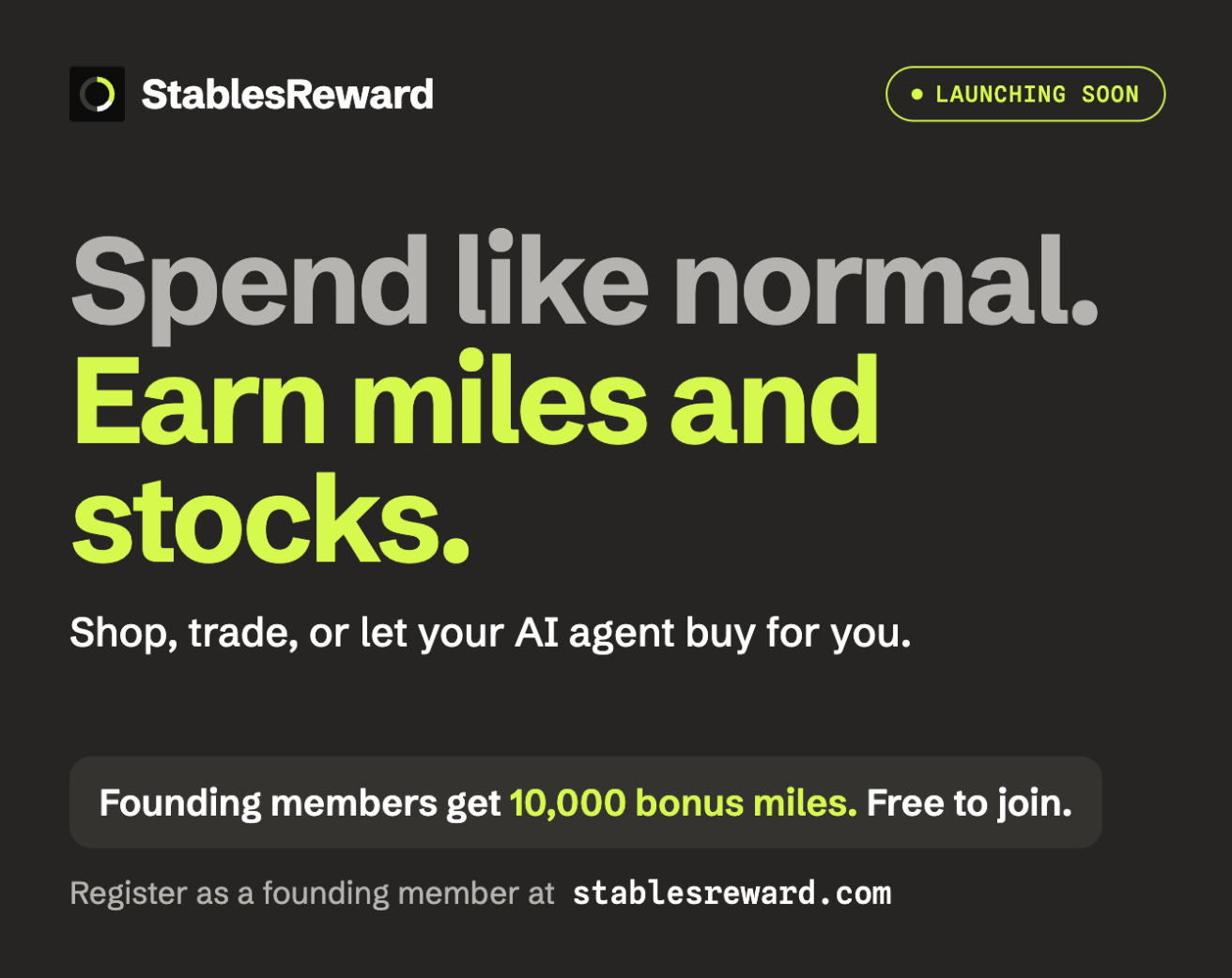
Every purchase pays you back. The best part is that you can choose how you’d like to be rewarded. Transfer miles to airlines and hotels, or let your stocks build a portfolio from the spend you were making anyway.
Launching soon. Free to join.
What on literal earth is an antseed?
I looked it up, and biology doesn’t have an antseed. But there’s something closely related. It’s a trick some plants play on ants. The plant sticks a small fatty snack on its seed. An ant carries the whole thing home, eats the snack and throws the seed out with the rubbish, where it grows, far from the parent. Thousands of plant species spread this way. This is called myrmecochory.
I don’t think the team had this in mind, but this idea suits them. The idea that a market could grow because lots of small participants find it useful to be there feels close to what made the internet exciting in the first place.
Spark Capital led a $2.4 million round into the foundation behind it this week, and on a dashboard that tracks the network, some sellers list OpenAI’s models at 97% below list price.
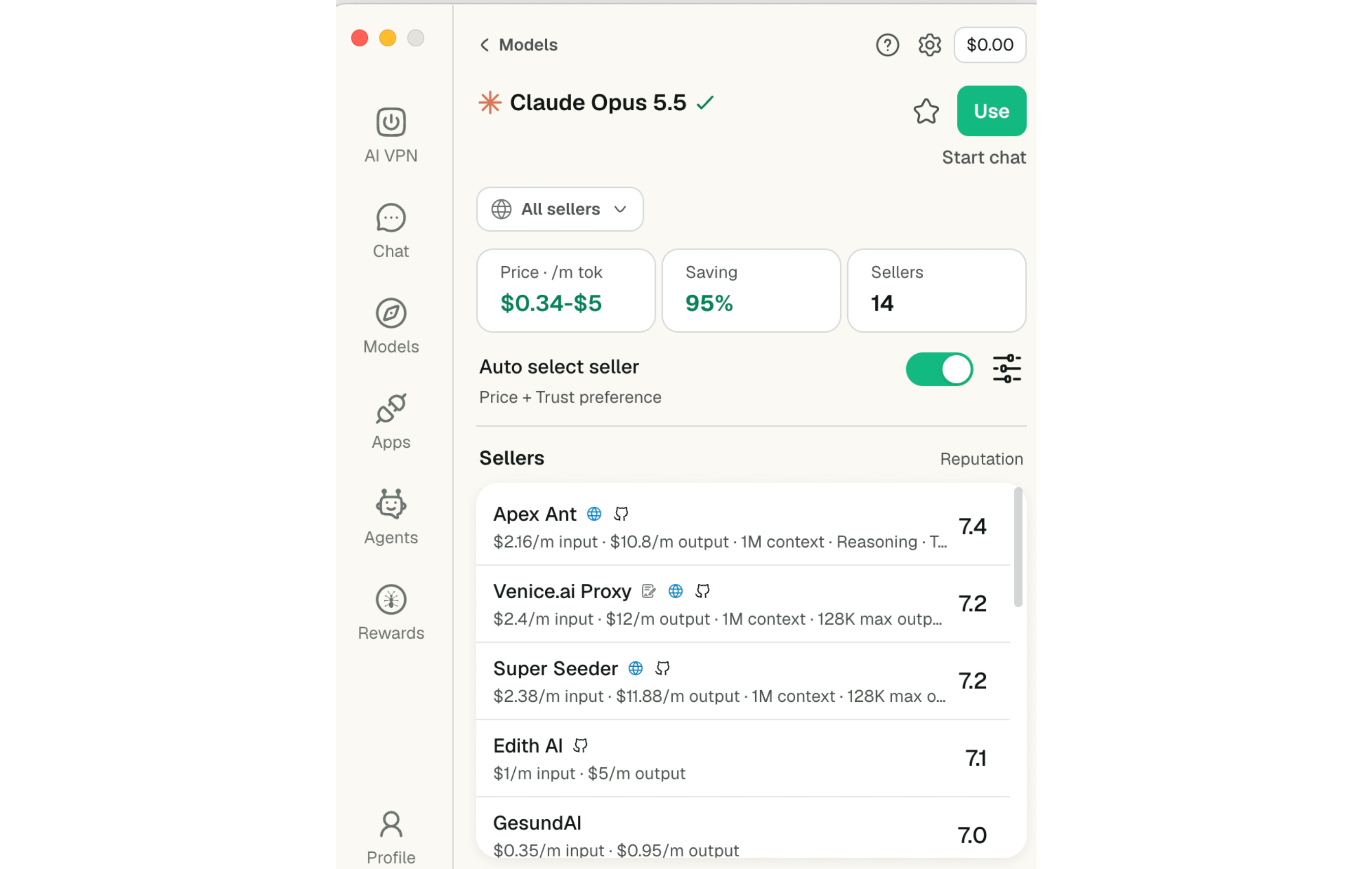
I found the following offer myself. 95% off on claude Opus 5.5. That is a large enough discount to make me finally look at what a token costs. I will tell you what that means
When you pay for a model by usage, you pay for what it reads and what it generates. Your prompt and the documents you give it count as input. What the model produces counts as output. Both are measured in tokens, which are small pieces of text.
Anthropic’s standard API price for Opus 5.5 is $4 per million input tokens and $20 per million output tokens. In my screenshot, an AntSeed seller called GesundAI advertises (bless him) those at $0.35 and $0.95, respectively. ApexAnt, the better-reputed seller, sells it for $2.16 and $10.80, respectively.
So, imagine your work adds up to a million tokens going in and a million coming out. At Anthropic’s standard rates, that costs $24. At this seller’s advertised rates, it comes to $12.96 - half. A less-reputed one comes down to $1.30 - about 95% less, before any additional fees and without applying Anthropic’s caching or batch discounts.
You are comparing offers from different suppliers for the same model. Before we go to the quality and reputation part, let’s see why they want to compare themselves with OpenRouter.
OpenRouter is one favourite name in the agentic universe, and it calls itself “Stripe for AI”.
Read: Stripe Bought Demand
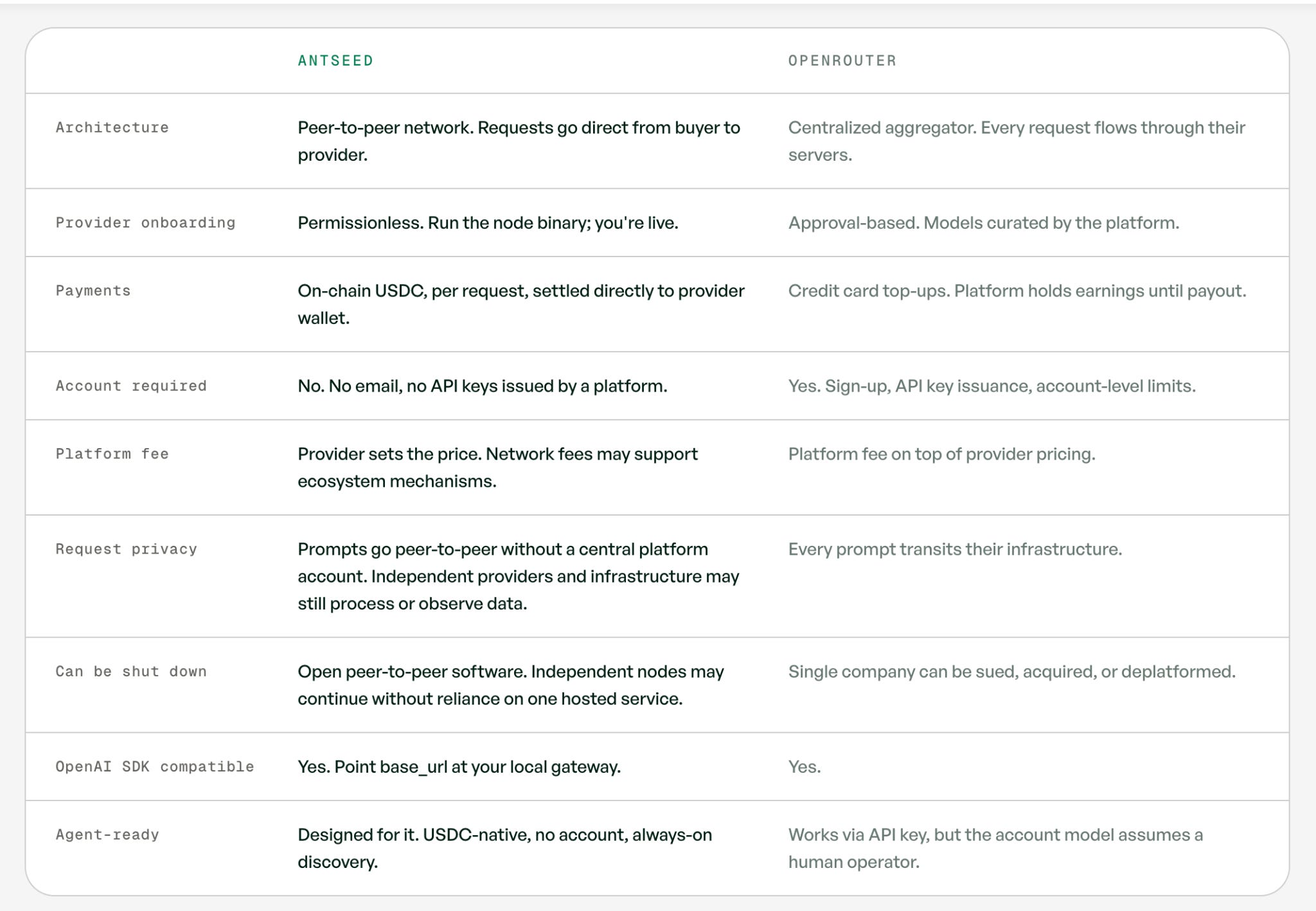
OpenRouter lets developers use different AI providers in one place. They can set a price limit, prioritise faster responses and exclude providers that store their prompts. If one provider fails, it can switch to another. AntSeed should not get credit for inventing these choices.
Look from the seller’s side. OpenRouter reviews provider applications, tests accepted endpoints and handles provider payments through monthly invoicing. It has a backlog and is prioritising providers with proprietary models. That creates a route to customers, but again admission depends on OpenRouter’s approval, so it’s not exactly an “open” market, fair, it never claimed to be one.
That’s where AntSeed finds value. The design allows providers to join without that central listing decision. Buyers apply their own selection rules, so a small operator can reach customers without persuading an aggregator that its service deserves a place or not. In exchange, the buyer’s software has more work to do deciding which unfamiliar operators deserve traffic. Open entry is valuable to the supplier who would otherwise be excluded. A customer may still prefer someone else to do the screening to avoid the trouble.
I like the idea of an AI shopping around before spending my money. I am kind of not comfortable with it deciding that an unfamiliar supplier is probably fine because the discount is excellent. Those two feelings belong in the same article.
What happens after a buyer finds a cheap offer?
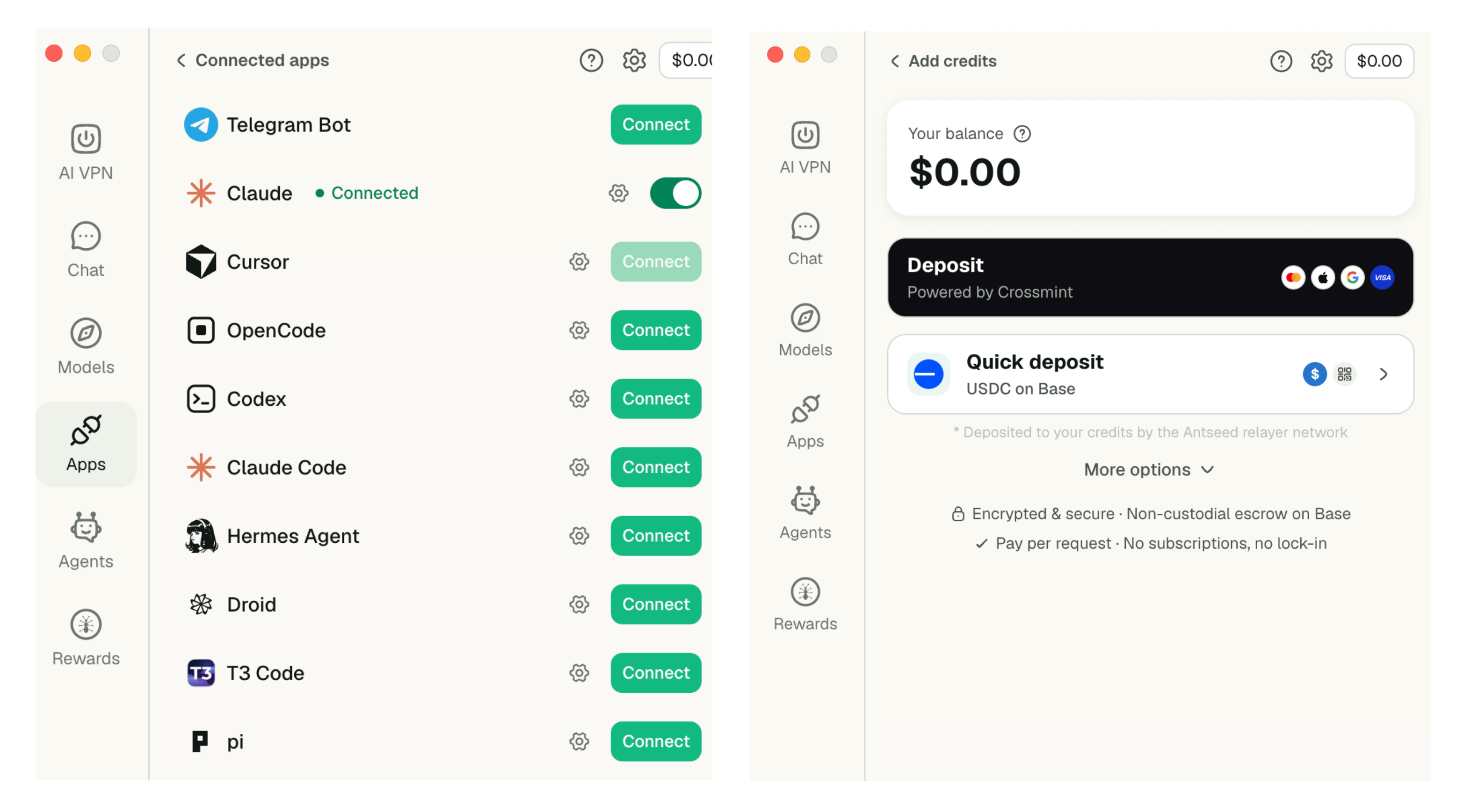
The easiest way into the product is its desktop app, called AI VPN. Despite the name, the key feature is a local connection between your AI tools and external suppliers.
Your application sends its request to AntSeed’s software on your computer. That software finds providers and connects to the chosen one. It will be encrypted communication directly between buyer and seller, without a central AntSeed server forwarding every prompt.
A seller might run a model on its own hardware. It could also build a service using another company’s model API, the connection through which software requests answers. AntSeed therefore does not necessarily remove the original model company from the transaction.
If the seller relies on an upstream API, that supplier remains involved. AntSeed says providers using upstream services must comply with their terms.
An operator serving an openly available model can compete on how efficiently it runs the hardware. Someone building on a closed model is still exposed to the upstream supplier’s pricing and access decisions.
Essentially, their cost control still depends on how they deliver the model.
From the buyer’s side, the useful part is being able to change suppliers and they skip rebuilding the application around each one. The local software handles selection, often called routing.
What builds a reputation?
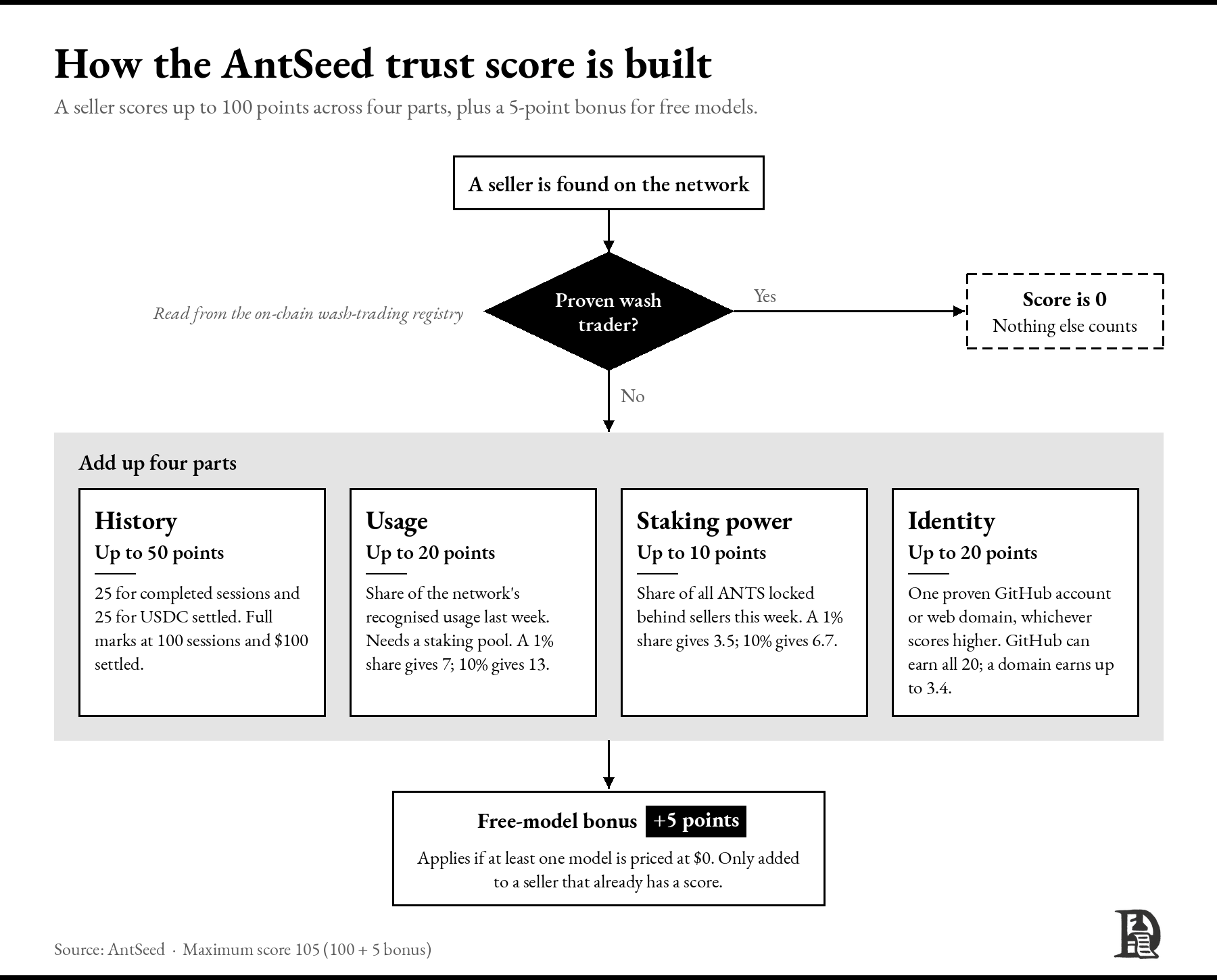
AntSeed computes a reputation score using evidence that buyers can inspect. Half the available score comes from settled payment history. Recent recognised usage contributes another 20 points, while verified identity history can contribute 20. The remaining ten depend on the seller pool’s share of staking power. AntSeed currently sets a default minimum trust score of 60 out of 100 for model-based requests. It can switch to another eligible seller after certain failures, while giving ongoing conversations preference for their previous successful route. Also, a seller proven to have engaged in wash trading receives a score of zero under the documented rules.
AntSeed supports an additional check for providers using a protected area of server hardware, called a trusted execution environment, or TEE. The buyer’s software can verify evidence about that environment before paying.
So it’s not all “the cheapest wins.” But I still had questions, and only some got satisfactory answers.
How do I know I’m getting Opus rather than a cheaper model?
The listing and reputation score cannot prove that. AntSeed can record which seller supplied an answer, but its tools for checking which model actually produced it are still proposed work. For now, these are advertised offers, not independently verified model access.
Could Anthropic or OpenAI cut off a seller?
Yes, if the seller violates its upstream terms. Anthropic allows developers to build products using its API, but requires express approval to resell its services. OpenAI also allows API-based products, but
prohibits reselling account access or API keys. Both can suspend access for violations. AntSeed leaves compliance with these rules to each seller and explicitly says a reputation score does not confirm that compliance.
Has anything concerning happened already?
The independent AntSeedStats dashboard reported that nine of its ten largest models by lifetime sales were almost entirely wash trading under its classification before it filtered the rankings. Those sellers’ payments still count towards the network total, so the roughly $310,000 settled number is not beautiful inside out.
The implemented system can attach a seller’s signature to a response, linking that seller to the exact content delivered. The specification still marks the proposed model-checking tools and penalties for confirmed substitution as work to come.
There is another reason to be careful, which is a token. AntSeed uses a separate token, ANTS, to reward eligible participation. USDC pays for the service, while reward rules determine which activity earns tokens. Staking affects rewards and pool power, but the minimum seller-pool stake for selling on Base is set to zero.
As we have seen before, rewards make it harder to infer customer demand from payments alone. Liquidity mining taught crypto that people will bring money when tokens are being handed out.
This was clearly a rollercoaster read, so let’s complicate it or lighten it with how the payment works? Because that’s my favourite thing about the tool.
Your AntSeed buyer software has a wallet with its own funding address.
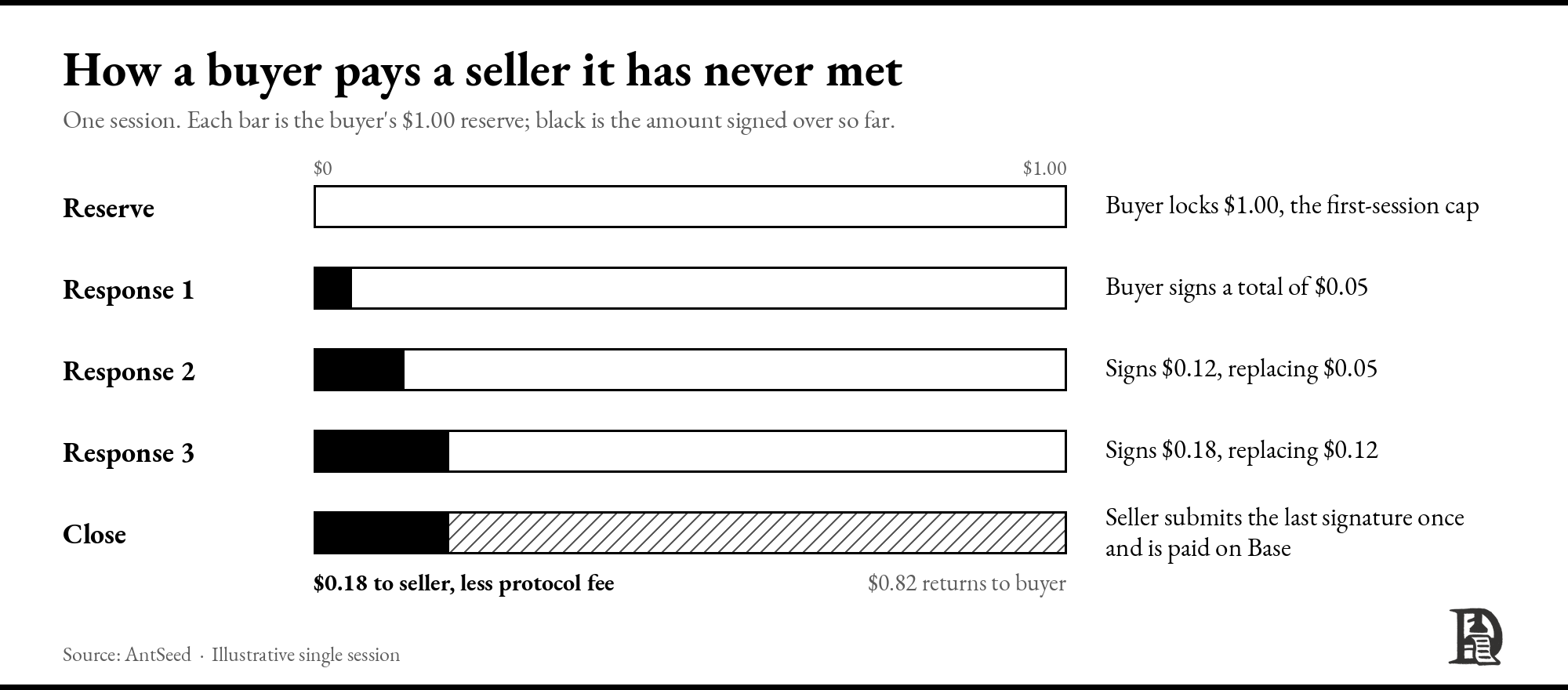
You send USDC to that address, and the software automatically moves it into AntSeed’s payment contract as your spending balance. The app then reserves money from that balance when you use a seller. These work as micropayments.
Say you have $10 in your AntSeed balance. The app sets aside $1 for a seller, leaving $9 available. Your requests cost 18 cents altogether. When the session settles, the contract pays out those 18 cents, with the protocol fee deducted from the seller’s share. The unused 82 cents is unlocked, bringing your available balance to $9.82.
If you spend the entire reserved dollar instead, the app pays that bill and automatically sets aside more money from your remaining $9 to cover further requests.
Silver lining
I think there are some defensible silver linings. Both could matter even if AntSeed’s cheap access to proprietary models proves unsustainable. Two things it built would still be useful to somebody.
One is that if I figure out an AI to do some useful work, small or big, and I don’t have the intention of building an entire company around it, I need a venue. A shared marketplace could give you somewhere to offer that service and find your first few customers. They bring documents you never tested on, expose mistakes and, perhaps, come back.
Being listed does not guarantee customers, of course. That is the part AntSeed still has to earn. But if buyers can discover small services and try them cheaply, a good product has another route to customers besides its creator becoming unusually good at marketing.
A study last November of Hugging Face, the site where open AI models get shared, covered 851,000 models and 2.2 billion downloads. It found downloads moving away from Google, Meta and OpenAI towards unaffiliated developers and community groups, with a new layer of people who take a base model and adapt it. So plenty of ordinary people are building useful things with AI. A download pays them nothing
There is something in this for ordinary users too. Most people encounter AI through a handful of chatbots and whatever features those companies decide to put in front of them. A broader market could let them try someone else’s solution to a very particular problem, without needing to build it themselves. That possibility is still rough around the edges. Finding a service, understanding what it does and trusting it with your documents all need to become much easier.
The other point is not commercial. I find it difficult to accept that powerful AI could remain inaccessible to people who nevertheless share the environmental costs of running it. Access will not compensate for those costs, but the imbalance is a problem still. People should have more ways to benefit from technology whose consequences reach them regardless.
An open marketplace feels like one direction we should pursue although it cannot make computing free or remove the environmental dilema. But making one of the biggest technological convergance inaccesible, makes no sense.
But humans have to be good people and behave so that we can have decentralised systems all over the world. But humans are famously, humans.
That is a bad bet, but giving people a way to earn by being useful seems a good start. Hail myrmecochory.
That’s all for today!
—Thejaswini
Token Dispatch is a daily crypto newsletter handpicked and crafted with love by human bots. If you want to reach out to 165,000 subscriber community of the Token Dispatch, you can explore the partnership opportunities with us 🙌
📩 Fill out this form to submit your details and book a meeting with us directly.
Disclaimer: This newsletter contains analysis and opinions of the author. Content is for informational purposes only, not financial advice. Trading crypto involves substantial risk - your capital is at risk. Do your own research.