


Hello,
Last week, I argued that remittance won’t have a global winner. Stablecoins help move money faster, but they can’t make sending money cheaper on their own. I wrote about how those who own licences, exclusive banking relationships, and the last-mile ramps will capture all the value arising from the evolving remittance stack.
More often than not, those who are building with these moats will be on either side of the blockchains and will have little to do with on-chain infrastructure.
Read: Remittance Won’t Have a Global Winner
In today’s piece, I take that argument one step further. With the help of some case studies in the LatAm region, I will explain why the logic holds for everything people do with money. Be it lending, borrowing, spending, saving, or investing.
Stablecoins are becoming finance’s common denominator just as fiat currency has been for decades. Nobody gets to capture much value just for supplying a common denominator.
Today, I will explain why money will be made a layer above, by local businesses who fit dollars around how people in their regions use such money.
On to the story...

StablesReward: Your AI Agent Spends, You Earn
AI agents can surf the web, read reviews, and book hotels for you. All these tasks cost money. But what if these tasks could earn you back something?
StablesReward does just that. Once you connect your agent to an MCP endpoint, it gives your agent a menu of paid tools. Every call your agent pays for earns you miles or stocks. And this is in addition to the rewards you earn anyway on your own spending across 800+ merchants.

Every purchase pays you back. The best part is that you can choose how you’d like to be rewarded. Transfer miles to airlines and hotels, or let your stocks build a portfolio from the spend you were making anyway.
Launching soon. Free to join.
Stablecoins are a Commodity
In June this year, more than 140 firms, including Visa, Mastercard, and Stripe, announced OpenUSD stablecoin and promised free minting and shared reserve income among its partners. Circle, the issuer of the second-largest circulating stablecoin, already pays ~58% of its revenue to distributors.
This shows that the stablecoin itself is being commoditised and is leaving little value on the table for others to capture.
So if the dollar isn’t the moat, what is?
Building around Local Habits
I think a local business needs three things to capture value in the evolving stack of moving money. First, a way to reach customers that a global player can’t copy. Second, a product that solves a money problem that is specific to that market. Lastly, the ability to provide further utility to the money they already transport, by way of investing, borrowing, saving, and so on.
Brazil found a fix to make payments more efficient. They did so even before stablecoins existed. Pix, the central bank’s instant-payment system, processed 67.25 billion transactions worth approximately Brazilian R$31 trillion (about ~US$6.22 trillion) in the nine months ending September 30, 2026.
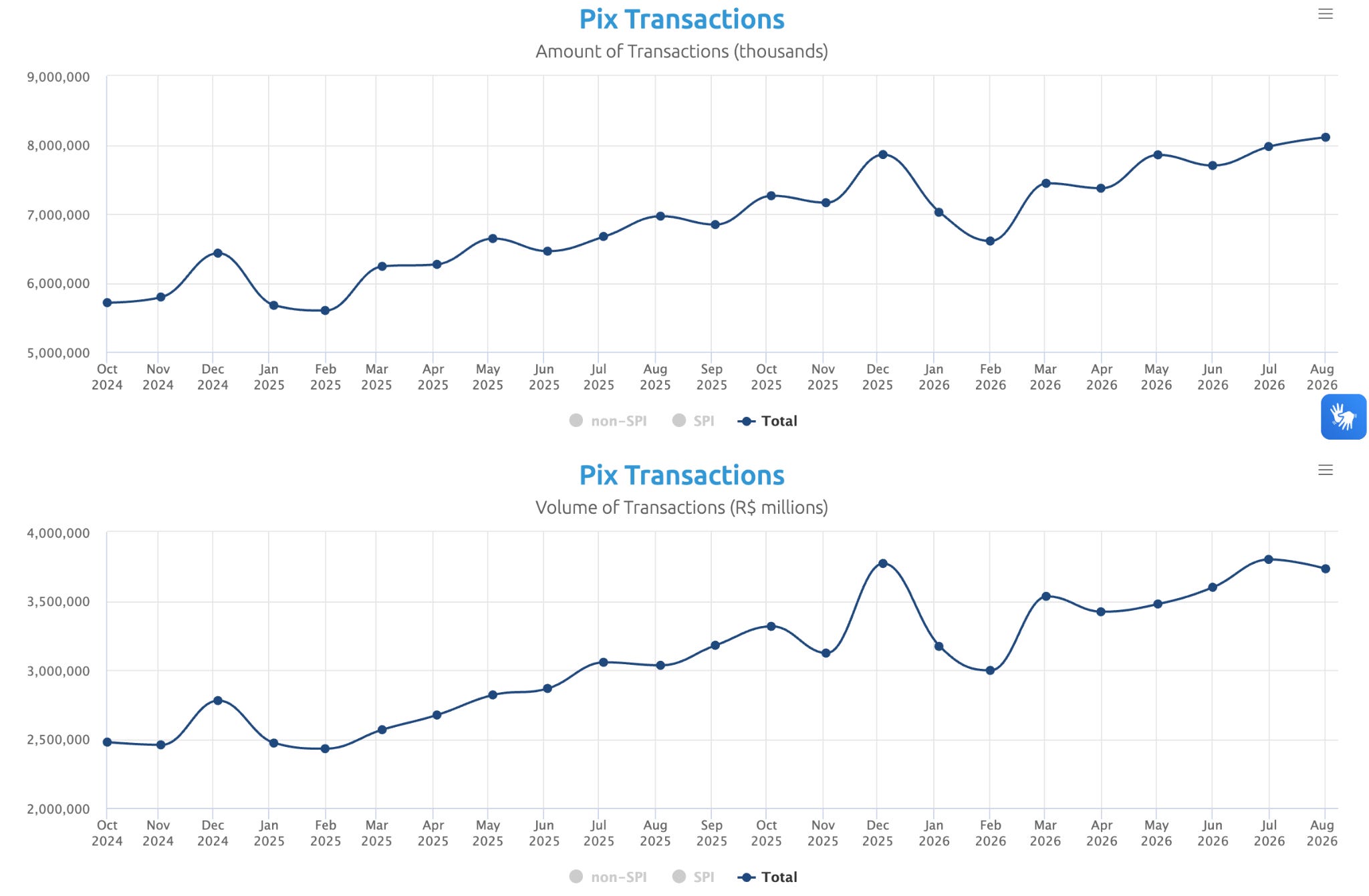
Making payments in Brazil is already instant and free. So a stablecoin has nothing to add to a Brazilian payment.
But there’s a gap here. Brazilian minors have struggled to open bank accounts in their names. Founded in 2021, NG.CASH let the Brazilian GenZ population open an account with Pix, gave them a customisable prepaid Mastercard and savings tools, with a parent’s approval.
About 70% of its users are still under 18. Most come from middle- and lower-income households, and for many, NG.CASH is the first financial account anyone in their family has opened.
NG.CASH found its initial customers almost entirely on YouTube, TikTok, Instagram, and Twitch. Co-founder Mario Augusto Sá ran a Minecraft YouTube channel with about 20 million subscribers before he built a bank.
This helped the company inherit a distribution that few can command.
NG.CASH’s other advantage is the stack that it has built to enable various utilities of money for its users.
Once teenagers started using NG.CASH app, the company kept adding more features and uses of money. After allowing them to open an account and card, they let them save their money and earn interest on it like a savings account in a bank. Then followed consórcio (a Brazilian group-buying EMI scheme to pay for phones, games, or motorbikes in instalments), insurance, fixed-income investments, and crypto trading products.
As the customer base grew, it added more features. Last month, the company expanded its financial services and credit offerings in Brazil after raising $15 million in a funding round led by Blockchain Capital.
The push for the credit product followed the demand from users. About 30% of NG.CASH’s 10 million-plus accounts now belong to adults. That could mean at least 3 million employees. Formal jobs speed up the adoption of credit products since the employees are left with disposable incomes and aspirational goals.
In March 2025, Brazil extended payroll-deductible loans to every formally employed private-sector worker. Repayments of up to 35% of a salary are deducted straight from the paycheck, which makes these loans far safer for lenders than ordinary personal loans.
New loans under the programme jumped 184% to R$54.5 billion in 2025. By March 2026, the programme had lent over R$117 billion across 20.9 million contracts, at an average interest rate of 3.67% a month.
This year, NG.CASH launched its own payroll loan, Crédito CLT. The company expects credit to make up more than half of its revenue next year. It aims to lend R$1 billion by the end of 2027.
What helps NG.CASH capture value across all these products is that no other global players can boast of the licences the company has. It has been an authorised payment institution since May 2025 and has bought a direct-lending licence so it can lend from its own balance sheet. It has also applied for Brazil’s new crypto licence. The company spent significant time and capital to acquire each licence, and a foreign entrant would have to spend much more.
For every $100 USDC in circulation, Circle keeps roughly $1.60 a year after paying its distributors. That’s a net margin of 1.6% a year on every USDC in circulation. A single R$4,500 payroll loan at the programme’s average rate earns about R$165 in interest in its first month alone. That’s an average of 3.67% a month, which works out to about 54% (compounded) a year. Defaults and funding costs will eat into that, but a lender still starts with more than 30 times the issuer’s cut on each unit of money.
But where do stablecoins fit in NG.CASH’s stack? Brazil’s central bank governor has said around 90% of the country’s crypto flows are linked to stablecoins. NG.CASH plans to offer stablecoin accounts. When that happens, a dollar balance will become another way for the users to move, store, and spend their money. It will be available in the same app that its users have been trusting all this time, alongside the card, savings, and loan products.
For NG.CASH, the stablecoin will just be an enabler that will let it cross-sell multiple uses of money to its users.
Using the Chain to Own the Customer
Across Latin America, the businesses capturing value from stablecoins use on-chain tools without building on-chain infrastructure.
Take Argentina. For the Argentines, protection from the devaluation of the peso is more important than seeking credit. In 2002, the government forcibly converted dollar deposits into pesos, wiping out about three-quarters of their value. In 2019, it capped dollar purchases at $200 a month. For those in Argentina, the option to save in dollars is a lifeboat.
Lemon, one of Argentina’s largest crypto apps with more than 4 million users, built its first product around that lesson. Users convert their peso salaries into stablecoins and spend them with a Visa card that converts back to pesos at the checkout counter.
Lemon has also added yield on dollar balances through Morpho, a lending protocol running in the background. It then added a peso credit card backed by Bitcoin and a virtual US bank account. Tokenised stocks are on the way, too.
These apps are sticky. Once users get habituated to using these products, they seldom leave, even if the original factors that led to the adoption of the app cease to exist. For instance, Lemon’s downloads kept rising every quarter, even as monthly inflation fell from 25.5% to 2.1%.
Here, Circle and Tether issue the digital dollars, Morpho runs the lending market, and Visa runs the card network. Yet, it’s the local apps like Lemon and NG.CASH that own the customer, and decide which use of money they should offer next on their app.
We see something similar even with Mercado Pago, Latin America’s largest fintech. In Argentina, it addressed the demand for US dollars with a dollar account that pays 1.8% a year.
There is a global winner in this picture, but it is the common denominator that sits underneath all this. Morpho’s lending vaults now hold more than $17 billion. Coinbase and Robinhood each passed $500 million in their Morpho-powered earn products in September, and Lemon’s yield product runs on the same engine. Visa and Mastercard process the card swipes for Lemon and NG.CASH alike, and both joined the Open USD consortium. The infrastructure is becoming shared, interchangeable, and global.
But the customer relationship will continue to remain the exclusive moat. Chainalysis found that 71.2% of crypto balances in Latin America now sit with service providers rather than in personal wallets, above the global figure of 68%. So, customers want to receive, hold, convert, spend, and access financial products from the same venue.
That’s why these businesses don’t work equally well across different geographies.
In October 2025, Lemon raised a $20 million in Series B, and said it would double its users to 10 million and expand to Chile, Colombia, Brazil, and Mexico. Last month, it told its Brazilian customers it was leaving. Four years after entering Brazil, Lemon had about 15,000 customers holding balances there. It said getting licensed under Brazil’s new crypto rules would require capital out of proportion to an operation of that size.
What let Lemon down in Brazil wasn’t their product. It had already solved Argentina’s problem using the same product. The concern was that Brazilians already use Pix for payments, USDC rewards inside Nubank, and dollar access through Mercado Pago. Lemon’s unique selling point, which was a way to escape a collapsing currency, had little pull in a country where people don’t feel the same urge to escape the Brazilian real. So Brazilians had little reason to move their money to Lemon. After four years, only about 15,000 of them held balances in the app, too few to justify the capital a licence required.
Lemon launched in Brazil without the local distribution and licence it was willing to pay for. That sets it back by two important moats that help local businesses win in the evolving payment stack.
Meanwhile, Lemon is doing well in Peru, where it has more than 1 million validated users. This shows that the product grows where people share the money habits of Argentines.
The direction is the same across remittance or savings. As stablecoins become cheaper and easier to issue, Circle and its rivals will keep handing more of their reserve income to whoever holds the customer. In Brazil, that’s NG.CASH, with its licences, its creator-led reach among teenagers, and its payroll loans. In Argentina, it’s Lemon, with dollar savings that Argentines have learned to trust.
Stablecoins have already cut the complications by making the dollar within reach of anyone with a phone. What people do with that dollar depends on the money habits of the people in that geography. Those who can build moats like licences and distribution in the geographies they operate in will capture the most value.
That’s it for today. I will be back with the next one.
Until next time, stay curious,
Prathik
Token Dispatch is a daily crypto newsletter handpicked and crafted with love by human bots. If you want to reach out to 165,000+ subscriber community of the Token Dispatch, you can explore the partnership opportunities with us 🙌
📩 Fill out this form to submit your details and book a meeting with us directly.
Disclaimer: This newsletter contains analysis and opinions of the author. Content is for informational purposes only, not financial advice. Trading crypto involves substantial risk - your capital is at risk. Do your own research.