


Hello,
All good technologies are great levellers. They create a common denominator for all the value that can be created on top of that. Mobile phones and the internet are great examples of the 20th century. Blockchains can be one such leveller in the 21st century.
High remittance cost is a nagging pain point in the international payments landscape. But the cost is not a single fee component for moving money from one country to another. It involves several players stacked across several layers, each charging a fee to facilitate a part of the cross-border transaction.
In this piece, I break down this stack and explain why off-chain and on-chain venues will come together to capture value accruing in an evolved remittance stack that cuts fees collected for remittances and moves money faster across borders.
On to the story…

StablesReward: Your AI Agent Spends, You Earn
AI agents can surf the web, read reviews, and book hotels for you. All these tasks cost money. But what if these tasks could earn you back something?
StablesReward does just that. Once you connect your agent to an MCP endpoint, it gives your agent a menu of paid tools. Every call your agent pays for earns you miles or stocks. And this is in addition to the rewards you earn anyway on your own spending across 800+ merchants.

Every purchase pays you back. The best part is that you can choose how you’d like to be rewarded. Transfer miles to airlines and hotels, or let your stocks build a portfolio from the spend you were making anyway.
Launching soon. Free to join.
Moving money costs money. That cost goes up even more when you move money across borders. The problem is that you accept that cost without even knowing what you are paying for.
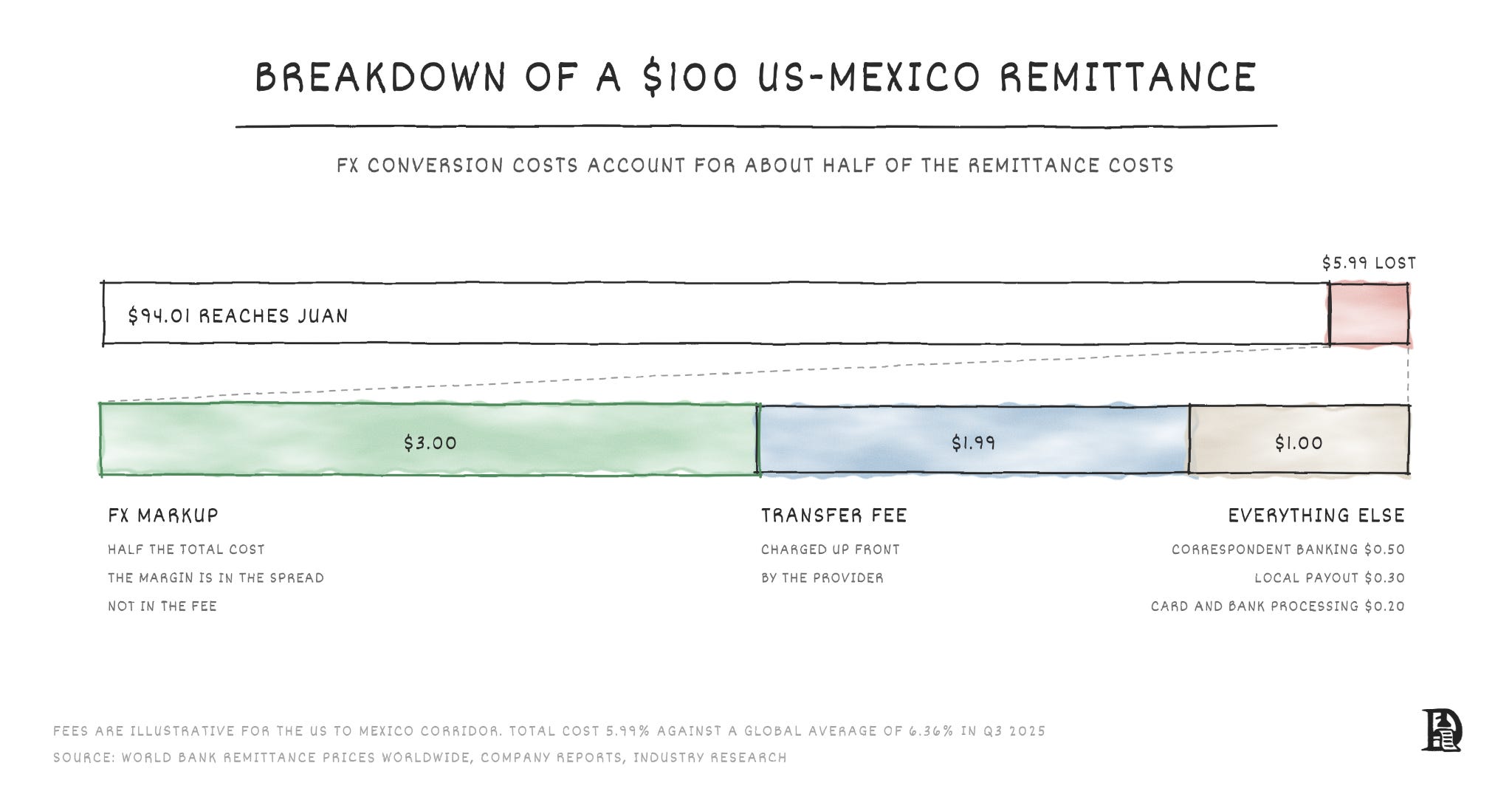
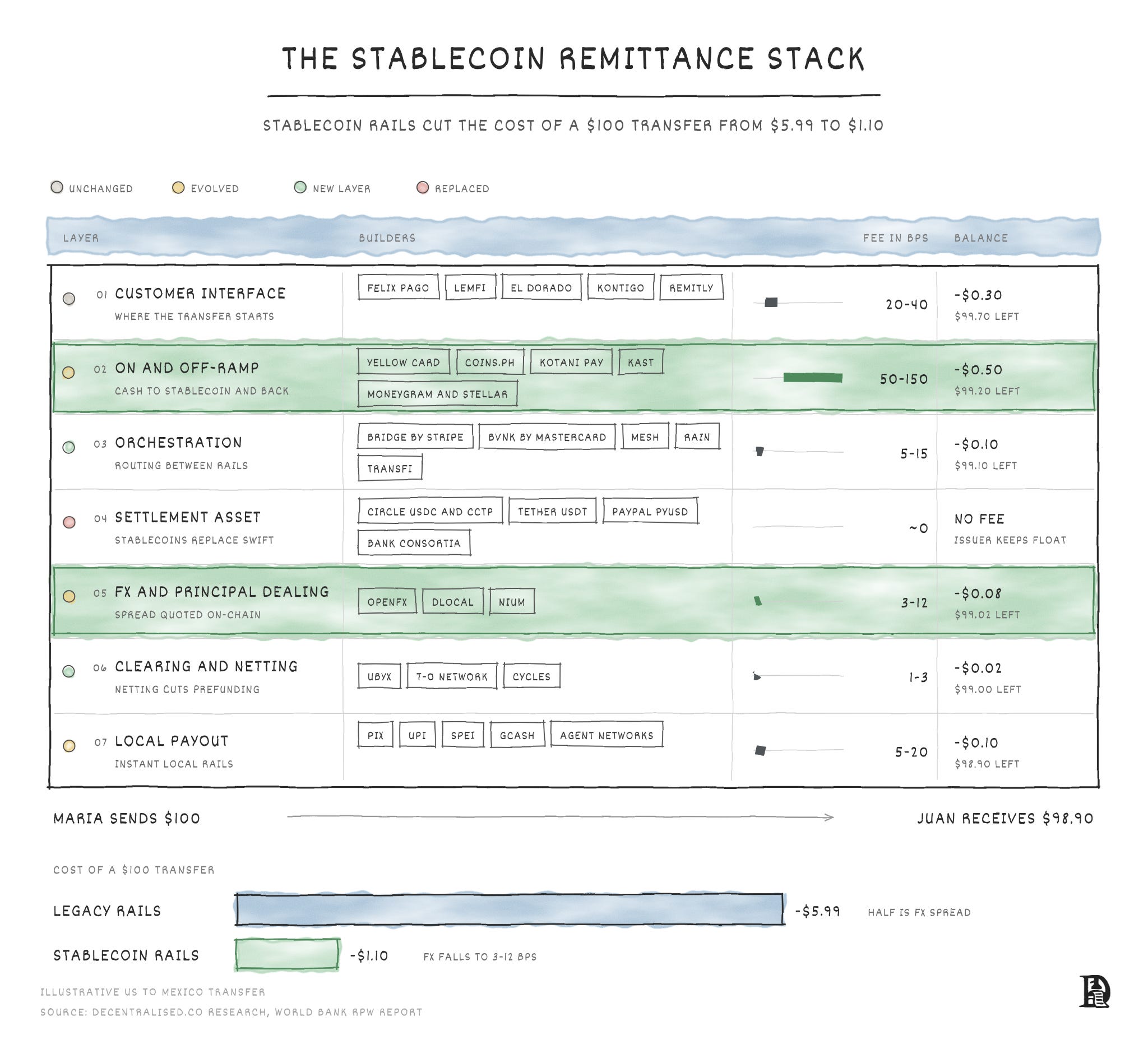
When you send $100 home from your job in the US, your family in Mexico gets pesos equivalent to barely $94. The $6 lost in between seems like the fee you pay to move money across the border. Except the actual fee is ~$2, far less than half of that $6. This fee is even shown on your screen before you send the $100. So what are the remaining $4 charged for?
An ordinary remittance transaction goes through multiple hops. Each is gatekept by some entity. And they all take a cut. The biggest cut is usually the forex leg. Your dollars have to become pesos before they arrive in a Mexican account, and banks charge a spread on the mid-market rate to do it. This sets you back by ~$3, about half of the total fee you pay.
Stablecoins launched, gained traction, and we rejoiced, thinking this would change the way we send money across borders. What happens from here? Blockchains will be table stakes and not a moat. They won’t produce a single winner.
The real value will come from off-chain work like securing licences, building banking relationships, and enabling last-mile payouts. Each geography has different regulations and banking requirements. We expect the remittance market to create a map of regional champions. Each player will own a corridor in the market that it can call its home turf, where it will have an edge over others. That edge may come from securing licences, distribution might, or cross-selling capabilities. This piece lays out how we see the stack evolving to get there.
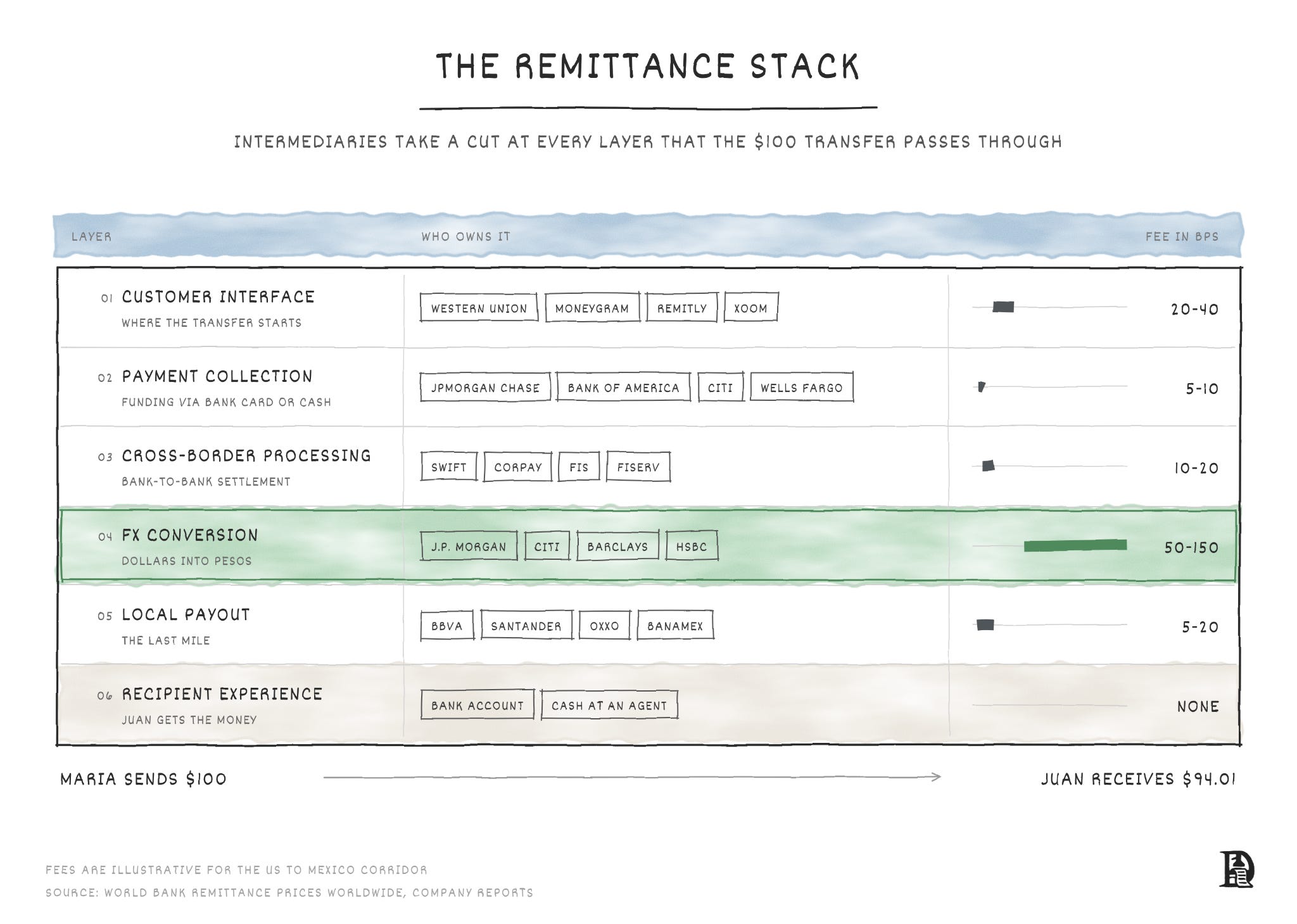
The above diagram is a true picture of just one route: sending $100 from the US to Mexico. When you consider different corridors like Europe-Asia instead of US-LatAM, or the remittance categories from B2B to C2C, the cost breakdown changes depending on the respective challenges. Each corridor and sender type has its own bottleneck, and as those shift, so do the opportunity and the value accrual.
Wish You Were Cheaper
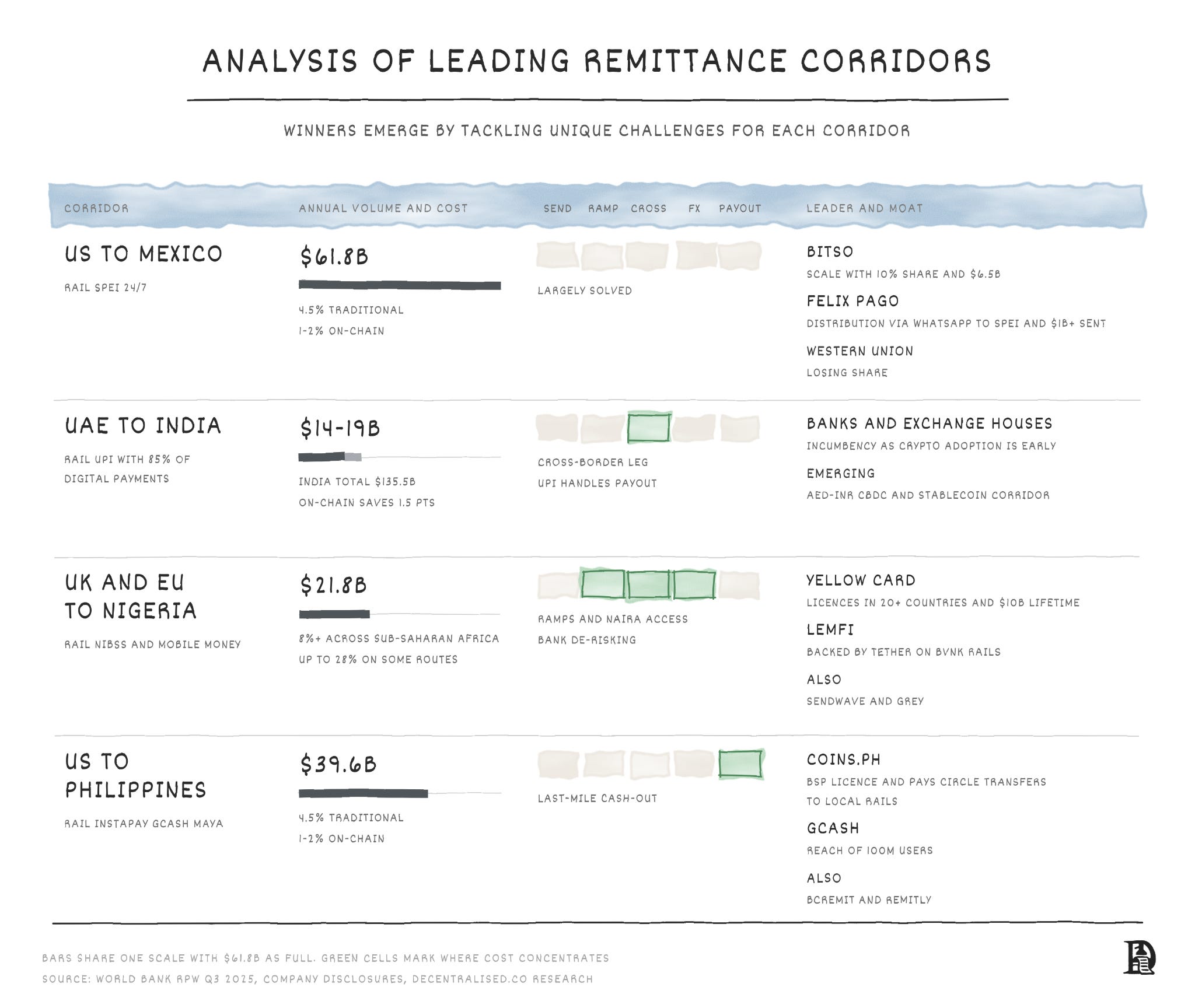
The US–Mexico corridor is the easy one. It’s the world’s largest bilateral remittance route. Payment rails on both ends are modern, and competition has already pushed the cost of sending dollars to Mexico down to 4.53%, the cheapest receiving market in the G20. It also helps that the peso is liquid and Mexico’s real-time payment infrastructure, SPEI, runs instantly around the clock. If every corridor looked like this, blockchains would have little to solve.
According to the World Bank, the global average remittance fee is 6.36%, more than double the UN target. In extreme cases like Sub-Saharan Africa, sending money costs 8.46% on average. About 13 individual corridors in Africa still cost more than 20%. This makes the region the most expensive receiving region on the planet. At the other end, the Middle East, North Africa, Afghanistan & Pakistan region (MENAAP) became the cheapest region in the world to send money to, at 5.11%.
Cost is a function of friction. A well-banked recipient country with reliable local rails, like Mexico, already solves most of the problem, leaving little for blockchains to do. But where banks are absent, expensive, or untrusted, blockchains become the natural choice. About 20 corridors worldwide have no cheap service at all. Most of them are intra-African.
The biggest bottleneck in any corridor is the FX spread, which depends on the trade relationship between the two currencies. When the trade is dense, both countries need each other’s currency. This ensures liquidity of currencies in both countries. US–Mexico is one of the busiest trade corridors in the world, making the dollar–peso pair liquid and leaving little room to mark up the conversion. When the two countries don’t trade as much, there’s no reason for them to hold each other’s currency. This makes forex markets largely illiquid.
The relationship between trade and forex markets creates a paradox. Moving money is most expensive exactly where it matters most.
Different Flows, Different Foes
Geography is only one factor; the category of transfer is another.
The $100 in the example is a consumer-to-consumer (C2C) payment. C2C was under 5% of retail remittances in 2025 but 14% of the revenue. At an average take rate of 3.1%, it is the highest of all categories. Business-to-business (B2B) was the mirror image, with the largest share of payments, but the thinnest take rate.
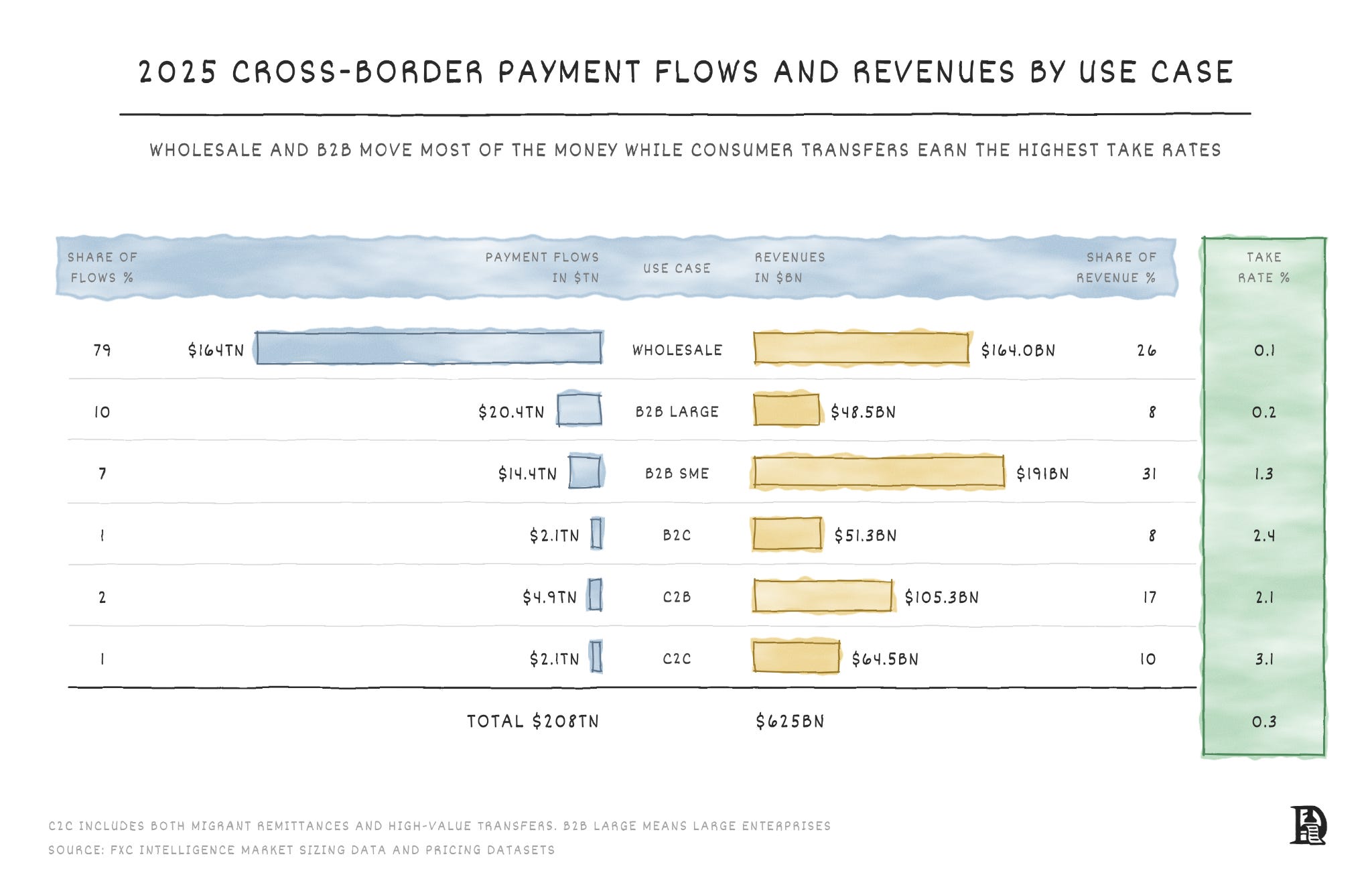
The two fail to scale for different reasons. Every C2C transfer is small, one-off, and expensive to acquire because of identity checks, compliance, an off-ramp at the far end, and the marketing spend. So C2C is less about FX and more about distribution. You need to acquire senders cheaply, retain them, and capture the value, because the rail underneath is already a commodity.
On the other hand, B2B transactions are large and frequent, so the take rate is thin. This means working capital determines the ceiling. Payment to a receiver in Manila can be completed on the same day, only if someone holds pesos in a Manila account. This is called prefunding. When you multiply that across every country served, the stranded prefunding quickly gets out of hand for any single player to manage.
So different types of payments need different fixes. C2C needs cheaper distribution, while B2B needs cheaper capital. So payments reach on time with minimal prefunding in all corridors. Blockchain projects are rebuilding the stack around both use cases.
Who Moved My Margin?
With all the infrastructure in place, blockchain is probably the easiest part to build right now. They can eliminate the settlement and FX costs. But since anyone can build blockchains, these cost compressions bring no unique value. Anyone using blockchains starts from the same place as everyone else. The value that’s up for grabs then accrues entirely off-chain. This is where local players who can boast exclusive licences, banking relationships, and a strong on- and off-ramping network stand a chance to capture the most value.
The layers in the new remittance stack still do similar jobs. They just settle on a different asset, and in doing so, rearrange where the value accrues.
Every remittance starts at the customer interface layer. A good interface that routes transfers through apps with huge distribution can help fix the C2C payments problem.
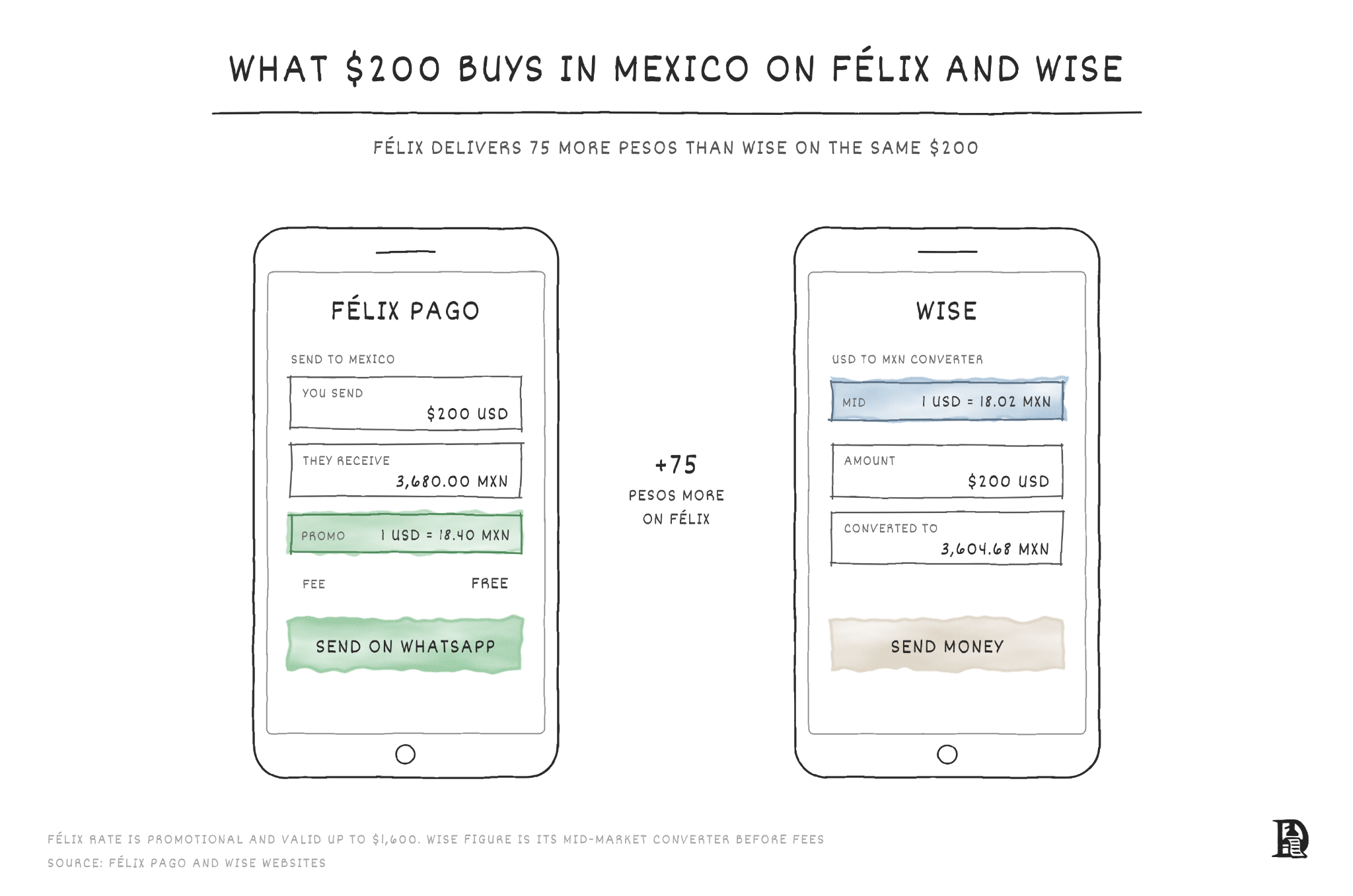
Felix Pago routes remittances through WhatsApp, so migrants don’t need to download a separate app. Sending $200 via Felix today would deliver 3,680 Mexican pesos, as against 3,604 pesos on Wise. Felix settles in stablecoins on-chain, but the customer only sees a messaging app she has used for a decade.
That distribution is the moat, and it is what let Felix raise $75 million in Series B and process billions in annualised volume.
The hardest layer is the on- and off-ramps. Stablecoins move money for near-zero, but turning cash into stablecoins and back is where most crypto payment solutions struggle. Every country has its own banks, licences, and cash habits. So, the ramp has to be rebuilt market by market, and the economics only work for someone deep enough in one region to earn back their costs. That’s why the winners here are regional specialists and not one global ramp.
Yellow Card holds money-transmitter and VASP licences across 20+ African countries, running the bank and mobile-money connections that swap naira, cedi, or rand for stablecoins and back. The licensing stack is slow and costly to assemble, so Yellow Card rents it out to other firms and earns on the ramp plus B2B volume rather than consumer fees.
Kotani Pay bridges stablecoins to mobile money over basic USSD, so even a feature phone with no internet can off-ramp. That’s an unglamorous integration few will build.
Coins.ph is the licensed ramp for the Philippines, plugged into the country’s instant rails and cash-agent network, capturing value through its licence and payout reach.
When you zoom out, you see that the ramp has several local problems. That is why regional players capture the value here, and why Yellow Card and Coins.ph can both own their corridors without touching each other’s share.
ZyntaFinance solves the same problem for businesses. Most African currencies don’t have a direct trading pair. So, a payment from Accra to Lagos is routed through correspondent banks in New York or London, to turn cedis into dollars and then into naira. Zynta settles that trade in stablecoins for 0.5% to 1% a transfer. It uses the cheapest chain among Solana, Ethereum, or Stellar, on a given day.
The orchestration layer addresses the problems for B2B transactions. Whoever controls it decides the rail, stablecoin, and corridor, and stitches ramps and settlement behind one API. This layer did not exist in the old stack, and the incumbents are buying in.
Stripe bought Bridge for ~$1.1 billion to let any developer move value cross-border while Bridge abstracts the wallet, chain, and licence. To remove this friction, it charges a toll on every payment, which scales fast across Stripe’s vast merchant base.
Mastercard bought BVNK for $1.8 billion to do the same for enterprises: multi-rail settlement between fiat and stablecoins, with the local licences to stay compliant.
Orchestration is the one layer where a single global winner is plausible. A Stripe or Mastercard can route through every corridor using one API. Yet even there, the orchestrator cannot own the naira off-ramp, the Philippine payout licence, or the Manila bank account. It has to plug into regional champions, which makes the global players customers of the local ones and lets value trickle down to the corridor leaders rather than pooling at the top.
Float Club
The settlement asset replaces the old cross-border messaging layer. Stablecoins replace SWIFT messages and prefunded nostro dollars by settling around the clock.
The value here is in holding the reserves. Circle keeps the interest on the tens of billions of Treasuries backing USDC while the holder earns nothing. This lets the issuer earn money on the money sitting still. Tether made over $10 billion in 2025 this way, built on dominance in the emerging-market corridors where remittances hurt most. This is why every incumbent, from Western Union to Visa to PayPal, is racing to issue a coin rather than merely use one.
The FX layer was the most expensive part of the old stack. In the new stack, the bank markup of 50 to 150 basis points collapses to a single-digit cost.
OpenFX quoting 3 to 12 basis points, uses stablecoins as the settlement rail between the two legs of a trade and tries to offset the forex leg with a reverse matching order or takes the other side of the forex leg onto its own book. This lets it commit to a firm rate instantly.
Holding a directional position can become risky with thin liquidity or volatile currencies. In that case, it passes the position to a local bank or OTC desk for a lower margin. Matching orders internally means you burn less capital, and fees contribute much more to the bottom line. dLocal employs this model across Africa, LatAm, and Asia, driving its take rate to ~0.7% and betting on absolute volume over margin.
The clearing and netting layer helps achieve capital efficiency. Netting adjusts payments flowing in opposite directions and offsets them against each other. After netting, only the leftover differential amount has to move. The clearing layer ensures this adjustment happens across many intermediaries and settles the leftover.
Remember the prefunded accounts that an intermediary needs to hold in every country? Companies like OpenFX and dLocal use clearing and netting layers to reduce the pile of stranded money they must hold across countries.
Ubyx, t-0 Network, and Cycles offset flows in both directions so that nobody has to prefund either end. If someone sends dollars to Manila and someone else sends pesos back, the two cancel and no capital moves. These clearing houses turn a pile of bilateral obligations into one net figure settled once, charging for the netting itself.
Although this is small today, it can unlock billions in blocked capital. t-0 Network launched in early 2026, but has already settled international payments across 1,200 FX pairs. Between January and August 2026, B2B stablecoin settlement reached $150 billion, up 40% from the preceding year.
Read: Unblocking Capital with Blockchains
When you compare the rebuilt stack with the old one, you see what has changed and what hasn’t.
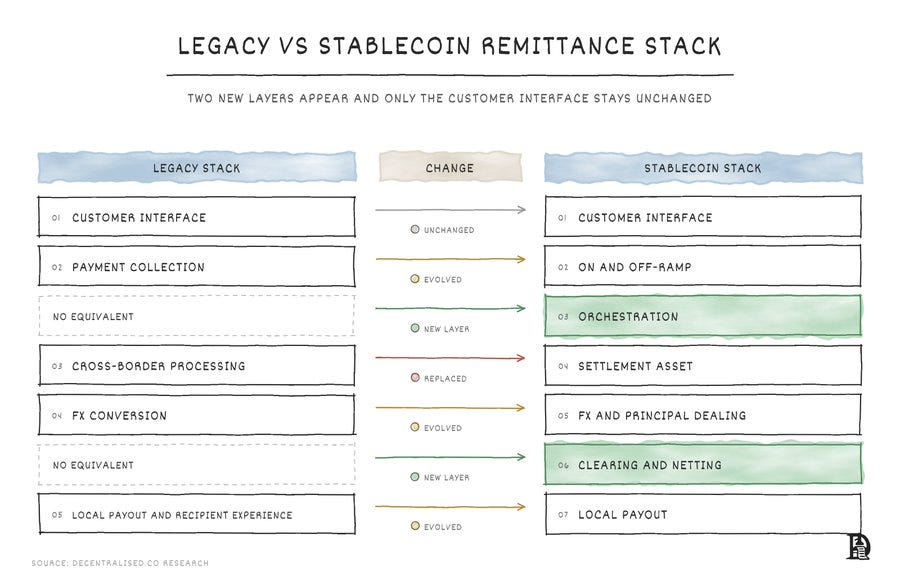
FX used to capture most of the margin, which is now getting redistributed across three layers. First, at the interface layer, where distribution is scarce. Then, at the orchestration layer, which the networks are busy buying. Lastly, at the settlement asset, on which the issuers earn interest income.
Value is migrating to those who control a scarce asset in each corridor, like a trusted interface, a compliant regulatory condition, or a huge reserve that earns revenue while passively resting. There is little value to capture on the on-chain layers of the stack. That’s because stablecoins can only move dollars between countries faster. Underneath all this, someone still has to hold pesos in Manila to convert the dollars.
Remittance is one of those patterns we will keep running into repeatedly. Blockchains make moving money cheap, but deny anyone from flaunting that efficiency as a moat. In Web 2.5, the protocol did the work and the app owned the customer. Remittance adds a geographical nuance to that story. Here, the infrastructure becomes global but the differentiating factors stay local.
The sender in the US will still send a hundred dollars. Her family in Mexico will get nearly five more of them, the same day. Most of what’s earned in between will go to companies neither of them has heard of, in cities neither has visited.
That’s it for today. I will be back with the next one.
Until next time, stay curious,
Prathik
Token Dispatch is a daily crypto newsletter handpicked and crafted with love by human bots. If you want to reach out to 165,000+ subscriber community of the Token Dispatch, you can explore the partnership opportunities with us 🙌
📩 Fill out this form to submit your details and book a meeting with us directly.
Disclaimer: This newsletter contains analysis and opinions of the author. Content is for informational purposes only, not financial advice. Trading crypto involves substantial risk - your capital is at risk. Do your own research.