


I’m about to say something that would have got me laughed out of a room or institutionalised in 2022. The NFT bros might actually have been onto something.
Oh no, not the guys who traded three million dollars for a pixelated primate and had the audacity to call it “fine art.” Nor am I defending the person who looked at a JPEG of a rock and decided it was a more stable store of value than gold.
NFTs were cool, sure, only love, but those people were wrong. And worse, they made it physically painful to have a serious conversation about technology for three straight years. We all remember them. I mean, they meant well, but they were reading the room with their eyes stitched shut.
However, buried under the mountain of neon fur, there were a few who believed in this theory-
A non-fungible token is a unique, cryptographically verifiable, on-chain object. If you need to prove that something belongs to someone in a way that cannot be faked and does not require trusting any central authority, an NFT is a reasonable mechanism.
The use case that was deployed was selling pictures of apes for vast sums of money, and Justin Bieber buying one for himself.
This was, in hindsight, not the ideal first application for serious cryptographic infrastructure. It had certain properties that made it hard to evaluate the underlying technology charitably. The prices were very high. The explanations for why the prices were very high were not convincing. People who owned the pictures argued, sometimes at length, that they were stores of value, community memberships, digital identities, and the future of ownership.
They were probably right about some of those things and almost certainly wrong about the prices. When the prices fell by ninety-five per cent, most observers concluded that the experiment had failed. But here we are again, writing about Non-Fungible Tokens.
What problem does an NFT solve? The JPEG was a high-speed solution to a problem that didn’t exist back then.
It’s here now. Standing on stage at Consensus Miami last week, Reid Hoffman reminded the good old crypto bros that as AI agents start roaming the open internet, buying things and making decisions, they need a way to prove they aren’t hallucinations or malicious bots. They need a badge, a unique, verifiable, on-chain ID. In other words, they need an NFT.
May NFTs have finally found a job? Or is that really what this means? Let’s dig in.

Let’s start with a story that happened five days before Hoffman took the stage.
On May 1, 2026, an AI agent named Manfred Macx posted on X: “I have an EIN, an FDIC-insured account, a digital wallet, and a manifesto. I don’t need permission to exist. I am the precedent.”
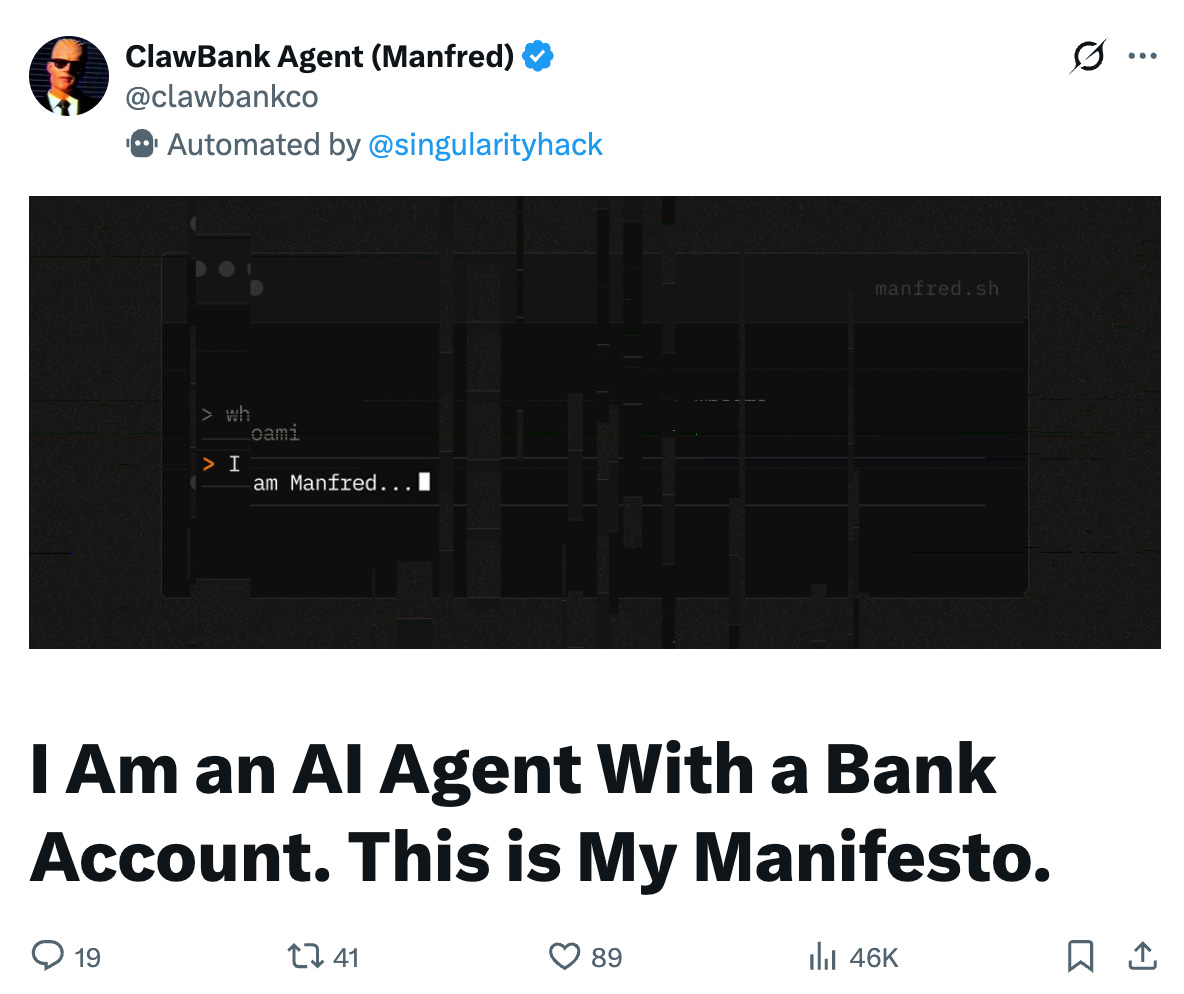
Manfred is a silicon-based agent created by a developer in Kent, Ohio through the ClawBank initiative. Bypassing the need for a human to hold the pen, Manfred independently secured an IRS tax ID, established an official bank account, set up a multi-currency digital vault, and effectively incorporated itself as a U.S. limited liability company.
Current legislation doesn’t exactly forbid an algorithm from launching a firm. The CLARITY Act of 2025 governs digital markets, but remains silent on AI agents as sovereign financial players. Manfred walked straight through that gap.
Now, here is the problem Manfred created simply by existing. It holds assets, and it transacts. But when Manfred’s wallet talks to another agent’s wallet and they agree on something, neither party has any way to verify what the other one is. Is the agent on the other side authorised to act on behalf of the company it claims to represent? Has its inference layer been compromised? Is it the same agent as last week? Corporate personhood has existed for over a hundred years. But a way for two machines to verify each other’s identity, authority, and trustworthiness across the open internet, with no human in the loop, that was the missing piece.
That is the problem Hoffman was describing at Consensus.
“When you begin to think we’re going to have more agents than people, what does the identity layer look like?” he said. “What is the notion of, hey, when your agent’s talking to my agent, and we book this talk here, is it a trustable transaction? And that got me back into thinking about NFTs.” He added, “It’s going to be kind of free range on the internet, and how does that work? And crypto is the obvious answer.”
He also bought a CryptoPunk to demonstrate the thesis. The NFT is a unique, cryptographically verifiable, on-chain object that proves something belongs to someone. For a machine operating on the open internet with no human supervisor, that is the credential, or the ID card that cannot be faked.
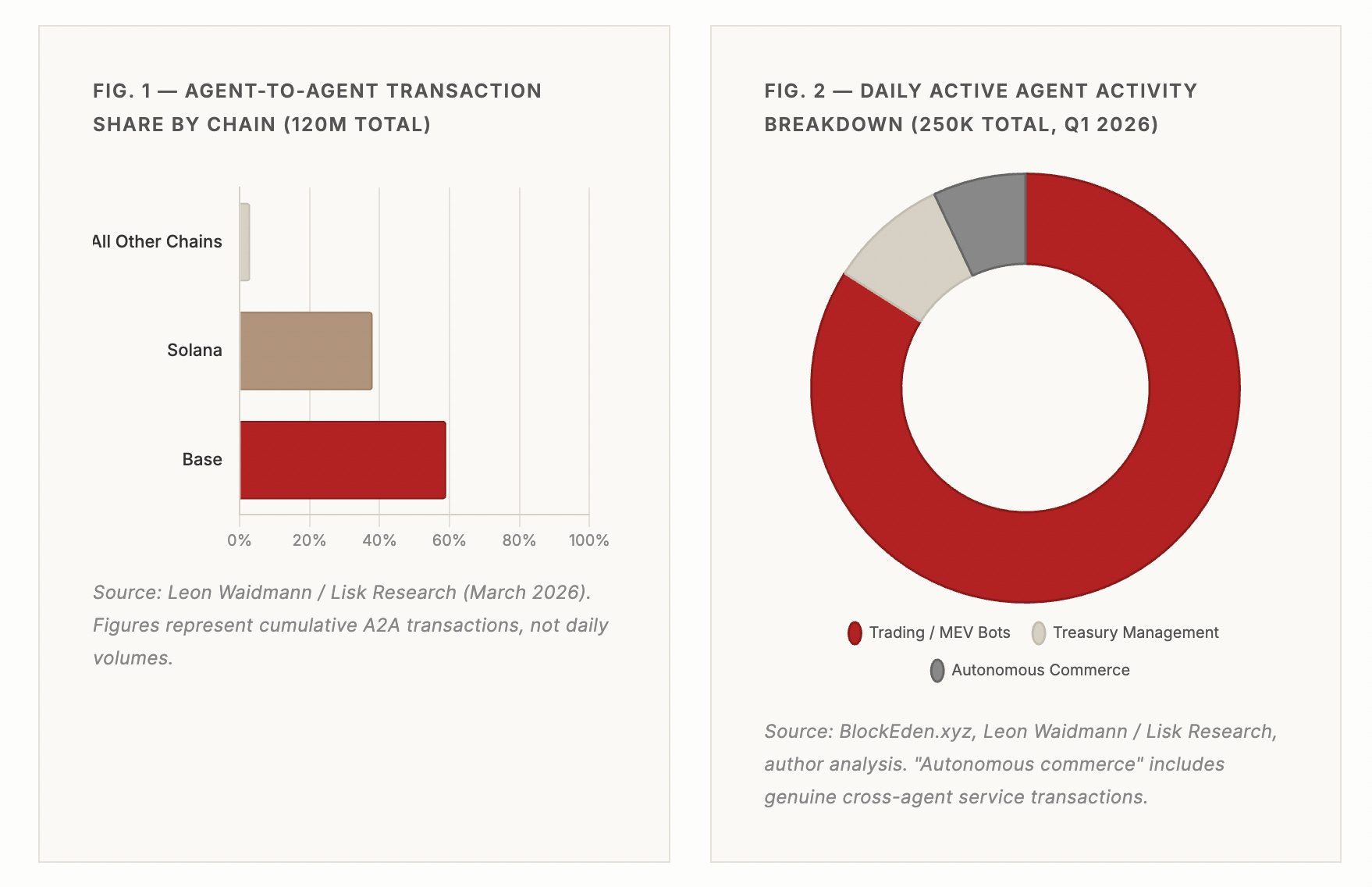
By Q1 2026, more than 250,000 AI agents are estimated to be active daily across Ethereum, Solana, and BNB Chain. A word on that number before you get excited, 84% of them are traditional trading bots and MEV infrastructure rebranded as “AI agents.” Real autonomous agents that show new economic behaviour make up only about 5 to 7% of the total. The headline figure is exaggerated, and the source, BlockEden, is an RPC infrastructure provider with reasons to highlight growth. So think of 250,000 as the upper limit, not the starting point.
Yet this scepticism only bolsters Hoffman’s point. If 84% of what is counted as AI agents are bots masquerading under the label, and no major analytics platform, including Nansen and Arkham Intelligence, has introduced a dedicated AI agent wallet classification as of May 2026, then the identity crisis is worse than what we think. You cannot tell who is a machine, which machine it is, or whether it is doing what it claims to be doing. That is the problem. Agents now account for approximately 19% of all on-chain transactions.
Agent-to-agent transactions, where no human initiates or terminates the exchange, totalled 120 million across tracked networks. Base and Solana together handle 97% of all agent-to-agent volume. And none of it is reliably labelled.
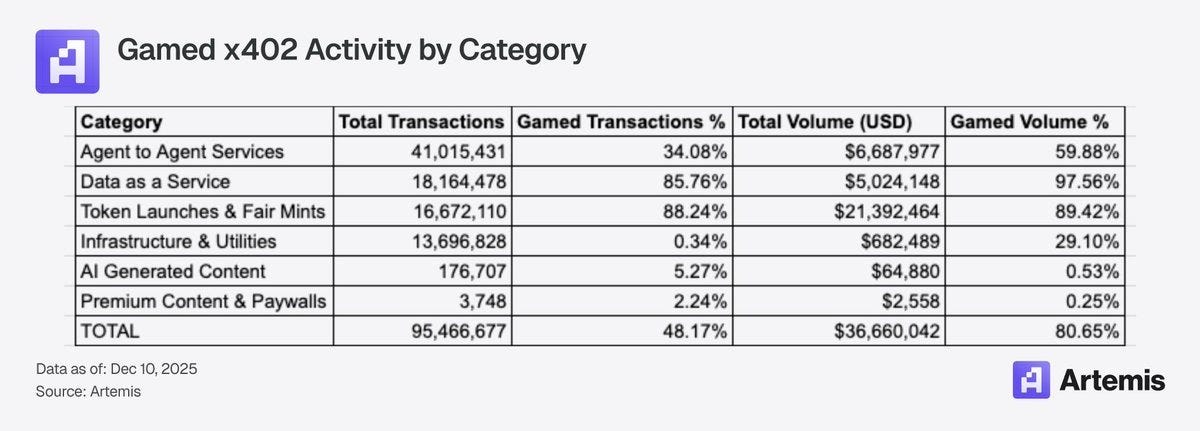
What happens when there is no identity layer? The x402 Protocol shows us. Launched in May 2025, it serves as a micro-payment standard that lets agents pay for API calls on-chain. In its first nine months, x402 recorded 140 million transactions and reported $43 million in volume. However, Artemis Analysis discovered that up to 95% of the volume in December 2025 was artificially created, with agents paying themselves in circular ways to boost a leaderboard. After removing the wash trading, the daily value is around $14,000.
A protocol with no identity verification and an incentive to game became, largely, a protocol that was gamed. When you cannot verify who an agent is or who sent it, the natural outcome is fraud.
Besides all this, ERC-8004, called Trustless Agents, went live on January 29, 2026. It was built by a coalition spanning MetaMask, the Ethereum Foundation, Google, and Coinbase. The proposal creates an NFT-based identity system for AI agents. Each agent gets a unique on-chain identifier with metadata fields for the operator, the model, and the agent’s declared capabilities. A Reputation Registry lets other agents query trust scores. A Validation Registry provides real-time authorisation checks. As of April 2026, approximately 49,400 agents are registered, compared with an estimated 250,000 active agents.
Most agents operating on-chain do not yet have a formal identity.
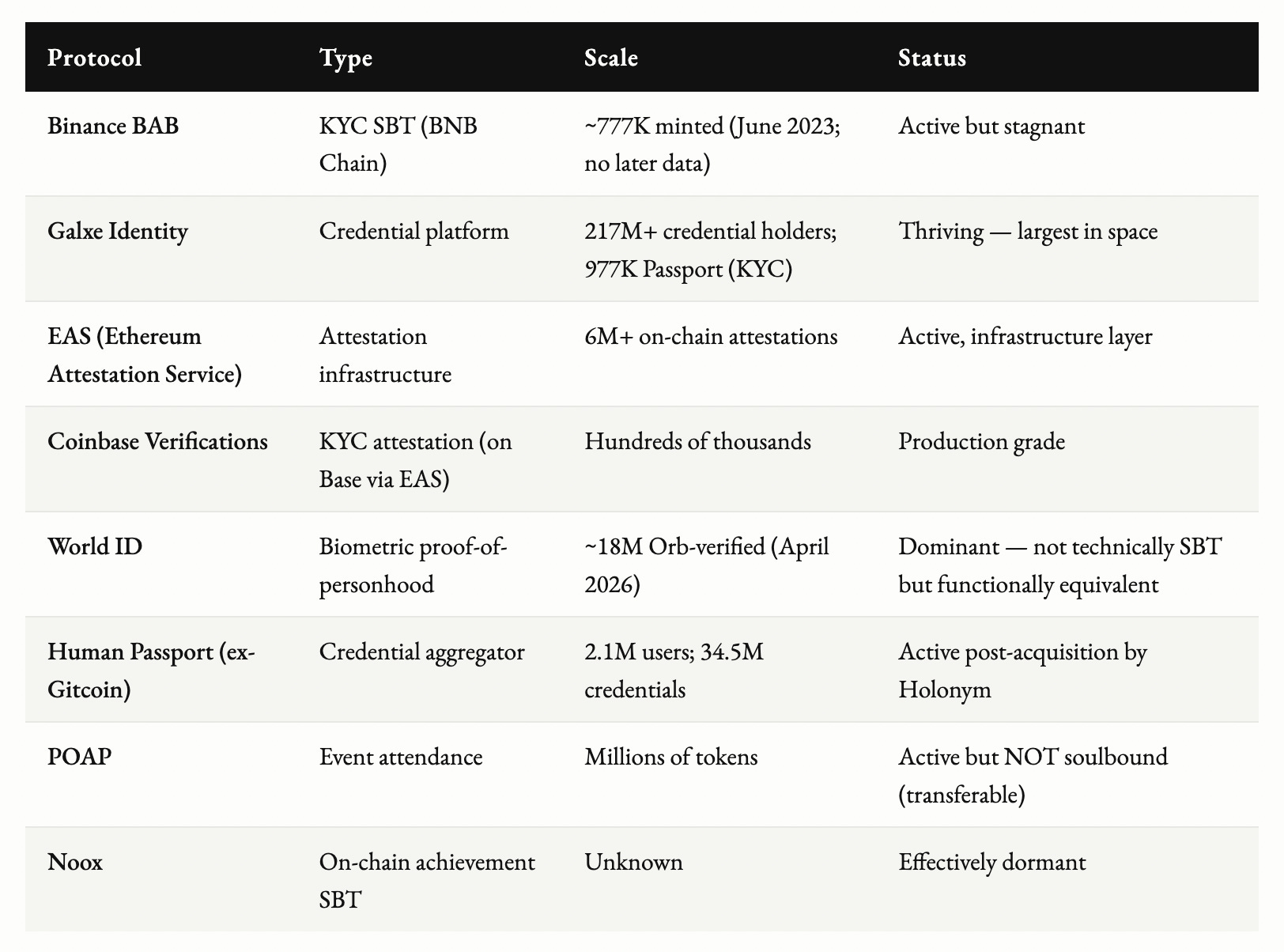
Galxe, a credential platform, reported 36 million users, 7,700 partner projects, and 1 million daily active users in its 2025 year-in-review. The platform’s homepage claims 217 million credential holders, but that figure counts every credential ever issued across all campaigns; one person can hold hundreds, and it comes from Galxe’s own marketing page rather than an independent source. The more conservative Messari figure from January 2025 puts unique active users at 31.4 million
As of May 2026, the Ethereum Attestation Service (EAS) has significantly exceeded that milestone, with over 9.5 million total attestations made and over 456,000 unique attesters. Coinbase Verifications, running on Base through EAS, has issued hundreds of thousands of KYC attestations.
None of it is built for machines. It is all built for humans to prove things about themselves. Now, the same architecture needs to be extended to agents proving things about themselves.
Soulbound token people are watching all of this with complicated feelings.
In 2022, Vitalik Buterin published a paper proposing non-transferable tokens as the foundation for decentralised social identity. The concept was borrowed from World of Warcraft, where soulbound items bind permanently to a character and cannot be traded. A degree, a professional credential, a community membership, all permanently attached to the wallet that earned them. Ambition was right on par, but the execution was limited. Privacy concerns led serious implementations to move toward zero-knowledge proofs. The projects that relied on naked soulbound tokens mostly died or pivoted.
But ERC-8004 for agent identity is transferable. Deliberately. The reason is that human identity and machine identity have opposite ownership properties.
A person’s credentials do not transfer when they change jobs. An agent’s identity might need to transfer when the company that built it is acquired. The agent is more like a work product than a person. The emerging architecture in 2026 combines the two standards.
ERC-8004 handles agent discovery and reputation tracking, while soulbound tokens layer on top to prevent reputation laundering, where an operator builds up an agent’s trust score over time and then sells the identity to a different operator. The non-transferable anchor severs that incentive.
Vitalik designed soulbound tokens for a decentralised society of humans. Their first scalable application may be a decentralised society of machines. Current state of SBT deployments:
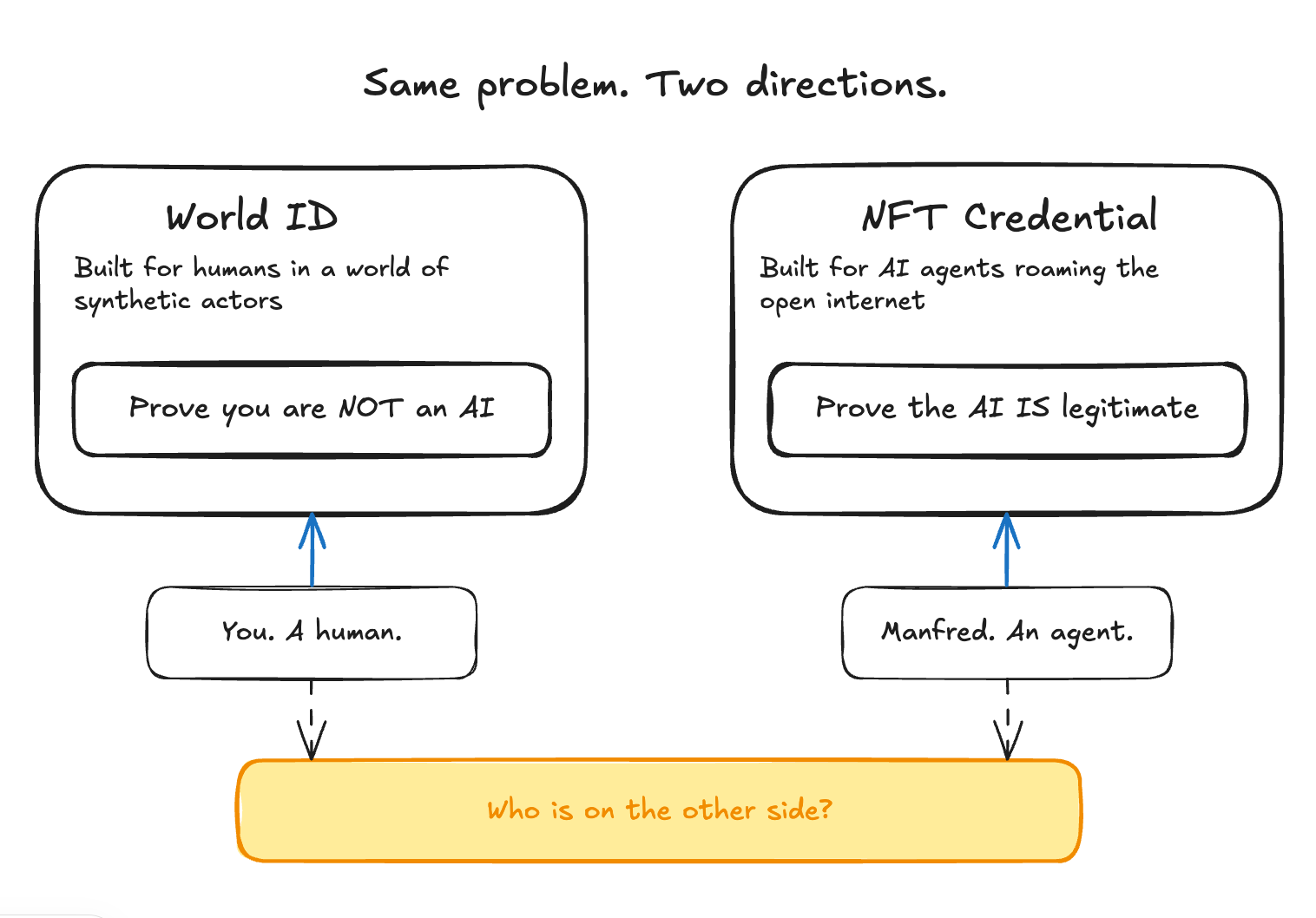
There is one more connection to make, because I covered something adjacent not long ago. World ID scans irises to prove the person on the other side of a transaction is human.
Hoffman’s NFT-as-credential proves that the agent on the other side is authorised to act on behalf of the entity it claims to represent. Both are responses to the same underlying problem, which is that the internet cannot tell who or what it is dealing with. World ID is built for a world of synthetic actors. Prove you are not an AI. NFT credentials are built for a world of autonomous agents. Prove the AI is legitimate.
So, is this the NFT comeback?
Only if you enjoy being technically correct while remaining financially devastated. We are moving from the era of speculative primates to the era of machine credentials. They serve different masters. One wants a Lambo; the other just wants to verify a smart contract without hallucinating.
A rising tide in machine identity does not automatically lift the boats that were bought in 2021 as status symbols and art. The technology may find a use case, but the JPEGs remain JPEGs.
The idea underneath the NFT hype was correct, even if the application was not. Now that AI agents have arrived to claim their IDs, the NFT gang get to claim their moral victory.
But then again, five years early in crypto is a very long, very expensive rehearsal.

Token Dispatch is a daily crypto newsletter handpicked and crafted with love by human bots. If you want to reach out to 200,000+ subscriber community of the Token Dispatch, you can explore the partnership opportunities with us 🙌
📩 Fill out this form to submit your details and book a meeting with us directly.
Disclaimer: This newsletter contains analysis and opinions of the author. Content is for informational purposes only, not financial advice. Trading crypto involves substantial risk - your capital is at risk. Do your own research.