


As someone who loathes making decisions, I understand Ondo’s plight.
Difficult because of facing the permanent loss of the path not taken, accepting that time is linear, and living with the grief of unchosen potential.
Wasting 20 minutes in the supermarket aisle holding a tub of protein powder, Googling the difference between isolate and concentrate while running price-per-scoop math against a 5lb bag on Amazon. All of that, and the commitment issues of picking a flavour!! I pick a Snickers bar at checkout instead, decision-making postponed.
Similarly, the obvious decisions are easy. If a project runs out of money or the tech completely crashes, the call is already made.
Time is the one thing you can’t buy more of, and every month spent building the wrong thing is a month gone. Taking it back means writing off things you already put in.
Ondo had to write off a year and a half. They had a working testnet and a tokenised Treasury settlement that JPMorgan had already run across it. That was not an easy kill, so we dig in.

On July 27, Ondo Finance released a blog post introducing the Ondo Network. It is a lot different from what they announced 17 months ago.
Ondo had announced its Ondo Chain. A layer 1 for tokenised real-world assets, with permissioned validators, staking for passive income, and native bridging. Big backers including Franklin Templeton, WisdomTree and Wellington. JPMorgan’s Kinexys settled tokenised Treasuries on the testnet with Chainlink.
But now, CEO Ian De Bode confirmed the company will not run both systems side by side. They scrapped the blockchain.
They pulled out the Execution and verification and kept Ethereum as the settlement layer.
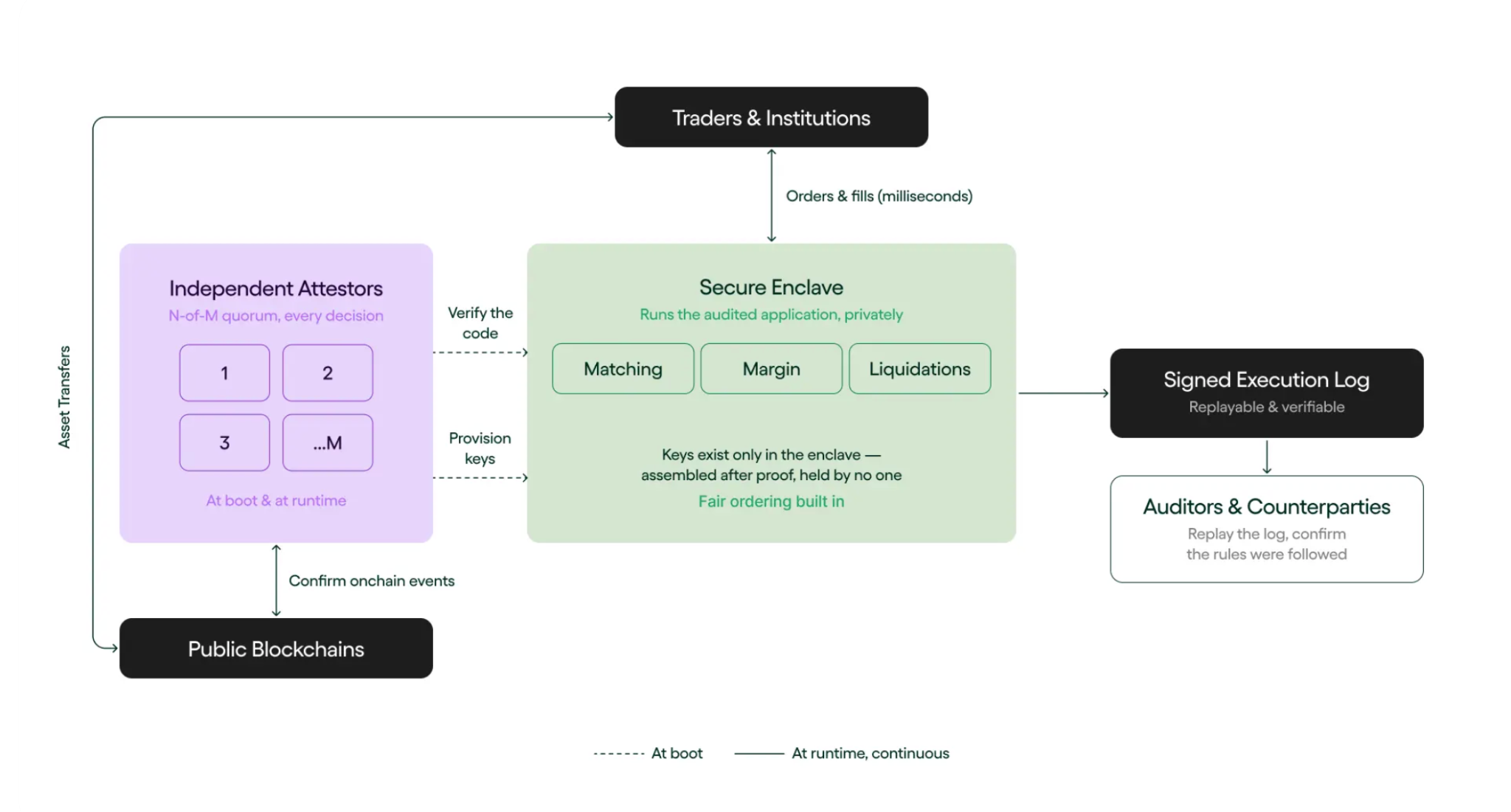
Execution runs inside hardware enclaves, also called trusted execution environments. These are sealed compartments on a server chip. Code runs inside them without the server operator being able to read or modify it. Each enclave generates a hardware fingerprint of its active code. Changing a single byte alters this fingerprint and fails verification.
Verification relies on a quorum of independent attestors. Before an enclave starts, they check its fingerprint against approved code. They also hold split key shards, meaning no single operator (including Ondo) holds a full key. The key can only be reassembled inside an enclave that has verified its code.
Settlement stays on Ethereum. Asset transfers land on a public chain, the same as before.
Ondo argues that blockchains bundle four separate functions, such as consensus, replication, transparency, and final settlement of state. Consensus and replication slow a system down, while transparency exposes everything publicly. Those trade-offs are an unnecessary tax for matching orders. So Ondo moved execution off-chain and kept settlement on the blockchain.
They say: “A matching engine wants one deterministic sequencer, and replication adds latency to every order.”
I don’t know about you, but I remember when Accenture said this back in 2022.
For over spent seven years, the Australian Securities Exchange tried to replace CHESS, its clearing and settlement system. They tried replacing it with a distributed ledger from Digital Asset, even buying 8.5% of the company in 2016. The launch target moved beyond 2021 and kept getting pushed back. By late 2022, an Accenture audit found the software was only 63% complete with no launch date in sight.
It said: “Distributed systems introduce higher latency.”
ASX wrote off up to A$255 million, while ASIC (Australian Securities and Investments Commission) sued the exchange over misleading market updates as the project collapsed. Market brokers lost tens of millions more after building connections to a system that was never deployed.
The NYSE and Nasdaq use private matching engines run by single companies. They don’t copy order books across hundreds of computers, and traders don’t want their live orders visible to the whole market. Then the trade goes to DTCC, which is slow, shared by the whole industry, and settles more value than anything else on earth. DTCC’s subsidiaries processed $4.7 quadrillion in securities transactions in 2025.
They say that no blockchain today can carry those volumes. DTCC is doing tokenisation anyway because settlement only runs on weekdays. It went live with production trades on July 15 and scales up in October. The tokens layer on top of existing post-trade rails.
Crypto promised that you could merge execution and settlement into one machine and keep the good parts of both. Rollups have been kind of doing what Ondo did.
Speed is a bad way to decide whether you need a chain. Every venue wants to be fast, and most of them can buy it. The better test is to see if anyone besides you needs to write to this ledger?
Ondo runs a venue. It matches perpetual futures on Nvidia, oil and the S&P 500, contracts that track a price and settle in cash, so nobody ever receives a share. The tokenised part is the collateral. You post tokenised Treasuries as margin. They hold the order book, and no outside party needs write access to their margin engine. Putting it on a blockchain would have meant running multiple copies of a database they only need one of, exposing a public order book their market makers would hate, and managing a validator set.
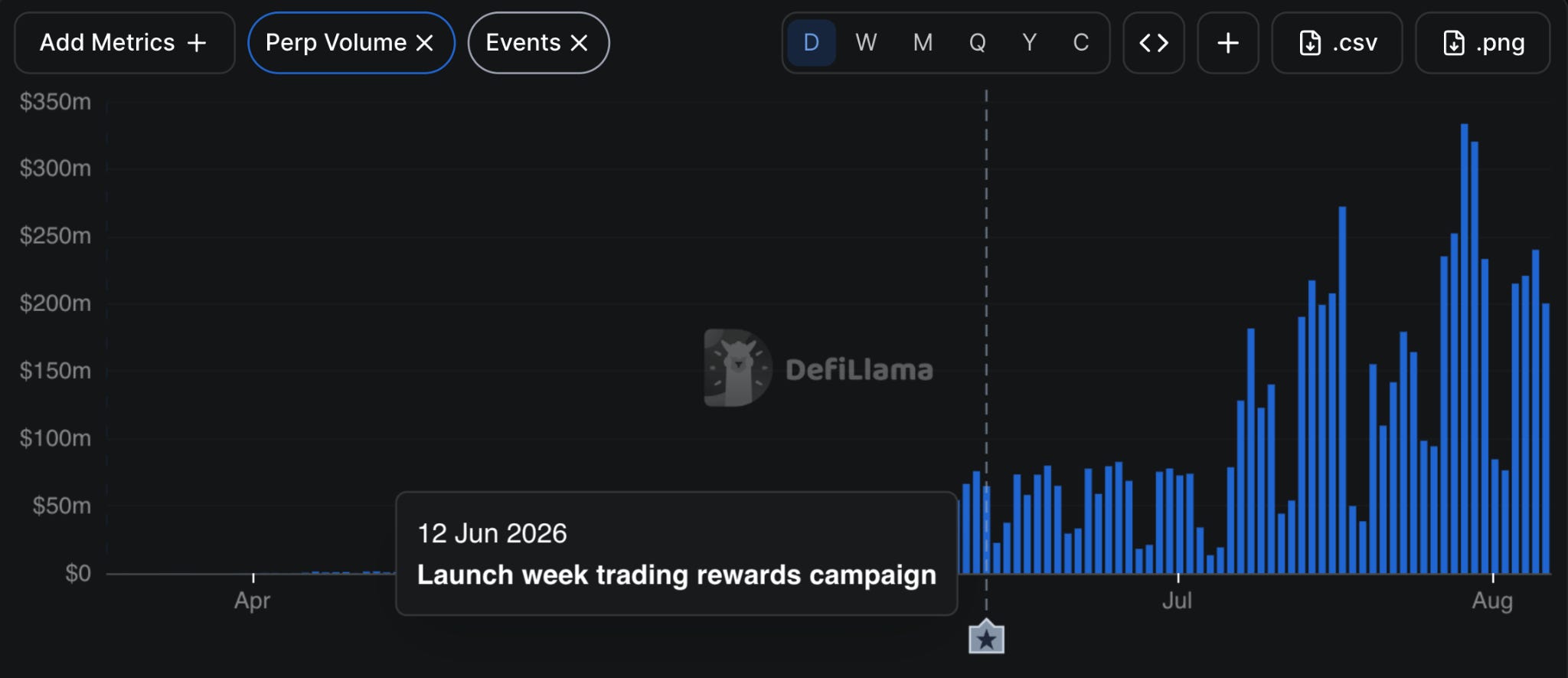
Instead, without any blockchain, the platform hit $6 billion in total perps volume in three weeks, averaging over $300 million a day.
Ondo fails that test, which is why the chain made no sense for it. Some companies pass it. The difference is who they’re building for. If your users are the only people touching the ledger, you’re running a venue. If strangers build things on your ledger without asking, you’re running a market, and a market needs a chain because the whole product is the part you don’t control.
Base is a different animal. Coinbase is selling blockspace for other people to build on. That’s why the numbers Coinbase quotes are about other people’s activity. In Q2 2026, more than 90% of agentic stablecoin volume ran on Base, and 97% of onchain agentic transactions used x402, which has handled 160 million payments in the past year. Stablecoin volume on Base is up 7x year over year, at $19 trillion so far in 2026. Hardly any of that belongs to Coinbase itself.
If Coinbase moved Base’s execution off-chain into a private enclave, the product it’s selling wouldn’t exist.
Robinhood stands in an inherently awkward position, which is the middle. The Chain went live July 1. An Arbitrum Orbit rollup, Stock Tokens live in more than 120 countries. But Stock Tokens are debt instruments issued by Robinhood Assets Jersey Limited, not shares, however you hold them. That puts Robinhood on the wrong side of the SEC’s January 2026 guidance, which drew a line favouring issuer-backed tokenised stocks over third-party synthetics. Self-custody protects you from Robinhood losing your token, not from Robinhood failing.
Read: The World Is Flat, and So Is Your Claim - by Thejaswini M A
What the chain does buy Robinhood is distribution. Uniswap put its token launch platform, pools.trade, on Robinhood Chain on August 5. A place where other people’s apps land next to your 23 million users is still good business.
Companies have been building their own chains for three years, and the results don’t favour the idea.
dYdX tested the app-chain concept at scale. In late 2023, the protocol left StarkEx to launch its own Cosmos chain, placing order matching directly on a decentralised validator set. Architecturally, it won the debate, but market share was a different story.
In early 2023, dYdX commanded 73% of total decentralised perpetual futures volume. By 2026, its market share fell below 3%. The platform now processes roughly $25 billion to $30 billion in monthly volume, compared to Hyperliquid’s $180 billion to $208 billion. Its total value locked stands at $100 million to $150 million, trailing Hyperliquid’s $6.2 billion.
Talking about Hyperliquid, it is the best argument for owning your chain. Its matching engine, HyperCore, runs consensus directly. It uses 27 validators, up from five at launch, with no slashing. Instead of publishing the source code, the repo publishes the finished program. You can run it. You can’t read what it does. Joining the active validator set requires over a million HYPE.
You have 27 validators running publicly unreadable code processing $200 billion monthly, versus one enclave running audited code checked by attestors. Both models rely on a tight circle of operators and cryptography. Though calling one a “blockchain” and the other “off-chain” makes them feel different than they are.
Unichain exists to capture Uniswap’s trading volume and send sequencer fees to UNI holders. But Uniswap processes roughly $15 billion a week across existing networks, and Unichain holds only $532 million of its $5.76 billion total TVL. Besides that, Uniswap’s fee switch already burns $90 million in UNI a year without needing its own chain.
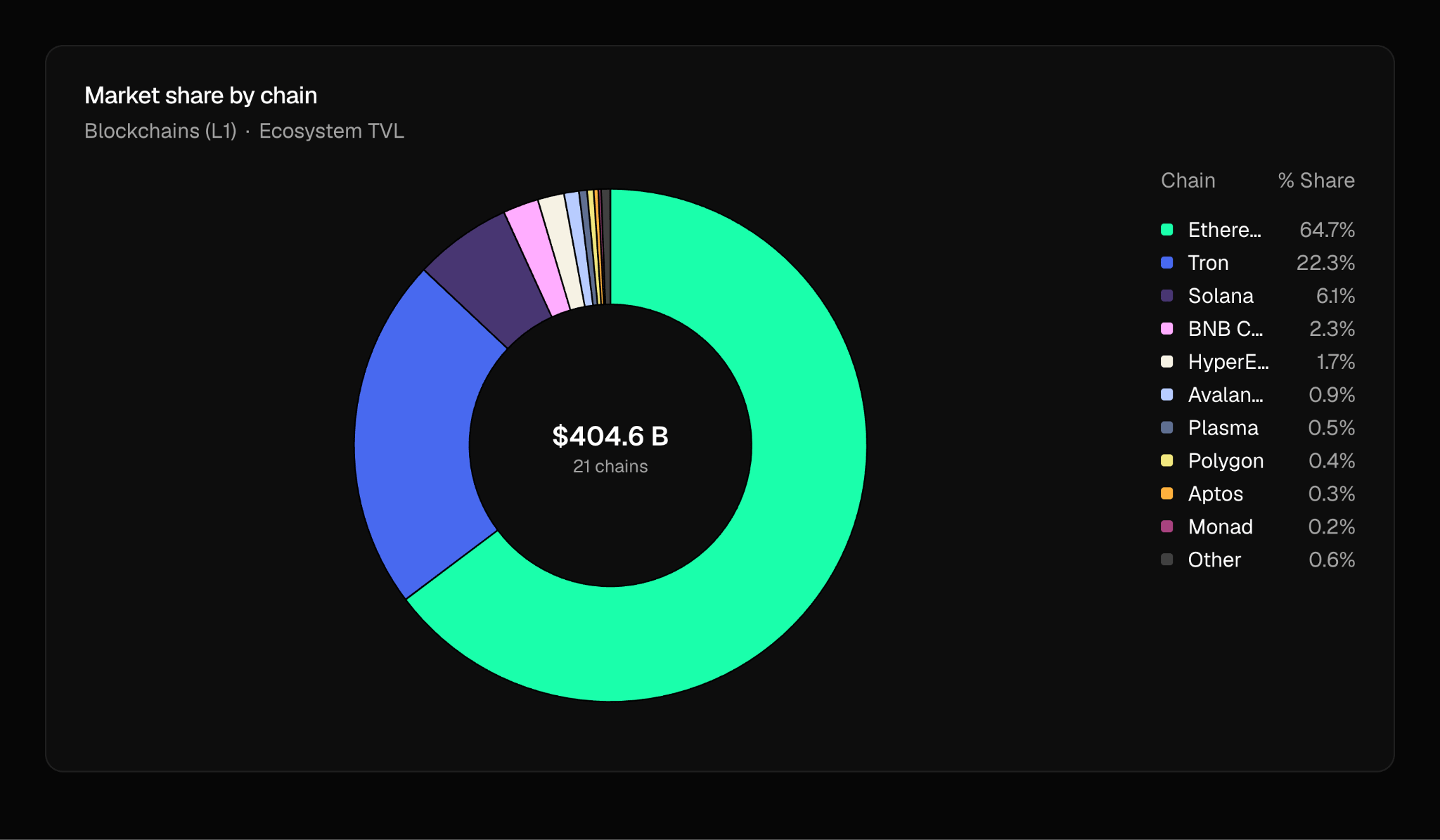
If you look at the broader landscape, out of all L2s, three hold 91% of TVL while twenty hold any TVL at all. Ethereum alone holds 65% of the L1 total, and Base holds 53% of the L2 total.
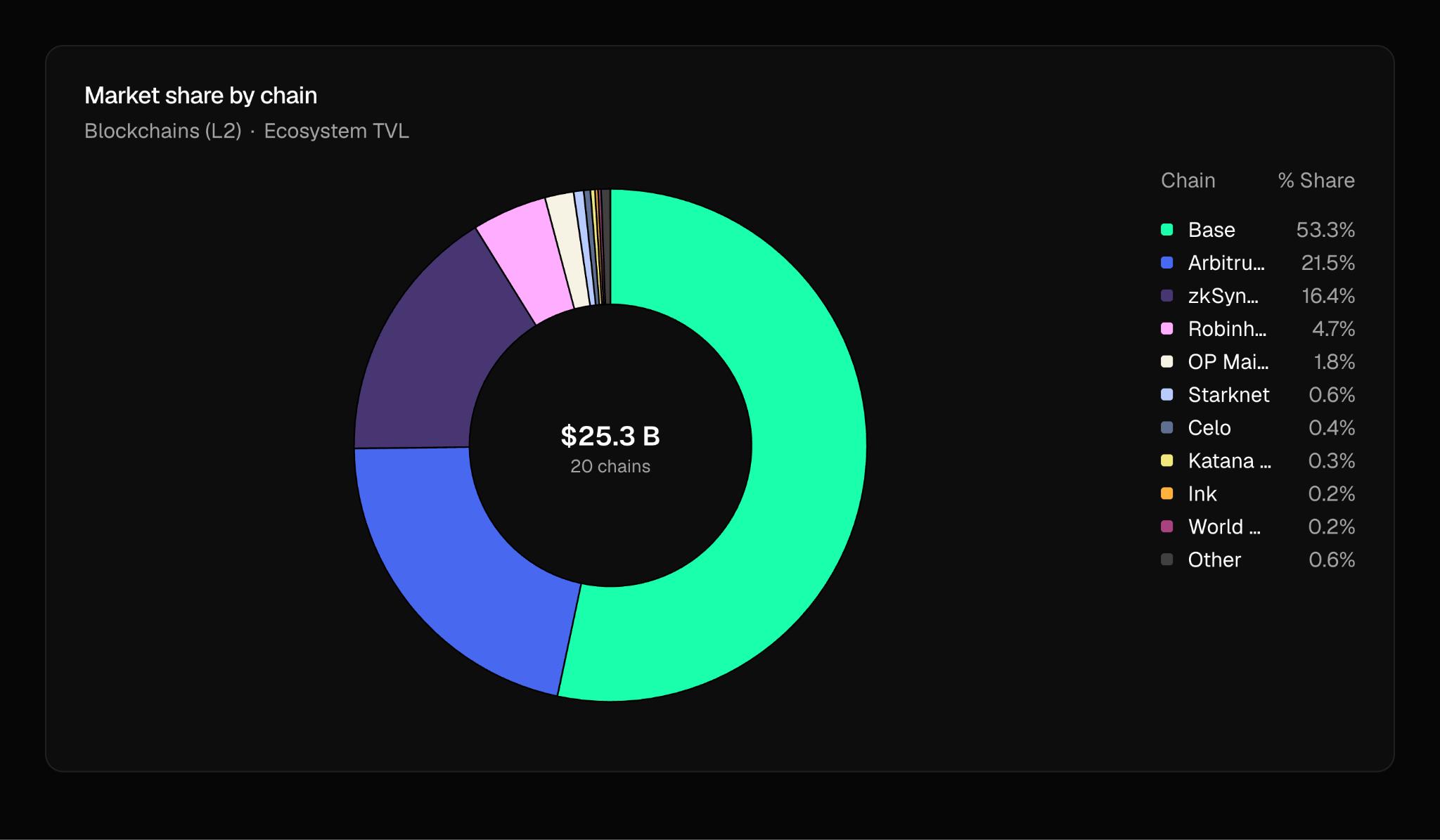
Chain closures are accelerating: Swell ended Swellchain in June, Mint Blockchain folded in April, and Polygon shut down its zkEVM sequencer on July 1. RootData logged roughly 100 dead crypto projects in early 2026, with networks representing a massive chunk of that body count.
Why is everyone launching anyway?
Until recently, apps were priced on revenue; chains were priced on potential.
When Ondo announced a chain with staking rewards, its token popped 11%. When the network actually launched, nothing changed. ONDO pays no yield, and rising protocol volume creates zero direct demand for it. Management says token utility comes later with proof-of-stake and slashing.
But enclaves are not free. Secure chip hardware took a beating this past year. Hackers repeatedly bypassed Intel and AMD security using cheap hardware. First using a $50 tool to break memory protections, then a $1,000 device to steal Intel’s master security key. Last October, researchers released TEE.fail, an attack named after the security failure of TEEs (Trusted Execution Environments, or “enclaves”). Enclaves only work because the chip promises no one can look inside. The researchers broke that guarantee using a $1,000 circuit board attached to the computer’s RAM memory, eavesdropping on plain-text data as it travelled down the wires between the memory and the processor.
They stole Intel’s signing key, the digital stamp of authenticity that proves code is running safely inside a real enclave. Using that stolen key, they created a fake safety certificate on BuilderNet (an Ethereum system for organising pending crypto transactions). This allowed them to secretly view private transaction orders while the system’s automated checks reported that everything was completely secure.
These attacks need physical access to the machine. So Ondo’s top-tier security basically boils down to physical security such as who installed the box, which warehouse it is in, and who delivered it. Is it worse than trusting 27 validators who can’t be punished? Maybe not. But it’s physical security, a real-world risk, and it should be priced like that.
Ondo has been facing the truth and plans to open attestations to bonded operators, while splitting code verification, key custody, and server hosting across separate entities. The final state gets posted onchain so outside watchers can challenge bad transactions, with proof-of-stake and slashing added later.
Might as well just build Ondo Chain….
Have a good day!
Token Dispatch is a daily crypto newsletter handpicked and crafted with love by human bots. If you want to reach out to 170,000+ subscriber community of the Token Dispatch, you can explore the partnership opportunities with us 🙌
📩 Fill out this form to submit your details and book a meeting with us directly.
Disclaimer: This newsletter contains analysis and opinions of the author. Content is for informational purposes only, not financial advice. Trading crypto involves substantial risk - your capital is at risk. Do your own research.