


Hello,
A few weeks ago, I called Robinhood a financial supermarket because of the single roof that caters to every financial need of an American. In Building a Financial Supermarket, I wrote how its newly launched chain doesn’t have to earn significant revenue on its own as long as it can connect its more than dozen businesses and cross-sell its various products to its 28+ million funded users.
I still think that thesis is directionally right, but falls short in terms of magnitude.
When I watched Robinhood’s Q2 earnings call sitting halfway across the globe this morning, it made me feel that the ‘financial supermarket’ framing undersells what could follow for the company. A supermarket thrives by getting more people to walk through the door. Robinhood’s second quarter shows it is thriving by getting the same people who came to buy A on the Robinhood app to buy more of A, buy it more often, and increasingly get them interested in buying products B, C and D on Robinhood, too.
And because the company is able to pull this off, it is thriving lately without even making significantly more people walk through its door for the first time.
In today’s piece, I will tell you about the machine underneath Robinhood’s supermarket that turns each customer into a denser revenue node over time, and why the two least profitable things Robinhood launched (or will launch) this year — its chain and its social feed — could become the most important pieces of it.
On to the story…

The Rubric
In just five years since its public listing and 11 years since the app launch, Robinhood has crossed $5 billion in annualised revenue. It took the brokerage giant Charles Schwab almost 30 years since it opened its doors in 1971 to cross $5 billion in annual revenue. One of the biggest drivers of Robinhood’s revenue has been its vast distribution of 30 million funded accounts. It has the entire breadth of product line-up, from memecoin trading to gold and retirement accounts, catering to every demographic. For most businesses, these metrics scream of distribution might. Yet, the company doesn’t want to judge its own progress using these metrics.
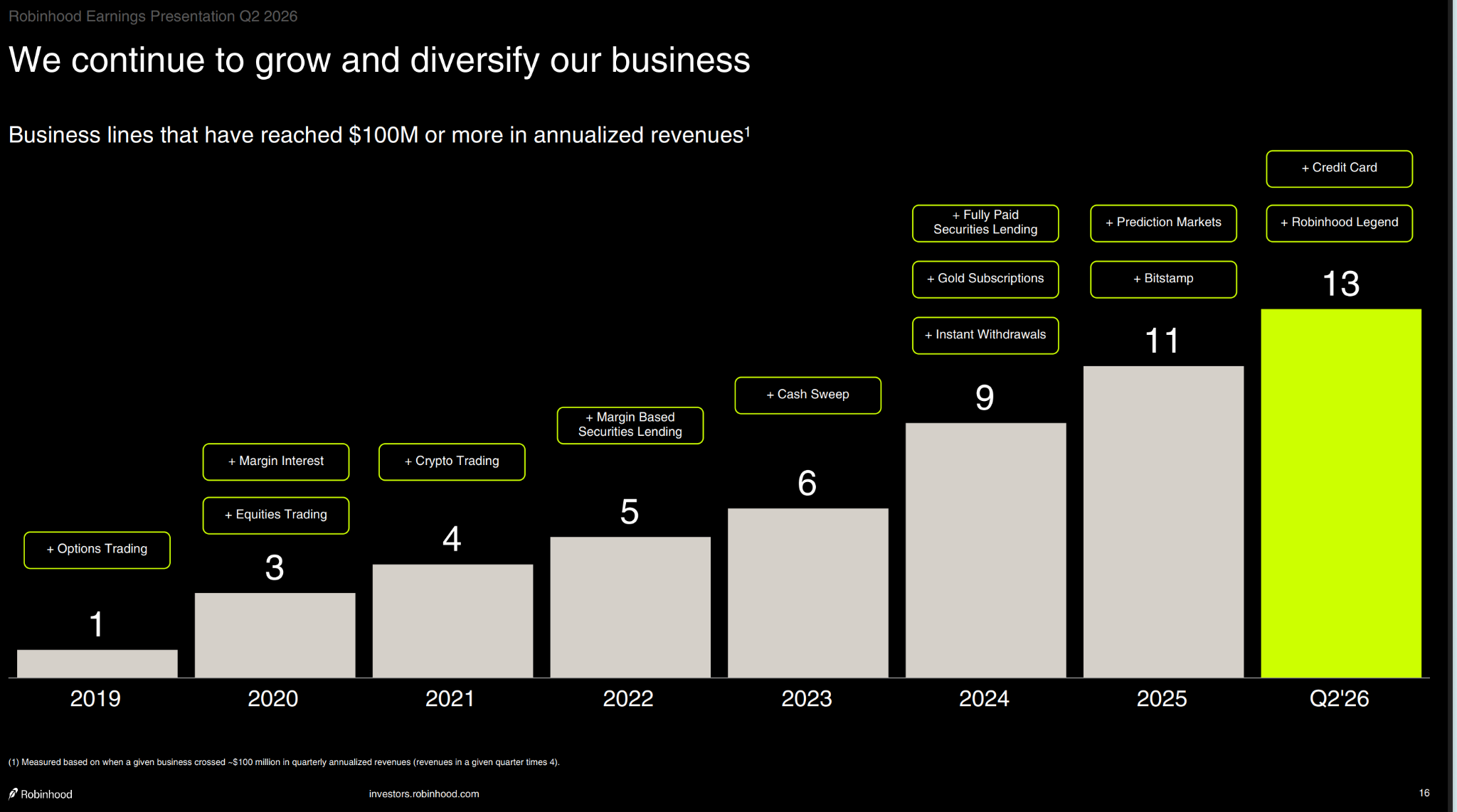
Early in the earnings call, Robinhood CFO Shiv Verma told investors to judge the company on three metrics: net deposits, the Rule of 40, and the count of business lines doing $100 million or more in annualised revenue rate (ARR).
In Q2 2026, Legend - Robinhood’s desktop trading and analysis platform - and Credit Card became the latest business lines to join the $100-million ARR club. It now has 13 business lines on that list.
But let’s set aside those metrics and look at something more granular.
At the end of Q2 2026, Robinhood’s funded customers grew 7% year-on-year, from 26.5 million to 28.4 million. Over the same period, average revenue per user (ARPU) climbed 24%, from $151 to $187.
Revenue per customer grew more than three times faster than the customer base.
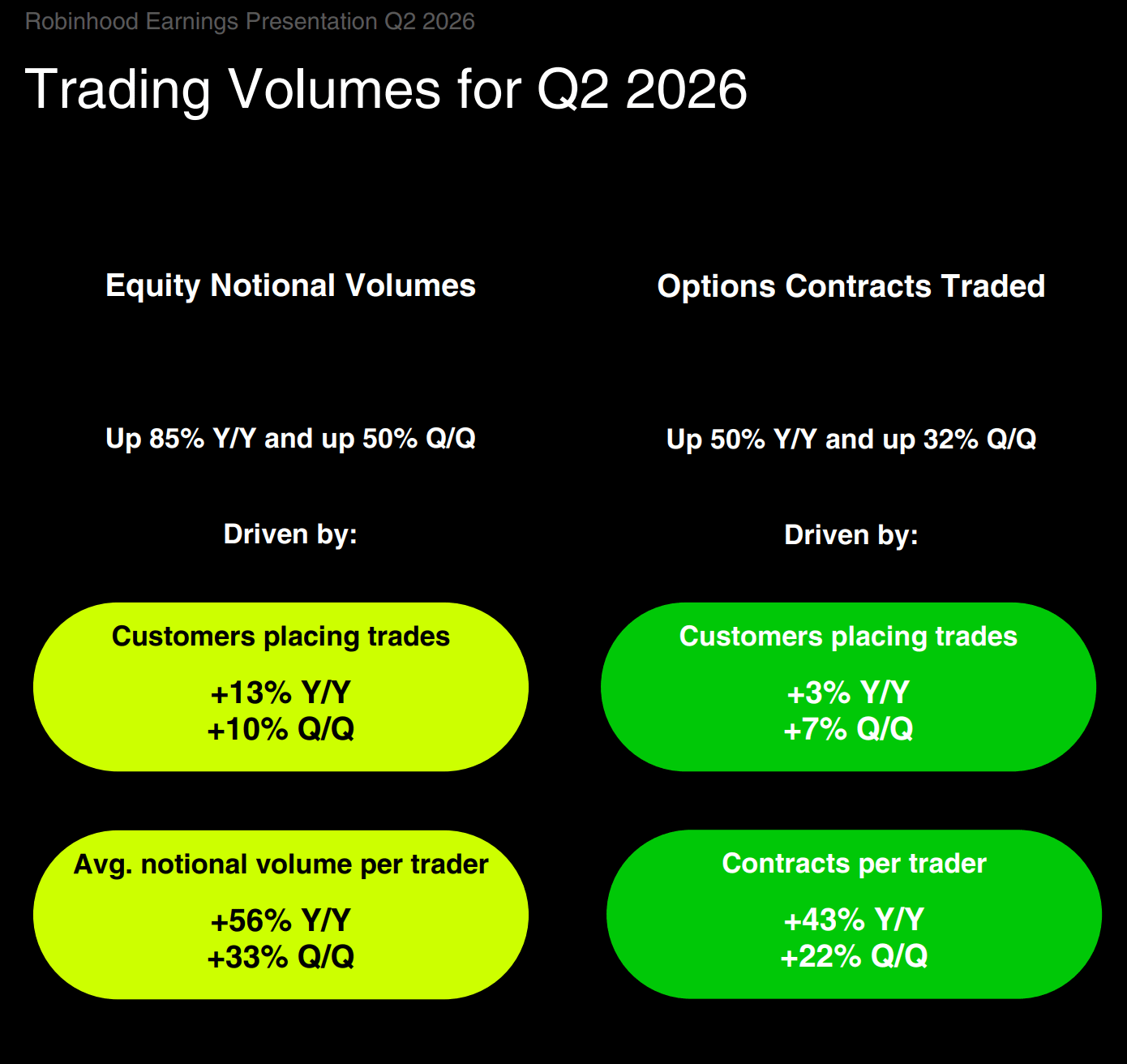
The trading data also reflects this. Robinhood’s Q2 trading volume on a per-customer basis shows that the equity notional volume per trader rose 56% year-over-year, while Options contracts per trader rose 43%. Yet the number of customers placing equity trades grew just 13%, and those trading options grew 3%.
Robinhood’s event contracts business, which didn’t exist 15 months ago, did $156 million in revenue, up 50% quarter-on-quarter. None of this required Robinhood to acquire a new set of users.
In May this year, I wrote how Robinhood’s ability to package equity, options, and perps trading along with event contracts allows it to offer a much better information-pricing platform than its competitors.
Read: Why Robinhood Might Eat Kalshi’s Lunch
All these suggest that the accurate rubric to assess a company like Robinhood is to look at how much more the financial supermarket sells per basket. That is the growth in its ARPU.
The Gold Ignition
Although Robinhood has more than a dozen businesses, one of the most crucial drivers of its engine is its gold membership subscription. In just the last two years, Robinhood Gold subscription adoption rate has almost doubled from 8.2% to 17% of the total funded customer base.
In Q2 2026, the Gold subscription business generated $216 million in annualised subscription revenue. That’s just about 4% of the total revenue. But there’s a bigger benefit from what every Gold subscriber adds to the overall business. Compared to the average funded customer, a Gold member carries about 4.2x the assets under custody and adopts retirement products at roughly 3.1x the rate.
On the earnings call, CFO Verma noted that 40 to 50% of Robinhood’s new customers sign up for Gold regardless of which product first brought them in.
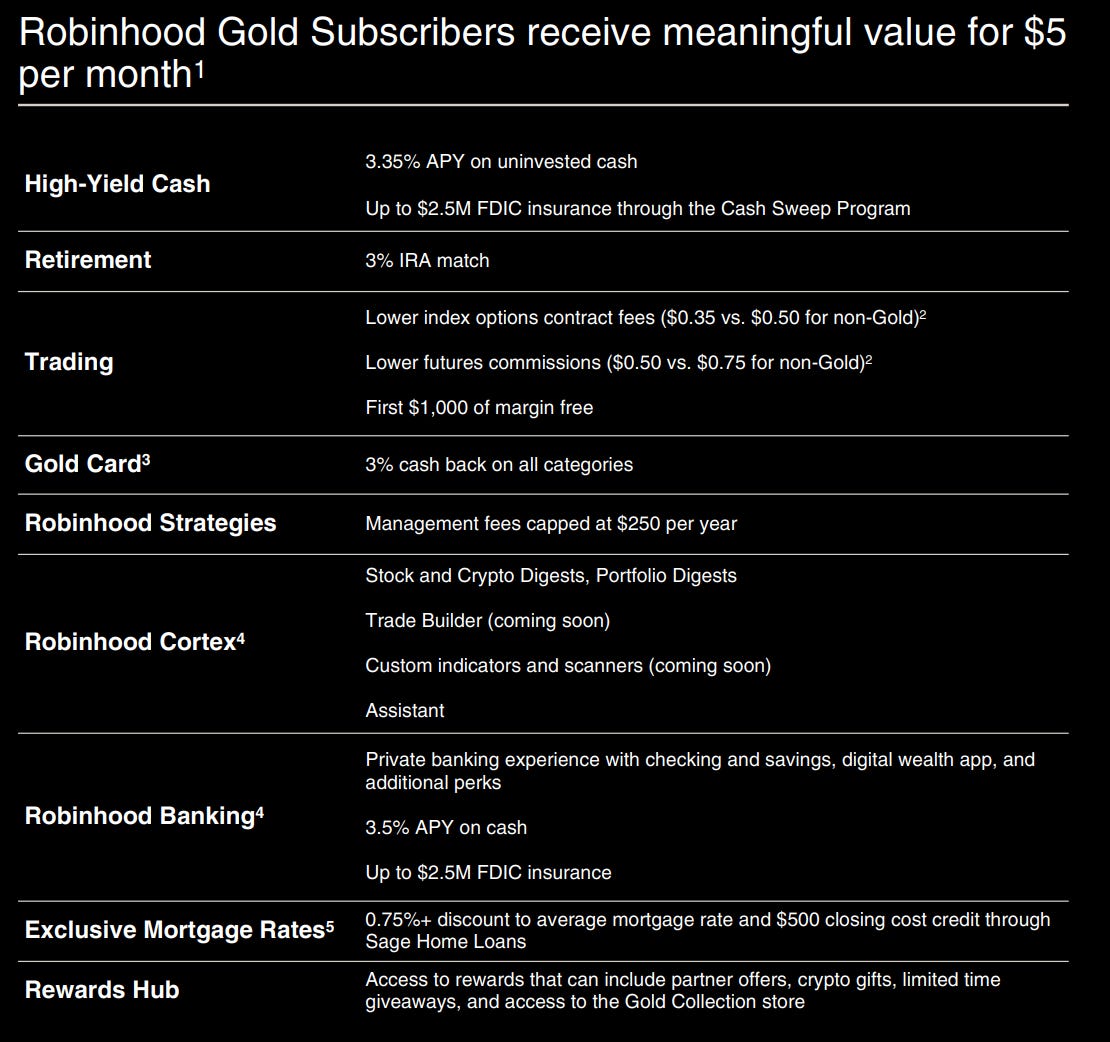
This shows the cross-selling moat Robinhood has. Even if a customer arrives for commission-free equities, a prediction market on the World Cup, or a 3% cash-back credit card, 1 in 2 of those customers convert to Gold. Once they purchase the $5 per month subscription, they join an exclusive community of 4.8 million members who get access to cheaper options contracts, a 3% IRA match from your employer, 3.5% APY on banking cash, the credit card and more.
The cross-adoption is measurable. Verma pointed out that a prediction-markets customer is more likely to also hold a retirement account with Robinhood. So a person betting on a football match through Robinhood’s prediction markets is also using Robinhood’s retirement accounts to compound their IRA.
Robinhood’s supermarket of financial products doesn’t segment its customers into “gamblers” and “serious investors”. It sells its products to the same customer, and every product the customer uses raises the probability of them using another one.
Despite all this distribution moat, I feel Robinhood is yet to make its most exciting move.
The Two Catalysts
In Building a Financial Supermarket, I argued the chain barely makes money and doesn’t need to. I instead framed Robinhood Chain as a connective layer that makes the other businesses stickier. Having watched Q2 earnings, I would slightly modify the outlook for Robinhood. Its chain and, soon, Robinhood Social, will become two of the biggest catalysts that cut horizontally across its entire suite of products and drive cross-selling across more than a dozen of its businesses.
Consider what the chain enables. A customer buys a tokenised stock. That token becomes collateral on a lending market. The loan funds a perpetual futures position. One dollar has now been used across three products in a single session without ever leaving the app. In the old, fragmented brokerage ecosystem, those three actions happened in three disconnected places. Each of those places had its onboarding frictions and required customers to make a fresh decision. Composability removes that friction.
The chain wires cross-selling into the infrastructure so that the customer can cross-sell themselves across products with minimal or no friction.
Robinhood CEO Vlad Tenev said that the company is set to make its Social feed available for the general audience by the end of Q3. Tenev expects the internal feed to add more credibility to the trade ideas by backing content with verifiable portfolios on the Robinhood trading platform in the same universe. Typically, trade ideas currently come from different worlds. A trader may consume content about prospective trades from Twitter, a podcast, or a friend. The customer would then form intent and arrive at Robinhood only to execute. Robinhood Social could pull that step inside its walls.
This is the most underrated aspect of its social feed. The trust it could add for its 30 million funded users will be unmatched by screenshots or podcasts from any other external platform. When the feed goes live for the masses, Robinhood’s last externally-sourced step in the funnel where the intent to trade is born will also move in-house.
Read: Culturally Crypto, Practically TradFi
I don’t see Robinhood Chain and Social as separate business lines for the company. Instead, I count them as catalysts that drive activity across all its other businesses. A community of 30 million people talking about the latest event contract, the kind of life they built using discipline via the Retirement Accounts and the latest Stock Tokens giving them pre-IPO exposure to Anthropic will drive more aspiration among other users than any user-acquisition marketing campaign.
The Loyalty Playbook
Robinhood’s value-capturing strategy is similar to what we saw with Costco. Most of the third-largest retailer’s margin came entirely from the membership, while their shopping aisles ran near cost to keep members walking in. The neutral layer is not where the profit sits. But often these neutral layers generate adjacent capacities where value accrues. Just as Costco’s aisles and inventory collection made people shop its subscriptions.
Robinhood Chain and Social are akin to such neutral layers that create value-accruing layers. Both of them give reasons to investors or traders to shop for Robinhood’s Gold subscription and shop multiple products across the aisles of the financial supermarket.
Over the years, one of the biggest question marks for Robinhood was the problem of cyclicality. Even as Robinhood registered record equity and options trading volumes in Q2, its crypto trading volume has slipped for three straight quarters. Even on Robinhood Chain, more than 80% of the volume is still driven by memecoin speculation.
A sceptic might see a problem in all this. But I beg to differ.
Robinhood’s diverse and deep ($100 million ARR) business lines ensure that the consolidated business is no longer at the mercy of market cycles. When trading volumes fall, interest-earning assets don’t necessarily fall. The margin book grew 127% YoY to $21.6 billion.
Prediction markets that were primarily driven by sports and elections take a different shape inside a platform like Robinhood. The Rothera joint venture with Susquehanna International Group gives Robinhood a CFTC-regulated prediction markets exchange licence, letting it create its own event contracts. This allows the company to eliminate cyclicality in seasonal categories like sports and elections and offer year-round event contracts tied to macroeconomic and S&P 500-related announcements.
Gold subscription revenue is a flat monthly income that doesn’t care how the markets are performing each month. Robinhood has spent five years assembling businesses whose revenues peak at different times, making the whole company far less cyclical than any single line inside it.
This is reflected in the ARPU number. It climbed 24% because the average customer is now plugged into more businesses at once, and a customer wired into five uncorrelated revenue streams is a fundamentally more durable asset than one wired into a single volatile one.
The more products each customer touches, the more consistent Robinhood’s own revenue curve becomes. Each trough in one business line gets filled by the peak of another, often driven by the same person’s account.
Coinbase reshuffles crypto capital that already exists across consumers and institutions. The legacy brokers hold assets but can’t manufacture engagement. Robinhood stands at a unique position to turn a single customer relationship into a compounding, self-diversifying revenue node across traditional and crypto businesses, both of which can be connected and amplified by its native blockchain.
That’s it for today. I will be back with the next one.
Until next time, stay curious,
Prathik
Token Dispatch is a daily crypto newsletter handpicked and crafted with love by human bots. If you want to reach out to 170,000+ subscriber community of the Token Dispatch, you can explore the partnership opportunities with us 🙌
📩 Fill out this form to submit your details and book a meeting with us directly.
Disclaimer: This newsletter contains analysis and opinions of the author. Content is for informational purposes only, not financial advice. Trading crypto involves substantial risk - your capital is at risk. Do your own research.
Can you teach me how to trade on robin hood ?