


“Man is small, and, therefore, small is beautiful. To go for gigantism is to go for self-destruction.”
E.F. Schumacher wrote that in 1973, in a book called Small Is Beautiful. He was an economist who had stopped trusting economists.
The rich world decided that the big problem, which is making enough stuff, was solved. And that all that was left to do was make more of it, faster, forever.
The new game plan was to make more of it, faster, until the end of time.
Schumacher thought this was a fatal misread. Because nothing in nature grows without limit, and the one system pretending it could was ours.
It was a strange read. A man asking the world to stay small and human and humble. And here we are, at the far end of the experiment he watched begin. A whole world order built on one unspoken promise, that the line can go up forever and nobody ever has to pay for the climb. Every country, every company, all running the same one-word instruction. More, more, and MORE.
“Gigantism”- his word for the sickness. Schumacher thought size itself could be a disease. A city, a company, a machine, a government, past a certain scale, stops serving the people inside it and starts serving itself. “Any activity which fails to recognise a self-limiting principle,” he wrote, “is of the devil.”
All I could think was, isn’t crypto one of the loudest rooms in that building? It is the kind of technology that might resonate with this the most. Small, peer-to-peer, built so no giant sits in the middle. You can guess where this goes, so I’ll keep it short, because we have had this conversation so many times and have moved on. Made to escape the big players, ended up growing its own, the way anything successful does.
The more useful thing Schumacher hands us, along with a scorecard on how decentralised we really are, is a way of seeing what scale costs. And that shows up most clearly in what the network eats.
The book is not a perfect prophecy. Schumacher got plenty wrong, and some of his solutions have aged like milk. But I am choosing this one because his diagnosis of what happens when systems grow too massive hits close to home.

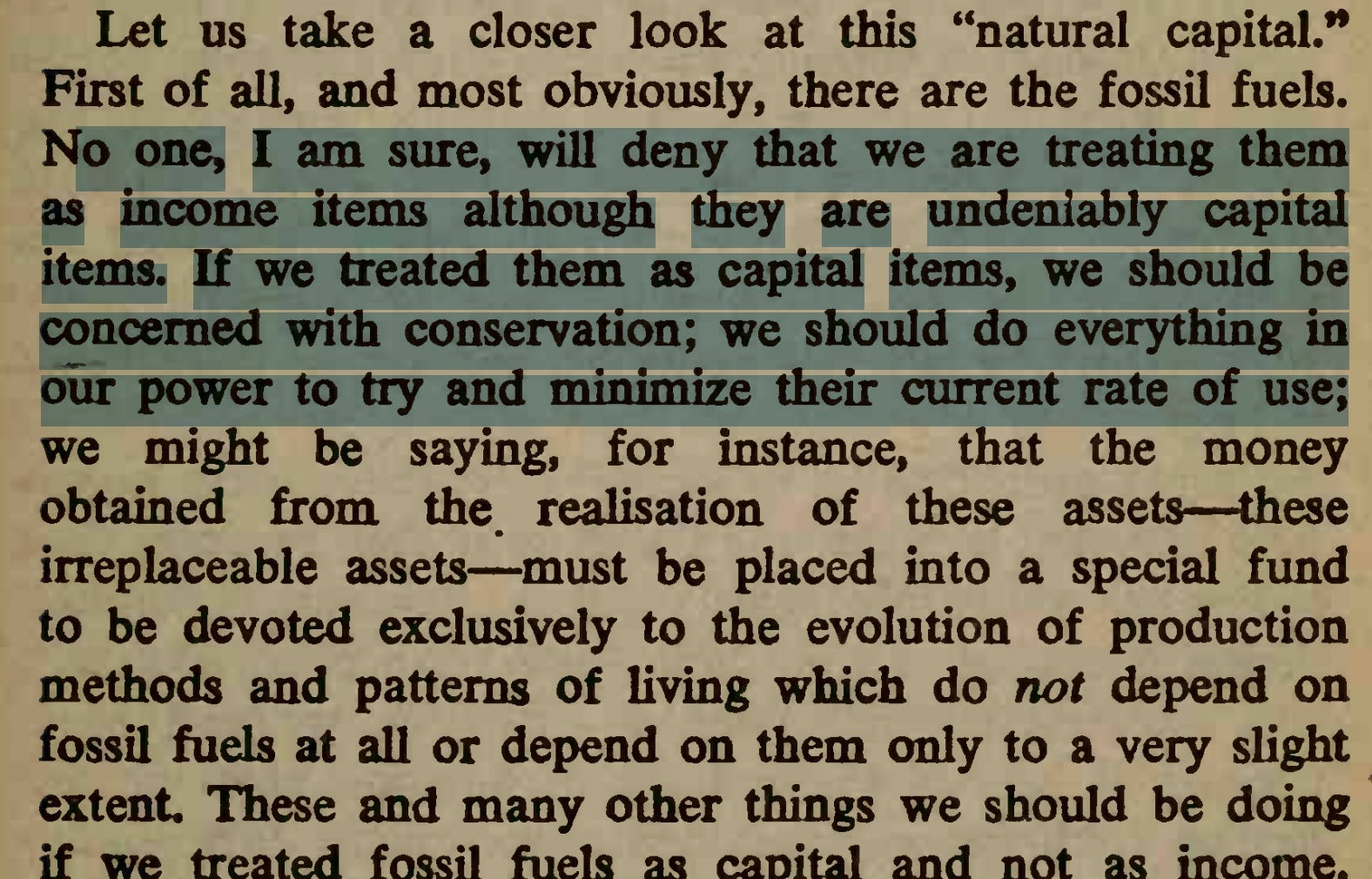
“Fossil fuels are not made by men; they cannot be recycled. Once they are gone, they are gone forever.”
Every business owner knows the line between income and capital. Income is what you can spend. Capital is the thing that makes the income, and if you start spending that, you’re dying slowly, still calling it a good year. Schumacher’s charge against modern economics is that we make this error with the one kind of capital, the kind man never made and only found. Fossil fuels, yes, but also the soil and the water and the living systems underneath everything. We book them as income and spend them like they refill. Once they’re gone, they’re gone for good.
Now Bitcoin enters the frame, doing its best impression of what it was talking about. Proof of work turns electricity into digital scarcity, on purpose. Cambridge reckons the network burns around 138 terawatt-hours a year, roughly half a per cent of the world’s electricity, on par with a mid-size industrial country. Whatever you make of the exact figure, the shape of it is pure Schumacher.
We take a capital asset, energy, much of it still fossil, and convert it into a thing whose entire value is that it was expensive to make.
Now, AI runs the same trade with another kind of capital. Which is not oil, but commons. The whole written and drawn record of human beings, scraped into models as if it were free and endless. Researchers at Epoch AI put the usable stock of high-quality human text at a few hundred trillion tokens and expect the models to chew through it somewhere between 2026 and 2032.
That’s why Elon Musk told us that “the cumulative sum of human knowledge has been exhausted in AI training.”
This was capital all along. The labs are now paying for it. News Corp handed its archive to OpenAI for more than $250 million. Reddit is selling its comment history; yeah, that’s why AI loves Reddit. You want AEO? I heard that you go sit on Reddit. Data that was once booked as free income but instantly gained a price tag once it became scarce.
This capital might not survive being spent. When models train on the output of other models, the quality rots, a failure that researchers named “model collapse” in a 2024 paper. If we flood the internet with AI-generated garbage, the AI starts learning from its own fake data and rots from the inside out. We’re basically poisoning our own water supply while we’re still trying to drink from it.

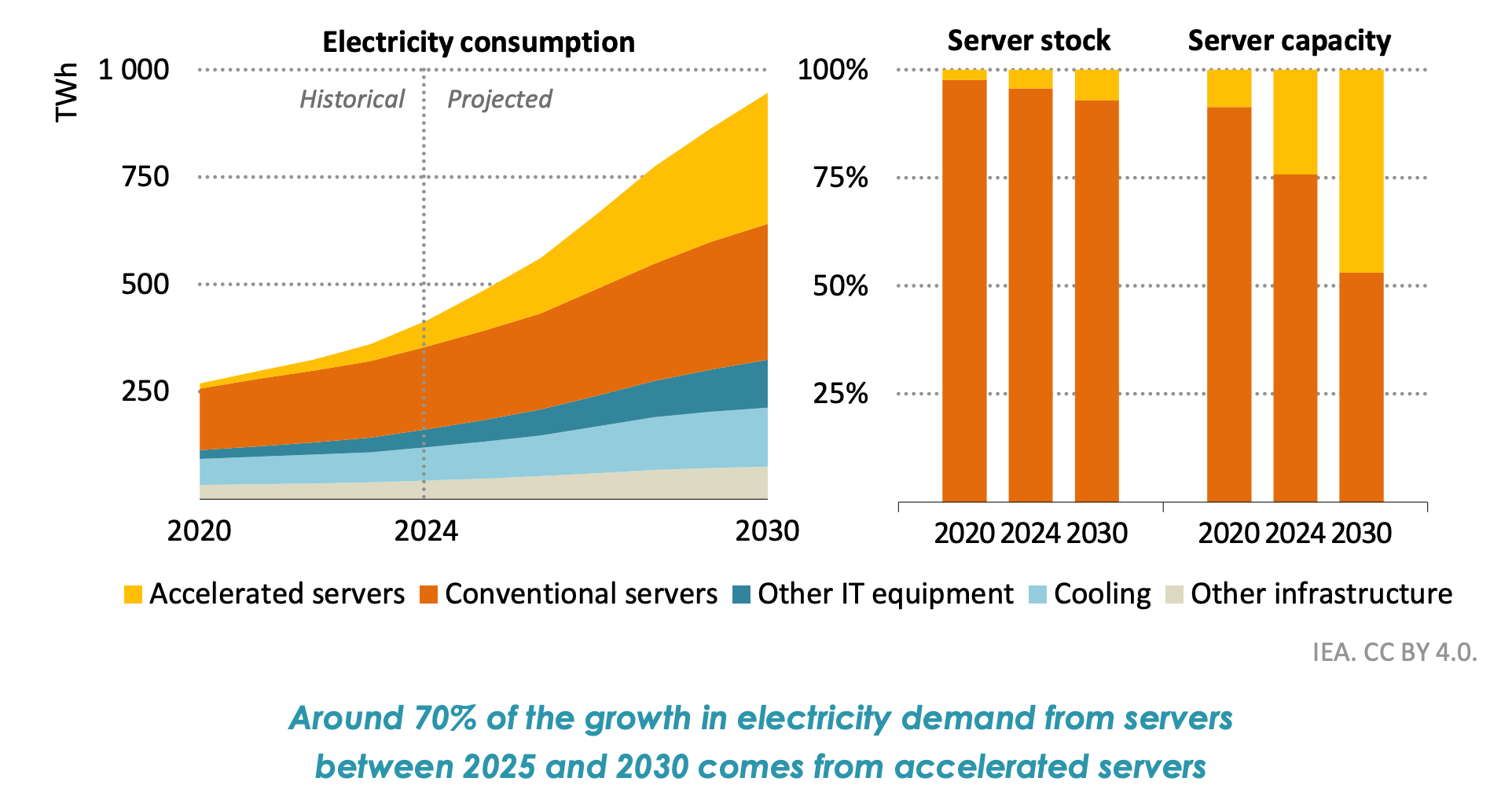
And the power bill always matters. Electricity doesn’t come from nowhere. It gets made, mostly by burning something, and there’s a fixed amount to go around at any moment. The IEA expects the world’s data centres to climb from about 415 terawatt-hours a year in 2024 to roughly 945 by 2030, close to the entire electricity use of Japan. By the end of the decade, data centres in the US alone are set to pull more power than all its heavy industry combined, the steel, cement, aluminium and chemicals that build the physical world. Much of it still comes from the same fossil capital Schumacher begged us to protect.
Why can’t we stop?
“If human vices such as greed and envy are systematically cultivated, the inevitable result is nothing less than a collapse of intelligence.”
The whole machine runs on greed and envy, and runs on them by design.
That’s why there’s no stop.
Growth economics needs you to want more, always, or it stalls. Schumacher thought a system built on farming those two feelings would slowly make its own people stupid, unable to see plain things in front of them. A collapse of intelligence.
A market powered by FOMO and green candles, maybe, feeling a little called out? But in crypto, for long stretches, envy has been the product.
Think about how most people got pulled in. Someone they knew turned a small bet into a noticeable number, and they didn’t want to be the fool left standing outside. That feeling, the fear of watching someone no smarter than you get rich, is what the thing ran on. Although that’s not the case anymore, since numbers don’t impress much now. But back in the peak, entire coins were launched with no purpose except to manufacture them, to make the next person afraid of missing the next one. Schumacher says that a machine built on that feeling takes your money and, if you give it long enough, your judgment.
I have to be ME about the book here because it would be easy to make Schumacher a saint, and he wasn’t one (RIP). His cure is where he loses me. He wanted “intermediate technology,” small tools, local making, “production by the masses” in place of mass production. I think it’s a beautiful idea. I also think it’s mostly lost, and it’s only fair to say why.
Schumacher pictured a village weaving its own cloth on simple looms, staying whole and self-reliant. What lifted people was the opposite of that. China, then Bangladesh and Vietnam, put millions of people into enormous factories making clothes and phones and steel for export to strangers far away, the thing he called uneconomic.
It was often grim and underpaid. It also pulled roughly a billion people out of extreme poverty between the 1980s and now, the fastest fall in human history. China’s own poverty rate fell from 88 per cent in 1981 to under 1 per cent by 2015. The world’s extreme-poverty rate dropped from about 38 per cent in 1990 to under 8 per cent today. The huge, ugly, centralised machine did something the gentle local one couldn’t. Which is to feed and power billions, fast.
Coming to the fight he’d have cared about most, the climate one. The reason clean power is finally cheap is a handful of colossal Chinese plants that, in 2024, produced about 86 per cent of the world’s finished solar panels and more than 90 per cent of the cells and wafers beneath them. They drove the price so low that a panel in Europe now costs less than the fence you’d bolt it to, and pushed solar to roughly four cents a kilowatt-hour, by most measures the cheapest electricity humans have ever made. The same machine built 16 million electric cars in 2025, three of every four on the planet. Smallness couldn’t have done that.
Food is the same story. The Green Revolution that saved India from famine ran on industrial fertiliser, big irrigation, and lab-bred seeds, not on small self-limiting farms. Schumacher would have hated the runoff and the debt it left behind.
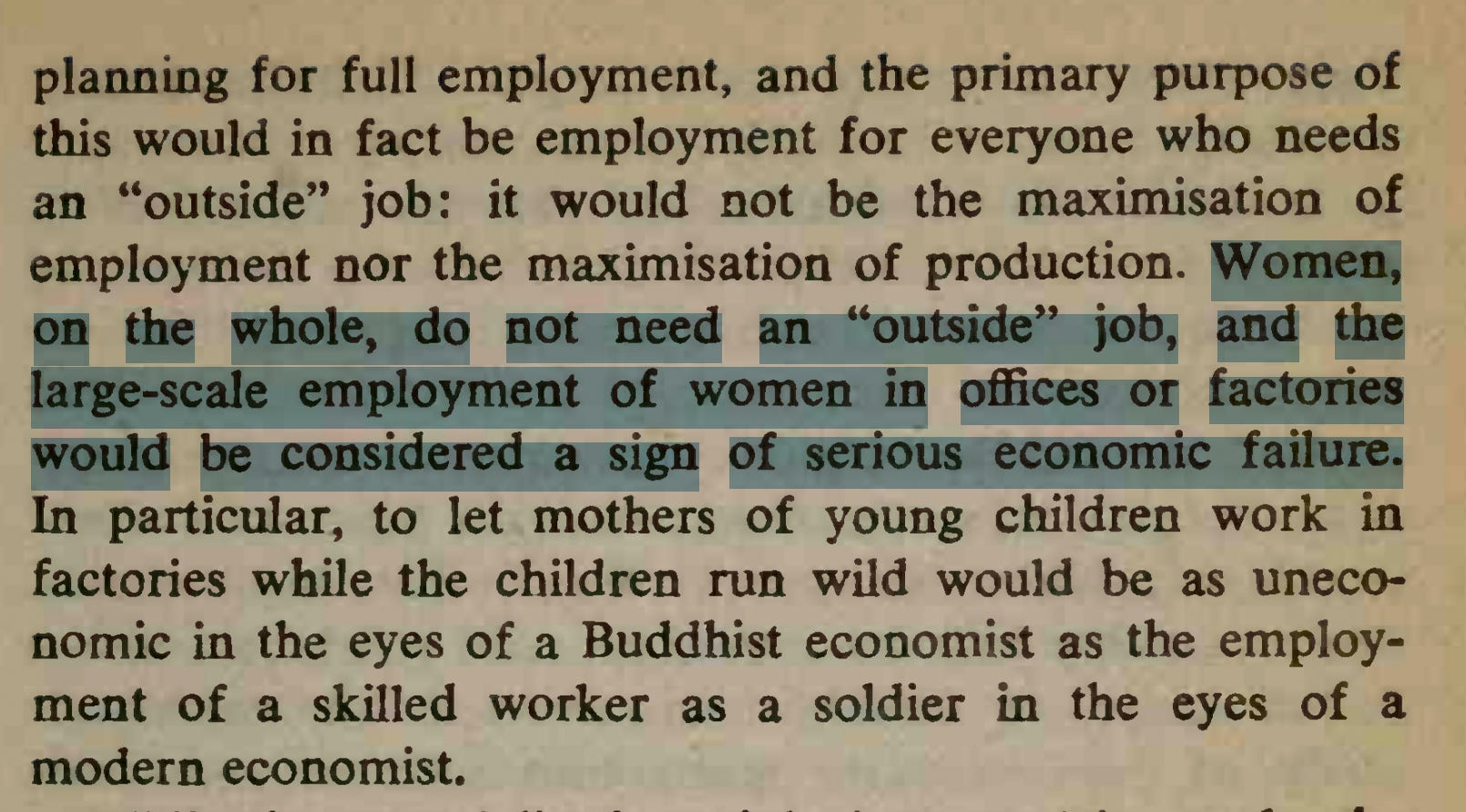
The scale he warned against is also the scale that fed the world. And some of his vision has aged badly, like the passage where he calls mothers working in factories “a sign of serious economic failure.”
For a lot of the women he was pitying, that factory wage was the first money that was ever theirs to keep, the first exit from a father’s house or a husband’s whim. The man who wanted everything human-scale couldn’t see that the big, anonymous factory was the very thing setting some of those humans free.
All of these brought me back to things we read before.
We spent three weeks on Tim Wu’s The Age of Extraction, and its whole argument is that a platform, once it becomes the unavoidable host for everyone else’s business, starts skimming. The app store takes its 30 per cent. Amazon takes half of what you sell. If you think about it, both men are saying the same thing over fifty years, that once a thing grows past a certain size, it no longer serves the people inside it; instead, it feeds on them.
In the oldest fight there is, who owns the ground everyone else has to stand on. For Schumacher, it was soil. For Wu, it’s data and rails. Wu still believes a working government will show up and prune the weeds.
So I went back to the chicken farm. Xiaowei Wang put a fitness tracker on a chicken in a Guizhou village so a farmer could prove the bird was real, that it walked around and had a life before it became dinner. It’s the smallest, most human use of a blockchain I’ve ever come across. And how did that small world go?
GoGo Chicken, the company behind the anklets, once talked about tagging 23 million birds. It never got near. In Wang’s own telling, the Guizhou farmer’s orders dried up right after the first sale, the fate of most beautiful small things. What scaled were the giants, Alibaba and JD, running food tracking for the whole country. So eventually, the big machine keeps the parts it likes.
So where does that leave me, closing a very old book in the middle of a hideous market?
Wanting to believe him, mostly. I’ve always thought people are better than the systems they build, that we’d choose enough over endless if someone just showed us the door. Schumacher shows you the door? Not sure about that, but he writes with a warmth you don’t always find in a book with “economics” on the cover. Reading this felt like being handed permission to want a smaller, kinder world.
And then the grown-up in me says it out loud. It’s too good to be true. Greed and envy don’t lay down their arms so easily. The world he wanted needs everyone to want less. For the big machine, it may already be too late to turn.
But maybe the big machine was never the place to look. It’s hard for you to change the big machine now. Change keeps coming from the edge, from the small and the overlooked, from a phone in Kenya doing what a bank branch wouldn’t, from a stablecoin holding its value in a country whose own money won’t. Crypto has been flunking Schumacher’s test. But it’s also one of the few rooms left where people still ask what he asked, with a straight face. What is money for? What do we owe the people who come after us?
Small is beautiful was a dare. Most of the world assumes that the era has passed and that giant machines have won. But in a few stubborn corners, we don’t have to listen to them. We can choose to stay small anyway. And let the mothers keep their jobs.

Token Dispatch is a daily crypto newsletter handpicked and crafted with love by human bots. If you want to reach out to 200,000+ subscriber community of the Token Dispatch, you can explore the partnership opportunities with us 🙌
📩 Fill out this form to submit your details and book a meeting with us directly.
Disclaimer: This newsletter contains analysis and opinions of the author. Content is for informational purposes only, not financial advice. Trading crypto involves substantial risk - your capital is at risk. Do your own research.