


Hello,
Money’s value is in its utility. Casino chips are real only until we stay on the floor. We can use them to play at the poker table or any other table. But once we walk out the door, it buys nothing until the casino cage turns it back into dollars.
We are surrounded by so many kinds of money. Gold, airline miles, gift cards, and reward points. They are all worth something, but they aren’t considered at par with fiat currency due to how hard each one of them is to spend.
Even when stablecoins were introduced over a decade ago, people jumped to ideological sides and claimed that the digital dollars would replace the entire payment system as we knew it. Stablecoins moved balances instantly between exchanges, protocols, and wallets. But that’s not the end of the journey for money. The difficult part is to make the digital dollars usable once they step out of the crypto ecosystem.
Last week, I argued remittance won’t have a global winner because the value sits in plugging on-chain rails into licences, ramps, and local banks that no blockchain can overwrite. Spending stablecoins also works the same way.
In today’s guest essay, Sebastien Davies, Partner at Primal Capital, shows how.
Onto Sebastien’s story,
Prathik

StablesReward: Your AI Agent Spends, You Earn
AI agents can surf the web, read reviews, and book hotels for you. All these tasks cost money. But what if these tasks could earn you back something?
StablesReward does just that. Once you connect your agent to an MCP endpoint, it gives your agent a menu of paid tools. Every call your agent pays for earns you miles or stocks. And this is in addition to the rewards you earn anyway on your own spending across 800+ merchants.

Every purchase pays you back. The best part is that you can choose how you’d like to be rewarded. Transfer miles to airlines and hotels, or let your stocks build a portfolio from the spend you were making anyway.
Launching soon. Free to join.
Stablecoins have largely solved settlement for crypto-native flows. Getting a token balance accepted at a till is a separate job, and for now, the most practical route runs through the card networks.
A Balance the Counter Can’t See
Put $2,000 of USDC in a wallet on Base and walk into a restaurant. The balance is real and dollar-denominated. The terminal on the restaurant counter has no idea it exists.
Over the past five years, stablecoins have become a credible settlement infrastructure for many types of transactions. They carry large, continuous volumes across trading, DeFi liquidity, treasury & remittances, on rails that run around the clock, finalise in seconds, and cost fractions of a cent per transfer. For crypto-native and cross-border flows, settlement feels close to solved.
Paying a merchant involves complexity. A checkout transaction needs a payment credential, an authorisation engine, a compliance check, fraud controls, chargeback rules, FX conversion, and clearance through a card network. A transfer between two wallet addresses needs none.
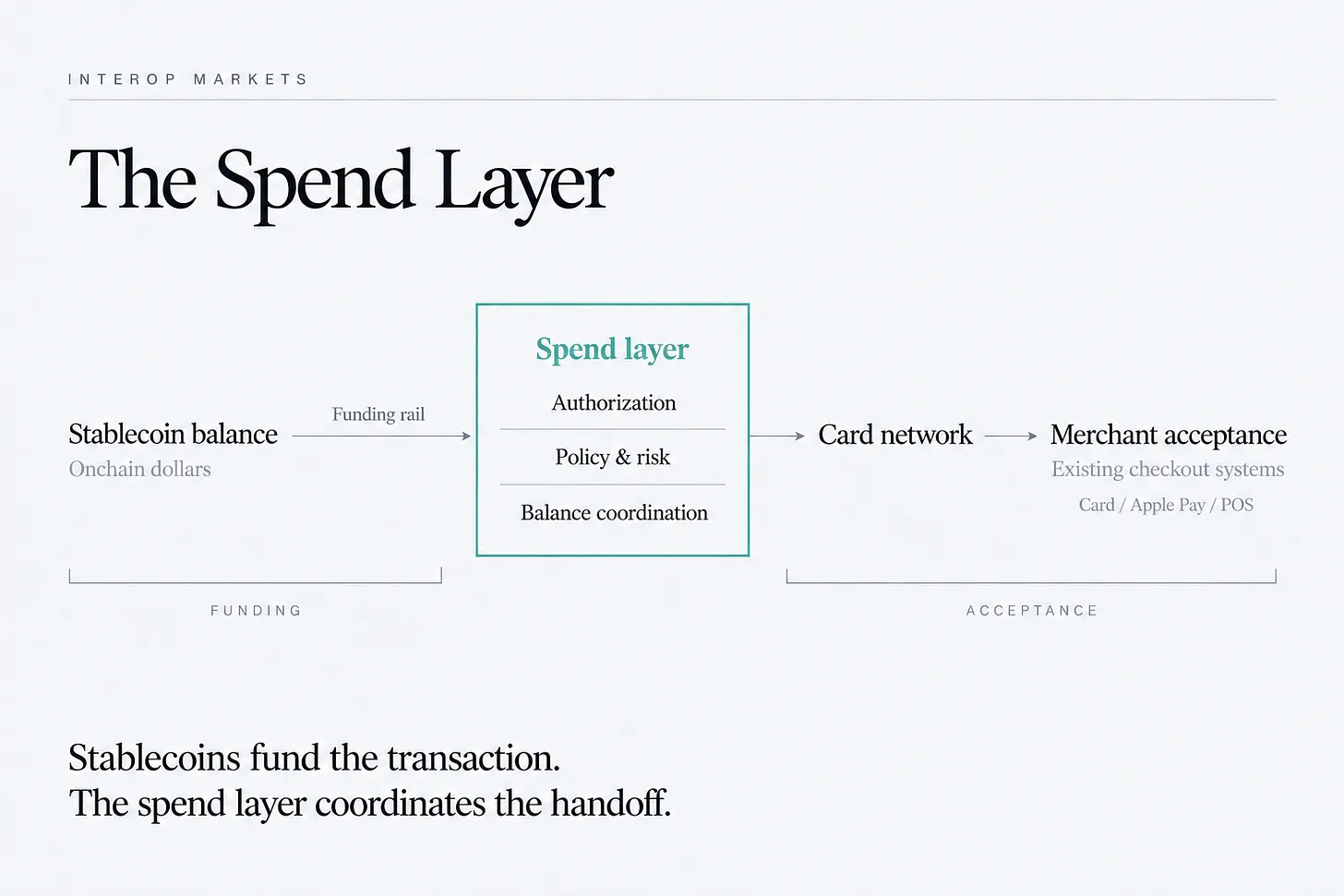
The interesting work in digital assets right now sits in between. Call it the spend layer, the part that turns a blockchain-native balance into an authorised, compliant card transaction that a merchant can accept through the terminals, software, and bank workflows it already runs.
Settlement And Spend Are Different Jobs
Narratives across the digital asset ecosystem tend to merge the two. A smart contract can move dollar tokens from Alice to Bob in two seconds, so it’s easy to assume checkout got simpler, too.
But, settlement answers one question: Did the value move?
Spend answers a more nuanced question. Can the merchant approve the sale, hand over the goods, manage fraud & disputes, reconcile the day’s takings, and get paid through the systems it already has?
Merchant checkout runs on ISO 8583 (the message format card terminals and processors use to talk to each other), point-of-sale software, acquirer relationships, and network rulebooks. When a customer taps a card or phone, the merchant’s system expects an authorisation answer in a fraction of a second. Nobody at the checkout counter wants to think about gas fees, block confirmations, chain reorganisations, or slippage on a token pair, and most of them shouldn’t ever have to learn what a reorg is. Nor does the cardholder want the payment experience to feel like crypto. Apple Pay and Google Pay matter because they turn the card credential into something familiar, fast, and invisible at the moment of spend.
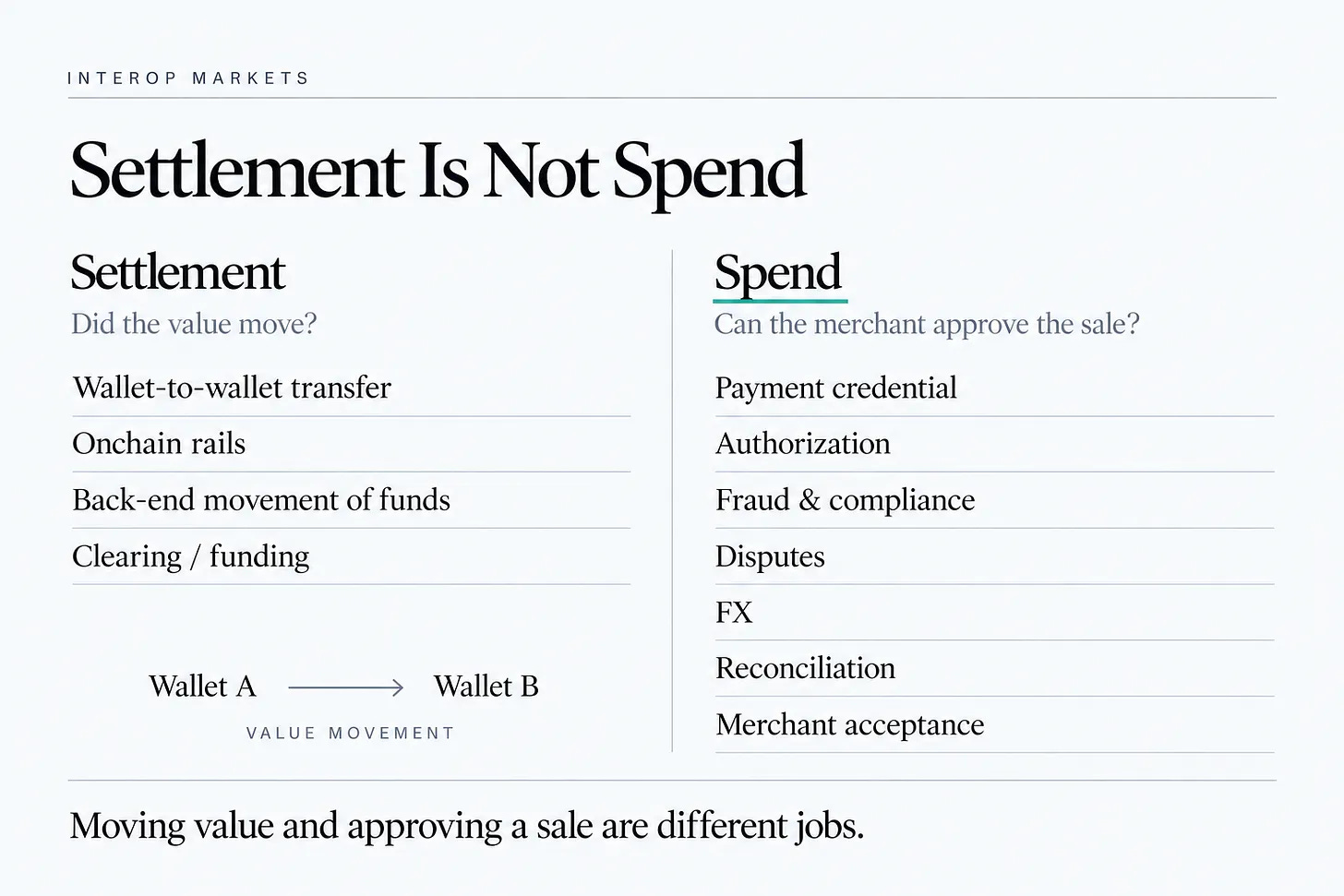
Settlement is the backend clearing of value. Spend is the trust, rules, authorisation, messaging, and commercial guarantees that make a merchant willing to hand over the goods before that clearing happens.
Merchant Acceptance Is the Bottleneck
Blockchains can move value globally without permission. However, they can’t make a merchant accept cryptocurrency.
Merchants take Visa and Mastercard because those networks are built into point-of-sale hardware, e-commerce checkout software, acquirer relationships, accounting workflows, and customer habits. A retailer prices a payment method on the total cost of running it across the whole business, and the transaction fee is only one line in that. Changing how payments land in the ledger means touching POS integrations, store training manuals, end-of-day reconciliation scripts, tax software, and acquirer liability agreements. That’s what makes acceptance path-dependent. Unless a new payment rail is dramatically better for the merchant, inertia wins.
Raw stablecoin acceptance runs into three specific problems:
Retailers won’t put a separate QR scanner next to the terminal they already have.
Finance teams expect settled funds in a bank account by ACH or wire on a predictable cycle.
Merchants lean on card-scheme chargeback rules to defend against fraud & processing errors, which an irreversible transfer doesn’t give them.
Therefore, the holder of that USDC is liquid and unable to spend it at the same time. That turns the useful question around. Rather than persuading tens of millions of merchants to change hardware and software at once, can crypto-native balances inherit the acceptance merchants already have?
Cards Are Still the Front Door
Early crypto writing assumed stablecoins would route around the card networks entirely. No interchange, no intermediaries, just peer-to-merchant transfers.
That thesis treated the networks as merely expensive message pipes. But these card networks are also acceptance networks, rules engines, dispute systems, issuer/acquirer coordination layers, and merchant integration standards, which is why they’re so hard to route around.
For now, cards are becoming the main channel that carries stablecoin balances into the real economy. Stablecoins improve the funding rail, cards own the acceptance rail, and the spend layer is where the two meet. This does not mean that cards forever own the payments landscape. For the current phase of stablecoin adoption, acceptance may matter more than replacement.
The result is not a clean swap of one rail for another. Stablecoins fund the transaction. Cards translate it into something the merchant can accept. The spend layer coordinates the handoff.
The Stablecoin Spend Stack
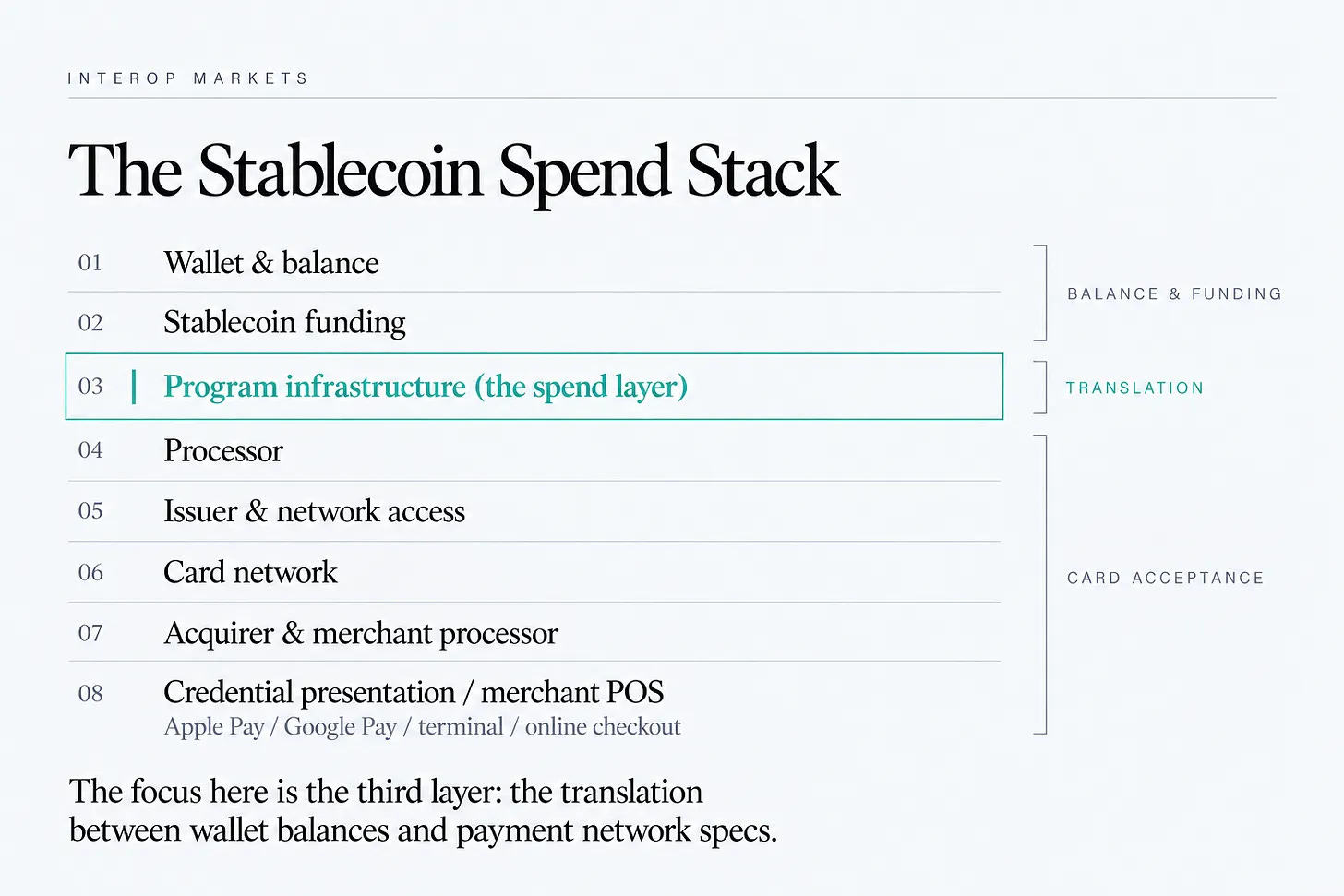
Turning a token balance into a completed card payment takes eight layers working together in well under a second:
Wallet & balance. Where the user holds the assets, whether that’s a self-custodial mobile wallet, a browser extension, or a regulated exchange account.
Stablecoin funding. The APIs, protocols, or smart contracts that reserve, lock, or debit tokens when an authorisation request comes in.
Program infrastructure (the spend layer). The engine that turns an incoming card authorisation message into a real-time balance check, policy evaluation, and risk decision.
Processor. The technical processor that handles ISO 8583 messaging formats, PIN verification, and authorisation routing between the scheme and the program management system.
Issuer & network access. The regulated issuing bank or principal member with legal authority and scheme permissions to issue credentials.
Card network. The scheme, such as Mastercard, that routes authorisation, clearing, and settlement messages between issuers and acquirers.
Acquirer & merchant processor. The merchant’s bank-side partner, which processes transactions, manages terminals, and settles local currency to the business.
Merchant point of sale. The terminal, mobile reader, or online checkout where the customer presents the credential.
The focus here is on the third layer, which facilitates the translation between wallet balances and payment network specifications. Without it, on-chain dollars stay disconnected from everyday commerce.
Immersve as a Case Study
Immersve is a useful example because it sits in the translation layer. The company has assembled the B2B card infrastructure around Mastercard-enabled card issuing. Wallets, exchanges, and fintechs use it to offer their users card credentials funded by crypto balances, without building the issuing, authorisation, compliance, and settlement stack themselves.
It’s a complex stack. An in-house card programme means network memberships, issuer-processor connections, transaction monitoring, dispute workflows, and multi-currency treasury operations. For most wallet teams and exchanges, it’s a poor use of engineering and compliance headcount, which is the gap a platform like this fills. End users stay in the app they already use, and Immersve runs the programme behind it. The wallet or fintech gets a branded card and recurring payment activity without taking on the card stack itself.
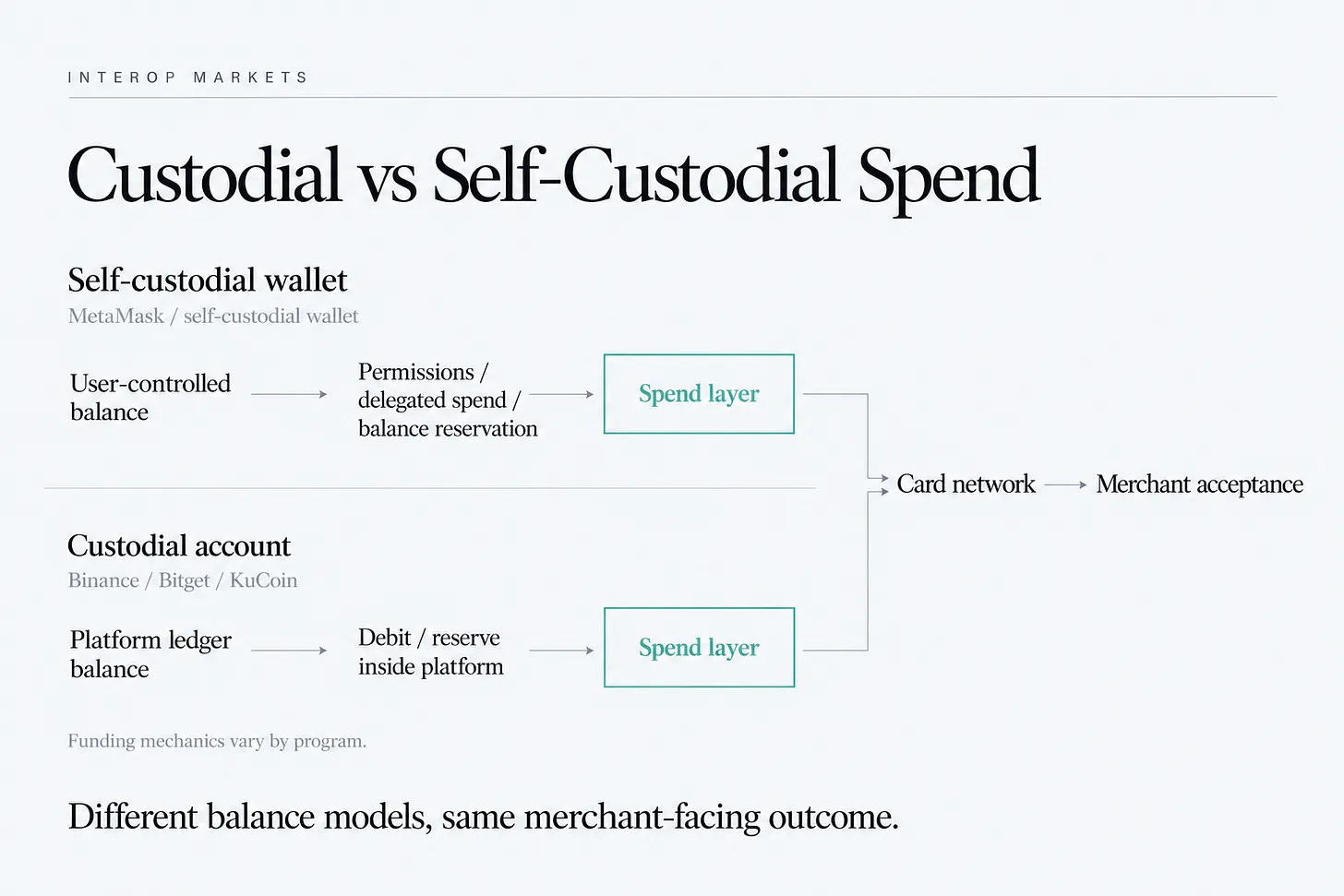
Recent reference points show the thesis across both sides of the custody spectrum. Immersve’s work with MetaMask brings the spend layer into a major self-custodial wallet, where the user stays inside the wallet environment, and the infrastructure underneath turns a blockchain-native balance into a card-network transaction. Binance, Bitget, and KuCoin show the same need from the custodial exchange and wallet-account side. In those environments, the user’s balance may sit inside a platform ledger rather than directly in a self-managed wallet, but the payment problem is the same: how does that balance become spendable at merchants that already accept cards?
That custody distinction matters because the technical mechanics differ. A self-custodial wallet has to solve permissions, balance reservation, and on-chain funding without waiting for a fresh transaction at the counter. A custodial platform can debit or reserve funds inside its own ledger, but still needs card issuing, authorisation, compliance, settlement, and reconciliation. Different balance models, same merchant-facing goal.
Immersve is not alone in that fight. Rain, Baanx, Marqeta, Bridge, Gnosis Pay, and others all touch parts of the same problem, with different models for custody, issuing, programme management, settlement, and distribution. That is what makes the category interesting. This is not one company trying to bolt a card onto crypto. It is a market forming around the operating layer between blockchain asset balances and merchant acceptance.
What Happens at Checkout
Here’s the sequence in a typical card-linked stablecoin spend flow, when someone pays in a shop. Programmes differ in the details, so treat this as the general shape:
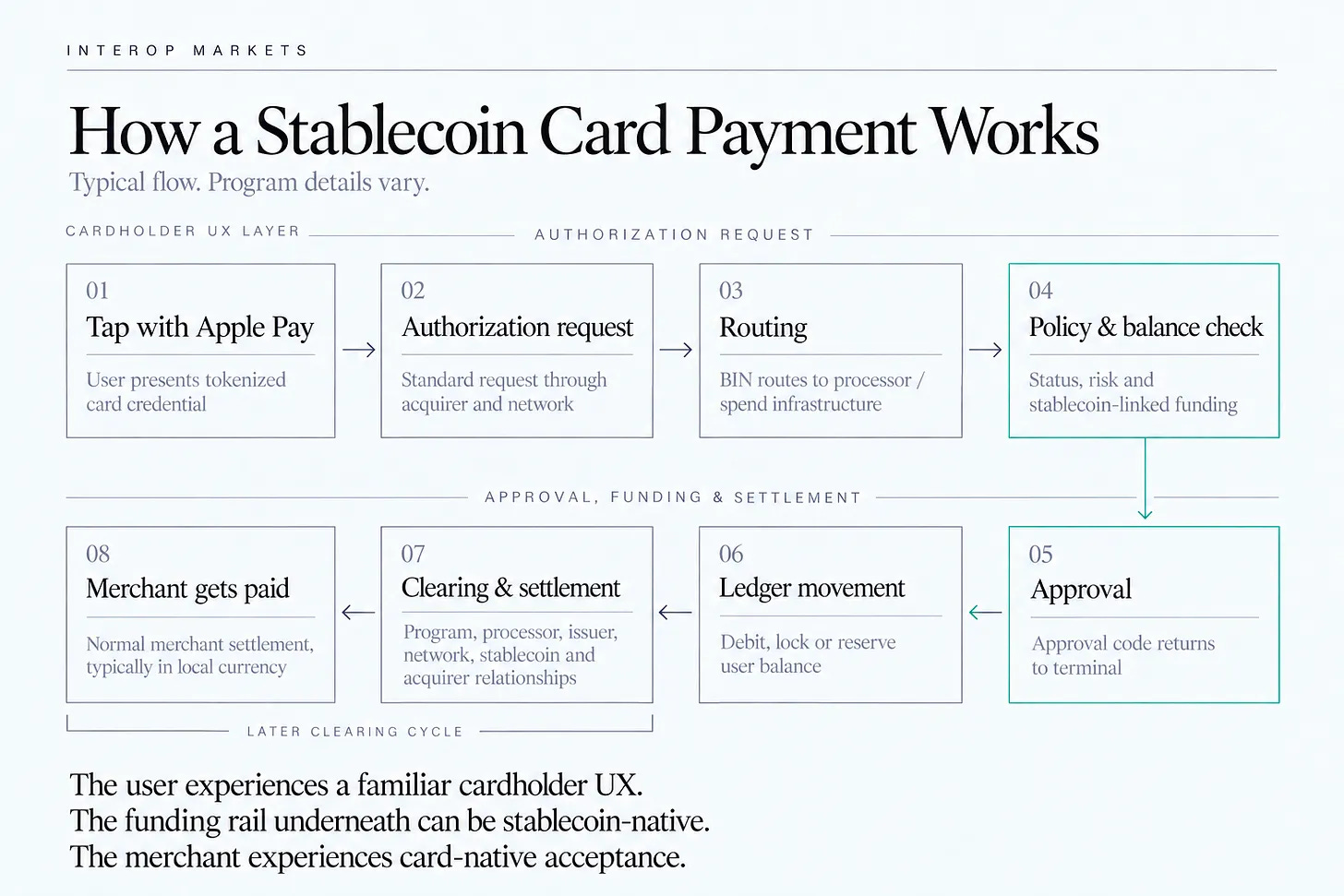
Tap. The user taps a virtual card stored in Apple Pay or Google Pay at a contactless terminal.
Authorisation request. The terminal sends a standard card authorisation request through the acquirer to the card network, Mastercard in this example.
Routing. Mastercard reads the card’s BIN (Bank Identification Number) and routes the message to the programme’s processor and spend infrastructure.
Policy & balance check. Depending on the programme structure, the platform checks account status, runs fraud rules, scores the transaction, and confirms the linked account or wallet holds enough stablecoin to cover the amount plus an FX buffer.
Approval. An approval code goes back through Mastercard to the terminal, and the customer and clerk see it immediately.
Ledger movement. Behind the scenes, the programme debits, locks, or reserves the user’s stablecoin balance, depending on how the program is structured.
Clearing & settlement. In the normal clearing cycle, funding and settlement run through the relevant program, processor, issuer, network, stablecoin, and acquirer relationships.
Merchant gets paid. The merchant sees a normal card transaction and receives settlement through its usual acceptance setup, typically in local currency, without touching digital assets, managing cryptographic keys, or altering its corporate accounting routines.
That cardholder experience matters. The closer the front end feels to Apple Pay, the less the user has to understand about the funding rail behind it. The user experiences crypto-native funding, while the merchant continues to offer card-native acceptance.
Custodial and Self-custodial
People hold stablecoins in very different places, from exchange accounts to hardware wallets, and a spend layer has to handle both ends of that range.
In a custodial model, the exchange or custodial wallet keeps user balances in its own database. When an authorisation arrives, the spend infrastructure queries the platform’s API to confirm funds, the platform typically deducts or locks the balance internally, and the programme’s settlement arrangements fund the scheme obligation.
Self-custody is harder. The user holds their own keys, and their stablecoins sit on-chain. An authorisation window can’t wait for a fresh on-chain transaction, and block times, network latency, and gas spikes can’t be counted on to fit inside it. So the programme has to be able to approve the card transaction before the final on-chain movement happens. That takes something arranged in advance, whether pre-positioned permissions like smart contract allowances, reserves, and delegated spend, or liquidity arrangements that let the programme pay first and settle on-chain afterwards. The exact mechanics vary by programme.
Handling both behind one authorisation layer means the cardholder gets the same experience wherever the money actually sits.
The Boring Parts Dig the Moat
Stablecoin payment pitches tend to lead with speed and low gas fees. The real work is somewhere else, and it’s the strongest evidence that settlement and spending are different jobs:
Compliance & sanctions. KYC, AML, sanctions controls, transaction monitoring, and wallet-risk screening. This happens across onboarding, monitoring, and authorisation.
Fraud. Real-time scoring for card-not-present risk, geographic anomalies, velocity, and credential misuse.
Disputes & chargebacks. Card networks let consumers reverse unauthorised charges or non-delivery. The spend layer has to reconcile irreversible on-chain funding with a dispute system built on reversibility.
FX & treasury. A USD stablecoin spent in Paris or Tokyo needs real-time conversion to EUR or JPY. The programme has to hold FX buffers on every authorisation and manage spreads, liquidity, and slippage, or it eats the losses.
Reconciliation across three ledgers. On-chain records, the processor’s transaction stream, and the scheme’s clearing files all have to reconcile every day.
Issuer & program obligations. The issuing bank and programme manager answer to the scheme and to regulators for every card in the programme, and those obligations don’t shrink because the funding happens on-chain.
Network rules. Scheme rulebooks govern authorisation, disputes, settlement, and what a programme is allowed to support. Every programme operates inside them, and they change.
“Pay with stablecoins” fits on a slide. Reconciling three ledgers every night is the difficult part. This is where payment businesses get hard. Getting authorisation, compliance, disputes, FX, and reconciliation to work without the merchant or the user noticing the machinery is the job, and it’s most of the job.
What Still Needs to Be Proven
Card distribution gives stablecoins immediate reach, and it comes with its own open questions:
Network dependency. Programmes on card rails live under scheme rules, fee changes, and policy shifts. If a scheme restricts certain digital-asset structures, providers have to adjust quickly.
Regulation. Rules on card issuing, stablecoin reserves, consumer disclosure, and cross-border transfers are still moving, in different directions in different places.
Consumer behaviour. It’s unclear whether people will use stablecoins as everyday spending accounts or keep them for narrower jobs like travel, trading payouts, freelancer remittances, or inflation hedging.
Technical risk. Self-custodial funding depends on smart contract integrity, network uptime, and predictable gas. Congestion or a contract bug can interrupt payments.
Direct competition. Large merchants or acquirers may eventually build a cardless stablecoin checkout for high-value B2B or e-commerce payments.
Card-mediated stablecoin spend doesn’t eliminate the card stack’s economics. It inherits interchange, scheme fees, processing costs, programme costs, compliance overhead, and dispute obligations. Direct stablecoin checkout can be cheaper at the rail level, but only if the merchant is willing to absorb new integration, reconciliation, refund logic, accounting treatment, and operational risk. For many merchants, the cheaper rail isn’t cheaper if it forces the enterprise workflow to change.
Cards solve acceptance. Building on them means inheriting their rules and constraints along with their reach.
Making Stablecoins Ordinary
Wallets own the consumer relationship. Merchants own the checkout. Schemes own acceptance and brand trust. Issuers and programme managers hold the licences, BIN access, and scheme relationships. Someone has to make those four work together on every tap. Coordinators like Immersve get paid for a job the wallet does not want to staff, and the merchant does not want to think about.
Asking merchants to drop their terminals, acquirer flows, and accounting to accept blockchain transfers directly has so far looked unrealistic. Stablecoins made settlement work. Spend brings its own problems in authorisation, compliance, merchant integration, and the user’s experience at the till.
If stablecoins are going to become ordinary, the winning architecture may not ask every participant to change at once. Users can hold dollar tokens. Wallets can own the interface. Card networks can preserve acceptance. Merchants can receive ordinary settlement. The spend layer coordinates the translation between those worlds.
Settlement made stablecoins useful. Spend will determine whether they become ordinary.
Disclosure: The author is a partner at Primal Capital, which is an investor in Immersve. This note was not paid for or sponsored by Immersve or any affiliated party.
P.S.: This story was first published here.
P.P.S.: We will be featuring good writing and writers we love from time to time. If you have recommendations, send them our way.
Token Dispatch is a daily crypto newsletter handpicked and crafted with love by human bots. If you want to reach out to 165,000 subscriber community of the Token Dispatch, you can explore the partnership opportunities with us 🙌
📩 Fill out this form to submit your details and book a meeting with us directly.
Disclaimer: This newsletter contains analysis and opinions of the author. Content is for informational purposes only, not financial advice. Trading crypto involves substantial risk - your capital is at risk. Do your own research.
