


Part I mapped how platforms become unavoidable. Part II handles what happens next. Let’s go deep into The Age of Extraction by Tim Wu.
“Sofalarity.” There’s my favourite word of the month/year (depending on what I read next).
I conveniently realised that my own exhaustion is exactly how the system needs me to behave to keep working, not a personal failure. Slouched on my bamboo sofa in a position guaranteed to cause back pain, I asked Alexa to brighten the lights. Because the reading was getting a bit uncomfortable and personal.
You know the singularity, that is, the theoretical point where AI surpasses human intelligence, everything changes forever. We are not there yet, but sofalarity, it’s here in this room with us.
It’s the point where convenience itself becomes so complete that leaving a platform feels roughly as plausible as moving to another country where you might not find a bamboo sofa.
The ecosystem you choose to stay in seems free of drama or friction, offering a level of convenience that actively improves your day. But you can see friction everywhere else; that is how we keep making the same choices. But did you make the choice yourself, or was the choice already made for you?
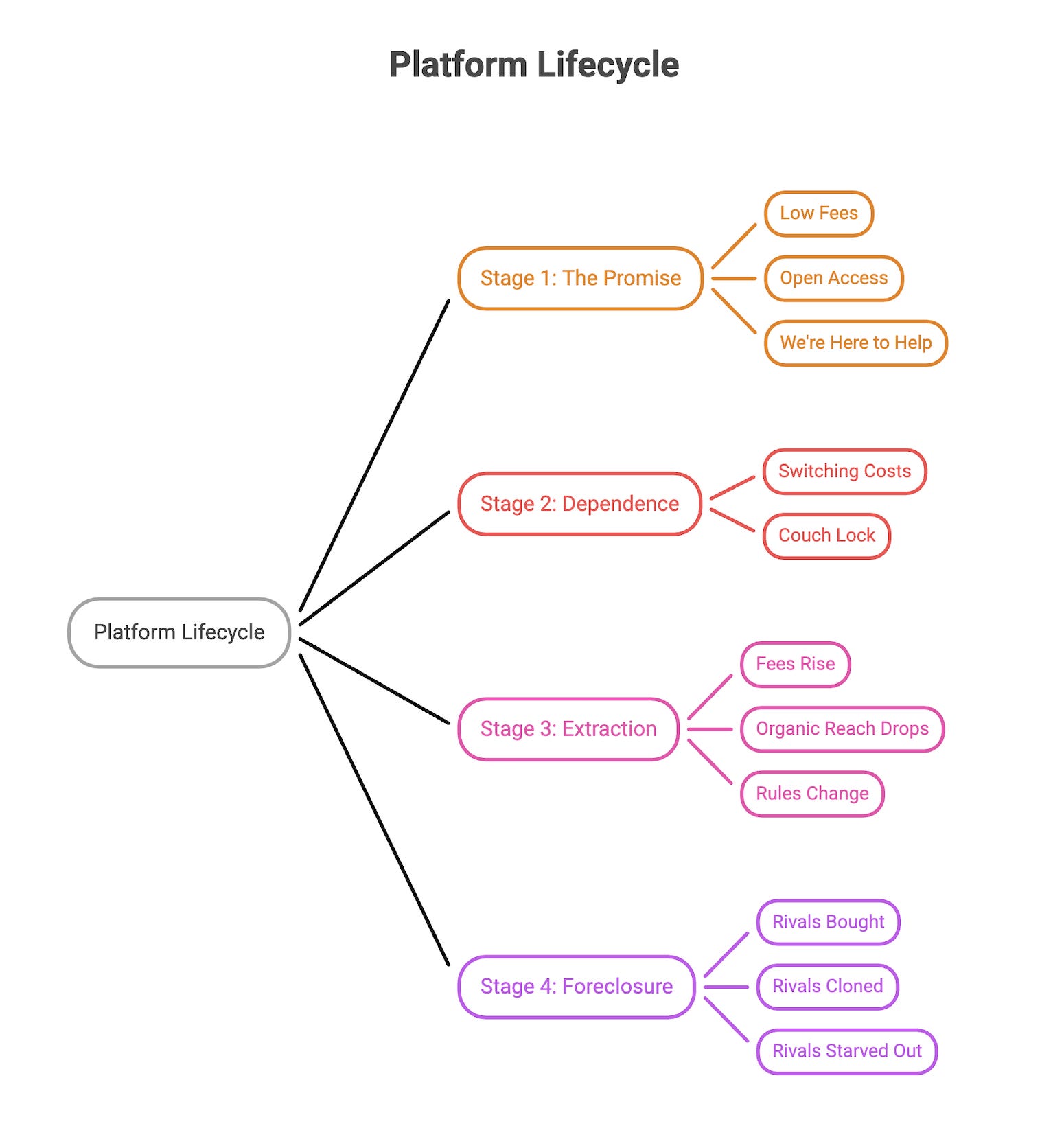
The book describes something I think most of us know but don’t have the language for. The (comfortable) weight of staying on a platform you’re still not even sure you like. The way switching feels is not impossible, but somehow exhausting in advance, before you’ve even started. He borrows a phrase from stoner culture for it. “couch lock.” It pretty much explains itself.
As always, my brain immediately drifted back to crypto. Are we ever going to build a product slick enough to give people couch lock? Or did we already make that promise, try it, and fail miserably? Are we operating entirely beyond a cosy consumer haven, or are we just stuck below it?

Look at how these apps keep us hooked using what psychologists call a variable reward schedule. It’s the slot-machine effect that makes gambling addictive, which is something you can easily find in crypto. Price volatility acts like one of the most powerful slot machines ever created. Most positions don’t move much. Occasionally, something increases tenfold. This unpredictability triggers the compulsive checking behaviour linked to Instagram notifications and TikTok scrolling.
Crypto’s variable reward system skips the platform entirely, pulling people straight to a price chart where the dopamine builds for traders. It lacks the habitual system reliance that large tech platforms profit from. This likely explains why, after fifteen years, speculation remains the only consumer product that crypto consistently provides.
Wu explains why platforms spend billions on things that seem unrelated to their core business. Google paid $17 billion for NFL streaming rights, or Amazon spent $11 billion on Thursday Night Football. The goal was hours. They wanted to control enough of your Sunday that your week would naturally revolve around one company’s interface.
Every hour you spend inside a platform’s ecosystem is an hour you don’t spend wondering if something better exists elsewhere.
For someone in India, there are two options to watch “The Office”. Netflix and Amazon Prime. Amazon offers benefits that make it a good choice, and it’s got a lot of perks for Prime subscribers.
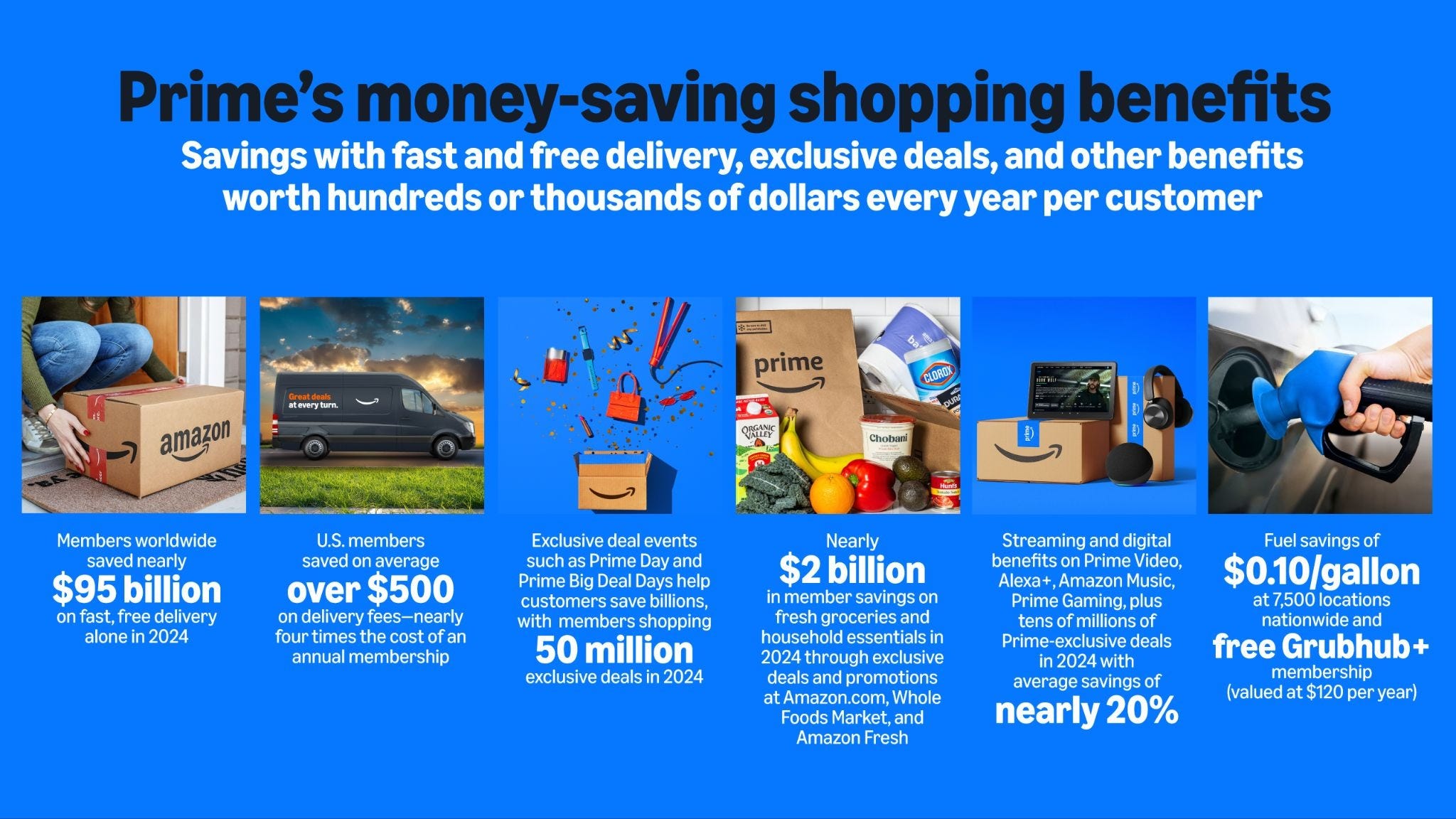
“If it’s easy, it wins,” says Wu.
Borderless money, self-custody, and transparent systems are all great. The pitch requires you to first convince someone that something they don’t consider broken is actually broken. Most people didn’t walk around thinking about how to fix correspondent banking.
The internet’s convenience gap was visible to everyone. “You don’t have to drive to the post office anymore.” Okay, convinced.
The before-and-after was obvious, immediate. Crypto’s chasm is just as real but almost entirely invisible to the people living inside it. The inefficiency lies within institutions, within settlement layers, within the correspondent banking system that most people will never have to know about. “Replaced all of it with blockchain.” sounds completely alien to the average user.
The internet replaced something that bothered everyone. Driving to a travel agent to book a flight was annoying. Going to a video store to rent a movie was annoying; if you were late, someone else had already taken it. When the internet removed those barriers, people felt the difference immediately because it made their lives comfortable. Explaining the solutions to all of this, people were okay with.
Crypto is replacing something most people have never had to think about. The average person sending money to family in another country knows it takes a few days and costs money. They likely don’t know what a correspondent bank is. They don’t care that their $200 transfer goes through three or four intermediary banks before reaching its destination, each taking a fee. They just know it worked for them, more or less, and they’ll use it again next month.
If you switch that entire system to blockchain technology, the person sending the money experiences roughly the same feelings. It might be faster. The fee might be lower. However, nothing about their life visibly changes. They don’t have a moment of realisation like, “Oh, I don’t have to do that anymore.” That’s the issue.
Adoption has always been a challenge for the industry, not the users. As long as crypto requires explanation for people to understand it, it will remain in the nerd category, regardless of how good the technology is.
What else is missing from crypto? The data chapter requires a fresh perspective on this issue.
Google and Facebook made $360 billion in combined ad revenue in 2024 because they spent two decades collecting data on everything you do. Every single scroll or long pause on a post helped them build a machine that predicts your next move. Brands pay billions for that prediction. We built that engine for them, completely free of charge, starting from when we opened our first accounts.
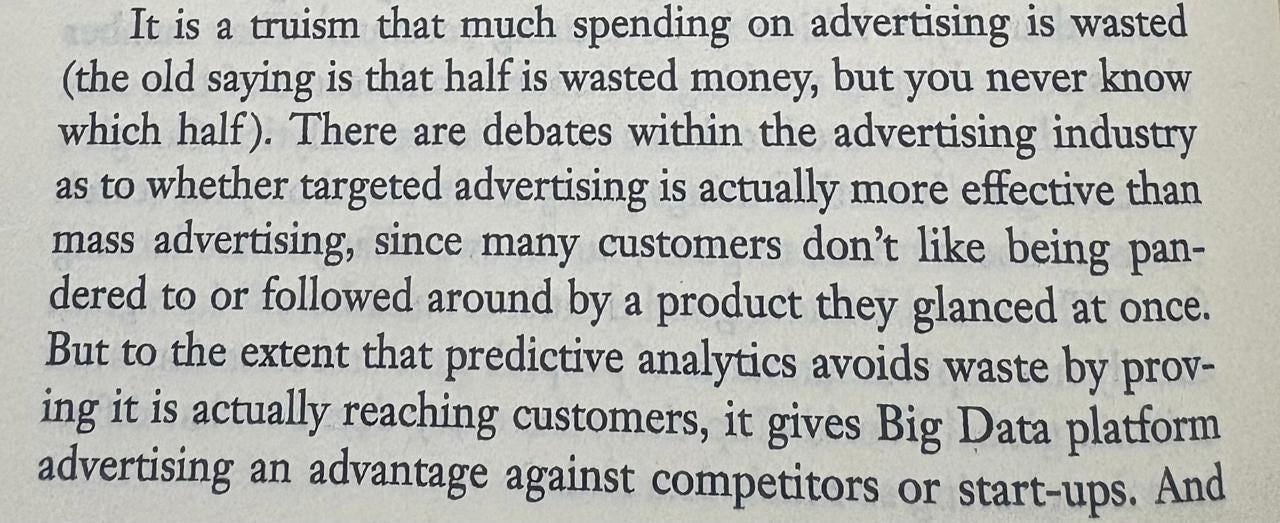
Wu compares it to a poker game where your opponent has watched every hand you’ve ever played. They remember your bluffs and your worst calls. They are playing completely within the rules, but they know your mind. That exact advantage compounds over billions of separate rounds, ultimately generating a massive corporate empire.
I circled back to check if crypto has anything like this. No, I’m not referring to prediction markets.
Bitcoin’s entire blockchain, which includes every transaction since 2009, is about 611 GB. Meta processes more data than that every few hours. Ethereum’s on-chain data is richer, but it captures only financial behaviour: wallet addresses, transaction amounts, and protocol interactions. It shows what someone did with money but offers no insight into why. It misses the countless small daily choices that make behavioural prediction commercially valuable.
900 million people use ChatGPT weekly and share work documents, medical questions, their anxieties, and business strategies. It helps them. They don’t see the privacy trade-off when they use it.
People routinely surrender their private search histories and location data to Big Tech in exchange for daily convenience. Turning around and asking that same audience to suddenly care deeply about financial autonomy and transparent ledgers is a big stretch. Some people do care. Some care, but are busy. The pitch appeals to people who are already convinced. This approach is not effective for growth if you want to achieve mass adoption and create “everything apps.”
Wu engages with Shoshana Zuboff’s argument about surveillance capitalism. She claims platforms have created Skinner boxes. They act like little games, tricking our brains into checking them over and over by giving us surprise rewards. He counters that mass attention manipulation existed long before big data. I agree with him on this point.
Goebbels didn’t need a recommendation algorithm. Yes, the “totalitarian control” framing is overcooked.
Look at the variable reward schedule. Crypto has them too, just like we talked about at the start of this article. The way prices constantly go up and down is like a giant, exciting game of surprise. But that excited feeling never locks you inside a helpful everyday app.
The more you rely on a tool, the worse you get at doing the thing without it. That’s fine when the tool is a calculator. It gets complicated when the tool is an infrastructure that someone else owns and controls.
Crypto keeps rebuilding this problem. Developers build on top of sequencers they don’t control. Protocols depend on liquidity providers who can leave. Apps sit on top of chains run by a handful of validators. Each layer feels like progress, but it’s not entirely. You built something on someone else’s foundation, and now you can’t move without their permission. Web2 had the same shape. AWS goes down, and half the internet goes with it.
Now that’s where we go back to the IBM analogy. IBM dominated its era by building elite enterprise infrastructure and letting the application layer run on top of it, entirely bypassing the fight for consumer couch lock.
Crypto’s realistic best-case outcome might look more like that, which we recently realised as well. Settlement rails, institutional clearing, cross-border infrastructure, nobody wants to rebuild from scratch.
That is a major achievement, even if it is completely different from the consumer super-app dream.
Further down the pages, the book pivots away from technology to expose how the exact same corporate playbook dominates healthcare and housing. I felt it was important to mention that.
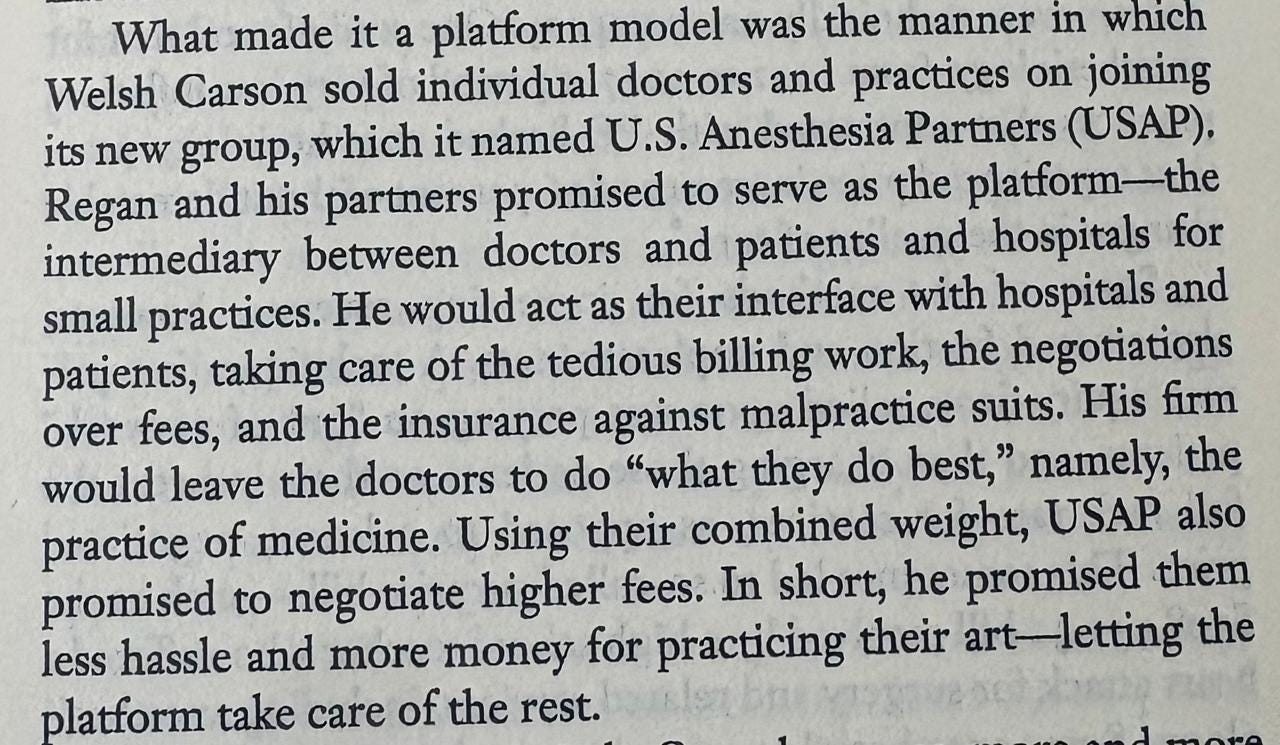
Welsh, Carson, Anderson and Stowe bought anesthesiology practices across cities because patients under anaesthesia don’t shop around. Prices rose 26% between 2012 and 2017. One patient got a bill for $108,951.
Invitation Homes spent $150 million a week buying foreclosed homes from 2012, now owns 110,000+ properties, paid a $48 million FTC settlement in 2024, and mailed refund checks averaging $106 to 444,131 tenants. Rents grew 4.5% the quarter after the settlement.
We discuss Real World Asset (RWA) tokenisation as the best tool for financial inclusion, arguing that fractionalised real estate will make wealth more accessible to more people. Does breaking a house into digital tokens help the local buyer compete against a firm spending $150 million a week on acquisitions?
What it does is digitise the inventory for giant corporations. Big firms own 1% of housing nationally, but they control 25% of housing in Atlanta and 21% in Jacksonville.

A more liquid crypto layer makes these exact markets even easier for Wall Street to buy up. Tokenisation fails to stop corporate landlords; it builds them a faster ledger for collecting rent. Crypto functions as a tool that cuts both ways here, entirely neutral rather than an automatic saviour.
The platform model merely accelerates extraction, making the process hyper-efficient and inescapable. A private equity firm owning a single anesthesiology practice operates as an isolated business. The game changes completely when a single entity buys up every practice across major metropolitan hubs. Coordinated through shared software, corporate owners apply fee increases uniformly across hundreds of healthcare providers. Individual doctors operate blind, unable to see the full shape of the trap. It is old greed running on superior infrastructure.
Wu stays careful about where he draws the line. I’m less careful. The deeper mechanics of these sectors reveal a slow-moving process of primitive accumulation within the American middle class. The corporate shift effectively forces doctors back into a standard labour pool and locks homeowners into a lifetime of renting.
The corporate platform model depends entirely on captive audiences and centralised gates. We have a technology built from the ground up to smash those gates. It gives sovereign individuals the tools to build their own systems, entirely outside the extractor class’s reach. That’s the moat.
Part 3 next week, until then, stay curious.

Token Dispatch is a daily crypto newsletter handpicked and crafted with love by human bots. If you want to reach out to 200,000+ subscriber community of the Token Dispatch, you can explore the partnership opportunities with us 🙌
📩 Fill out this form to submit your details and book a meeting with us directly.
Disclaimer: This newsletter contains analysis and opinions of the author. Content is for informational purposes only, not financial advice. Trading crypto involves substantial risk - your capital is at risk. Do your own research.