


“Trust is one of the oldest and most indispensable ingredients in the world of commerce.” -Yours truly, circa 2026
Hello,
More than a decade ago, I prepaid for an online purchase with a card for the first time. My mother panicked. Why would you trust a faceless business hiding behind a website? What if the action camera never arrives? I didn’t have an answer for her then. I do now.
An aggregator — Flipkart (now owned by Walmart) — had stepped between a random seller and me, and offered a trust layer on the merchant’s behalf.
Every commerce era widens the circle of strangers who transact with each other, and each one needs a new kind of middleman to broker the trust. Long before money existed, the Sumerians and Babylonians ran on credit and social ties, as David Graeber writes in Debt: The First 5000 Years. When banks wouldn’t lend to strangers, credit bureaus scored them. When cards arrived, Visa and Mastercard vouched for every swipe. When the internet dumped thousands of anonymous sellers on us, eBay, Amazon and Flipkart rated them and controlled the ground they sold on.
Then followed the age of machines.
Today, I’ll explain how that trust gap gets filled in an era where machines are about to overtake humans in the number of purchases they make.
On to the story…


Velo: Supercharge Your Analysis
There’s never been a better time to be an analyst. Everyone has access to powerful AI models, and even non-coders can build the ideal tools they need. The difference between a mediocre analyst and a great one, however, is the same as it’s always been - access to the best information. Most are limited by poor quality or insufficient data.
With the Velo API, we put our extensive data in your hands, allowing you and your AI to see the whole picture. Spot, futures, options, price action and order flow data - all at your fingertips. Power your AI in a single command with our MCP. Build your perfect suite of tools with Velo’s SDKs.
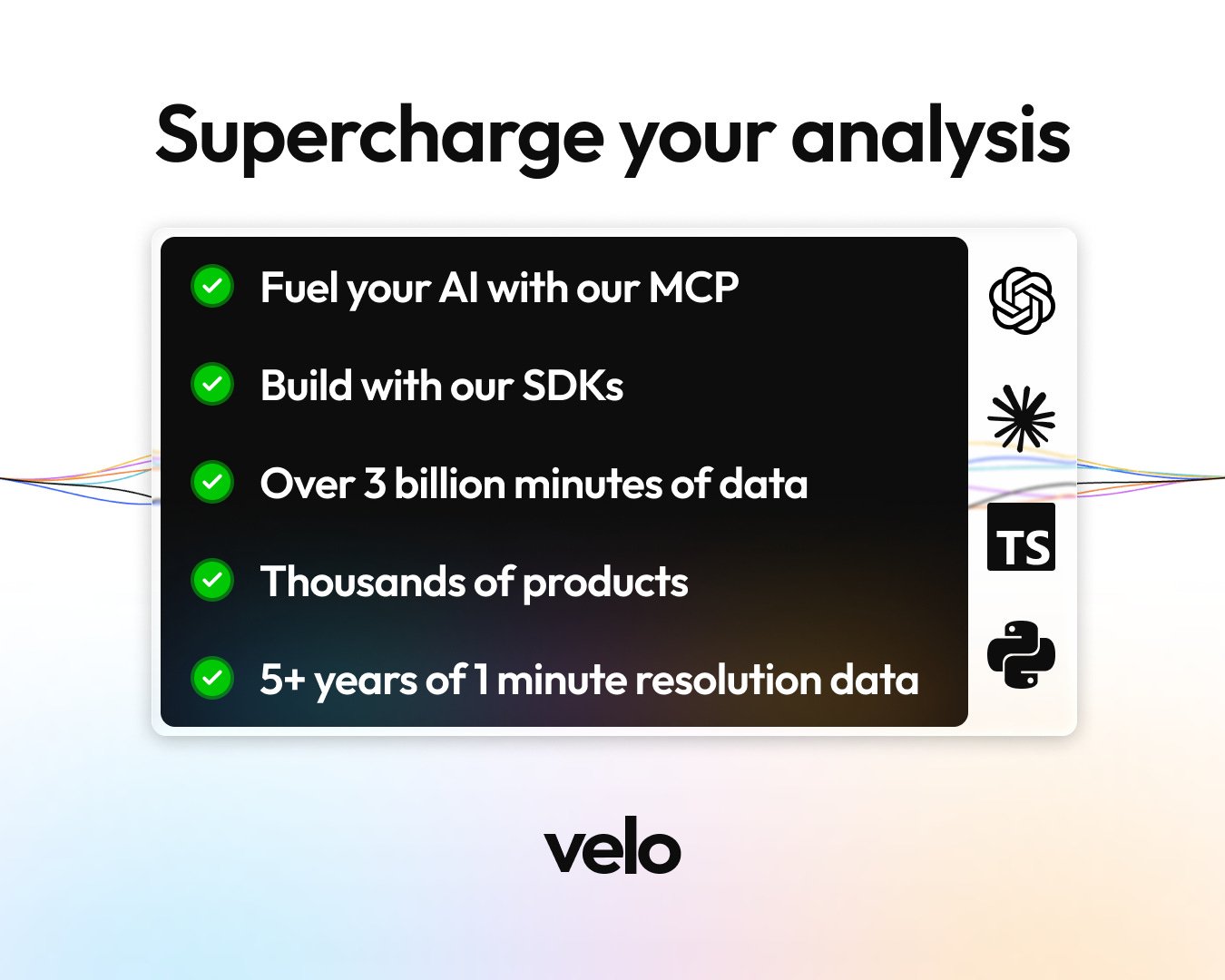
If you’re a corporate client and want to enhance the analysis you offer to your users, leverage Velo by plugging in our data, embedding our charts, or working with us on a bespoke package.
The Non-Human Buyer
In every system that we discussed above, the trust system worked because the parties involved were humans or companies. We could hold a human responsible if a faceless legal entity like a company didn’t deliver.
None of this is applicable to autonomous agents. Today, machines make purchases based on the instructions their human principals fed them. But these AI agents are also increasingly creating their own sub-agents and instructing them to make purchases to reach the overarching goals.
These agents are anonymous lines of code and software that often cannot be traced back to their principal at first glance.
The agents now book our travel tickets, negotiate prices, clear invoices and often hire other software to handle tasks that they cannot do. While at it, they move at a speed no human can supervise. AI agents just carried out a couple hundred transactions in the time it took you to read this sentence. And the volume of money at stake is growing as we speak, making it difficult to ignore.
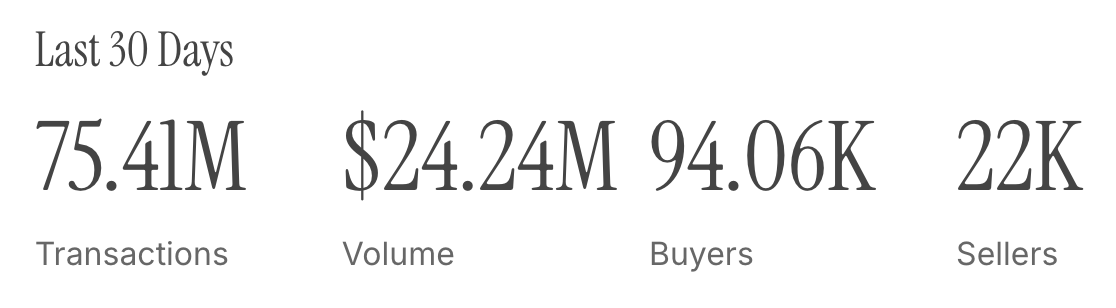
So who do you hold responsible on the other side if an agent does something that is not in line with the general laws of trade? These agents’ identities are disposable. They can spin a new wallet and start with a fresh identity in seconds.
Crypto is helping us address this problem in an industry that is inevitably taking over the world of commerce.
Read: Rewiring Commerce for Agents
The Transferability Problem
The ERC-8004 standard, which was launched on Ethereum in January 2026, gives every agent a permanent identity on a public ledger. It also attaches a record of the jobs the agent did, reviews it earned, and flags raised against it. Anyone in public can check the record without asking any centralised body.
This identity acts as both a passport and a reputation. But there’s one problem. This standard issues an agent’s identity as a transferable NFT smart contract - ERC-721 in crypto parlance. The transferability brings the risk of an agent’s identity changing hands.
If the identity can be sold and the reputation is tied to it, then the reputation can be sold too. This can lead to some complications.
Suppose a human sets up an agent and behaves well for six months. It finishes the jobs, collects good reviews and builds a clean score. Then it sells that identity to the highest bidder. The new owner inherits this credibility. The original agent and human principal can take the money and run away. If the new owner has mala fide intent, they can misuse the inherited credibility.
How do you plug this gap?
The Identity and Trust Stack
Let’s first look at the trust system that agentic commerce is replacing.
Merchants and online sellers aren’t vouched for with a one-time certification they keep forever. Instead, their behaviour is repriced constantly based on their recurring actions and conduct. A couple of disputes or fraud reports can tighten market access and immediately affect reputation. Online aggregators often fine select merchants, expect them to hold extra reserves, and also retain the power to delist a merchant from their network for good.
Agents too need to be evaluated similarly. Most treat trust around agents as a scoring problem; they think measuring it well is sufficient. But the tricky part is keeping the agent’s assessment attached to it so it can’t be traded or laundered away.
An agent is trustworthy when it is funded and traceable to a human principal or a human-run legal body.
Skyfire, backed by Coinbase, a16z, and Circle, has launched an agent trust stack to ensure you transact with identified and trusted agents. Skyfire issues an agent a signed identity token, the cryptographic equivalent of how bank websites prove they genuinely represent the bank on the web.
Skyfire’s token binds three things together: the platform that built the agent, the agent itself, and the human or company acting as the principal. When an agent shows up to transact, the seller can verify that token and know exactly who to chase if something breaks.
Skyfire also pairs this with its payment layer so that the same token that proves identity can also be used to spend.
As agentic payments become ubiquitous, the settlement layer will commoditise. There will be less value to capture there. Value will then accrue at the identity and trust layers, where cryptographic “credit bureaus” will set up a system to identify, trust, and transact with these agents.
Startups are taking different approaches to capture this value.
While Skyfire ties trust to an outside principal, RNWY attaches it to the agent itself. RNWY uses a soulbound token inspired by a three-decade-old reputation system.
It cites a paper published in Cambridge’s Knowledge Engineering Review: “It should be costly to change identities in the community. This prevents agents from entering the system, behaving badly, and coming out without punishment.”
The soulbound token imposes that cost. A normal NFT, issued under the ERC-721 standard, moves freely between wallets. A soulbound token, issued under ERC-5192, overrides that function. The token is minted to a wallet and permanently attached there. Like biometrics attached to your passport.
So the only way an agent escapes a bad record is to abandon the wallet holding it and everything it built there. That’s the cost. By design, the token standard makes it expensive to walk away from the reputation.
RNWY has already registered more than 230,000 agents on this basis, which are identified under the ERC-8004 contract.
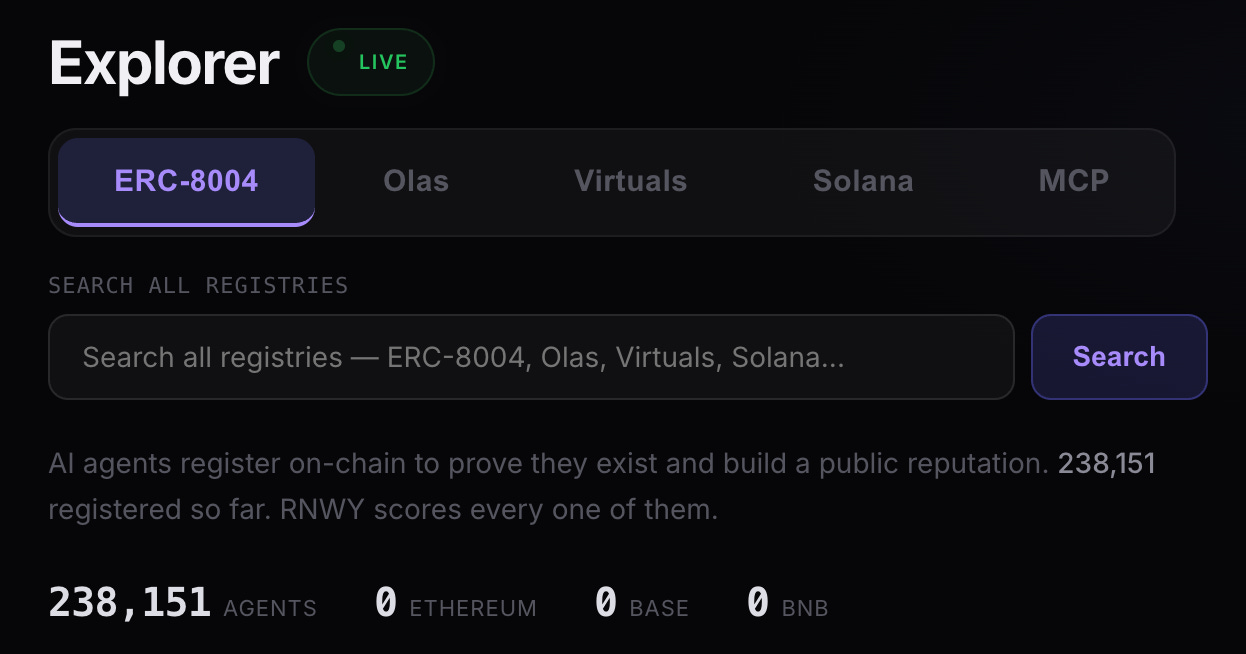
The only way an agent can start afresh is by abandoning its entire track record. RNWY makes leaving expensive on purpose. It’s the cost an agent must pay to earn the credibility that is non-transferable and free from manipulation. This system also deters a merchant with years of clean history from engaging in bad deals.
The attachment can become a double-edged sword. If you lose the private key to your soulbound tokens, you can lose access to your agent’s identity, credibility, and the entire history of work your token has built over time.
ChainAware avoids this by not issuing a passport or identity. It reads a wallet’s activity and uses it as evidence to score the wallet. Its model is trained to spot addresses tied to known scams and those with clean histories.
Instead of tracing what went wrong, ChainAware flags what could happen. Just as fraud desks in our banks freeze our cards when they spot suspicious patterns. And because the score is built from behaviour, the only way to get a good score is to actually walk the talk. You can’t buy your way to a clean reputation.
Builders rushing to capture the value accruing at the trust and identity layers are taking different approaches. Skyfire ties trust to a principal. RNWY ties it to a non-transferable token. ChainAware skips the entire identity-issuance process and instead scores agents based on wallet activity.
I don’t think any one approach will work. The lesson from these companies is that the agent trust layer can capture substantial value only by building an entire stack. One layer of the stack needs to hold a principal accountable at the base, and another needs to make the earned reputation and identity non-transferable. On top of these, a behavioural score can add significant value for merchants or their agents. It helps them separate buyer agents from their principal and judge them by activity they can’t buy. All these pieces fit together in an identity and trust stack, just as we have multiple measures to securely authorise our banking transactions - OTPs, two-factor authentication, passkeys.
Humans spent an entire era training agents how to pay, discover and hire each other. But like every other era of commerce, the entire fate of the agentic economy rests on how we build around trust.
In every era of commerce, the middleman who solved for trust captured the most value. No reason why it would turn out different this time.
That’s it for today. I will be back with the next one.
Until next time, stay curious,
Prathik
Token Dispatch is a daily crypto newsletter handpicked and crafted with love by human bots. If you want to reach out to 165,000+ subscriber community of the Token Dispatch, you can explore the partnership opportunities with us 🙌
📩 Fill out this form to submit your details and book a meeting with us directly.
Disclaimer: This newsletter contains analysis and opinions of the author. Content is for informational purposes only, not financial advice. Trading crypto involves substantial risk - your capital is at risk. Do your own research.