


This was the first book about blockchain I ever read.
Before this, I had read a lot of articles and understood nothing. Distributed ledger, Immutable, I knew, but I could not have told you what any of it meant if you had pushed me even slightly.
Then I read this in 2021; I was like, woah, blockchain can save the world, dammit!
Still a believer, for what it counts. But I now recognise that financialised systems are easily co-opted by major capital. Achieving decentralisation requires more than mere technical solutions.
This is how he describes decentralisation:
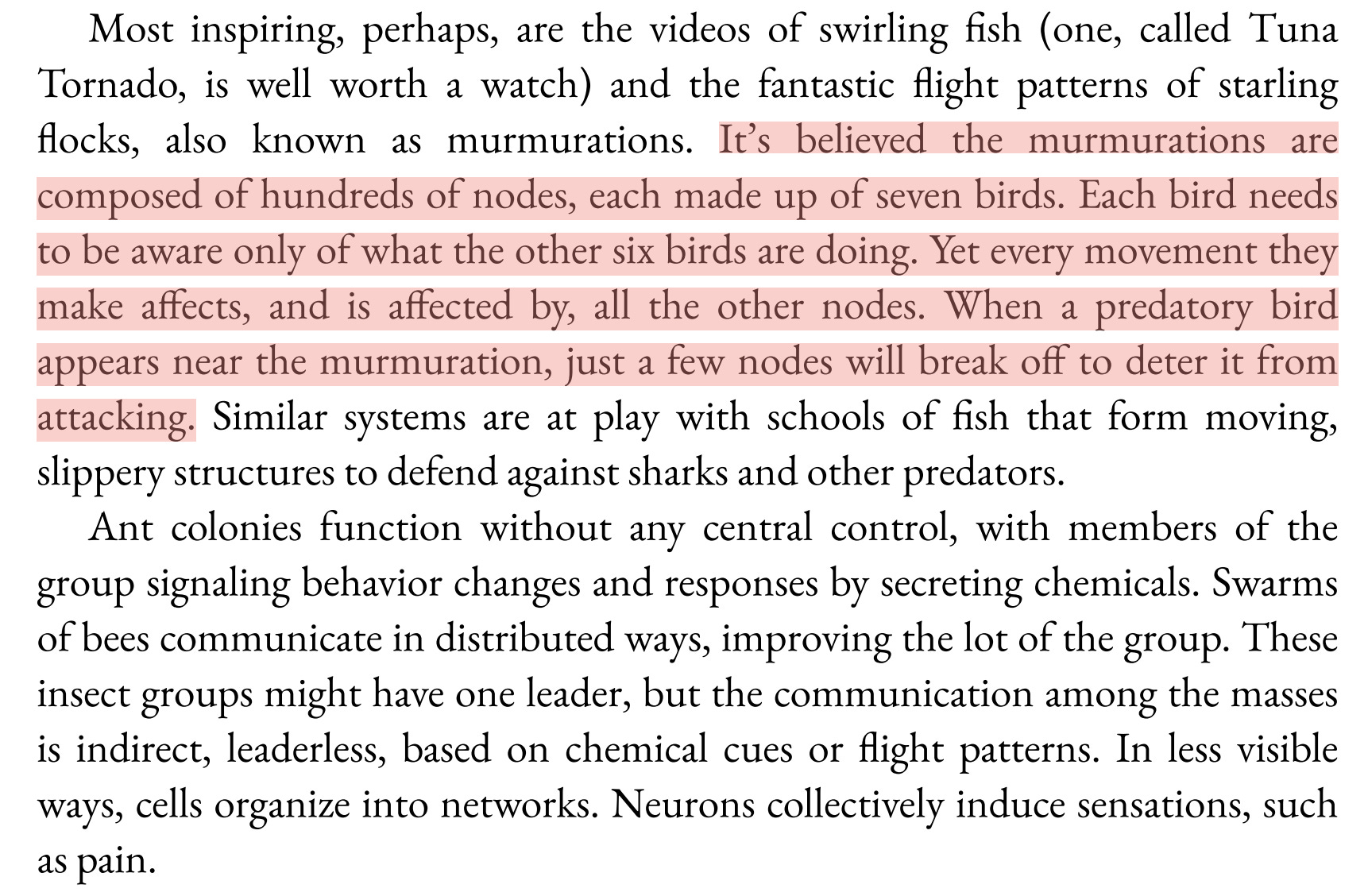
I saw the beauty of the thing if it works, and reading it the first time felt like freedom. Maybe because it involved birds, but yeah.
Stephen P. Williams is a journalist, not a tech guy. In 2015, he read a piece about coltan mining in the Congo, the mineral in every smartphone. It mentioned that blockchain could track it from the forest to the factory. The selling point was that a buyer in America would know their phone was clean. Williams thought about the miner instead, who hands over what he dug and never finds out where it went or what it sold for. He went down the hole and came out with this book - Blockchain: The Next Everything
It’s 2026 now, and I've been writing about this for a living since 2021, so I can finally mark his homework.


It helps to remember what 2019 felt like. The 2017 bubble had popped, everyone was embarrassed about bitcoin, and the respectable line was that the coin barely mattered and the ledger underneath it was the prize. Big companies were standing up a blockchain team.
Williams opens the second part of the book with a Gartner forecast. Blockchain would add $176 billion in business value by 2025, and pass $3.1 trillion by 2030.
That $176 billion can never be graded. It isn’t revenue or sales, which you could count. Business value-add is Gartner’s own private measure, and no company reports it. So look at Gartner instead. Every year Gartner publishes a chart ranking new technologies from overhyped to genuinely useful. In July 2024, they filed most blockchain projects in the disappointing zone, then said they might stop making the chart for blockchain at all, because too few people were still asking about it. One of their analysts, Adrian Leow, said the real payoff was maybe five years away. People had been saying five years away since 2016.
Williams quoted the most trusted research firm in the business, same as we all do to date.
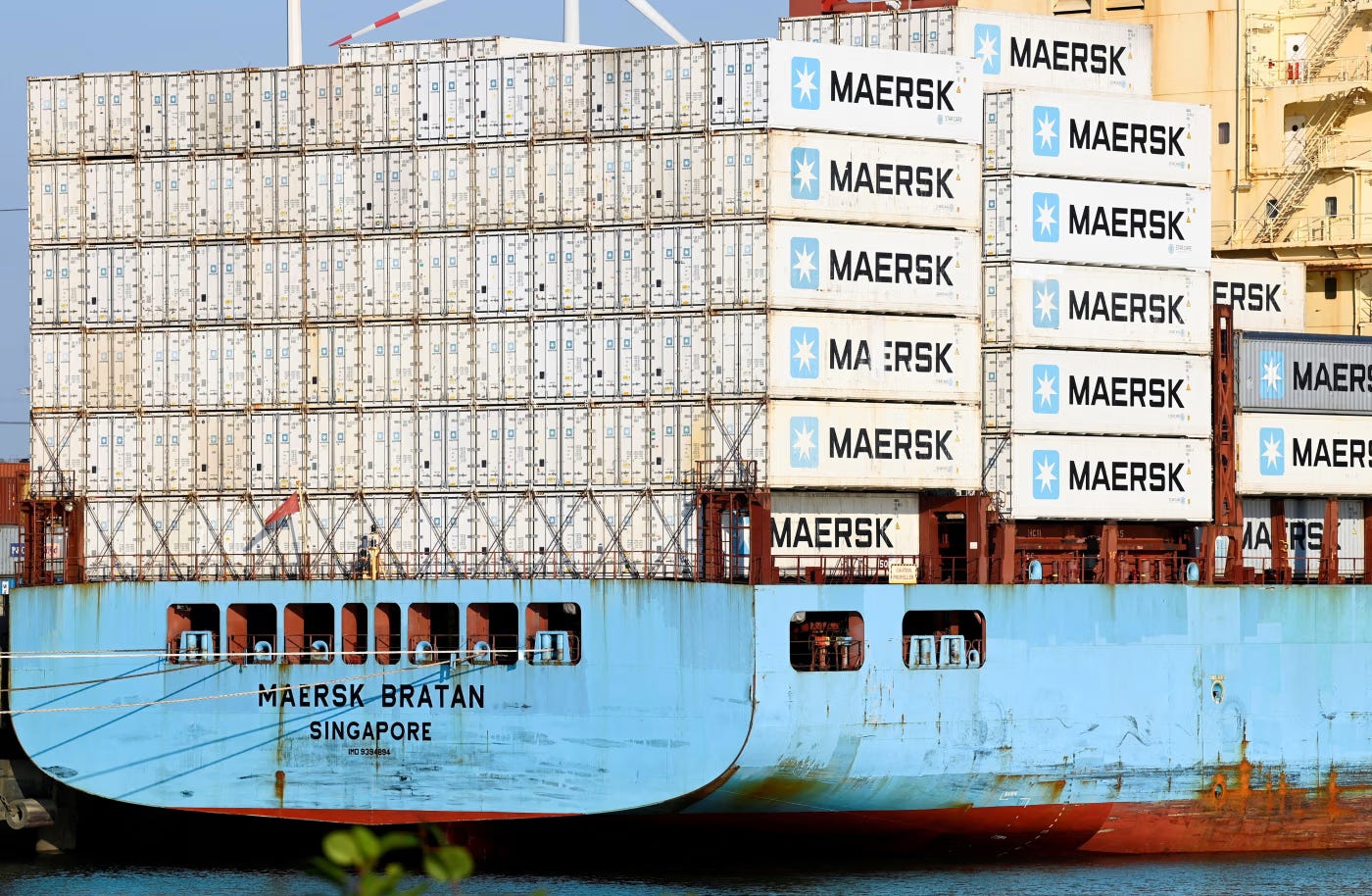
Williams' big supply chain example is Maersk and IBM. IBM told him that shipping one container of flowers from East Africa to Europe produces a couple hundred paper documents. If you put everyone on one shared record, the paperwork goes away. Every company was citing this example in 2019. The product was called TradeLens. Maersk and IBM shut it down in 2023. Maersk said the system needed the whole industry to join; not enough companies did, and the business never paid for itself. Five of the six largest ocean carriers had signed up. Still not enough. Rival shipping companies would not share their data with each other.
Voting is the second one. In May 2018, a few dozen West Virginia soldiers posted overseas voted from their phones using an app called Voatz. Williams calls it a promising test and lists what blockchain voting would fix, including his claim that miscounts become impossible. In early 2020, MIT researchers audited the app and found an attacker could change a vote, block a vote, or find out how someone voted. West Virginia dropped it and went back to paper.
Williams calls the ledger unhackable. Now that I think about it, it’s a dangerous word to put in a beginner’s book. Technically, that’s true for the core Bitcoin network; no one has managed to hack the database itself. But hackers still steal billions of dollars by targeting the exchanges, apps, and websites connected to it. In the first half of 2026 alone, security firms logged nearly $1 billion stolen across more than 200 attacks. So much for unhackable. Every other way of losing money is still open. Someone gets into your account, or the exchange holding your coins collapses, or you sign a transaction you didn’t understand, or a stranger talks you into sending it.
Holding on to the optimism it gave me back then, there’s a chapter in the middle about the Internet of Things (IoT) that fascinated me the most.
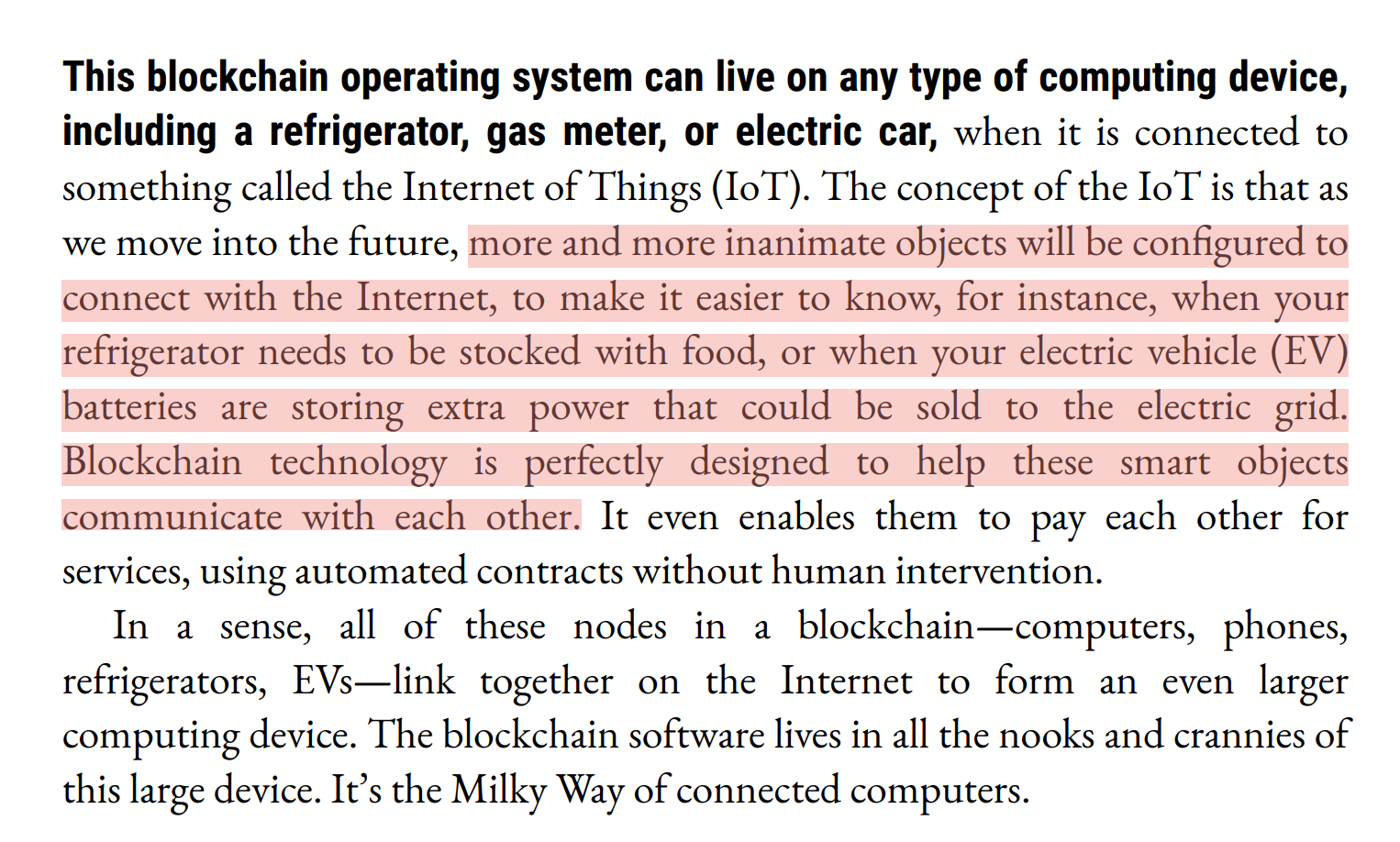
His idea is that as more objects get connected- a fridge, a gas meter, an electric car- they can hold a blockchain too. And once they can hold one, they can pay each other. Your fridge notices you’re low on milk and orders it. Your car’s battery has extra power stored and sells it back to the grid while you sleep. No human involved in any of it. He calls all these connected devices linking up the Milky Way of computers, which is a lovely way to put it.
Money that moves without a person deciding, every time, in tiny amounts, between machines. It made the whole rest of the technology feel small. But fridge ordering milk did happen, though.
Amazon has run Dash Replenishment since 2016, where connected devices automatically reorder their supplies, like washing machines that order your detergent, or printers that order your ink. On fridges specifically, Amazon Your Essentials and Alexa Smart Reorders are now available on Samsung Family Hub refrigerators, and LG’s model automates orders via Instacart or Amazon Fresh. Samsung shipped an update in May 2026 where the fridge proactively alerts users when frequently consumed items need to be replenished. None of this needed a blockchain.
But the idea still materialised in an unexpected way. AI agents are now paying other machines directly. Coinbase created the x402 standard, which repurposes HTTP 402 (”Payment Required”), an old web status code that had gone unused for decades. Under this system, when an AI agent requests data from a server, the server quotes a small price, the agent pays instantly in stablecoins, and the server delivers the data. Coinbase transferred governance of the standard to the Linux Foundation. Major companies like Google, Visa, Mastercard, AWS, Cloudflare, and Stripe are now working with the same concept.
AI agents have made roughly 176 million of these payments totalling $73 million. This means the average transfer is just 40 cents, and most are under 10 cents. That’s why this has to run on crypto rails. Visa charges around thirty cents just to process a transaction, so it can’t profitably move three cents. On a crypto layer-2, sending that same three cents costs a fraction of a penny.
Near the end, he writes about visiting refugees in Rwanda, and wonders if one day the ID someone gets entering a camp might sit on a blockchain and still mean something when they leave. Well, we know that out of this entire book, that soft little hope is the thing that scaled.
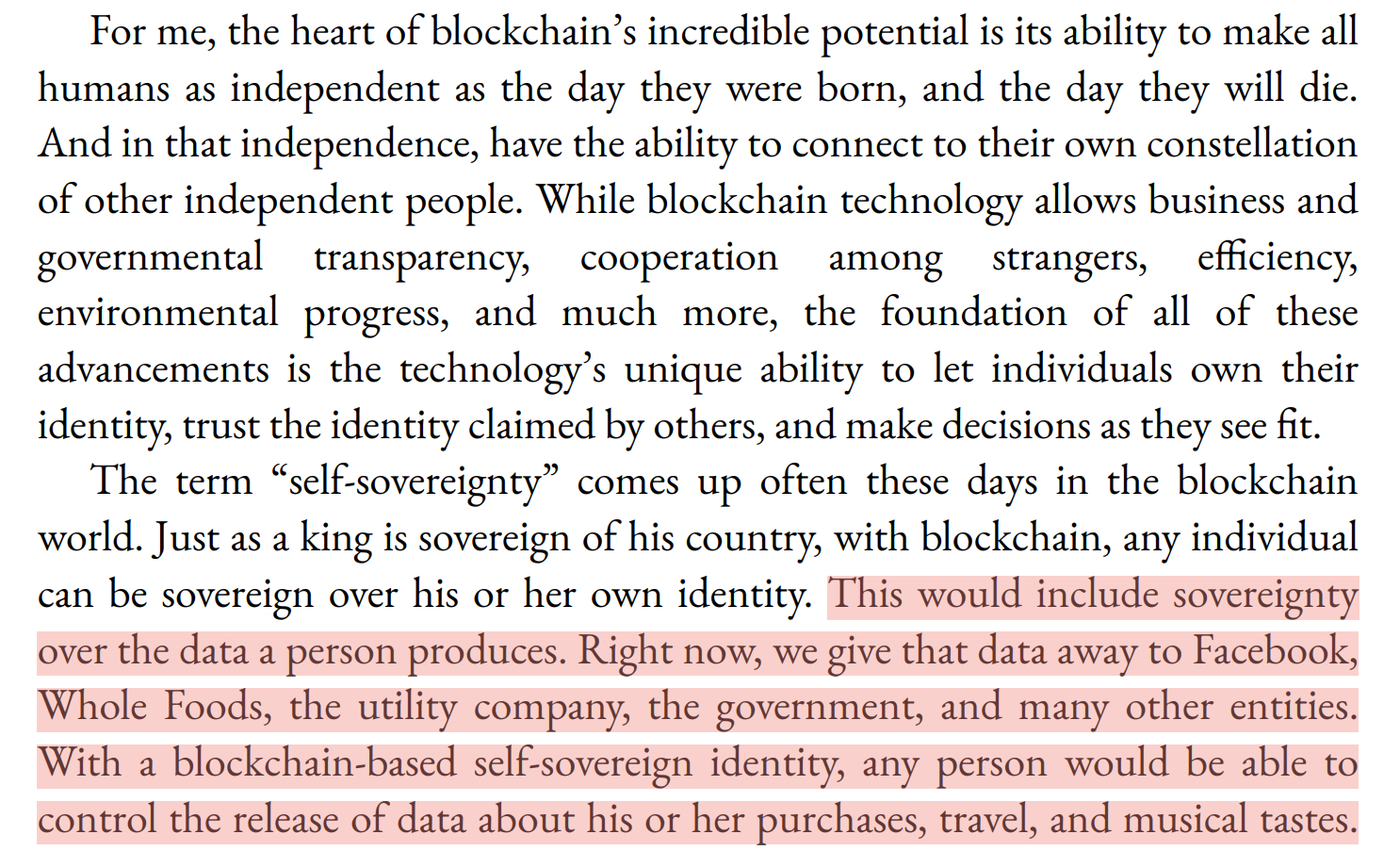
It’s called Building Blocks, and the World Food Programme runs it. Started in 2017 with a hundred people in Pakistan. It has now supported around six million people, moved more than $760 million in aid across over 40 million transactions, and saved more than $3.5 million in bank fees by cutting the banks out. In Jordan, a Syrian refugee buys food by looking into an iris scanner. It’s a database that cuts bank fees, run by an organisation that badly needed to cut bank fees.
Similarly, Bhutan became the first nation to run self-sovereign digital identity on Ethereum, giving 800,000 citizens total control over their personal data.
Read: The Fortress and the Phone - by Thejaswini M A
Williams argues bitcoin was only the first thing anyone built with this. The useful part is the shared record itself, and it doesn’t have to hold money. It could hold anything people need to agree on. Who owns which piece of land. Which diamond came from where. Whether your degree is real. Who won an election.
Half right. Half no.
The ledger got freed from money and mostly lost the demand there. TradeLens died. Australia’s stock exchange was trying to replace its settlement system with a distributed ledger and wrote off up to A$255 million. Companies kept building chains anyway. Ondo killed its own in July. dYdX had 73% of decentralised perps volume in 2023 and now has under 3%. Swellchain, Mint and Polygon’s zkEVM all shut this year.
Money went the other way. Stablecoins market cap passed $300 billion. On Base alone, stablecoin volume is up sevenfold in a year. BlackRock and JPMorgan tokenised Treasury bills.
Shared databases fail when direct competitors refuse to share their data, like the ships, but they succeed when neutral organisations use them to coordinate without anyone taking control. We can say that, but it’s seventeen years of evidence on a technology that will be around for a lot longer, so I’d hold it loosely. I still think blockchain grows out of most of these constraints.
I’ve been hard on a book I love, so let me end straight. If I could send a note to the person who read this in 2021, I wouldn’t say the book was wrong. I’d tell her the instinct was right and the examples were not, and that she should have let go of the examples years earlier than she did. It took me a long time to stop assuming a good idea wins because it’s good. Williams assumes that on every page. It makes the book generous, and it’s why so much of it has aged badly.
Token Dispatch is a daily crypto newsletter handpicked and crafted with love by human bots. If you want to reach out to 170,000+ subscriber community of the Token Dispatch, you can explore the partnership opportunities with us 🙌
📩 Fill out this form to submit your details and book a meeting with us directly.
Disclaimer: This newsletter contains analysis and opinions of the author. Content is for informational purposes only, not financial advice. Trading crypto involves substantial risk - your capital is at risk. Do your own research.