


Every lender in the world is doing one of two jobs. Either they are learning who you are, or they are holding something of yours.
The first job is enormous and expensive. It built the credit bureaus, the scoring companies, the underwriting departments, the collections agencies, and the courts that enforce a judgment. A default follows you for years. Trillions of dollars of infrastructure exists so that a bank can hand money to a stranger and have a decent idea whether it is coming back.
The second job takes a set of scales, and that’s it
The securities lenders, the margin clerks, they price the object, and sleep well. It is the oldest lending there is, and it works perfectly. It has never grown into anything, because a system where you must already own something to borrow something mostly serves people who do not need it.
Crypto lending does the second job when it comes to lending, safely. People think of crypto, they freak out, they just remember the bad things and Sam Bankman-Fried first. So, pick a safer option, good for us.
In crypto, to borrow a thousand dollars, you first have to have fifteen hundred dollars.

The product is available only to people who already have capital. It works fine for a trader who wants leverage without selling a position, and that is a real business. For the rest of the world, the offer is to prove you do not need this, and we will give it to you. Fair enough.
In the traditional financial system, credit drives economic growth. A bank will lend a baker money to buy an oven based on the baker’s future ability to sell bread. The bank trusts the borrower, and new economic value is created. Works because the people who need a loan are, by definition, people who are short.
Today I want to show you who is trying to do the first job on-chain, and what happens to them.

In the US, that market runs to $5.14 trillion. Crypto has approximately zero of it. Few things block the way:
Identity. Unfortunately, a wallet is not a person. I can make ten thousand of them now for the price of the gas. If a lender cannot tell that the address asking for money today is the same human who walked away from a loan last year, the reputation system built on top collapses on the first day someone bothers to attack it.
Pricing. Even with identity solved, a lender needs a way to charge one borrower 9% and another 29%. That takes history, and which requires a bureau. On-chain data shows what a wallet did in DeFi. But you have no way of knowing whether that person kept a job or paid the previous loans on time.
Recourse. When a borrower stops paying in the normal world, a chain of consequences starts. Collections call. The default lands on a credit file. A court can garnish wages. When a wallet stops paying, what can you do? The wallet costs nothing to abandon. The lender has no name to sue, or address to send a letter, and nothing to seize.
The fourth is the law. Every enforcement tool I just listed requires a license. A collections agency operates under a licence and follows federal rules on how often it may call and what it may say. The rate a lender charges is subject to a usury cap that varies by state and product. Consumer lending is one of the most heavily supervised activities in finance, and a protocol doing it without permission is simply breaking the law.
Watch where that pushes everyone. Straight to the graveyard we go.
Goldfinch launched in 2021 with a16z and Coinbase Ventures behind it, and they skipped on-chain identity entirely. They lent to real businesses in emerging markets through professional underwriters who know those markets, and let crypto supply the capital. Goldfinch has motorcycle taxi financiers in Kenya, lenders in Nigeria and Southeast Asia, and borrowers across eighteen countries.
Tugende Kenya took $5 million in October 2021 to expand its book of financing bikes for taxi drivers. Goldfinch later found that $1.9 million had been moved to Tugende’s struggling Ugandan parent, which the loan terms did not allow. Tugende defaulted in June 2023.
Another borrower, Stratos, left $7 million unpaid on a credit line, while a third, Lend East, defaulted on nearly $6 million. Altogether, the protocol watched more than $18 million vanish into the very real-world risks they wanted to solve. Goldfinch wound down in June this year, after originating around $100 million. Its token is down 99.8%.


You think about it, every one of those failures was an ordinary credit failure. Fuel prices rose, drivers could not pay, covenants broke, a borrower moved money they should not have moved. The blockchain worked well. It just had absolutely no way of knowing if that money was ever coming back.
Maple is the more instructive artefact, because Maple was the biggest unsecured lender crypto ever built and it did not die. But to survive, it had to completely abandon its original mission. It realised that doing unsecured lending based on trust and identity was too dangerous in crypto.
On 5 December 2022, Orthogonal Trading defaulted on eight loans totalling $36 million. That was roughly 30% of all active loans on the protocol. Orthogonal had told its underwriter through November that its FTX exposure was about $2.5 million. On 3 December it admitted the actual number was far larger. The deception instantly erased 80% of the capital in the most exposed pool (M11 USDC pool, which held about $31 million), and Maple conceded they would likely recover only $2.5 million of the $36 million total.
Sid Powell said afterwards that undercollateralised lending needed harder due diligence, and that Maple might move to partial collateral.
It moved all the way. Maple today runs loans at collateral ratios above 140%, reports no losses since 2023, and has grown past $2.2 billion in deposits doing it. Safer option worked well enough.
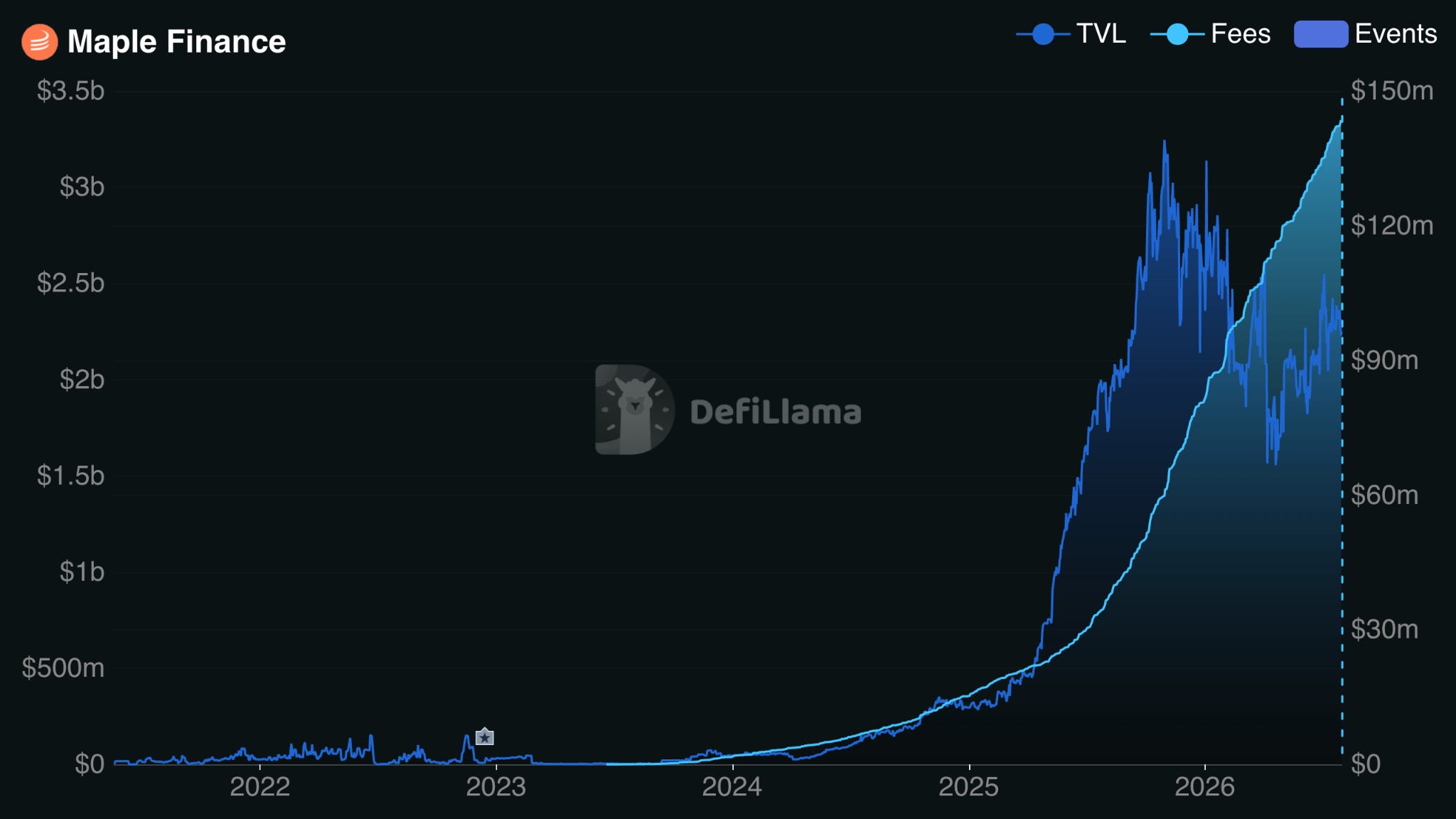
Which brings us to who is trying now, because plenty of people are, and they have sorted themselves neatly by which blocker they attack.
Divine Research goes after the identity blocker. It has issued around 30,000 loans since December 2024, mostly under $1,000, in USDC, to teachers and fruit vendors and anyone with an internet connection. Borrowers verify with a World ID iris scan, which stops one person from opening a second account after walking away from the first. Interest runs 20% to 30%. The first-loan default rate is about 40% according to Financial Times.
3Jane goes at pricing blocker. It pulls a borrower’s bank data through Plaid and their VantageScore from Credit Karma, wraps both in zero-knowledge proofs so nothing sensitive moves on-chain. They issue a credit line off the result. Paradigm led its seed round. It holds roughly $62 million and is the largest uncollateralised lender on-chain today.
Wildcat goes at recourse, without underwriting anyone. It publishes a template master loan agreement that borrower and lender sign, and then it gets out of the way. Its own documentation says it does not assess creditworthiness and cannot interfere with a market once deployed.
Huma took a different route and stopped lending to people at all. Huma Finance is considered the first PayFi network. They have partnered with Qiro Finance, which serves as a strategic underwriting and risk-monitoring partner for Huma’s PayFi network.
Huma finances invoices and cross-border payment flows, where a known institution owes a known amount on a known date. It has originated $2.3 billion that way.
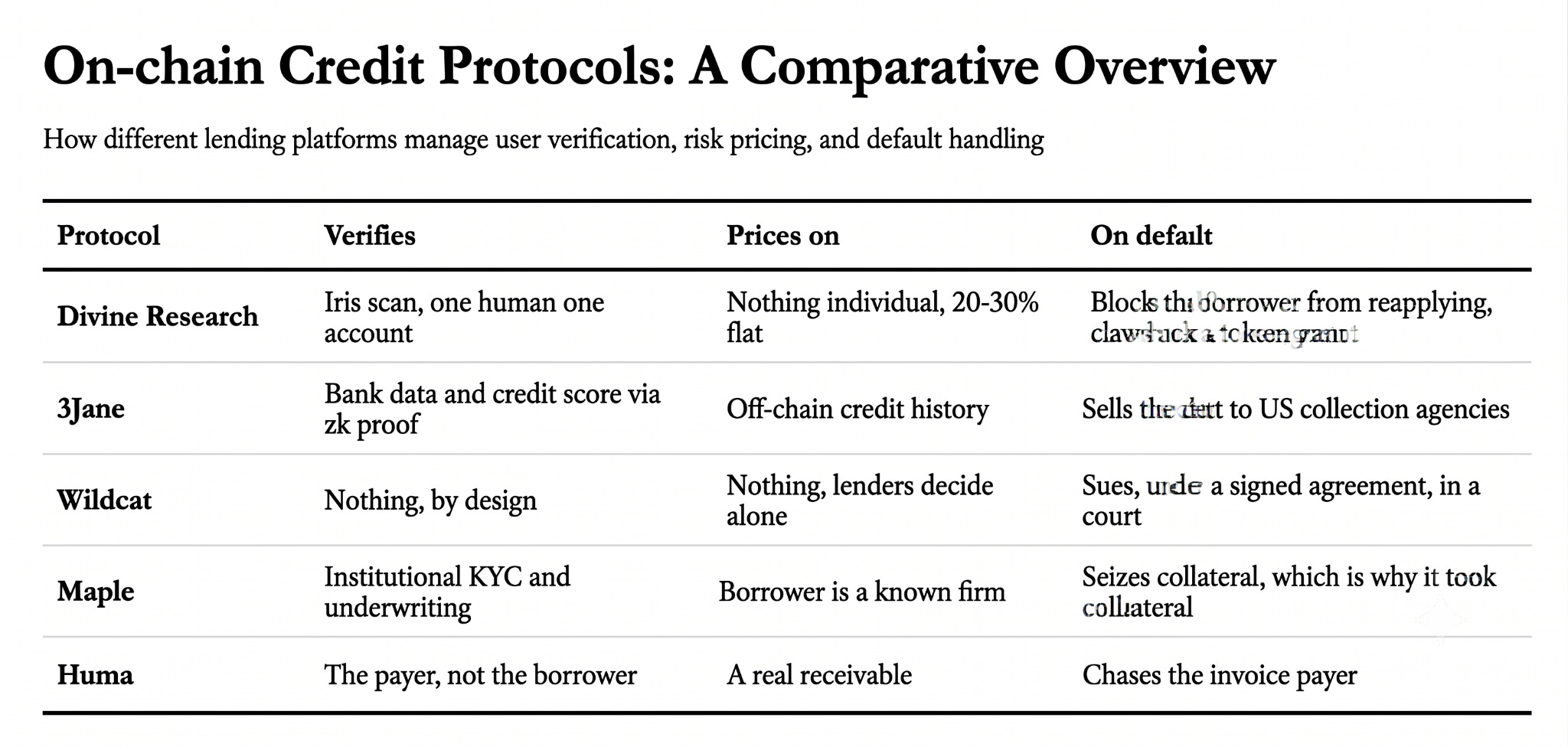
Not one of these enforces anything on-chain. Divine excludes you from the future, which is the weakest sanction on the list and which its 40% default rate tells you the borrowers have already priced. 3Jane hands the file to a US collections agency, which works because its borrowers are Americans with legal identities and credit reports that a default will damage. Wildcat goes straight to court.
Without over-collateralization to seize, every workable mechanism here is forced back into the old system. When things go wrong, in most cases something with a lawyer in it made people pay.
And notice where the successful ones drifted. 3Jane’s site now describes it as a credit-backed yieldcoin for fintech originators, offering warehouse lines of $5 million to $200 million. It bought $8.5 million of small business credit receivables from a company called Slope. Huma finances B2B payment flows. If a payment defaults, Huma relies on real-world factoring agreements and sends lawyers to enforce the contract. Both protocols pivoted to institutional lending because it anchors the debt in the old world. With a signed agreement and a jurisdiction to enforce it.
Which is why the market’s next attempt is deduction at source.
If your salary lands on-chain, a lender can be paid before you are. That is the first mechanism crypto has ever had that touches a consumer’s actual money where it spawns. The infrastructure went live this year. Deel processes $22 billion in payroll and started offering stablecoin salary payouts through MoonPay in March, across roughly 40,000 businesses in the UK and EU. Rise has run stablecoin payroll natively for years. Toku built a private version with Aleo and Paxos for companies that cannot have salaries visible on a public chain. Because these companies are officially processing salaries in stablecoins, the infrastructure is finally there to do “deduction at source”.
Read: The Glorified Babysitters - by Thejaswini M A
But there’s still a problem. Deel pays into non-custodial wallets - The worker’s wallet, the worker’s keys. Once the money lands there, a lender has no more claim on it than it had before, and no way to reach in. Interception must happen upstream in the Web2 payroll file. But if a provider like Deel allowed a crypto protocol to hook into their system, they would suddenly be acting as a debt collector or credit servicer.
As we pointed out in the blockers, “the law,” wage garnishment and salary deductions are heavily regulated. Right now, no payroll provider, including Rise, Bitwage, or Deel, natively offers automated loan deductions or wage garnishment to Web3 lending protocols.
Crypto can move money to anyone on earth in seconds. Because the system guarantees irreversible settlement, it inherently cannot force that money to return. Every time somebody solves the coming-back part, they solve it with traditional instruments like court, a collections agency, a credit bureau, or a boss.
Now, deduction at source is not a new invention.
Nineteenth-century British and American employers paid wages in company scrip, redeemable at the company store, at prices the company set. The worker’s pay never became money they controlled. Parliament passed the Truck Acts specifically to stop it, requiring wages in coin of the realm. The mechanism there was the employer controlling both the pay and where it could go.
Deduction at source is also how a 401k works. Also how student loan garnishment works, and child support, and every payroll savings scheme ever run. These are hardly called exploitative.
Brazil has run deduction at source for twenty years as consignado, deducting instalments directly from paychecks. Average payroll loan rates are 28%, while unsecured loan rates are 146%. But it works entirely through strict legal frameworks like employer contracts, wage caps, and labour courts. Crypto wants this system, but blockchains cannot natively read or enforce the traditional legal machinery required to run it.
The FTC wrote its Credit Practices Rule in 1984, and one of the six things it banned was the wage assignment. A creditor can no longer put a clause in a consumer loan contract that sends the borrower’s pay straight to the lender. A creditor may use a payroll deduction plan in which the consumer authorises a series of deductions as a way of making each payment. What a creditor cannot have is an assignment the borrower is unable to revoke.
So, deduction as a way of paying is allowed, but deduction as a way of collecting is not.
The FTC wrote down its reasoning. It found that wage assignments pushed people into giving up legitimate defences, because a borrower would rather pay a debt they disputed than have a creditor ring their employer about it. Some feared losing their job over the call. Without legal enforcement, crypto payroll deduction relies on voluntary borrower consent, solving nothing, since defaulting borrowers can simply revoke it.
Brazil’s model works because the law locks in the deduction and caps the wage hit, removing the borrower’s ability to cancel.
This is why protocols pick their jurisdictions strategically. Divine Research operates offshore, while 3Jane relies on American courts and credit bureaus. Each anchors itself in whatever real-world jurisdiction provides the legal leverage they need to make the money come back.
What would have to be true for crypto to have consumer credit, then?
A lender would need to know that multiple wallets belong to the same person, which biometrics can solve if everyone agrees to be scanned. It would need a legally regulated credit bureau to track a person’s repayment history across different protocols. It also requires a way to force you to keep paying even after you decide you want to cancel. Consumer protection laws simply won’t let anonymous software have that much control over your real-life income.
Aave has been running for six years and has never learned the name of a single person who used it. Blockchain can’t go to the lawyers and the courts. And therefore we wait.

Token Dispatch is a daily crypto newsletter handpicked and crafted with love by human bots. If you want to reach out to 200,000+ subscriber community of the Token Dispatch, you can explore the partnership opportunities with us 🙌
📩 Fill out this form to submit your details and book a meeting with us directly.
Disclaimer: This newsletter contains analysis and opinions of the author. Content is for informational purposes only, not financial advice. Trading crypto involves substantial risk - your capital is at risk. Do your own research.