


Hello,
Although we see a “Transaction Successful” message and hear a beep, nothing moves from our bank account when we tap our card. At that instant, the only thing that happens is a bank promising a merchant it will settle the payment later.
The bank charges a fee for facilitating this trust layer that vouches for someone’s ability to pay. From our neighbourhood shopkeeper who lets us run a tab to the banks that vouch for thousands of businesses to honour a payment, they all run on this trust layer. It is one of the most valuable parts of the financial system, yet the least visible.
Without the trust layer, no kind of commerce or financial system can function. I wrote about this last week, on how companies are building the trust and identity layer even for machines transacting in the agentic economy.
Read: The Business of Trust
Crypto rails, coupled with stablecoins, remove intermediaries from the monetary system - be it for holding money, moving it or earning more through compounding it. We now have crypto cards that let us use our digital assets to pay for day-to-day expenses. Here, too, this new form of payment requires guaranteeing a wallet holder’s ability to honour the payment.
But since crypto payments settle much faster than bank-routed card payments, we need a faster vouching mechanism for this wallet holder’s ability to settle payments. In today’s piece, I explore this.
On to the story…

The Anatomy of a Card Payment
When you dissect the anatomy of a card payment, you find five parties and a moment of trust. There’s you - the buyer, a merchant (the seller), the merchant’s bank, the card network infrastructure (Visa or Mastercard) and your bank (issuing bank).
When you tap, a payment request moves from the POS terminal, through the merchant’s bank, across the network, to your bank, and back. All of this happens in seconds.
Your bank (issuing bank) checks whether you have the money, ensures the transaction isn’t fraudulent, and gives the green signal. It then places a hold on your balance to ensure the merchant gets paid before money moves from your account. The money eventually changes hands on a one-to-two-day delay.
Until then, the merchant has only the bank’s certainty that the buyer will honour the payment. The issuing bank fills the gap between certainty and settlement by bearing the risk that the buyer fails to honour the payment. For this, it charges a handsome fee.
In the United States alone, merchants handed over a record $198 billion in card fees in 2025. The largest slice of these fees (interchange fees) flowed to the banks that vouched for the transaction, as shown in the chart below.
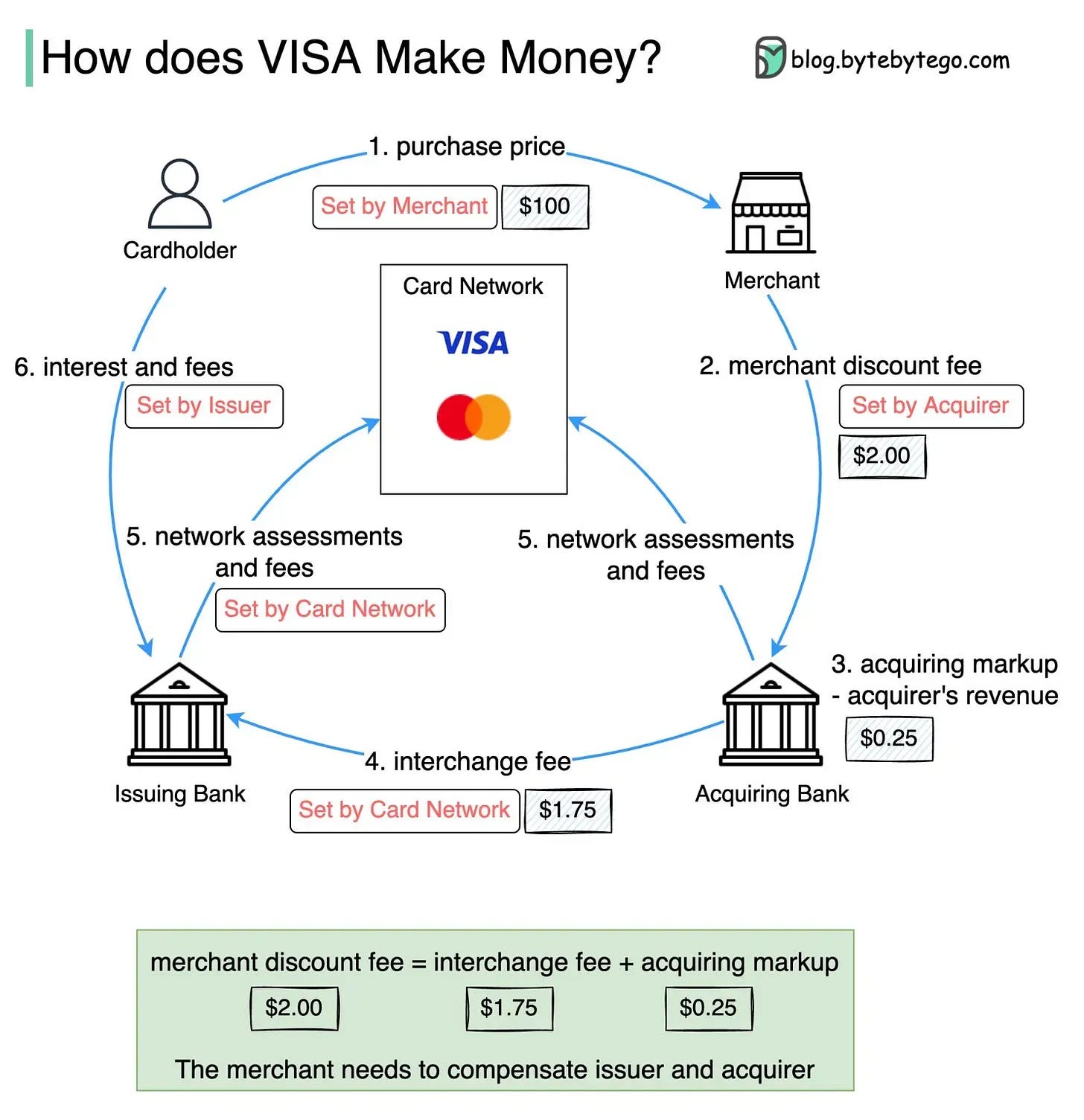
Here, the bank that vouched for the buyer’s ability to pay, and not the card network (Visa/Mastercard) whose infrastructure facilitated the transaction, captures the lion’s share of the fees. This is because it is the most scarce layer in the payment stack. Vouching requires the bank to employ its resources - technology, systems and humans- to ensure that the buyer has the liquidity and that liquidity is blocked for honouring the payment.
Too Fast to Vouch
For more than half a century, this system has been working. But crypto rails challenged this by moving money faster and cheaper.
A stablecoin transfer can settle in seconds, for a fraction of the cost banks charge, and doesn’t care about geographical borders, time, or day. For businesses that pay suppliers regularly across borders or pay employees, blockchains offer major time and cost savings.
This preference to choose crypto rails to move money is only picking up pace.
Roughly $33 trillion in stablecoins moved in 2025, about a third ($10.8 trillion) of which was adjusted transaction volume after filtering activity from automated smart contracts and bots. This year, the adjusted stablecoin transaction volume has surpassed $11 trillion in just eight months.
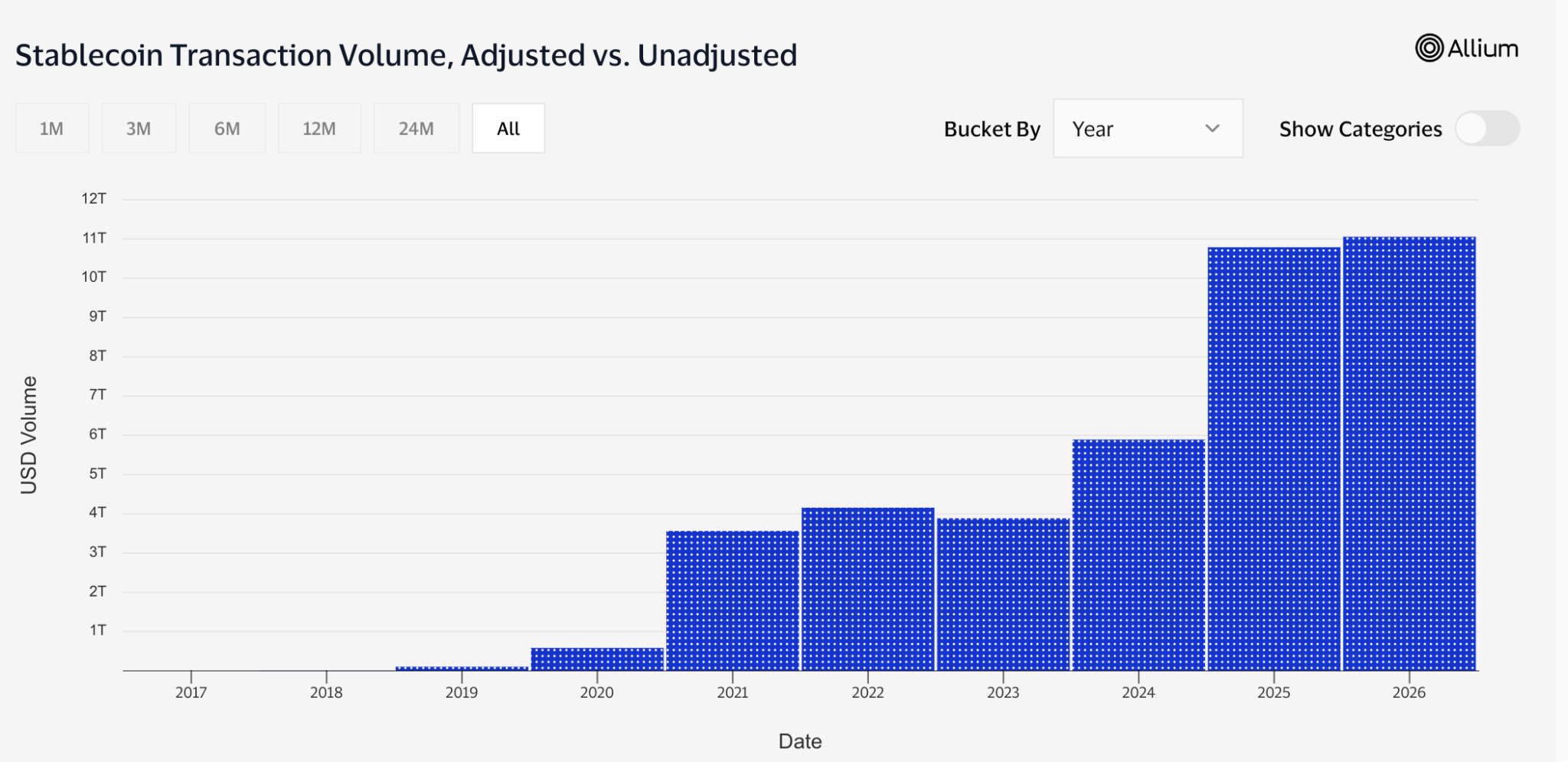
Companies are enabling this movement by introducing crypto cards that let stablecoin holders spend the digital currencies in their wallets.
But this faster, better payment infrastructure creates new problems. The existing vouching system in card payments can afford to be slow because settlement occurs with a one-to-two-day delay. Blockchains collapse settlement to a few seconds.
If the vouching for crypto card transactions still takes days, then the entire point of choosing a faster payment infrastructure is defeated. The merchant who prefers blockchain-enabled payments over the centralised banking route does so for faster and cheaper settlement. But a self-custody wallet, whose entire purpose is that no institution stands between you and your money, has no banking authority in the position to give the merchant the guarantee of honouring a payment.
But friction in new technologies and systems also creates opportunities to capture value by building solutions that solve it.
The Race to Vouch Faster
Crypto card companies are approaching this problem in different ways.
Gnosis Pay settles the payment on-chain without requiring your money to ever leave your wallet. It achieves this by integrating Gnosis Safe, a smart-contract wallet deployed on Gnosis Chain, with two modules.
The Roles Module restricts what the card can do. This lets users set rules to limit spending to only one approved stablecoin, set a daily spend limit and add a whitelist of authorised settlement addresses. The Delay Module places a three-minute buffer on any transaction you initiate.
When you tap a Gnosis Pay card, it receives the authorisation request from Visa, checks your balance in the Gnosis Safe account and replies with a ‘yes’ or ‘no’ immediately. If yes, it simultaneously moves your stablecoin to the issuer’s account through the Roles Module, and the issuer settles with Visa off-chain at the end of the business day. The three-minute delay on your withdrawals ensures the user can’t pull the funds that Gnosis just approved for a Visa transaction out from under it before that on-chain debit clears.
Merchant settlement still takes about 24 hours, but the non-custodial wallet lets the buyer keep control of their funds and earn yield.
Gnosis captures value like a bank by reserving settlement liquidity and taking a slice of every transaction it guarantees.
Ether.fi lets you borrow against your staked ether and spend the loan so that the underlying asset can keep earning yield. It uses Rain’s underlying stablecoin issuing and settlement infrastructure for its Cash programme to issue a non-custodial, cash-back credit card for its users.
While Ether.fi built the borrowing engine, it uses Rain’s infrastructure to vouch for settlement, letting Rain capture the value it creates.
Bleap also keeps your money in your own wallet until the instant you tap. When you pay, its issuer, Unlimit, pulls the exact amount straight from your wallet and converts it to euros in real time. Tria does the same across many chains, and its cards run through Rain, the same firm that supports Ether.fi.
In both these cases, your money stays with you in a non-custodial wallet until the moment you tap. When your money sits in a bank, the bank holds it, lends it out, and keeps most of the earnings. A savings account may pay you back a little, but the bank sets that rate and pockets the spread, and you carry the risk if the bank fails. In a crypto non-custodial wallet, you hold your money. The edge here is that until the money leaves your wallet, it is unfreezable and untouched by anyone else.
All four of these cards — Gnosis, Ether.fi, Bleap, Tria — keep the money in your wallet and still let a licensed firm vouch for your payments the moment you tap.
However, these approaches only solve the buyer’s side. Payment is instant the moment the stablecoin leaves your wallet. The money reaches the merchant’s account based on what they accept. If they accept stablecoin, it can reach in seconds. But if they only accept fiat, it still moves on Visa’s clock.
Then there are the biggest players, KAST and RedotPay, who are resolving the vouching problem by replacing it altogether.
They do this by holding your money. You load your cash into their account first, and only then can you spend. Once a firm holds your balance, it can vouch instantly. It is simpler and faster, but the trade-off is losing self-custody. But it works nevertheless.
RedotPay alone accounted for roughly half of all crypto card spending in mid-2026. People don’t care whether the money is in their custody or with a fiduciary. As long as the payment and settlement happen with the least friction, they are willing to pay a cost.
Show Me the Money
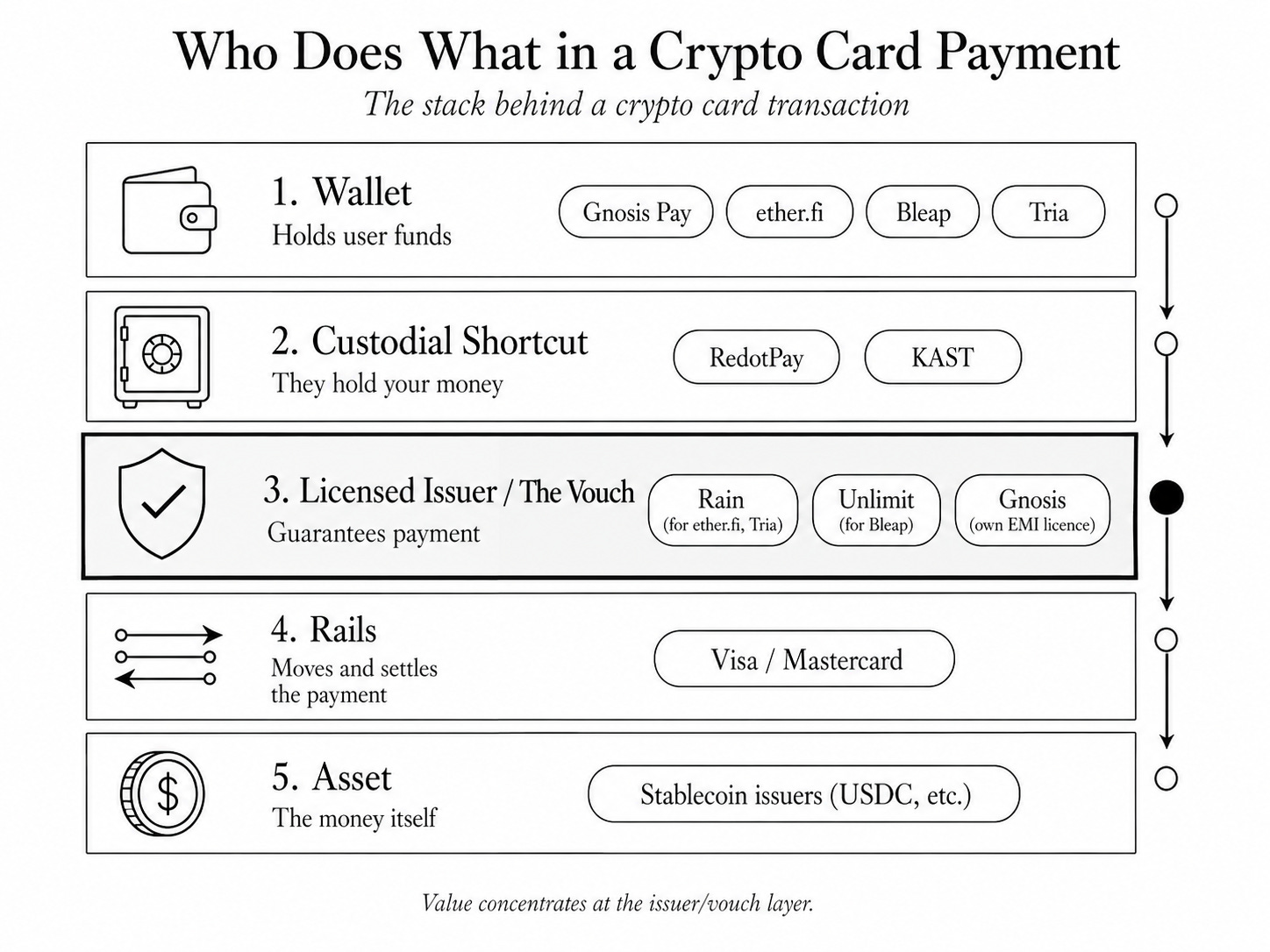
When you track money through all of this, it drifts away from all the commoditised layers. Stablecoin issuers make nothing from the card payment stack.
The wallet owns the distribution of users, but still rents out everything underneath - including the licence, the guarantee and the settlement. This limits the margins a wallet can make out of the vouching process.
The value settles with the licensed firms doing the unenviable, risky and regulated work of vouching. They cannot go wrong with this job. Rain holds the card-network membership, settles volume in stablecoins, and provides the actual guarantee for Ether.fi, Tria, and others. Rain, the infrastructure provider, raised at a valuation near $2 billion, much more than what several of the apps (Bleap, ether.fi, Tria) built on top of it were valued at.
Above them all looms the incumbent. Visa continues to run stablecoin settlement at a multi-billion-dollar annual pace and pockets a spread that might seem inconsequential but adds up quickly with the volume it processes.
This is a pattern you can see whenever crypto merges with fintech. All the value does not accrue at the front end. Instead, it accumulates at the infrastructure layer. It’s where irreplaceable, non-commoditised layers form, calling for specialised solutions from builders to solve existing or emerging problems.
In the traditional banking system, settlement is slow because banks moved money in overnight batches through a chain of intermediaries. This slow process also has a benefit. If an incorrect payment is made or if the customer doesn’t receive the goods or services, they can claim a chargeback. Since the payments are controlled by the banks, they could could always reverse it after sufficient inquiry. Crypto made settlement fast and irreversible. It traded off guardrails for speed. This faster settlement made vouching more valuable because it has to happen instantly and is more susceptible to failures and risks. This necessitates a licensed, well-capitalised firm to do that. Crypto compressed and commoditised the settlement layer by making it faster and cheaper to move money. But in the process, it created more value to capture at the vouching layer.
Those who can combine the scarce job of instant vouching with self-custody will capture the most value.
Both Rain and RedotPay are approaching this from different ends. Rain holds the licence, settlement liquidity, and the guarantee, and earns by renting this infrastructure to everyone else. RedotPay gave up self-custody entirely, holds the balance itself, and bets on its distribution edge. It knows most people care about friction, not custody, and is capitalising on that by making users pay to avoid friction and get a user-friendly interface to move and manage their money.
Every wave of financial technology promises to cut out the intermediary. But each attempt has inevitably introduced new friction, attracting more players to capture the value created by solving it. In the card payment ecosystem, that friction occurs at the vouching layer. Whoever removes it inherits the money that was stuck behind it.
That’s it for today. I will be back with the next one.
Until next time, stay curious,
Prathik
Token Dispatch is a daily crypto newsletter handpicked and crafted with love by human bots. If you want to reach out to 170,000+ subscriber community of the Token Dispatch, you can explore the partnership opportunities with us 🙌
📩 Fill out this form to submit your details and book a meeting with us directly.
Disclaimer: This newsletter contains analysis and opinions of the author. Content is for informational purposes only, not financial advice. Trading crypto involves substantial risk - your capital is at risk. Do your own research.