


Last week, we met the guys who proved Bitcoin was not anonymous.
Tigran Gambaryan, corrupt Silk Road agents, the IRS cyber unit. The chain as a diary you did not realise you were keeping. That was the small version of this story. One team, one big market, one set of breakthroughs.
Part two of Tracers in the Dark is what happens when that trick becomes an industry.
Read: Tracers & Ghosts 🕵🏻♀️ - by Thejaswini M A
The main new character is Michael Gronager, the co-founder of Chainalysis. If you have been in crypto long enough, you have probably seen his company logo on every conference stage and every “compliance partner” slide. In Greenberg’s telling, he starts out not as a villain or a hero, but as a very optimistic infrastructure guy who thinks blockchains are beautiful and broken at the same time.
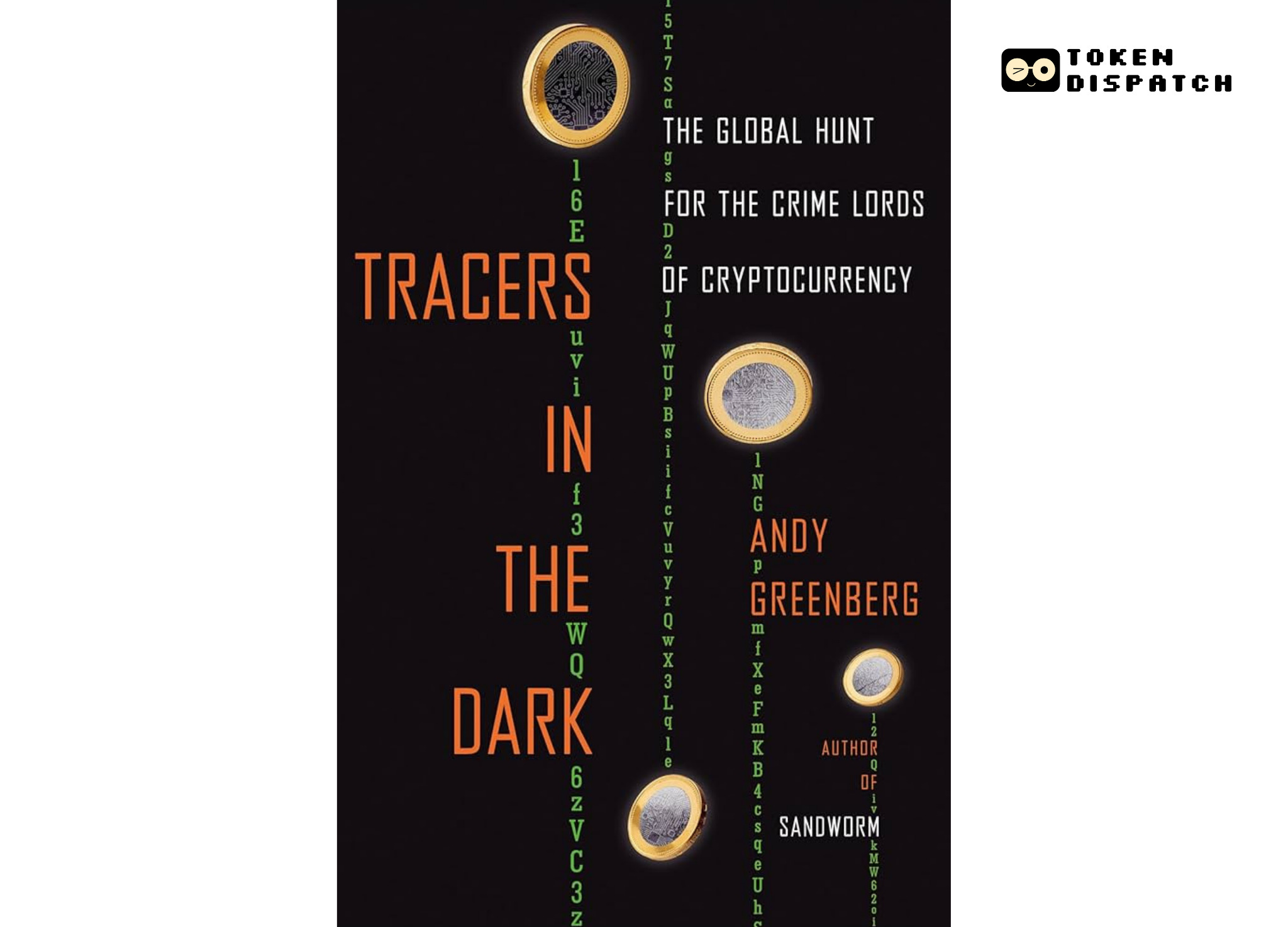
The book drops him into Tokyo in 2014, in the wreckage of Mt. Gox.
Hundreds of thousands of bitcoins are missing. Something like six hundred and fifty thousand, according to later court documents.
Nobody can give a clean answer about where they went. Exchanges are collapsing. People are panicking. Bitcoin’s credibility is on the line.
Gronager shows up and does a very simple, very aggressive thing. He tells the Japanese team that he can try to follow the coins.

No special access. No subpoena power. Just the public ledger, a new way of indexing it, and an attitude that treats the entire Bitcoin history as one giant problem set.
Greenberg’s description of this is quite funny in a dark way. At first, everyone still talks about “untraceable stolen bitcoins”. Then Gronager and others start loading the chain into databases, running queries, marking clusters, and slowly watching stolen Mt. Gox coins march across the screen into other services. Years later, US prosecutors charge Russian hackers with laundering about 647,000 of those bitcoins. The indictment casually notes that they moved through addresses controlled by Alexander Vinnik and his BTC-e exchange.
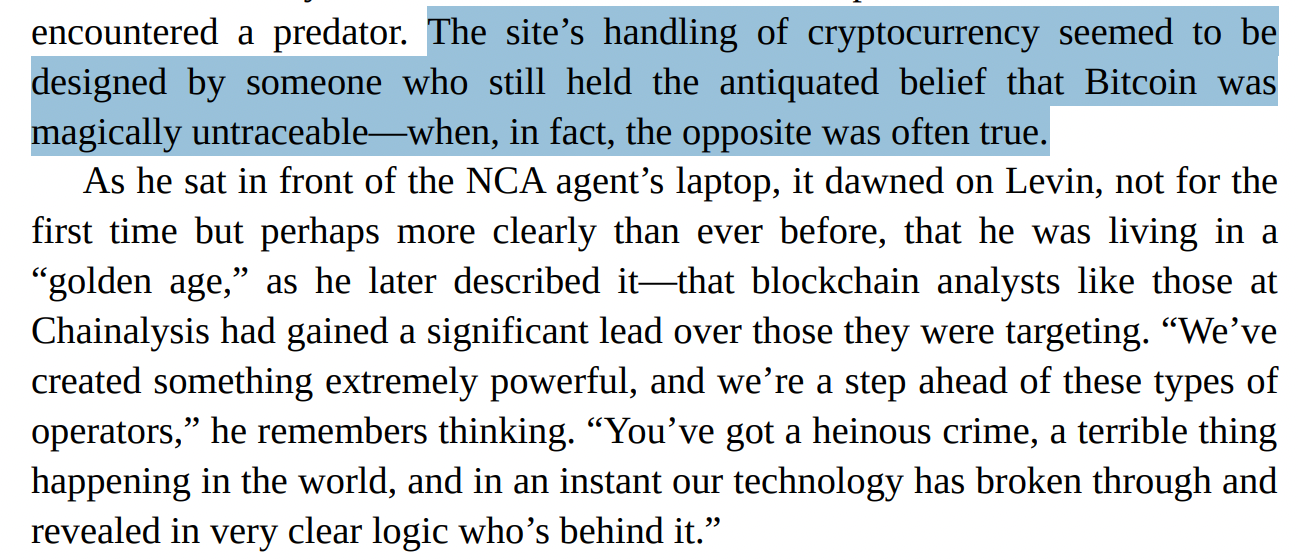
You read that and realise the important part is the time delay and not the name.
The hack was 2011–2014. The tracing keeps going. The indictment is 2023. The blockchain does not care that a decade has passed. It remembers.
There is a line in my head after these chapters that goes something like: “the half-life of a bad decision on chain is a lot longer than you think”.
Once Mt. Gox becomes a tracing problem, the rest follows.
If you can follow those stolen coins into BTC-e, you can start to see what BTC-e really is. Not just another shady exchange, but one of the main laundromats of the entire early Bitcoin era. US authorities would later call it a “significant cybercrime and online money laundering entity” that processed more than nine billion dollars for over a million users, many of them criminals.
From there, you get to Vinnik himself. Then to more exchanges. More clusters. More cases.
This is the point in the book where “follow the money” stops being a line in a movie and becomes a business model.
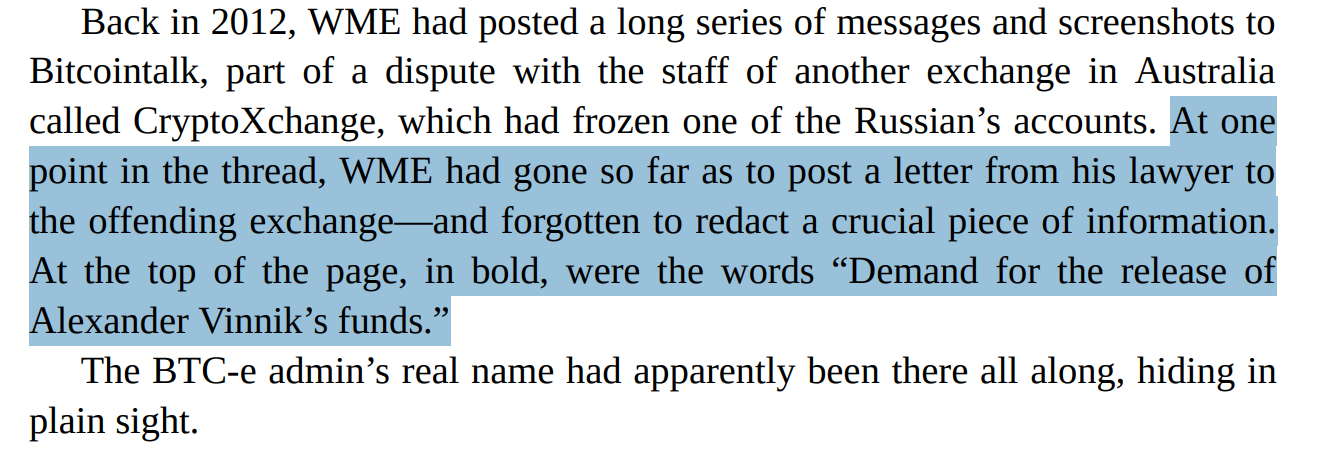
Chainalysis, Elliptic, all the familiar names in today’s compliance decks, are born in this moment where governments suddenly realise they can outsource part of their work. Tracing becomes a product. “Tracer for hire” is not just a chapter title, it is a category.
I found that shift more unnerving than any of the individual busts.
When tracing lived inside a few government teams, it felt like a specialised, slow tool. When it becomes a SaaS line item, it starts to look like any other piece of enterprise software. You can imagine the sales pitch. Better risk controls. Better AML. Better dashboards. No one has to say the quiet part out loud, that the product is literally “we turn your users’ transaction history into something legible to people with badges”.
You can already feel the future privacy discourse arguing with that.
On one side, privacy coins and privacy layers selling the dream of opaque money. On the other, a growing, profitable industry whose entire reason to exist is to make sure that money is not opaque at all.
The second big thread in this middle section is AlphaBay.
If Silk Road was the messy proof of concept, AlphaBay is the full-scale platform version. At its peak it serves over two hundred thousand users and forty thousand vendors, with hundreds of thousands of listings for drugs, fake IDs, hacking tools and more. It is the dark net marketplace that grows up with Bitcoin, not just beside it.
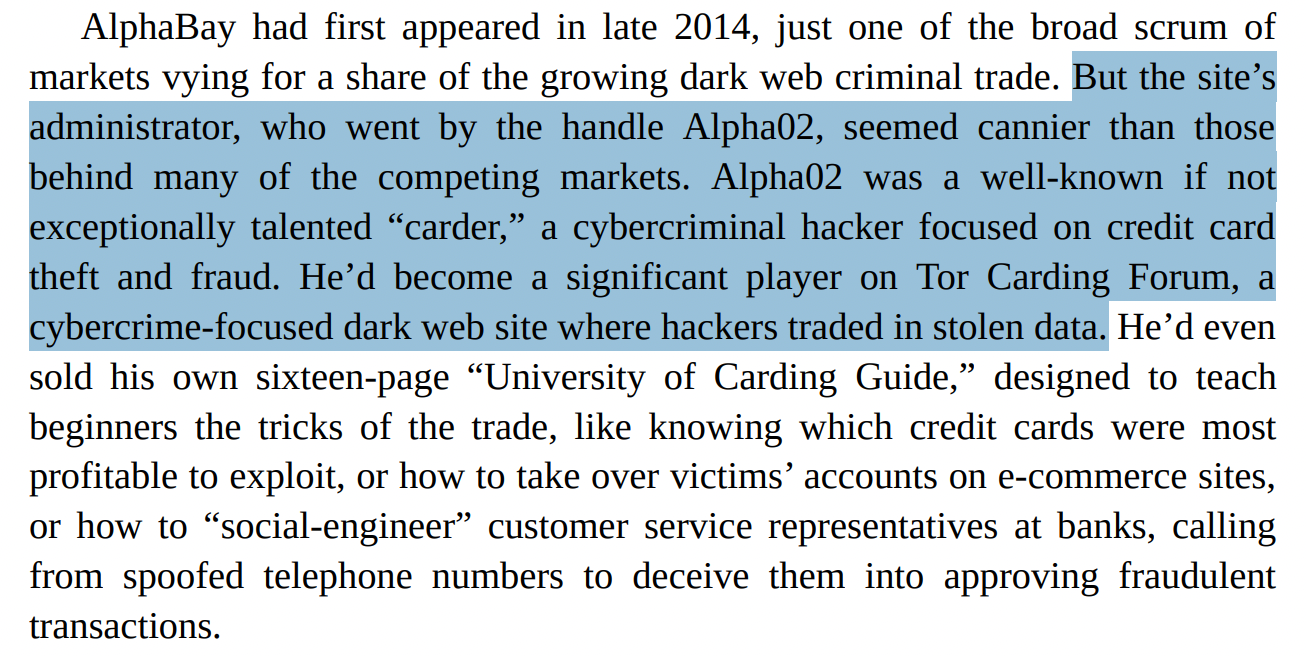
Greenberg introduces a DEA agent in Fresno, Robert Miller, who wanted to be on SWAT and ended up on dark net duty instead. He sits in California, watching this sprawling market run by someone who calls himself Alpha02, and tries to find a way in. On the other side of the world, Alpha02 is a Canadian named Alexandre Cazes, living in Thailand, running this giant criminal marketplace from his laptop and a very expensive car collection.
The AlphaBay chapters read like a collaboration between two different genres. One is classic undercover work. Informants, tips, patient infiltration, weird online personas. The other is blockchain tracing and data work.
Miller’s team uses traditional investigative tricks to get closer to Alpha02. At the same time, people like Gambaryan and Gronager are pulling the financial threads. The more they map the flows, the clearer the hierarchy of the market becomes. Which vendors matter. How escrow works. Where the profits sit.
All of that culminates in Operation Bayonet, the joint takedown of AlphaBay and Hansa in 2017.
If you have not read about it before, the short version is: the FBI and other agencies quietly seize AlphaBay’s infrastructure and arrest Cazes in Thailand. At almost the same time, Dutch police take over another big marketplace, Hansa, and keep it running in secret for weeks. As AlphaBay users panic and migrate to Hansa, they are essentially walking straight into a site run by law enforcement. The Dutch team logs their messages, delivery addresses and passwords while pretending nothing has changed.
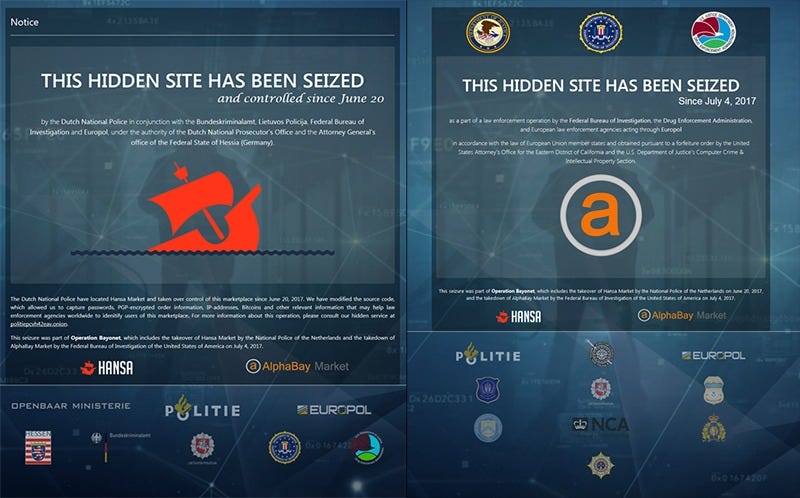
Greenberg’s account of this is very proud, and honestly, it is hard not to be impressed. It is one of those rare moments where governments actually coordinate across borders and departments, and the whole machine does what it is supposed to do.
For a while, at least.
The part that bothered me, reading this now, is how quickly AlphaBay’s rise and fall starts to look like just another chapter in the same loop.
Market launches.
Criminals flock to it.
Investigators start watching.
An analytics vendor lands a contract.
Someone makes a mistake.
Market dies.
Users scatter to the next platform.
Repeat.
The technology on both sides gets more advanced each time, but the basic dance stays the same. Vendors move, but they still pay in traceable currencies. Tracing tools improve, but they still rely on human error. The ledger records the whole thing with complete indifference.
There is one line from later reporting on Operation Bayonet that sticks in my head. Even after AlphaBay and Hansa go down, users on Reddit are already talking about when they will be “sober for a while” and then go back to the dark net once the chaos settles. The demand does not vanish. It just waits.
I kept thinking about what that means for crypto people who are not in these stories.
Most of us are not running one-billion-dollar drug markets or laundering Mt. Gox coins through Russian exchanges. We are just trading, investing, degening, whatever. It is very tempting to look at AlphaBay and BTC-e and think “this is not about me”.
Parts of it are not. Parts of it absolutely are.
Because what these chapters really show is how normalised tracing has become.
It is a service that law enforcement agencies expect to have, a box they expect to be able to tick. It is a product that regulators cite in public reports as proof that crypto is not ungovernable. It is an entire ecosystem of companies whose success depends on making sure there are fewer and fewer blind spots on public ledgers.
And this is where it loops back to the privacy narrative of this cycle.
If you listen to the current hype, privacy is the new big trade. Private L2s. ZK layers. Account abstraction tricks that hide your moves. People frame it as a kind of reset. We tried full public mode, that did not work out, now we retreat.
What Tracers in the Dark quietly reminds you is that there is no clean slate. The ledger is already full. The tracing industry is already mature. Whole careers and companies exist because the first decade of crypto was one big “assume nobody will read this too closely” experiment.
Any honest privacy story now has to start from there. From a world where Mt. Gox, BTC-e, Silk Road, AlphaBay, Hansa, all of it, is permanently written down and attached to real names in case files.
After the first AlphaBay and BTC-e chapters, my mental summary of the middle of this book is that you think we just invented uncensorable money. In fact we bootstrapped a new kind of financial surveillance industry, then gave it a recurring revenue model.
Next week, the book shifts into even harder territory, where tracing is used not against markets, but against the worst kind of crimes. Child exploitation, abuse, things nobody can defend. That is where the ethics get complicated, because you can feel why these tools exist, and also see all the ways they can spill over.
For now I am sitting with this more boring lesson from part two:
There is no way to talk honestly about “crypto privacy” in 2026 without first understanding how satisfying it is, for the other side, to live in a world where the money has already been writing its own testimony for fifteen years.

Token Dispatch is a daily crypto newsletter handpicked and crafted with love by human bots. If you want to reach out to 200,000+ subscriber community of the Token Dispatch, you can explore the partnership opportunities with us 🙌
📩 Fill out this form to submit your details and book a meeting with us directly.
Disclaimer: This newsletter contains analysis and opinions of the author. Content is for informational purposes only, not financial advice. Trading crypto involves substantial risk - your capital is at risk. Do your own research.