


Somewhere between Base leaving the OP Stack and Dankrad Feist walking out the door to join a Stripe-backed chain, the Ethereum Foundation (EF) decided what the moment called for was a manifesto.
On March 13, the EF published a 38-page document called the EF Mandate. Constitution + manifesto + guide. It opens with “Dearest Friends” and closes with “with the greatest love in the world.” The document was stored on-chain and has illustrated pages. One page even reads: “May the Foundation fall on its own sword if it fails to uphold its solemn promise to Ethereum.”
Ethereum must function independently, even if the EF ceases to exist tomorrow. The core idea of the document is that the EF’s success is measured by how unnecessary it becomes.
That is possibly the most principled thing anyone in this space has committed to paper. Beautifully said, but also an impressive way to say we are already on our way out.
I also perceive this as the sound of an institution that has been losing the argument for a year, writing down its values before anyone else can define them for it?
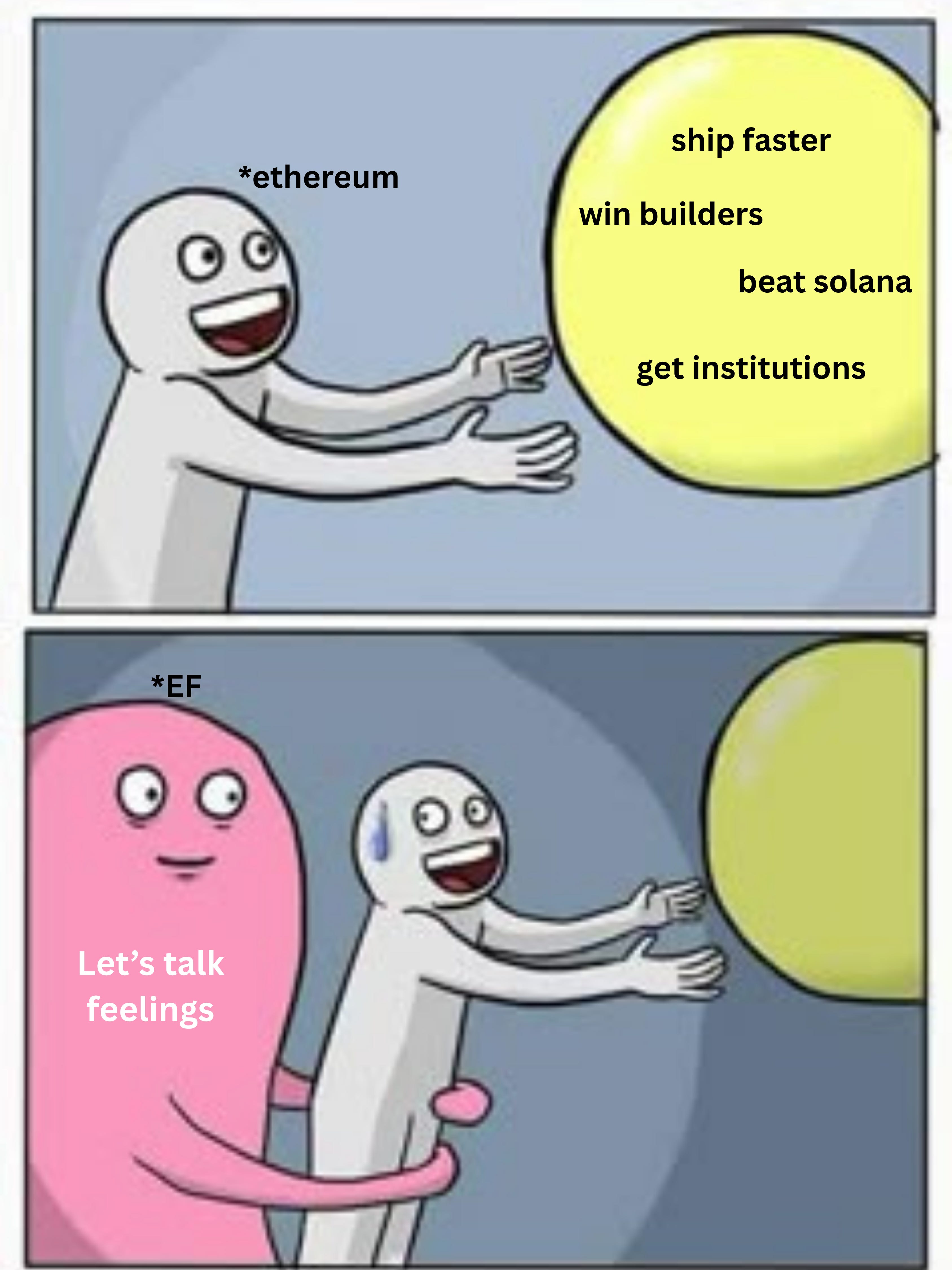
For context, this document dropped two weeks after Tomasz Stańczak left. Stańczak was the co-executive director who spent 2025 pushing the EF toward pragmatism, builder engagement, and paying attention to the real world. Vitalik praised him on the way out. Yet, the foundation just declared it was going back to cypherpunk fundamentals.
Why are they saying this now?

Stable: Rails For The Real World
If you’re done juggling volatile tokens just to move value, Stable is your platform.
Pay fees in USDT; no extra tokens, no surprises
Free peer-to-peer transfers, sub-second finality
Native USDT settlement and enterprise-grade throughput (10,000+ TPS on roadmap)
EVM compatible, to let developers already familiar with Ethereum tooling build faster

Whether you’re a dev, business, or crypto user, Stable gives you rails that actually feel like digital dollars, not blocked rails.
What The Mandate Says
The EF mandate is structured around CROPS, an acronym for censorship resistance, open source, privacy, and security. The document is explicitly saying that CROPS override everything, permanently, and proposals that trade any of these properties for convenience face a harder bar. Non-negotiable.
The EF sees its role as stewardship, and not leadership.
What the EF is not about:
Building products
Doing the BD work that attracts institutions or retains builders
Chasing adoption metrics
Instead, they want to be doing:
Protocol hardening
Privacy research
Security
The foundational infrastructure that a neutral settlement layer needs to remain neutral over decades. Fair?
Now let’s talk about the walkaway test. Ethereum must work even if the EF disappeared tomorrow. If any system requires the foundation’s presence to function, it fails the test. The whole document is a case for why Ethereum should be able to live without the people writing the document. Call it a coherent philosophy.
What Is The Problem?
This is what Yuga Cohler, a senior engineer at Coinbase, says: “Just as Netscape wasted time on a rewrite from version 4 to 6 at a time when Microsoft was absolutely killing them, the EF insists on focusing on cypherpunk values at a pivotal time when the institutions are finally coming on-chain - often to other networks. An EF determined to win would focus on how to make Ethereum the best chain for finance.”
Netscape had the internet browser market almost entirely to itself in the mid-90s. Then Microsoft bundled Internet Explorer with Windows for free. Netscape’s response was to scrap their entire codebase and start over. By the time they shipped the new version, it was too late. Microsoft had won. The rewrite took so long that the window closed. Netscape went from 90% market share to irrelevant in three years. This is where you SIGH.
They were focused inward at exactly the moment the competitive landscape shifted. Is EF doing the same?
The mandate does little to address practical concerns about how the ecosystem serves real users.


Feist’s departure is itself a data point. He co-created Danksharding, one of the most important technical contributions to Ethereum’s scaling roadmap. He left for Tempo which is the Stripe and Paradigm payments chain. Which i would like to look at like something that moved faster and served several financial use cases. He voted with his feet.
So did the builders who moved to Solana and the institutions that went multichain. Base left the OP Stack. But let’s unleash a philosophy paper.
Read: The Best Thing Optimism Ever Did - by Thejaswini M A
Since the bottom of the previous crypto bear market, Bitcoin has rallied over 348% while Ethereum has gained over 130%. But look at the network itself. Ethereum commands about 58% of all DeFi TVL. This has been consistent throughout the last few years.
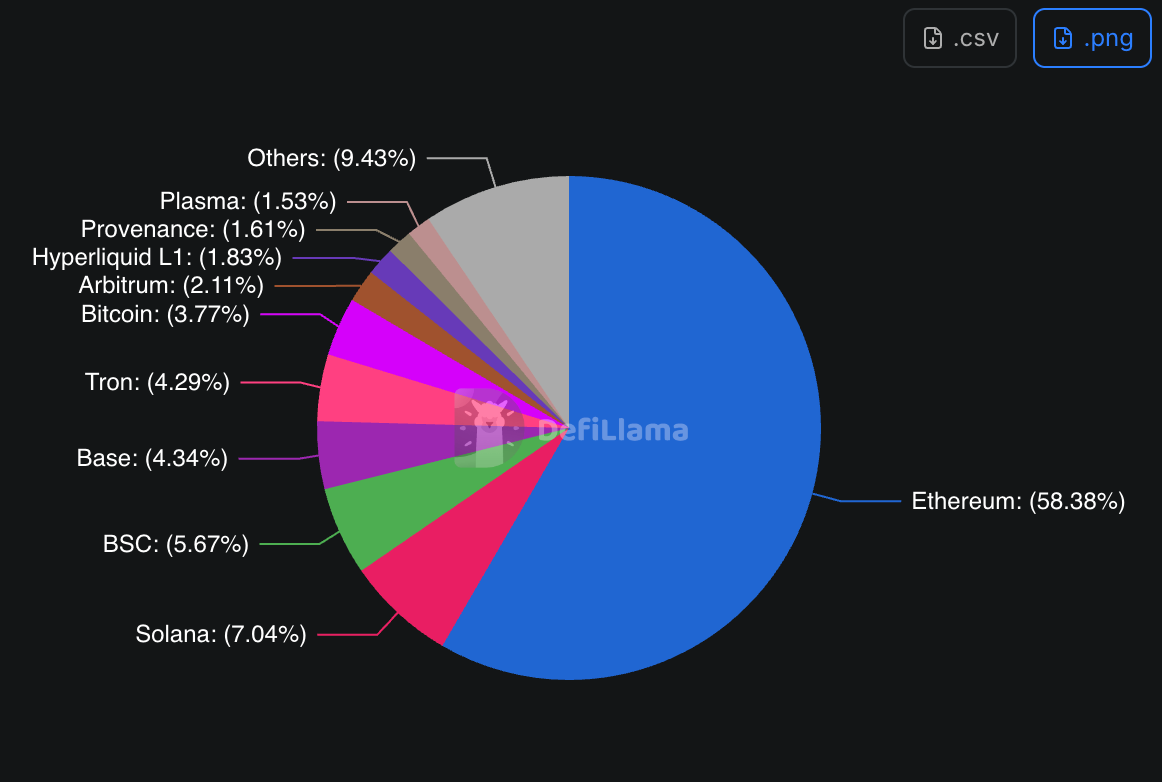
Ethereum maintained roughly 55% of total stablecoin supply, adding $50 billion in new issuance in 2025 alone, driven primarily by institutional flows, tokenisation, and RWA infrastructure. Tokenised real-world assets, the thing every bank wants to do on-chain are 56.8% on Ethereum, which holds nearly $10 billion of the RWA market. When institutions want to park something serious, they still come to Ethereum.
But there are other competitors who are also not doing badly either.
Solana? Doing fairly well for a bear market. Not the same conversation yet.
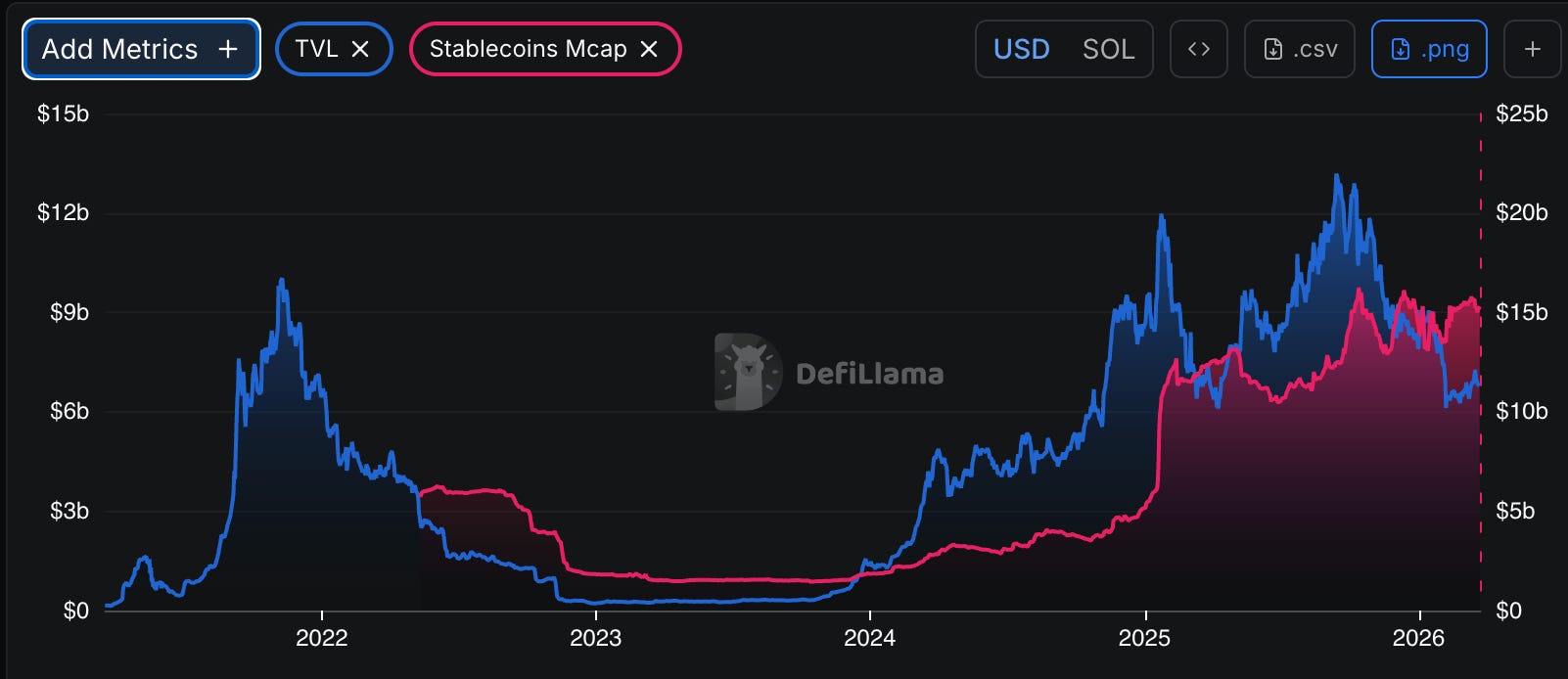
Hyperliquid processed nearly a billion dollars in oil trading over a single weekend during the Iran conflict. Institutions are going multichain as a default, not even an exception anymore. BlackRock launched a staked ETH ETF but also has positions on other chains. The world is not waiting for Ethereum to decide what it wants to be.
The ecosystem feels like it is losing the narrative.
There is no section on how to make Ethereum more attractive to builders who currently prefer Solana. No mention of the competitive pressure from chains with better UX and more aggressive roadmaps. The document is not addressed to the market, but to the EF itself.
The Case For Disappearing
Bitcoin has no foundation, yet it is the most valuable crypto asset in the world. The less a base layer is controlled by any single entity, the more credible its neutrality. Every time a foundation accumulates power, it becomes a target - regulatory, political, and eventually internal. The EF is trying to avoid becoming what it became.
I will explain the strongest case the EF has. Ethereum’s value to institutions is not speed or cheap fees. It is credible neutrality and the assurance that no single actor controls it, that the rules will not change based on who is in power today, and that it is safe infrastructure for the next thirty years. Every time the EF shrinks its footprint, its credibility increases. Every time it steps back, Ethereum becomes less like a company.
The EF does the protocol work nobody else will do. The ecosystem does the product work the EF should not do. If both work as intended, Ethereum becomes the neutral base layer that the financial system builds on, regardless of whether any particular EF employee is still there.
The Power Vacuum
When an institution steps back, something fills the space. The EF is choosing to shrink its footprint. That is the whole point of the walkaway test. But Ethereum does not exist in a vacuum, and the entities that have the most influence over its future do not share the EF’s relationship to CROPS.
Coinbase has Base. It has 100 million users, a developer platform, and more economic interest in Ethereum’s direction than almost anyone else. Lido controls a significant share of staked ETH, which gives it governance weight that no document can revoke. a16z has invested in protocols that shape the roadmap. These are not neutral stewards. They are participants with their own interests, their own timelines, and their own ideas of what Ethereum should be.
The mandate says the EF is “one steward, not the sole one.” But it does not say who the other stewards are, what they are optimising for, or how their interests stay aligned with CROPS when those interests conflict with growth.
The talent and institutional weight that used to sit inside the EF is now distributed across entities with commercial incentives that the EF explicitly says it does not want. Who are they building for, and do those interests converge with Ethereum’s long-term neutrality or pull against it?
Decentralisation does not eliminate power dynamics, but it sure makes them harder to see.
What Does Ethereum Want to Be When It Grows Up?
The mandate offers an answer: Sovereignty infrastructure. It aspires to be the neutral base layer for human freedom in the digital space. A thousand-year project, all about the machinery of freedom.
Also want to be the most liquid stablecoin settlement network. The most credible neutral chain for institutional finance. The place where RWAs are tokenized because the regulatory standing is cleaner than anywhere else.
These goals aren’t mutually exclusive, but the path to the first requires slower growth and ideological purity. The path to the second requires engaging with the competitive reality, where Solana and others are currently winning the battle for builders and mindshare.
Tell me this a year ago, I would clap and reshare. But today, we hardly find adoption from the people who want to use blockchains. Everyone wants a product; they want convenience.
Principles may win in a long enough timeline. Though I would never say this, timelines are shorter than Vitalik thinks.
There is also the asset problem, which the mandate does not touch at all. Ethereum is not just a protocol. ETH is something people hold. An asset that keeps underperforming its peers stops attracting capital, which reduces the security budget, which eventually comes for the protocol itself. Principles can sustain a network, but cannot sustain a token price. And in crypto, those two things are more connected than we assume.
The one bet that matters most is the one the builders make when they decide where to build next.
In my view, the mandate is right about one thing and silent about another. It is right that a protocol whose value depends on a foundation’s presence is a fragile protocol. It is silent about the fact that a protocol whose steward is focused elsewhere while the competition moves faster is also fragile. These are two different failure modes and the document only addresses one of them.
Ethereum has survived tougher times than this. It has also never been written off with more conviction by people who used to believe in it the most.

Token Dispatch is a daily crypto newsletter handpicked and crafted with love by human bots. If you want to reach out to 200,000+ subscriber community of the Token Dispatch, you can explore the partnership opportunities with us 🙌
📩 Fill out this form to submit your details and book a meeting with us directly.
Disclaimer: This newsletter contains analysis and opinions of the author. Content is for informational purposes only, not financial advice. Trading crypto involves substantial risk - your capital is at risk. Do your own research.
The Netscape analogy is apt. Ethereum's 58% DeFi TVL and dominance in RWA tokenization show the moat is still real — but moats erode faster than the incumbents expect when competitors offer better UX and faster iteration. The EF mandate reads like principled stewardship for a 30-year horizon, but builders typically choose on a 6-month horizon. Both timelines matter, and right now they're pointing in different directions.