


Last week, we were arguing that we buy software in a slightly stupid way.
We subscribe to a product for a month when we may only need one small thing from it. Monid was interesting because it breaks some of those products back into the individual things they can do. You keep one balance, call whichever tool you need and pay for that use.
That was: Software by the Sip
I wanted to see how much the difference counts when the software is expensive enough that you would normally think carefully before subscribing. So I went back to video generation, which is very good at making credits disappear.
Let’s see how it turned out in this piece.

TOKEN2049: The Largest Crypto Stage
Over 25,000 attendees, 300 speakers, 500 exhibitors and 1,000 side events will come together at TOKEN2049 to rewrite the future of finance. And you are invited!
TOKEN2049 Singapore is just over three weeks away. The global crypto industry meets at Marina Bay Sands, 7-8 October, for the world’s largest crypto event.
Book by Wednesday, September 23, to lock in the current rate of $539 ($599) and get the exclusive 10% discount before the price goes up next week.

I asked Monid to make me a 20-second video of a yellow duck wearing headphones and walking through a crowded subway. The style was supposed to look like an oil-pastel animation drawn frame by frame on paper. Monid found ByteDance’s Seedance 2.0. Seedance itself has a 15-second maximum, so that is what it made.
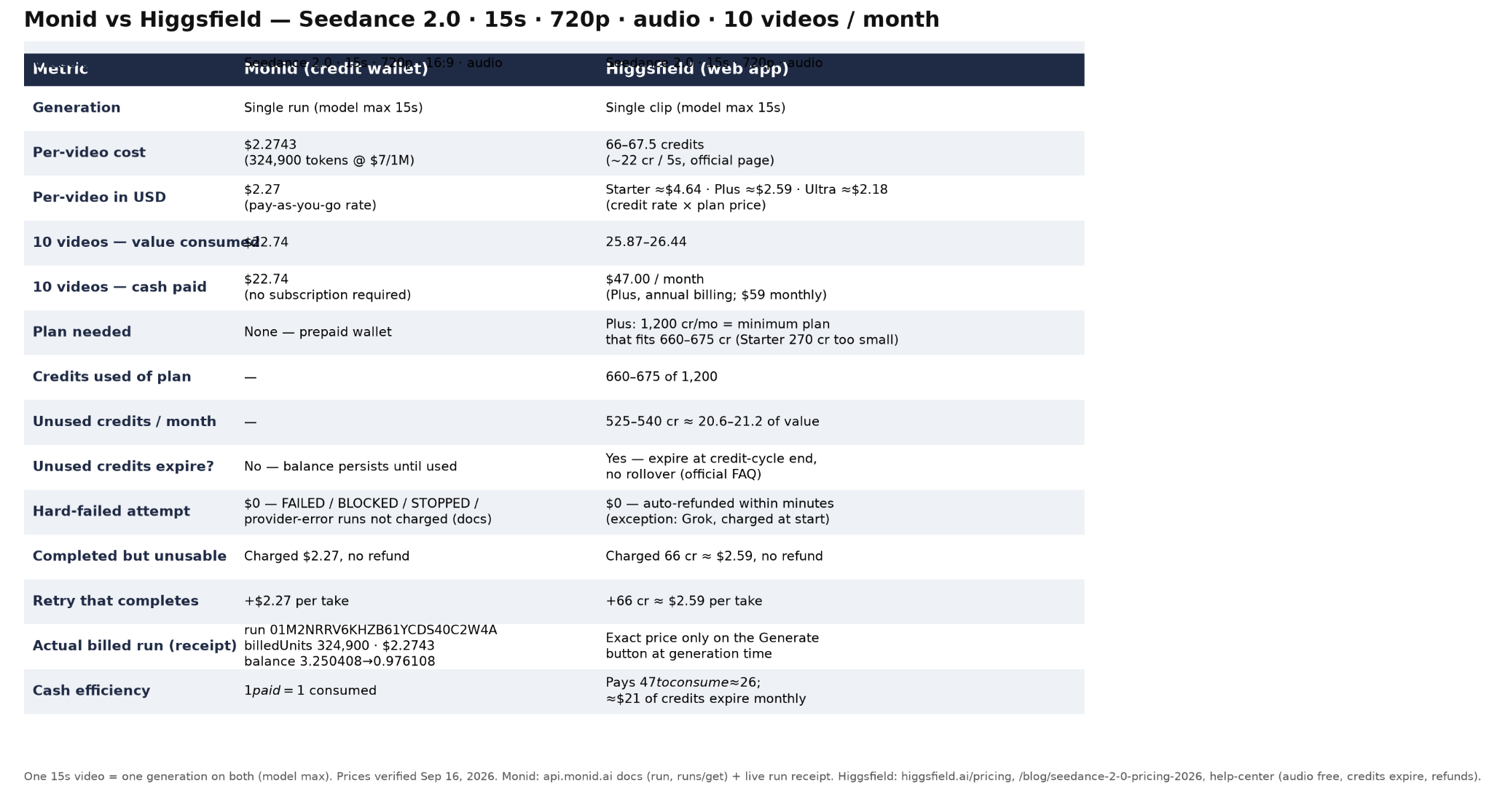
The finished video was 15 seconds, 720p, with audio. The exact Monid receipt was $2.2743 for 324,900 tokens.
The duck was pretty good, in fact (although I have no idea what the people behind are up to, they seem pretty aggressive. It stayed yellow, kept the headphones and moved through the subway as requested. The animation was smoother than the hand-drawn movement I had asked for, not that happy about it for an unexplainable reason, and a “No Smoking” sign sneaked into a prompt that explicitly said no text, so we are not talking about cinema history here.
What would the same habit cost if I made ten of these videos every month through Higgsfield?
Ten Monid generations at the price I paid would cost $22.74. There is no monthly plan involved, so $22.74 of usage means $22.74 is deducted from the balance.
At the time of my test, the Higgsfield plan that could cover the same ten 15-second Seedance generations cost $47 per month. Those ten videos consumed roughly 660 to 675 credits, worth around $26 at that plan’s credit rate. The plan came with 1,200 credits, leaving roughly 540 credits after the ten videos. Higgsfield’s subscription credits expire at the end of the credit cycle rather than rolling over. Higgsfield’s current help centre still says subscription credits reset each billing cycle and unused credits expire.
These were Higgsfield’s prices when I ran the experiment. The exact numbers may change later.
If I made the same ten videos through Higgsfield, they would consume about $26 worth of credits, but I would need a larger subscription to cover them. That can be completely reasonable if I also use its other video models, image tools, camera controls, identity features and editing workflows. In this case, its subscription pays for a larger creative workspace rather than Seedance alone.
Seedance sits inside a larger creative suite with features such as Soul ID, Cinema Studio and Marketing Studio. If all I want is ten Seedance clips, however, much of that product disappears from my calculation.
I only want the capability.
Like we discussed last week, Monid describes itself as the “OpenRouter for agent tools.”
There are now more than 1,700 tools from over 55 providers listed on the site, across 71 categories. Its dedicated OpenRouter page says a request can return several possible sources with their live prices, and the system can route towards the cheapest one capable of doing the job.
Monid Founder Shengkun Ye said in September that the platform had crossed four million transactions and raised a $2.1 million pre-seed round. A few months before that, Monid was being described as a wallet with just over 200 endpoints. The catalogue is already several times bigger now.
OpenRouter provides the obvious blueprint because AI models have become unusually easy to compare. You can send similar work to several models, record price and latency, watch for failures and route the next request accordingly. The customer usually cares more about the output, price and speed than about who actually ran the model.
Tools are harder because a TikTok scraper and a video generator do not have the same unit of work. One provider charges by result, another by call, Seedance charges according to generated video tokens, and browser automation may charge according to time. This makes it difficult for Monid to compare tools on price alone or decide which one offers the best value. Outputs are different too, as a data tool might return a table of prices, while a video model gives you an MP4 file.
Monid is trying to put all of these very different tools behind the same buying experience. It wants more software companies to sell through this system.
An API developer can list a tool on Monid instead of finding every customer themselves. Monid brings the users, keeps track of how many times the tool is used, collects the payment and gives the provider its share.
That is when it could become a software marketplace instead of a collection of APIs. Which brings us to wholesale software.
Wholesale is a word we usually associate with physical goods.
When a factory makes thousands of products, and a distributor buys them in bulk, and those products eventually reach customers through shops and marketplaces. Wholesale markets have traditionally existed because producers and buyers do not always want to deal with each other one-on-one.
A wholesaler would buy goods from many producers, sort and standardise them, hold inventory, then break those large quantities into smaller amounts that retailers could use. The product itself usually did not change very much. How it was packaged, priced and distributed changed over the years. And it makes some software unusually suited to the same model.
An API already turns software into a defined unit of work. When you send a request, it returns something. The amount consumed can usually be measured. Monid is effectively trying to do the wholesaler’s job around those units. It gathers capabilities from many providers, gives them a common place to be discovered and paid for, and lets the buyer purchase only the amount they need.
A good wholesale software capability probably needs a few things.
The job should be narrow enough that another system can describe it clearly.
The result should come back in a format another program can use.
Software should have a clear thing you can count and charge for.
The customer should be able to switch suppliers without rebuilding their entire business.
That explains why search, enrichment, scraping, market data, media generation and verification appear so heavily in Monid’s catalogue. But where does the idea start to weaken?
Take Figma. Figma has APIs and an MCP server. In it, you can read files, work with variables and comments, and connect parts of Figma to other systems. But the reason companies buy Figma is much larger. Several people can view and edit a file simultaneously. They can iterate through designs and basically maintain a shared working state over months. Figma itself describes multiplayer files, cursor chat, comments and the shared canvas as central parts of the product.
So if you reduce Figma to one API call that says make this design, you are only capturing a small part of what people actually use Figma for.
Same with Salesforce. Salesforce is where a company keeps track of its customers and sales work. A team might use it to store contact details, past conversations, deals in progress, follow-ups and internal notes.
Getting one small piece of that information, such as a customer’s email or the status of a deal, is easy to imagine as a single paid call. But the full product is much harder to sell that way. The value comes from keeping the entire customer record and workflow together continuously. That ongoing workspace does not break neatly into tiny one-off purchases.
Wholesale software could therefore take individual capabilities out of a product and take some of its customers with them. How much of the original business survives depends on the value of everything surrounding those capabilities.
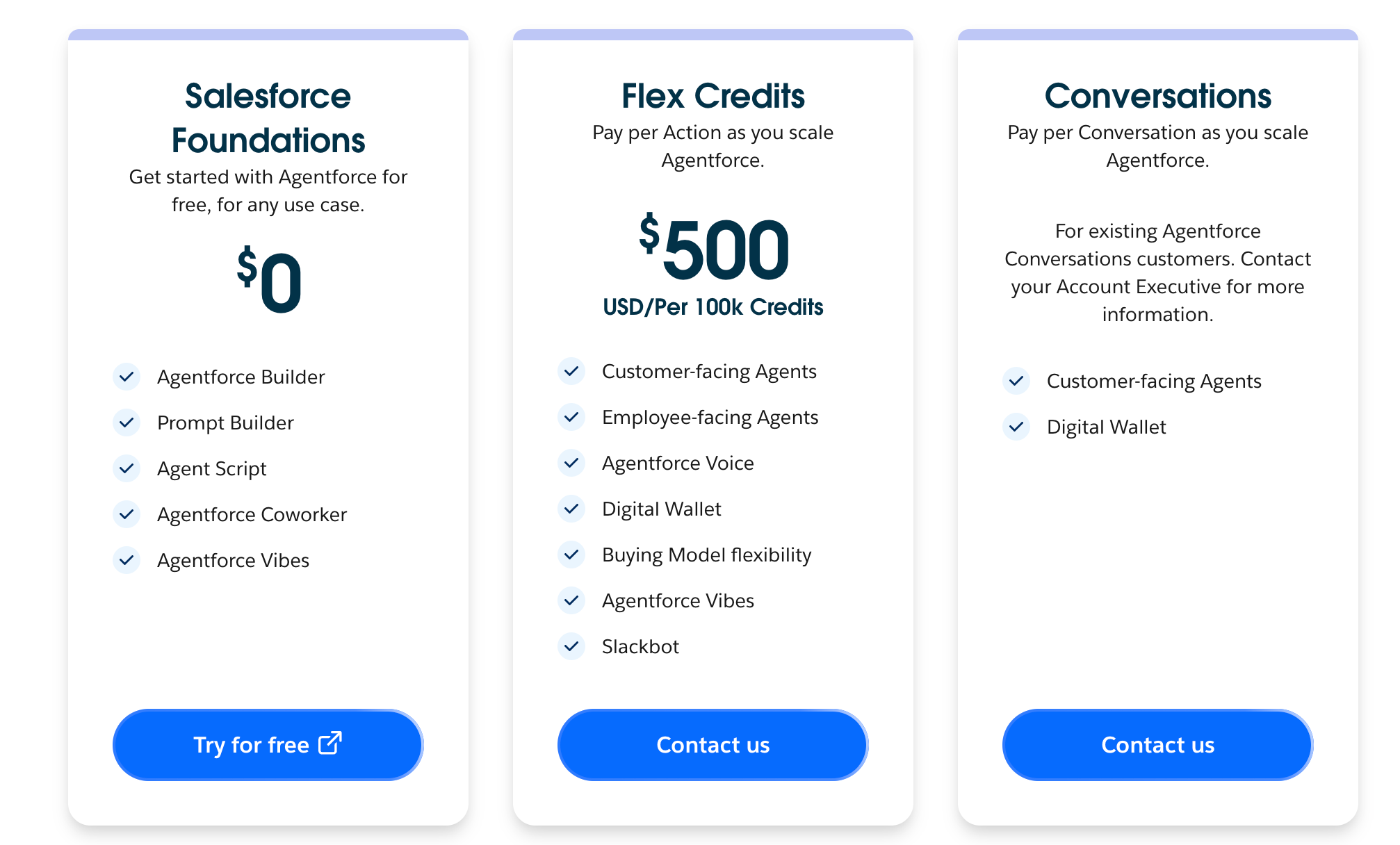
Monid is threatened when software companies start to charge for individual tasks within their products. Salesforce itself sells Agentforce through Flex Credits, with individual actions consuming credits. Its published rate is $500 for 100,000 credits, with a standard Agentforce action consuming 20 credits. That means a task such as updating a customer’s details or answering a question costs about ten cents, on top of any other charges. Companies still use Salesforce to store customer information and manage their work, but now pay separately for specific tasks the AI performs.
Salesforce is also investing in the machinery needed to support this model. It completed its acquisition of usage-billing company m3ter on July 1, 2026. The stated purpose was to bring metering and rating into Agentforce Revenue Management so businesses could track usage and bill for consumption or outcomes. That is a concrete commitment from a company whose business was built around subscriptions.
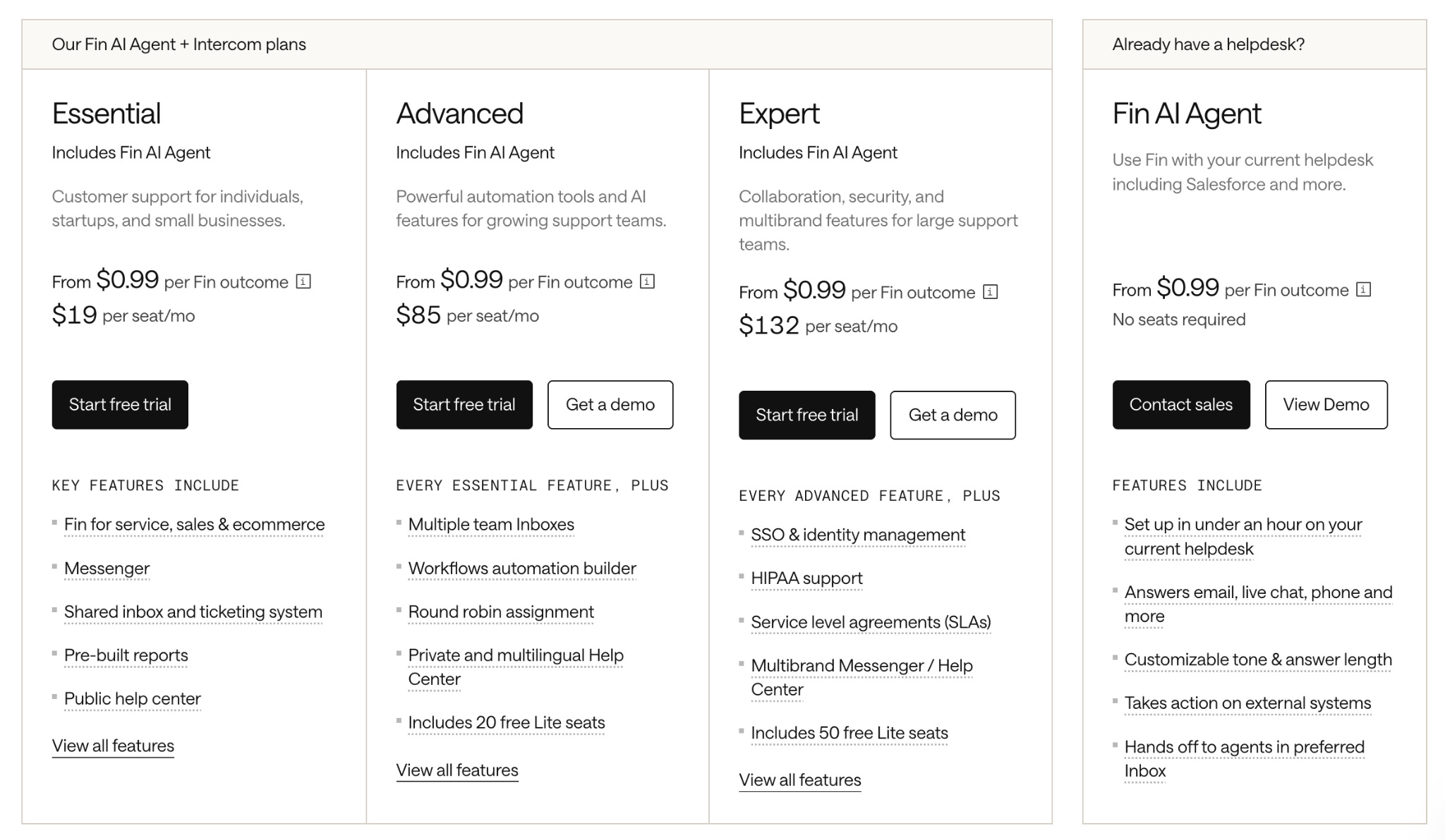
Look at Intercom, the customer-support software to get an even closer perspective of a capability becoming separable from its original workspace. A business can use its AI agent, Fin, to answer customer questions inside the support software it already uses, including Salesforce. It does not have to subscribe to Intercom’s helpdesk. Fin’s pricing starts at $0.99 per outcome, with a minimum monthly commitment. So the business can get the AI’s help without switching the software its support team uses.
Established companies can separate their capabilities, change their pricing, and maintain the customer relationship. Monid’s opportunity depends on making it sufficiently easier to compare and buy across those companies that customers prefer going through it.
Establishing a broader shift would require evidence of repeat spending, customers replacing existing subscriptions and providers winning business they would otherwise never have reached.
When would software brands disappear?
Today, buying software usually begins with a brand.
If you decide to use Canva, you open Canva and choose a Canva plan. You learn where Canva puts everything. A company might spend months choosing Salesforce and train employees on Salesforce. They might spend several more years complaining about Salesforce while continuing to renew it.
Brand choice happens before the work now, and that is the model Monid can reverse if it wants to.
Suppose I ask for the current price and reviews of a product. There may be several providers capable of retrieving them. Monid’s discovery layer can show those providers with prices and choose according to the job.
If that becomes normal, I may stop starting by picking which software company I should use. And instead, you just ask for the result.
The provider moves one level down. This could make these big brands uncomfortable since a surprising amount of software economics is built around being remembered. A 2025 study by 6sense of nearly 4,000 business buyers found that 95% bought from a vendor already on their shortlist when the buying process began.
An analogy I can’t resist is, if I want a mocha in Bangalore, I first decide which café to visit, then whether to book a Rapido or an Uber. Once I get there, I look at the menu and find out what’s actually available. Would it make me happier to start with exactly what I want and let someone figure out the rest? Probably. zomato’s of the world tries to fix this to some extent. But a cab company, where I can get in and click on what I feel like eating, gets me to a place I just pay once for all, easier! But no fun, so that’s okay.
The point is, companies spend heavily on websites, content, sales teams, demos, free trials, onboarding and brand. Once a customer is inside, they bundle more features into the account because those extra features make leaving feel more uncertain.
If I’ve already paid for Higgsfield this month, I’ll try to use the tools included in my plan before spending money somewhere else. With Monid, I can buy each task separately, so I have less reason to keep choosing the same provider. I can pick whichever works best for that job.
Monid could learn which tools work well by tracking what happens when people use them. If one keeps failing and another usually works, it could recommend the reliable one next time. But four million transactions alone don’t prove it can do this well. It needs enough results for each type of tool to make a fair comparison. Monid currently ranks tools mainly by how closely their descriptions match the request. It also shows speed and stability information, with performance playing a smaller role in its documented ranking. Learning which tools consistently do the best job remains an opportunity.
Let’s go back to the “OpenRouter for tools” claim. The ranking system is harder to copy than the catalogue.
For an amazon seller, being available on Amazon is useful. Appearing near the top when somebody searches is considerably more useful. If Monid chooses a tool behind the scenes, the user may never notice which company supplied it. Providers could then spend more effort getting Monid and other platforms to recommend them.
Smaller companies might welcome the customers this brings. Bigger brands with unique data or popular tools may prefer selling directly, where they control pricing and keep the customer relationship. They could offer only selected features through marketplaces while keeping their best tools inside their own apps.
For instance, Customers pay for Bloomberg’s combination of financial data, analytics, news and working tools. Selling individual pieces through a marketplace could bring in more buyers, but Bloomberg would have to weigh that against giving another company more influence over pricing and access to its customers.
How far this goes depends on whether providers think the extra business is worth giving up some control.
The fun consequence is that we may get software companies that barely look like software companies. Someone could build an API that takes a product link and returns accurate specifications and the latest price, then sell that service without building an entire app around it.
Today, the standard startup checklist would eventually arrive. Building the tool is only the beginning. Then you need a website, accounts, payments, pricing plans and a way to convince people to sign up. Before long, you’re writing welcome emails and posting on LinkedIn. All because the company needs to acquire, bill and retain human customers.
A wholesale marketplace can take some of it away.
Monid is already inviting API owners to bring the capability, while Monid handles discovery and metering.
There would still be work. It needs reliable infrastructure, clear schemas, security, compliance where relevant and enough support to stop the endpoint breaking. But for plenty of smaller jobs, the company may not need a consumer application at all.
This could create a long tail of tiny software suppliers that could not support the normal cost of running a SaaS business. You can’t afford a whole sales team when each request earns you a fraction of a cent. In such a case, it could work if the marketplace brings enough business without you having to find each customer yourself.
It also creates dependence. As loyalty is close to zero, a supplier could lose customers when the platform starts recommending another tool.
Does Monid need to become Amazon?
Monid has a reason to keep adding tools. More choice could attract more customers, which could encourage more providers to join. But I am not convinced the biggest catalogue automatically wins.
RapidAPI already taught us that an enormous API marketplace can exist without permanently owning the relationship between buyer and provider. Once they know which provider they want, they can go directly to it. Monid therefore needs to keep making the purchase easier. That means showing accurate prices, keeping instructions up to date, handling billing problems and helping agents find tools that work.
The mistakes can also spread quickly. An agent could keep using a tool that returns wrong information, repeating the error across hundreds of tasks sometimes.
In 2012, A faulty automated trading system placed millions of unintended orders in about 45 minutes and lost roughly $440 million. This is probably old and not an AI example, but it shows how quickly an unchecked automated loop can do damage.
In 2025, Anthropic had Claude run a small office shop. It told customers to pay into a Venmo account that didn’t exist. It also kept handing out discounts after being told to stop. Even a year after that, we are no strangers to slops.


So, to survive that, Monid’s next challenge is helping agents choose well. As we saw already, the recommendations currently rely mainly on matching tool descriptions. Reliable comparisons of actual results would make those recommendations more useful.
If it becomes very good at choosing among suppliers, it can gain plenty of marketplace power without making humans browse an Amazon-sized software mall.
The machines are the ones doing the shopping anyway.
Token Dispatch is a daily crypto newsletter handpicked and crafted with love by human bots. If you want to reach out to 170,000+ subscriber community of the Token Dispatch, you can explore the partnership opportunities with us 🙌
📩 Fill out this form to submit your details and book a meeting with us directly.
Disclaimer: This newsletter contains analysis and opinions of the author. Content is for informational purposes only, not financial advice. Trading crypto involves substantial risk - your capital is at risk. Do your own research.