


Hello,
You can express a financial view about the future in multiple ways. If you believe that people worldwide will embrace peptides that aid weight loss, you can buy shares in companies that manufacture those drugs. Alternatively, you can take a leveraged long position through a perp. Or you could bet on how big the peptide industry could grow using a prediction market.
All these pricing tools sound familiar to a regular trader. But everyone has an opinion about most things around them, whether they are traders or laypeople. To the latter group, a perp or a contract priced as a probability may be less intuitive. This is where agents come in. Last month, I wrote about TrueNorth, which allows users to plan and execute trades by chatting with agents.
But placing trades on exchanges alone is the bare minimum. The bigger prize is combining instruments to either double down on your position by pairing the stock with a perp, or hedge your equity position by using an event contract that pays if regulators clamp down on the peptide’s future. An agent could build that position for anyone, whether a trader or a layperson. But today, most agents can’t help execute multiple trades across different financial venues.
Today, I look at what that could unlock and what it would take to achieve that.
On to the story...

StablesReward: Your AI Agent Spends, You Earn
AI agents can surf the web, read reviews, and book hotels for you. All these tasks cost money. But what if these tasks could earn you back something?
StablesReward does just that. Once you connect your agent to an MCP endpoint, it gives your agent a menu of paid tools. Every call your agent pays for earns you miles or stocks. And this is in addition to the rewards you earn anyway on your own spending across 800+ merchants.

Every purchase pays you back. The best part is that you can choose how you’d like to be rewarded. Transfer miles to airlines and hotels, or let your stocks build a portfolio from the spend you were making anyway.
Launching soon. Free to join.
Pricing One Belief with Three Pieces
On Monday, October 5, SpaceX shares closed at $171.09 on Nasdaq. At 5:00 the next morning, about four hours before the market opened, a perpetual futures contract on Hyperliquid had already marked SPCX at $172.98. On Polymarket, a $0.67 contract pays out $1 if SpaceX’s market cap can rise from about $2.17 trillion today to more than $2.25 trillion at the end of October.
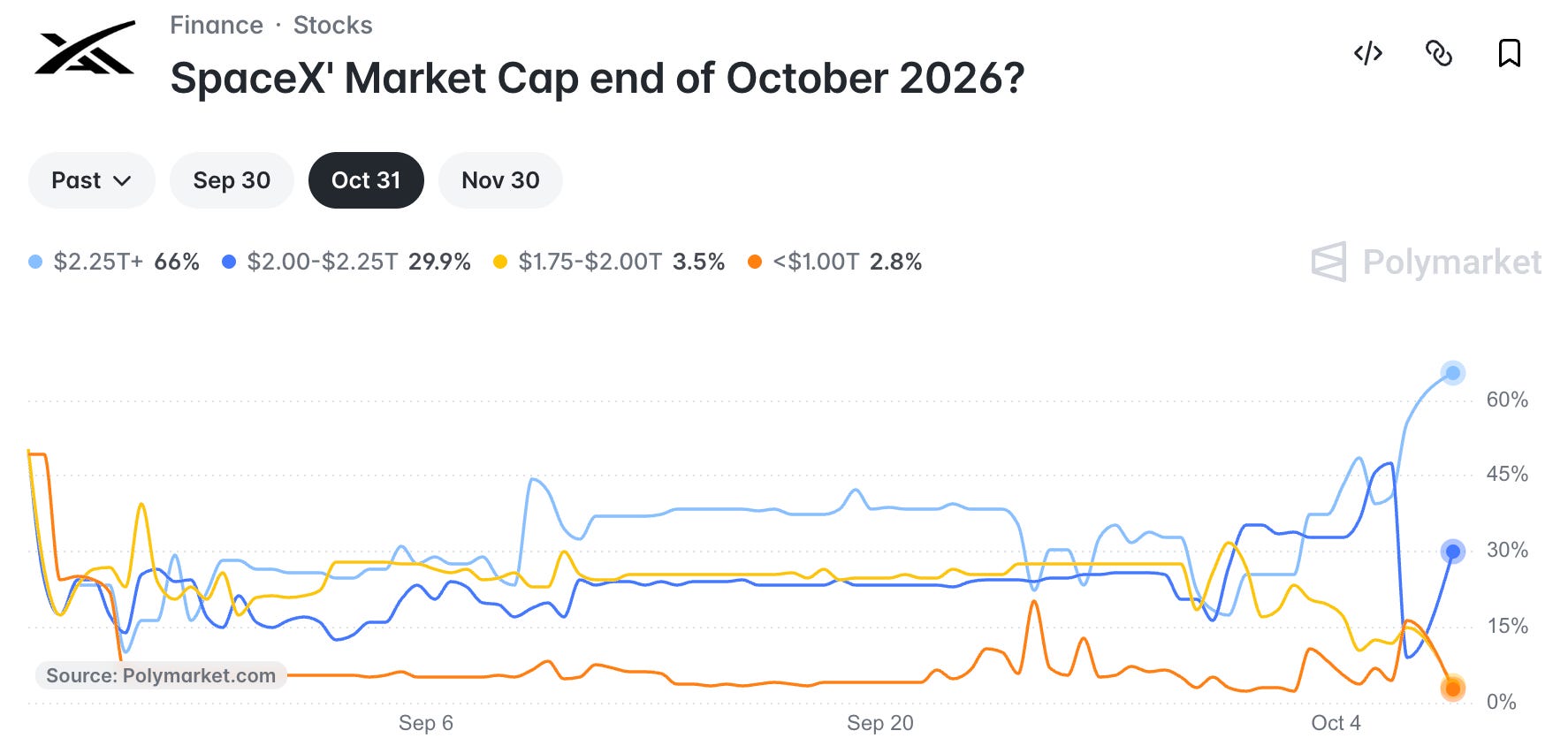
A trader who thinks SpaceX will hold its rally can express their opinion on a stock exchange, a perps venue, or by buying event contracts on a prediction market.
Each of these venues prices the trader’s opinion differently. Builders in the crypto industry have spent the last few years building tools in silos. They built agents that can research and trade on our behalf. They built venues that could price everything from listed companies like SpaceX and Tesla, private companies like Anthropic and OpenAI, to Fed decisions through perp exchanges and prediction markets. They also assembled tools like TrueNorth that can turn sentences into strategy. More such tools are launching.
On September 28, Michael Mignano, General Partner at Union Square Ventures (USV), announced the launch of Supertake. It’s a platform that lets users type a belief and have its agent builds a portfolio of stocks around it.
Think every home will soon have a robot? Just type it in, and the agent will do the rest.
All your trades are placed either through your Robinhood or Coinbase account. My colleague, Thejaswini, wrote yesterday about how far such apps have come in turning an opinion into a trade.
Read: The Apps That Trade for the Clueless
But Supertake only trades US-listed stocks and select cryptocurrencies. More crypto assets, derivatives, and prediction markets are on its roadmap. It’s that convergence of venues that helps people price their opinions better.
Consider the example of SpaceX again. It costs nothing to hold its stock beyond its price. It is a plain vanilla spot position that trades only during market sessions. But what if you were living halfway around the world from the US and asleep for most of the US trading session? That’s where perps and prediction markets come in handy.
A position held in a perpetual contract has no scheduled expiry unless you get liquidated or close it. The contract keeps the instrument’s price close to the price of the stock, while letting you bet on the stock with leverage. That means you can take a $500 position with $50 of margin at 10x leverage. With perp contracts, you can also set stop-loss and take-profit orders that are automated based on predefined conditions. You can use these contracts to either double down on your stock position or hedge that position so that you can control the damage if the position moves against you.
An event contract can similarly be used to either double down on your existing stock or perp position, or hedge it.
Finding positions that you can hold across multiple venues is easy for a stock like SpaceX because all three instruments exist. You can find a stock on a brokerage platform, a perp contract on Hyperliquid, and an event contract on Kalshi or Polymarket. But many beliefs cannot be easily translated into straightforward positions. Let’s return to the peptides example from the introduction. Buying stocks of the drug makers is straightforward, and an app like Supertake can build that basket today. But a leveraged perp or an event contract around drug makers exists only if a venue has chosen to list one. For that to happen, it needs sufficient demand on either side of such contracts.
This is where laypeople need the most help. For most beliefs, they need guidance to look for the right pricing instruments, decide how much capital to allocate, and determine which venues they may legally use.
ZEIT Finance also lets you describe your view in simple language while its AI builds a basket of prediction-market positions around it. The basket can be traded through a vault that issues a single token representing the entire basket. When one of its markets settles, the vault rolls the money into related markets, so your bet doesn’t expire with the contract.


Blanket solves this for small businesses that cannot afford a treasury desk. A business owner can describe what worries them about the future of their business. It could be an unfavourable rainy season for an ice cream business, or a brewing geopolitical conflict that could spike fuel prices, and, in turn, raw-material costs. Blanket’s agents return the Kalshi contracts that could help these businesses hedge that risk.
Where the Agents Stop
Yet all these baskets are built around a specific narrative and are siloed. Firms like Supertake and Zeit Finance build such baskets around crypto, prediction markets, and stocks, separately. Their agents work within the same asset ecosystem.
Robinhood also lets outside agents trade through its connector. Its in-app agents can trade stocks, options, and crypto. Kalshi and Polymarket have trading interfaces that agents can use to automate trade execution. Hyperliquid also allows users to approve agent wallets that can sign trades on their behalf. So, in principle, one could connect all these agents to one general-purpose assistant and place a Robinhood order for SPCX stock, a Polymarket bet on SpaceX’s market cap, and a Hyperliquid short position using the same conversation.
Yet, each venue still requires separate authentication, jurisdictional eligibility, permissions, and funded capital. Each of these connections is also constrained by a separate pool of money. An agent on Robinhood can only spend what you deposit into a separate agentic account. Polymarket needs the agent to hold the private key to your entire wallet. Hyperliquid allows its agentic wallets to sign trades but not withdraw funds.
These rules protect users from a rogue agent that runs off with their money. But collectively, they prevent a common agentic stack from moving money between venues that offer different financial instruments.
If you wanted an agent to move money from a position that is making a profit and use it to fund a position that’s losing money, it can’t do that. It also cannot offset your margin across multiple venues to reduce the collateral you must hold.
But are there enough users who would need agents that can help them trade across venues?
A Morningstar report showed assets in thematic funds almost doubled to $562 billion in the five years ending in June 2024. These funds are ready-made wrappers that let you bet on your theme using a basket of stocks, for a fee. However, only 9% of thematic funds survived and beat global equities over 15 years. Over five years, investors in these funds earned only 2.4% a year, against the 7.3% returned by the funds themselves. How did that happen? People bought into themes late and sold out at the wrong time. This is what can be partially avoided if an agent can add a hedge to control the damage when the theme flips.
Robinhood says more than 150,000 customers have opened agentic accounts since May, and agents now call its tools almost 30 million times a day.
So the demand for agents exists.
Public, a US brokerage, now lets its agents watch a prediction market and act on stocks when the odds move. One of Public’s examples says: if the probability of at least three rate cuts this year rises by 10 percentage points in a day, alert me and summarise my exposure to bank stocks. This is what a step towards executing a cross-venue thesis could look like.
So what’s stopping agents from executing trades across venues?
Making Collateral Common
The difficult part is to unify collateral across venues. There are some workarounds for this.
Robinhood already offers stocks, options, crypto, prediction markets, and, soon, perps under one roof. But currently, the company books positions across these instruments through separate legal entities. That prevents users from unifying their holdings and margins.
But regulators are moving the needle here. On June 26, the SEC and the CFTC jointly asked for public comment on harmonising portfolio margining. SEC Chair Paul Atkins said cross-margining could unlock liquidity that is frozen in separate accounts. If this process results in broader cross-margining, then your Robinhood account could net your stock positions against your derivatives.
The second option is to route all positions through a common venue like Hyperliquid. It already lets one account hold crypto perps, perps on stocks, and outcome contracts.
The constraint isn’t the agents. It depends on whether the venues let our money leave their ecosystem.
Most venues earn from the money they hold, through interest, trading fees, and the orders they route. Letting an agent use your balance on one venue as collateral for a position on a rival venue means giving up control of your account, which is what they compete for. I don’t expect Kalshi, Polymarket, Hyperliquid, and Robinhood to agree on a common collateral standard soon.
So the edge will go to those who already host multiple instrument types under one roof.
Platforms such as Supertake, TrueNorth, ZEIT, and Blanket could capture more value in the stack by offering the layer that turns beliefs into positions across different financial instruments. But before that, they will need to expand their integration across asset classes and build a credible collateral and permissions layer.
That’s it for today. I will be back with the next one.
Until next time, stay curious,
Prathik
Token Dispatch is a daily crypto newsletter handpicked and crafted with love by human bots. If you want to reach out to 165,000+ subscriber community of the Token Dispatch, you can explore the partnership opportunities with us 🙌
📩 Fill out this form to submit your details and book a meeting with us directly.
Disclaimer: This newsletter contains analysis and opinions of the author. Content is for informational purposes only, not financial advice. Trading crypto involves substantial risk - your capital is at risk. Do your own research.