


Hello,
The company earned billions in revenue from interest on Treasury reserves it held as collateral backing its stablecoins and paid other platforms to distribute and settle USDC across the payment stack. For every dollar Circle earned, it paid roughly 60 cents to the partners who moved the USDC around. It could afford to part with that money as long as the margin it retained was significant. But with the low-interest regime underway, the USDC-issuer was leaving too many cents on the table. For most of its life, Circle owned one product: USDC.
In its recent Q1 2026 earnings release, the USDC-issuer announced multiple moves to capture value across the stack it operates in. A $222-million presale for its native Layer-1 token, ARC, at a $3 billion fully diluted valuation; the launch of AI agentic infrastructure; and the expansion of its Circle Payments Network to enable banks to facilitate stablecoin payments by avoiding the volatility of digital assets. That is set to change with what Circle has built over the last few quarters.
Collectively, they mark Circle’s attempt to go from a single-layer company to a full-stack financial platform that operates and captures value across multiple layers of the payment stack.
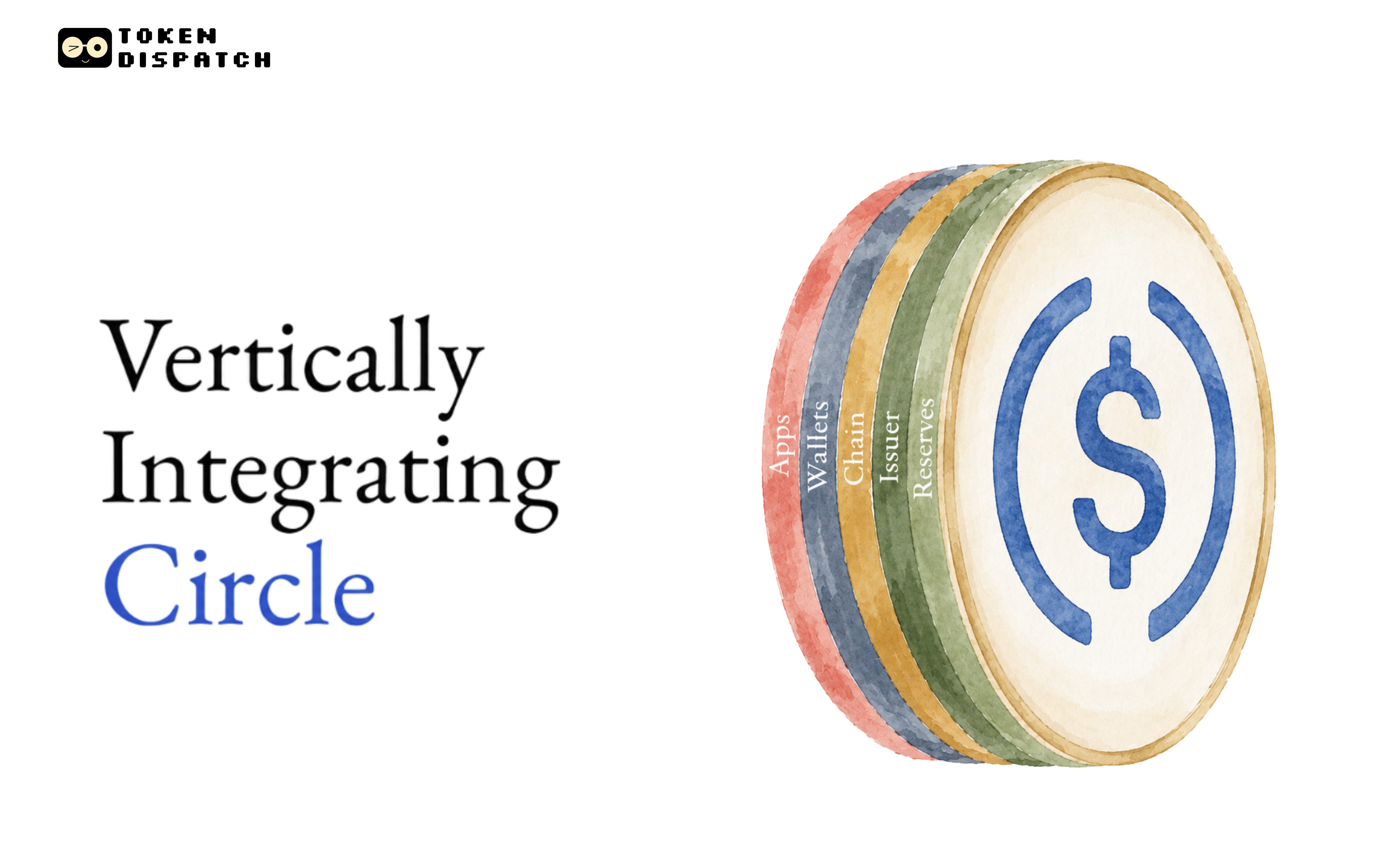
Today, I assess whether Circle can capitalise on vertical integration to offset the shrinking yield business, which is getting thinner with every Fed cut.
Onto the story,
Prathik

The Vanishing Float
In Q1 2026, Circle made $694 million in total revenue, up 20% year-on-year (YoY). That growth is solely attributable to the growing pie of stablecoins in circulation, with nothing specifically improving for USDC. Stablecoins in circulation grew over 30% from $235 billion in March 2025 to $315 billion in March 2026. During the same period, USDC lost 62 basis points in market share.
Circle faces a bigger problem. The low-interest-rate regime is here, with the Fed rate down from 4.5% a year ago to 3.75% today.
While average USDC circulation through Q1 2026 grew 39% YoY, Circle’s revenue from reserves grew only 17% YoY to $653 million. That’s because it was heavily offset by a 66 bps YoY decline in the average reserve rate, from 4.16% in Q1 2025 to 3.50% in Q1 2026.
This is not a one-time phenomenon. The gap between the growth rates of Circle’s reserve income and USDC’s supply has consistently dropped across the last four quarters.
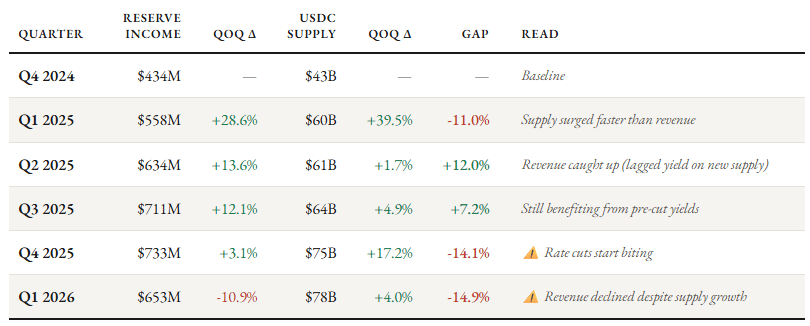
Circle’s predominant source of income is not growing in proportion to its stablecoin supply in circulation.
The company also faces a value-leakage problem.
The 60-Cent Wake-Up Call
That’s more than 60 cents per dollar paid to platforms for holding and distributing USDC. Out of the $405 million, Circle paid $330 million (~80%) to Coinbase alone as distribution costs in Q1 2026. Of the $653 million in reserve income this quarter, Circle paid $405 million to partners under distribution and transaction costs.
That’s a lot of money left on the table in an industry that’s seeing new players expand and integrate across various layers of the stack.
At this point, there are too many signs for Circle to not wake up to the reality. Interest rates are falling and dragging down the reserve income with them; distribution costs are sticky and leaking value; and Circle’s core business remains a yield proxy, getting thinner with every Fed cut. The expectations of a dovish Fed stance have only intensified under U.S. President Donald Trump’s administration.
What’s Circle’s answer to all this? A vertical integration to capture more value across the stack and reduce reliance on interest rates for its topline.
To understand what Circle is building, consider what it has today.
The USDC-issuer started at the issuance layer, which is the bottom of the stablecoin stack, and spent years watching others capture value at every layer above it.
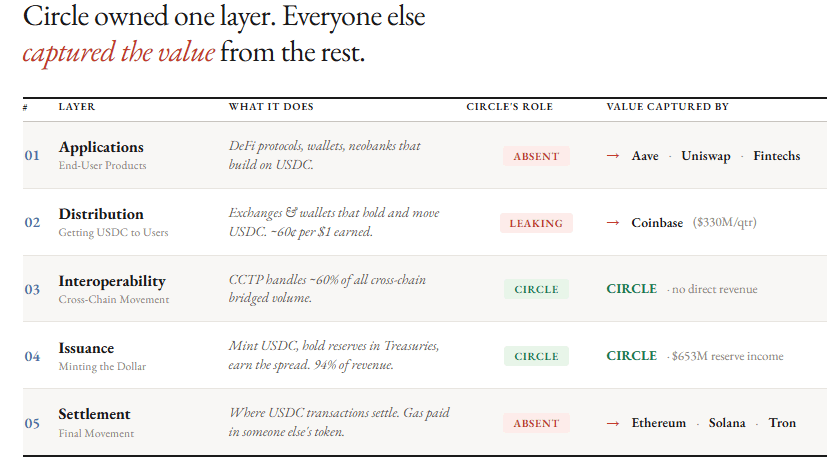
At the issuance layer, Circle mints USDC and EURC, holds reserves in US Treasuries via BlackRock’s Circle Reserve Fund, manages the 1:1 peg and processes mints and redemptions through Circle Mint. It earns 94% of its total revenue through reserve income by parking dollars in government debt.
It then expanded to the interoperability layer via Circle’s Cross-Chain Transfer Protocol (CCTP), which moves USDC between blockchains and handles approximately 60% of all cross-chain bridged volume. Although this plumbing routes USDC across chains, CCTP itself runs on chains owned by others. So, Circle doesn’t capture meaningful direct revenue from it.
All the other layers in the stack were owned by others.
Settlement ran on Ethereum, Solana, and Tron. Every USDC transaction paid gas in someone else’s token (ETH, SOL, TRX), while Circle had no control over congestion, fees, or governance on those chains.
Distribution relied on Coinbase, exchanges, and wallets. Circle paid revenue shares, incentive programmes, and integration costs to get USDC into the hands of users.
Third parties such as DeFi protocols, fintechs, neobanks, and prediction markets built applications and products that used USDC. This meant that the end customer, whether retail or institutional, never dealt with Circle directly.
The structure left Circle with barely 40 cents per dollar.
Owning the Stack
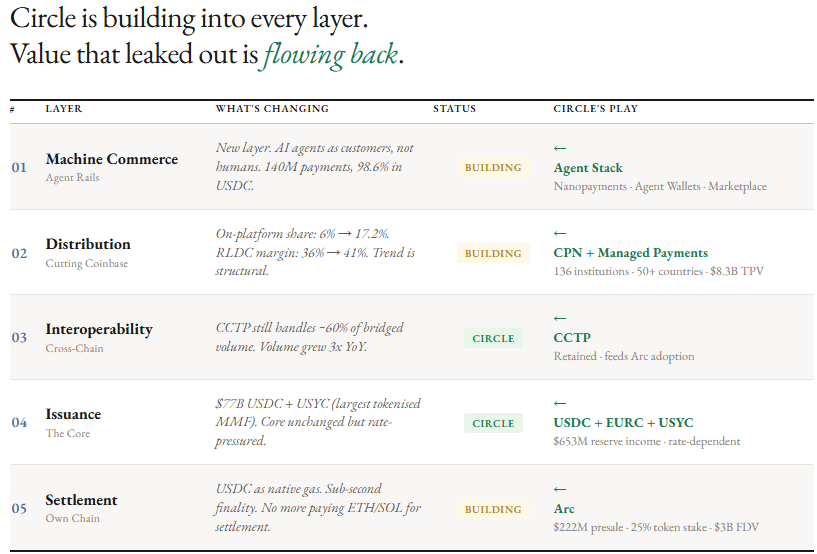
On May 11, Circle announced three bets to vertically integrate different layers of the stack it previously didn’t own.
First, settlement. With its native Layer-1 blockchain, Arc, Circle aims to capture fees that Ethereum, Solana, and Tron currently pocket by moving USDC on their chains.
The EVM-compatible Arc offers sub-second finality and uses USDC as its native gas fee token at roughly $0.001 per transaction. To make its chain more attractive for institutional users, Circle is offering configurable privacy and quantum-resistant architecture. The generic public chains, like Ethereum and Solana, are completely transparent and offer no privacy for sensitive transactions such as institutional payments.
Read: Making Blockchains Great Again
Circle has also raised $222 million at a $3 billion valuation via a presale of its ARC token. The investment was led by a16z’s $75 million round, along with BlackRock, Apollo, ICE (the NYSE’s parent), Standard Chartered, ARK Invest, SBI Group, IDG Capital, Bullish, and Haun Ventures.
Second, distribution. The Circle Payments Network (CPN) helps the USDC issuer reduce its dependence on Coinbase.
CPN connects financial institutions directly to Circle’s rails to mint, redeem, and route USDC without going through an exchange. The network has 136 enrolled institutions (up 36% QoQ), $8.3 billion in annualised volume (up 17% QoQ), and fiat payouts in 50+ countries.
As a result, the USDC sitting on Circle’s own infrastructure has almost tripled, from roughly 6% a year ago to 17.2%. The RLDC margin (Revenue less distribution and transaction costs as a percentage of revenue) has steadily climbed back to 41% in Q1 2026, from 38% in Q2 2025, even as the reserve return rate has fallen.
Circle isn’t monetising CPN yet, prioritising adoption over fees. But when it does, every dollar of CPN volume adds usage-based income without depending on interest rates.
Circle has built an entire Agentic economy through products such as Agent Wallets, Nanopayments (which enable gas-free USDC transfers as small as $0.000001 [a millionth of a dollar]), Agent Marketplace (where agents discover and pay for services), and Circle CLI (to accelerate agent onboarding and wallet provisioning).
Third, the application layer. With this third layer, Circle is positioning itself to capture consistent value across the entire Agentic economy by charging a small fee on high-volume transactions that AI agents are expected to carry out.
How big is the agentic payment opportunity? Last month, Circle’s marketing head, Peter Schroeder, posted that USDC accounted for 98.6% of 140 million transactions AI agents made in nine months.
The Stack Race
Circle’s move across the payment stack won’t be easy. Payment giant Stripe started at the top and has since made its way down with deals and launches. Acquiring Bridge gave Stripe ownership over licensing, custody, FX, and issuance layers. By launching Tempo, Stripe has entered the settlement layer. Stripe now controls all seven layers and serves 5 million merchants.
Read: Why did Stripe build its own chain?
Tether uses Plasma, which the USDT issuer incubated, as its settlement chain. However, Tether still doesn’t have the same regulatory might as USDC.
While Stripe owns human commerce, Tether leads in terms of emerging-market dollar access and crypto trading. So, Circle is positioning itself for institutional settlement and machine commerce, an area where regulatory credibility and programmable infrastructure will likely matter more than checkout integration that Stripe owns.
The CRCL Pushback
Although Circle raised $222 million from the presale of ARC tokens to institutional investors, it was the CRCL shareholders who funded the initial stage of Arc’s development. The irony is that Circle’s biggest headwind could be managing internal pushback.
What is the point of accruing value to the Arc token for a publicly listed company? I flagged this complication in November last year.
“The nature of the native token will ruffle a few feathers in the public markets. Why would the market approve of or attach value to a native token that captures the value Arc and CPN generate, rather than letting it flow back into Circle’s income statement? Why would Circle’s surplus be used to fund the cost centre that is not expected to plough back profits to the shareholders? The current shareholders won’t stand for it. Public market investors buy CRCL for its reserve income. They will likely not watch a new asset absorb the upside of the infrastructure they’ve financed.”
How will Circle thread this needle? Would a separate IPO for Arc justify its case? We will know this only in the first quarter after Arc goes live on the mainnet.
For now, Circle’s forward bet is to capture as much value as possible by compounding its presence across these layers. Each time USDC settles on Arc, Circle earns the settlement fee. When institutions route transactions through the CPN, Circle will retain the distribution margin. Finally, when agents transact via Nanopayments on Arc, Circle expects to collect the fee on that layer, too.
That’s it for this week’s quantitative analysis. I will be back with the next one.
Until next time, stay curious,
Prathik
Token Dispatch is a daily crypto newsletter handpicked and crafted with love by human bots. If you want to reach out to 170,000+ subscriber community of the Token Dispatch, you can explore the partnership opportunities with us 🙌
📩 Fill out this form to submit your details and book a meeting with us directly.
Disclaimer: This newsletter contains analysis and opinions of the author. Content is for informational purposes only, not financial advice. Trading crypto involves substantial risk - your capital is at risk. Do your own research.