


Hello,
Consider a business that rewards its customers only with coupons they can spend inside the same business. That’s how most brands plan their loyalty programmes. And they do so for good business reasons. As long as people keep coming back, this arrangement works.
The idea is to make customers spend money, hand them coupons, and make them come back to spend those coupons again. The coupon-issuing brand can make these coupons scarcer over time by giving them an expiry date. But the entire system works only if customers feel the desire to earn these coupons.
For much of crypto’s history, its economic systems also have worked similarly.
Protocols created tokens and dangled them to attract users. They then rewarded those users with even more tokens. When that model made tokens inflationary, the industry found an alternative. Instead of printing new tokens, protocols began charging fees, buying back their own tokens from the market and destroying them from the circulating supply.
This mechanism worked better than the earlier one, but the money was still circulating inside crypto. That is beginning to change.
A new crop of projects is taking money generated inside crypto markets and using it to buy traditional assets. This is one of the most significant signs of crypto coming of age. The industry is beginning to connect its endogenous economy of fees, tokens and trading activity created inside its markets with the much larger exogenous asset universe of traditional finance.
On to the story…


PRED: Trade Sports at the Best Odds
Anyone who has watched a game with money on it knows the feeling.
A momentum shift in the fortieth minute, a red card, an injury or a goal against the run of play, and the game turns while you sit there holding a position you took before kickoff.
On most prediction platforms, that is all you can do. Hold and pray.
PRED, on the other hand, turns every fixture into a live market. You buy ‘Yes’ or ‘No’ and the price moves as the match does, so if the game turns, you can cash out and take whatever your position is worth at that moment.
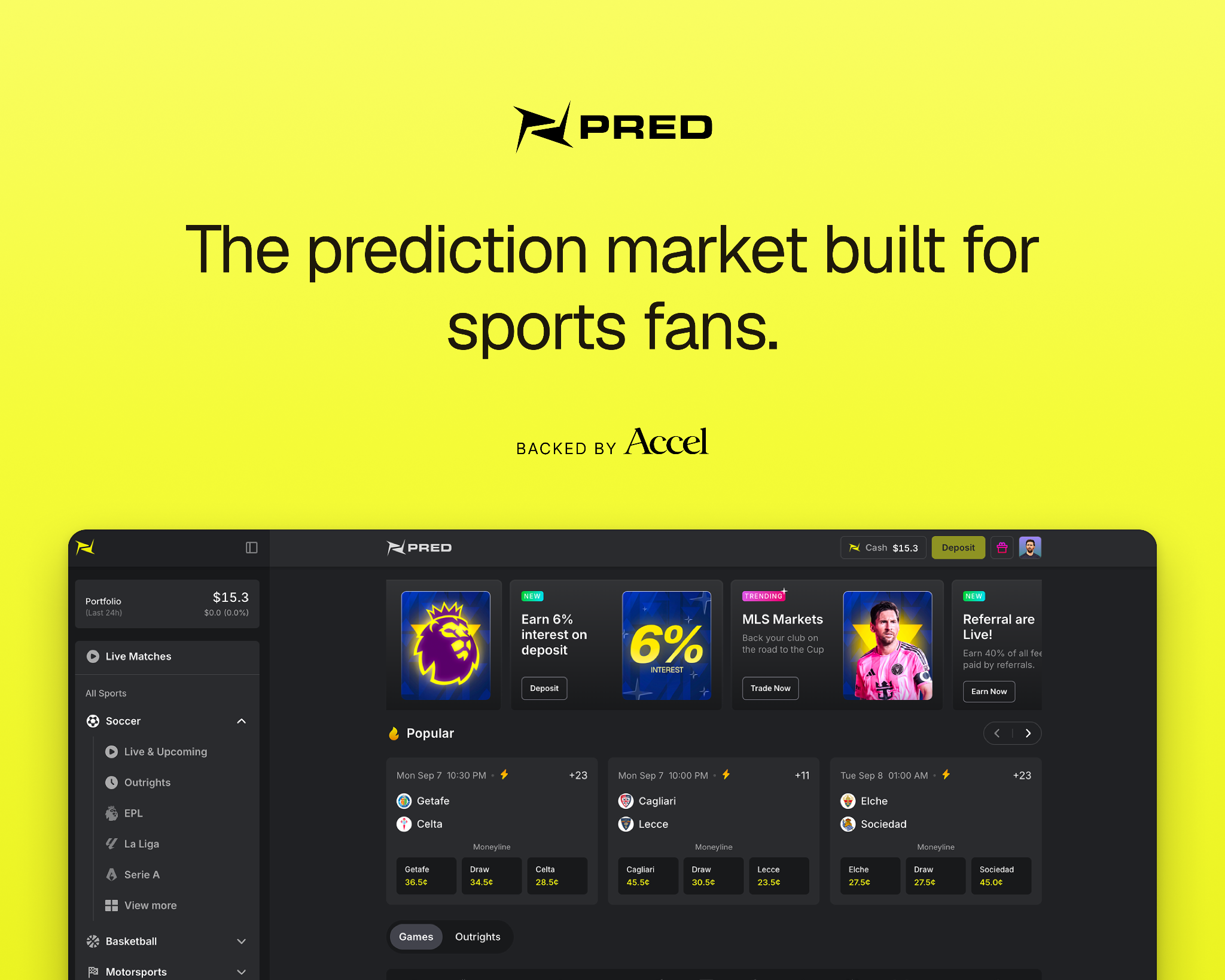
Our odds are 10 to 14 per cent better than the rest of the market. Across the season, that gap adds up.
Markets on PRED settle instantly once the result is in, and you’re never stuck holding a position waiting on someone else to agree on what happened. You can cash out any time.
Built for how fast sport actually moves.
On July 1, Robinhood launched its blockchain as a permissionless network, letting anyone build applications on it. By early September, nine native tokens with live products on its chain had crossed a circulating market capitalisation of $10 million: Pons, The Index, Orbio, StonkBroker, Hookr, Delta, Statics Protocol, Down to Finance and Pare.
Although most are too young for valuation to tell us much, what they do with the money moving through them hints at crypto’s collective trajectory.
Pons, the token launchpad, routes roughly 80% of protocol fees to buy and burn PONS. Even Hookr, another token launchpad, uses collected fees to buy back and burn HOOKR. Both follow the same mechanism as Hyperliquid: routing exchange trading fees to buy HYPE through its Assistance Fund.
While this crypto system mimics the share buyback mechanism from traditional markets, it’s only as good as the business supporting the buyback.
Pump.fun helps us understand this. By the end of April 2026, it had burned roughly 36% of its maximum token supply and dedicated 50% of its revenue to buybacks and burns in the following year. Yet its native token, PUMP, still traded around record lows for almost 10 months, from September 2025 to June 2026, when launchpad activity weakened.

While the buyback-and-burn mechanism did what it was designed to do, it can’t manufacture demand.
Some protocols on the Robinhood Chain are opting for a different model.
The Index’s stock distribution model contrasts this by not using the 3% fee it earns from all the trades it facilitates to buy back its native token, INDEX. Instead, the protocol converts part of its fee income into a basket of roughly 18 Robinhood Stock Tokens, including Apple, Nvidia and Google, and distributes those assets to INDEX holders.

Although these are not conventional shares registered in the holder’s name, the stock tokens provide economic exposure to the underlying equities held in custody. Holders still don’t have legal ownership or the voting rights of ordinary shareholders. But not everyone wants to hold tokens for voting rights and legal ownership.
Read: A Token Can Be the Asset
This pitch connects the two financial ecosystems by converting revenue generated within the crypto world into rewards that give holders exposure to real-world assets like publicly listed company stocks.
For years, crypto has moved capital efficiently within its own ecosystem. A token could be deposited as collateral to borrow another, which could then be used to earn yield in the form of another token. Trading fees could buy a token, then burn it to support the same economy. The industry built sophisticated financial loops, but most ended at another crypto asset.
But this wall is gradually coming down. Both the ecosystems have begun feeding off each other’s moats and captive audiences to expand their revenue streams or bases.
This changes crypto’s customer-acquisition problem.
Until now, most protocols have effectively had to sell a user the idea of entering crypto, and then the idea of owning a new token. That limits the audience to people already willing to speculate on crypto assets. An Apple stock, an Nvidia dividend or an ETF-like basket does not need the same introduction. People already understand why they may want them. If crypto can become the infrastructure through which those familiar assets are bought, packaged and distributed, the asset itself becomes the acquisition funnel. The user does not need to come for crypto. They can come for Apple and end up using crypto underneath.
Read: Distribution Trumps Asset Class
Stablecoins were the first large breach in that wall. A blockchain token could represent a claim on dollars and US Treasuries sitting in the traditional financial system. Tokenised stocks extend the same idea to equities. The Index uses internally generated crypto activity to acquire those external assets and hand them to users.
Nvidia’s value does not depend on whether people keep trading INDEX. It sells chips and computing infrastructure to customers who need compute power. Apple sells phones and services that have little to do with the crypto ecosystem. But the aspiration to own assets outside the crypto ecosystem can drive activity within it.
StonkBroker, a marketplace for 4,444 NFTs, converts fees into stock tokens, like Tesla, Amazon, Nvidia, or Palantir, and airdrops them into the wallets held by NFT holders. When the NFT changes hands, the tokenised equities inside the wallets also move with it. The protocol turns a simple NFT wrapper into a portable financial container that can carry value across into an exogenous world of traditional finance.

Pare lets users split a stock token into two pieces: one representing the stock’s principal value and another representing the dividend stream it generates until maturity.
Traditional finance has done this for decades with instruments such as Treasury STRIPS, which separate principal from interest. Pare applies this logic to tokenised equities. Once an external asset becomes programmable, you can separate its cash flows and trade them in ways that were previously cumbersome.
Statics Protocol and Down to Finance do the reverse by bundling assets together.
Statics can create redeemable baskets containing several assets, including tokenised equities. Users can create fixed baskets of up to 16 assets, including tokenised stocks, and issue the basket as a single redeemable token.
Think of it as something closer to building your own index fund: rather than buying and managing Apple, Nvidia and a handful of crypto assets separately. For someone coming from traditional finance, this is a much more familiar proposition than navigating individual tokens, liquidity pools and wallets. The basket does not need to remain entirely crypto-native. A protocol can combine assets whose value originates in public companies with assets and financial activity that originate on-chain.
Down to Finance (DTF) packages tokenised stocks, lending positions and other assets into products it describes as decentralised ETFs.
Its baskets can span tokenised stocks and real-world assets alongside crypto-native positions such as Morpho lending and Uniswap liquidity pools, all wrapped into a single token. A traditional investor is already comfortable with the idea that one ETF can contain dozens of securities; DTF applies the same abstraction to assets that normally sit in completely different financial systems.
A non-crypto investor should not have to become a DeFi user before getting any benefit from DeFi. Someone buying an ETF does not need to understand how its market maker hedges inventory or how its custodian settles securities. In the same way, an investor should be able to buy a basket combining equities and on-chain yield without first learning Morpho, Uniswap or wallet mechanics. If Statics and DTF get this right, blockchain becomes invisible infrastructure underneath a familiar investment product. That is a much larger market than asking millions of traditional investors to become crypto natives.
Pare, Statics and DTF collectively show that bringing stocks on-chain is only the first step. Once traditional assets share infrastructure with crypto assets, they can be split, bundled and combined with entirely different sources of return. A stock dividend can become its own instrument. Several equities can become one basket. That basket can sit alongside income generated by an on-chain lending market.
For years, crypto’s composability was economically constrained. It could endlessly rearrange crypto collateral, crypto yield and crypto risk, but the total pie was still largely bounded by capital already willing to enter crypto. Connecting the same machinery to equities, credit and other productive assets changes the ceiling. Crypto protocols stop fighting only for a larger share of crypto’s market and start competing for activity that today belongs to brokers, exchanges and asset managers. The opportunity is no longer simply to grow crypto’s own pool of capital. It is to intermediate a small piece of the vastly larger pool of capital already invested elsewhere.
In some cases, the external asset doesn’t even have to be a financial instrument. Orbio converts part of its fees into OpenRouter credits for AI inference.
But none of this guarantees that the protocol will become a sustainable business. Paying someone with an external asset or tying a crypto token to a publicly listed company share isn’t a magic pill.
For now, the rewards have escaped the circular economy. But the protocols still need to find a way to keep user activity up.
The Index is only half a bridge. Its payout has become exogenous, but its revenue engine is still endogenous. It has replaced the coupon with Nvidia, but people still have to keep trading the coupon to fund the Nvidia.
The real graduation happens when both sides cross over: the protocol distributes value originating outside its own token and earns the money to fund that distribution from demand that would exist even if its token stopped trading tomorrow.
For instance, Hyperliquid pays value back through HYPE, an endogenous asset, but its revenue comes from traders using the exchange to trade crypto and real-world assets alike. This is a stronger foundation than a business whose revenue rises mainly because speculators keep trading the same token that finances its rewards.
This shows that exogenous rewards alone aren’t enough. External rewards work better when external demand finances them. Coca-Cola pays dividends because people buy its drinks, and not because people keep trading its shares.
This is ultimately why these tiny Robinhood Chain experiments matter beyond their current market caps. Connecting crypto to external assets changes the size and quality of the market crypto can serve. The person buying an equity basket may not care about crypto at all. The investor buying a dividend stream may simply want income. Someone using an on-chain fund may care about diversification rather than decentralisation. Crypto does not need to convert all these people into believers. It only needs to become a better rail for the financial product they already want.
If that happens, the relevant market for crypto protocols is no longer measured only by the value of crypto assets. It begins to include the trading, packaging, lending and distribution of assets from the much larger traditional financial system.
Crypto coming of age is about breaking the assumption that money entering crypto must ultimately end up in another crypto asset. The Index, Pare, Statics and DTF are early attempts to punch holes through that wall. Some of them might fail. But the direction is more important than the individual products: crypto is moving from building a financial economy beside traditional finance to building infrastructure that can connect to it.
The moment that connection becomes two-way with outside assets flowing in, outside demand generating fees, and crypto infrastructure sitting invisibly in the middle, crypto’s addressable market outgrows crypto.
That’s it for today. I will be back with the next one.
Until next time, stay curious,
Prathik
Token Dispatch is a daily crypto newsletter handpicked and crafted with love by human bots. If you want to reach out to 165,000+ subscriber community of the Token Dispatch, you can explore the partnership opportunities with us 🙌
📩 Fill out this form to submit your details and book a meeting with us directly.
Disclaimer: This newsletter contains analysis and opinions of the author. Content is for informational purposes only, not financial advice. Trading crypto involves substantial risk - your capital is at risk. Do your own research.