


Hello,
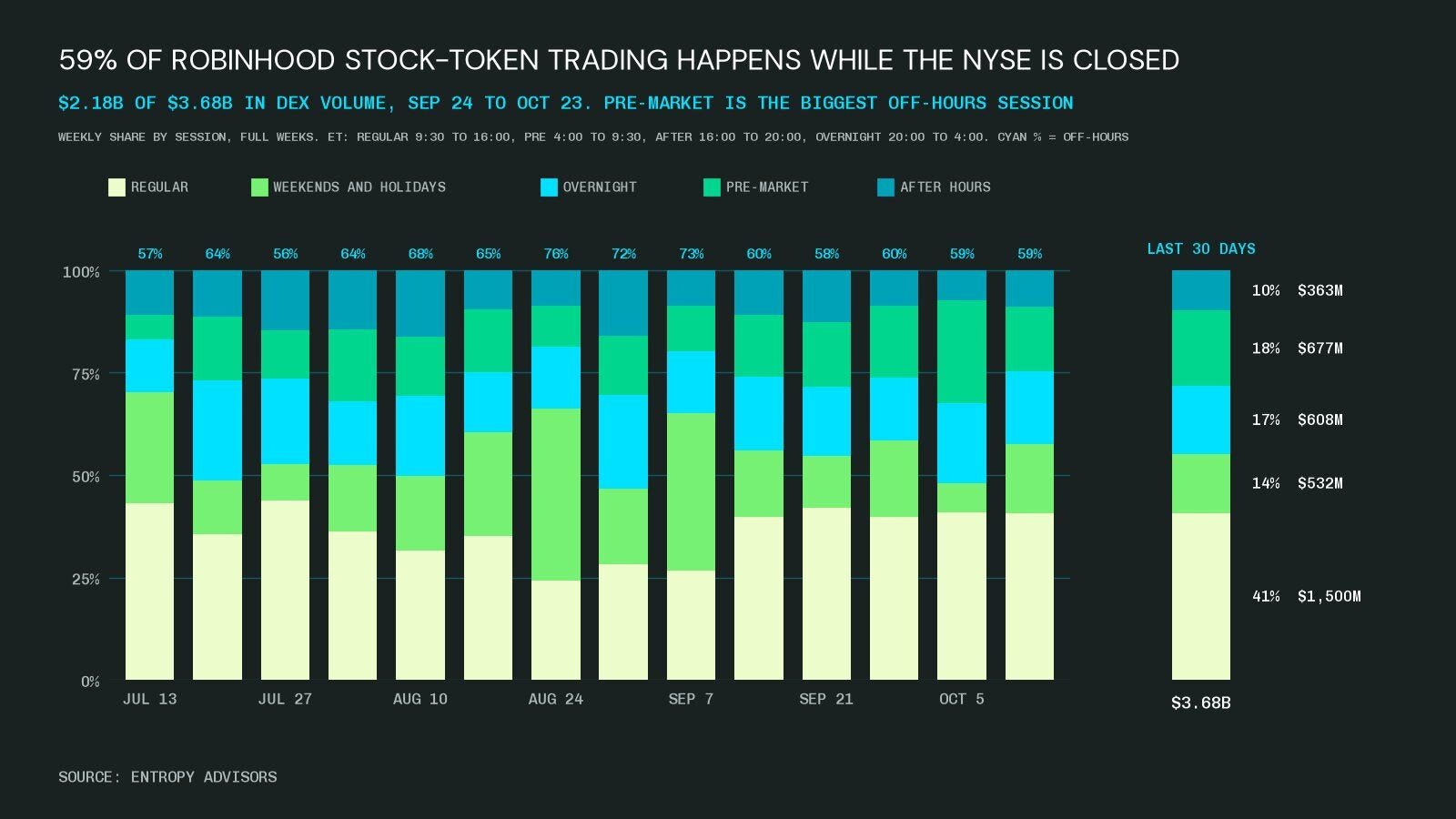
Robinhood’s stock tokens are traded all around the clock. Even on weekends, when the Nasdaq shuts its shop. Between September 24 and October 23, ~60% ($2.2 billion out of $3.7 billion) of all the stock-token trading on Robinhood happened outside regular US market hours. About $532 million of it changed hands on weekends and holidays.
It was only last Thursday when Robinhood’s stock token holders got some added value to their tokenised shares.
On October 22, Morpho opened markets on Robinhood Chain that let stock-token holders borrow stablecoins by using their tokenised stocks as collateral. Aave has offered the same against Coinbase’s tokenised shares since September 25.
Yet, none of this makes a tokenised share a better way to own a stock. It still has imperfect voting rights in most cases. What lending against tokenised shares does, though, is to make that share work for people who already prefer tokenised shares. Borrowing stablecoins against their holdings moves these tokenised shares from assets of globalised access to assets of usefulness.
The caveat is that these loans run all weekend, even when the prices of the underlying shares don’t get updated on the conventional markets. This could lead to price-driven manipulations.
In today’s piece, I look at what lending against tokenised stocks unlocks, who gets paid along the way, and what it will take to price the hours when Wall Street sleeps.
On to the story…


StablesReward: Your AI Agent Spends, You Earn
AI agents can surf the web, read reviews, and book hotels for you. All these tasks cost money. But what if these tasks could earn you back something?
StablesReward does just that. Once you connect your agent to an MCP endpoint, it gives your agent a menu of paid tools. Every call your agent pays for earns you miles or stocks. And this is in addition to the rewards you earn anyway on your own spending across 800+ merchants.

Every purchase pays you back. The best part is that you can choose how you’d like to be rewarded. Transfer miles to airlines and hotels, or let your stocks build a portfolio from the spend you were making anyway.
Launching soon. Free to join.
Credit without the Broker
Borrowing against shares is a bare-minimum feature. Every good asset lets its holders do multiple things besides just holding the asset.
In the US, that privilege has often been with the broker. A Reg T margin account needs $2,000 to open and lends up to half the stock’s value. Schwab’s pledged asset line starts at $100,000 and charges 8.27%. Every version has one precondition: the lender holds your collateral and decides whether you qualify.
Outside the US, the conditions often fail. Many brokers outside the country don’t allow investors to borrow against their holdings. India’s Liberalised Remittance Scheme rules issued by the Reserve Bank of India explicitly restrict investors from engaging in speculative trading abroad. Vested Finance, one of the apps Indians use to buy US stocks, offers only cash accounts. Interactive Brokers’ Indian arm also bars residents from margin products on foreign markets.
So, an Indian investor who owns $20,000 worth of Nvidia through one of these apps can trade their holdings, but cannot borrow against them. Same Nvidia stock, but less useful than the shares owned by someone in the U.S.
This geographical gap is not universal, though. Interactive Brokers accepts clients from many countries and earned an average of 4.25% on its margin loans in Q3 2026. Nigeria’s Trove, a retail investing app, started offering twice the buying power on US stocks in August. So, credit against stocks does exist in most places. But it comes with minimum balances, paperwork, and a broker at whose discretion your qualification is decided.
Tokenisation changes one main thing in this entire setup. It moves the collateral out of the broker’s books and into the holder’s wallet. Once that happens, any lender that accepts the token can lend against it.
How much they’ll lend comes down to the haircut, which every venue prices differently. Kraken began accepting 10 xStocks as futures and margin collateral on July 3. It knocks 10% off index trackers like SPYx, 20% off single stocks like Nvidia, and 30% off volatile names like Robinhood’s own stock.
Aave lets borrowers post seven Coinbase stock tokens for USDC, up to 79% of value for Microsoft, 70% for Nvidia and 65% for Tesla and Meta. On Aave, that limit is also the liquidation line, so a borrower who takes the maximum starts at the edge. Paboxo reached Robinhood Chain on October 19, and Morpho followed three days later. Morpho liquidates Nvidia loans at 62.5% and SPY loans at 77%, a gentler line for an index that moves less than its parts.
On Aave, the number of borrowing wallets rose from 8 to 144 by October 18. Three in four had never used Aave on Base before.


LlamaRisk, the firm that sets Aave’s risk parameters, found that most of the borrowing happened while the stock market was shut. These are new users who are borrowing at hours when no other broker lends.
But tokens just replace the broker with the issuer, who keeps a wider gate. The gatekeeper still exists. Neither Robinhood’s nor Coinbase’s tokens can be sold to US persons.
What the holder owns is also thinner than a share. Robinhood’s stock tokens are debt securities issued by Robinhood Assets (Jersey) Limited. Its own filings say they confer no legal or beneficial rights in the underlying companies. Coinbase’s tokens are certificates from a Coinbase special-purpose vehicle that reinvests dividends instead of paying them out.
Read: A Token Can Be the Asset
Even for someone who already has a margin account at Interactive Brokers, a stock token does a few things a conventional share can’t. The loan comes without a margin application, the collateral settles on-chain in minutes rather than a business day, and the cash lands on a Saturday if that’s when you need it. But beyond all this, the real edge is offering lending in markets where conventional brokers don’t lend at all.
A simple rule about the nature of assets is that any asset that lenders accept is worth more than one that they don’t. US Treasuries are the best example. Investors accept a lower return on them because they are safe, liquid, and can be turned into cash almost anywhere by borrowing against them.
Tokenised stocks have none of that support, which is why the haircuts on them run from 10% to nearly 40%. The haircuts are the price of everything Treasuries have, and tokenised stocks don’t. Their collateral premium will be smaller, and borrowers will pay for the missing pieces through those haircuts.
Where Value Accrues
Lending is just the base layer. Once a token can back a loan, other products start building on top of it. Each of them pays someone.
First is plain cash. Aave founder Stani Kulechov says loans on Aave’s stock market carry rates of about 5%. Although that is more expensive than what Interactive Brokers charges, the main appeal is not the rate. This offers a loan without requiring any account minimums and broker’s approval. Also, this is available on a Saturday afternoon.
The second is leverage. Pendle’s new PendleLoop can borrow USDC against a stock token on Aave, buy more of that token, and repeat the cycle. This leads to a leveraged bet on Nvidia or Microsoft at 2.6 to 4.2 times, built in one click, with fees waived until December 31. A US retail margin account starts at twice the cash you put in. Aave’s risk team sets its limits as ceilings. Pendle’s interface turns them into targets.
The third is a margin for trading. Kraken lets xStocks back futures positions, capped between $100,000 and $1 million per stock. More than 300,000 people held xStocks as of September. Their Apple position can now fund a Bitcoin futures trade without being sold.
The fourth job extends from savers to borrowers. Robinhood Earn lets eligible US users lend USDG through a Morpho vault run by Steakhouse Financial. Steakhouse acts as the vault’s curator, the risk manager who decides which loans a pooled fund can make. The vault held about $543.6 million from roughly 75,000 wallets this week. Steakhouse has now approved it to fund loans against Robinhood’s stock tokens, with each market capped at 1 million USDG.
The irony here is that American investors in Robinhood’s Earn product now fund loans against tokens that Americans are not allowed to buy. Although the dollar exposure is still small today, the structure is now in place to enable a US savings product to become the lender behind global stock-backed credit.
Each of these jobs pays a different layer.
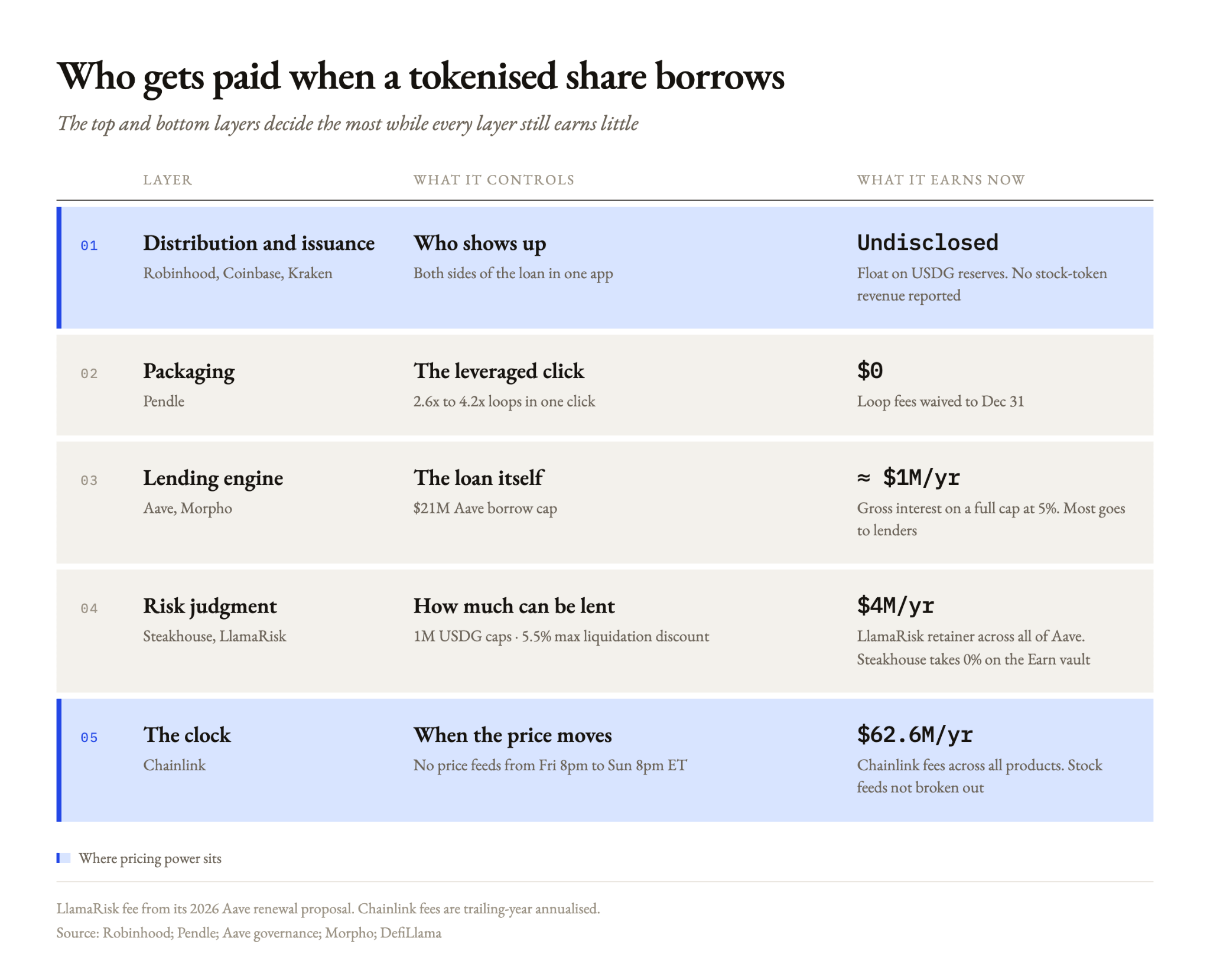
The issuers sit at the top of the stack. Robinhood issues the stock tokens, runs the chain they trade on, and owns the app where savers deposit the dollars that fund the loans. Both sides of the loan, the borrower’s collateral and the lender’s deposit, sit in one company’s app. It also earns from the float, because Paxos shares reserve income on USDG with Global Dollar Network partners. Coinbase runs the same playbook on Base, and Kraken owns Backed, the issuer behind xStocks.
The packaging layer sits just below. Pendle doesn’t lend a dollar. It owns the leveraged user’s click and routes the loan to Aave.
The lending protocols earn the spread between what borrowers pay and what savers receive. At the current business size, that is still a thin business. Aave caps borrowing on its stock market at $21 million. Fully used at 5%, that is about $1 million a year in interest, and most of it goes to the lenders.
The curators and risk managers charge a fee to sell judgment. Steakhouse decides how much of a $543 million savings pool may touch stock loans. LlamaRisk decided that liquidators on Aave get at most a 5.5% discount on the collateral they seize.
Chainlink owns the time factor. It prices both Coinbase’s and Robinhood’s tokens for these lenders. It decides when that price moves and when it doesn’t. I’ll come back to that in a while.
This fits the pattern I’ve written about before. Distribution decides who shows up, while risk managers judge how much they can borrow.
Read: Who Captures Value in Web 2.5
Nobody is making significant money from this yet. Robinhood has disclosed no revenue from its stock tokens. Its third-quarter results arrive after Wall Street closes today.
But the prize everyone is chasing is large. Interactive Brokers held $105.2 billion of customer margin loans at the end of September and earned $1.15 billion in net interest income that quarter. US margin debt hit $1.48 trillion in September. Aave’s stock market had $4.08 million borrowed on October 18. That’s about 0.004% of Interactive Brokers’ book.
Pricing the Time Gap
All these loans depend on what the collateral is worth right now. Chainlink’s equity feeds publish from Sunday 8 pm to Friday 8 pm, New York time, and hold the last price through weekends and U.S. holidays. The lending markets never close. Borrowings and liquidations stay open, and interest keeps accruing.
That leaves two ways to game the system. With the price frozen, a borrower who sees bad news break on a Saturday can borrow the maximum against Friday’s price, knowing the stock will open lower. The lender ends up holding collateral worth less than the loan.
Pricing the weekend from on-chain trading invites another problem. Weekend markets are thin on liquidity: Aave’s own assessment found only $0.3 million to $1.1 million of stock tokens on Base could be sold before prices moved 2%. A pushed price liquidates honest borrowers. On July 28, a single SK Hynix share printed 30% below its previous close on a Korean pre-market venue. An oracle carried that print into Hyperliquid and liquidated 960 accounts holding $57.4 million. The stock recovered within minutes, though.
Even without anyone gaming it, the gap comes back to bite. The whole weekend’s move lands in one update on Sunday night. In January 2025, Nvidia fell 17% after DeepSeek news broke over the weekend, then recovered. A borrower at 60% against Aave’s 70% limit would have been liquidated in one step, before the recovery.
Lenders are working the problem. Caps can help keep exposure small. Paboxo pauses liquidations while markets are shut, which protects borrowers but pushes the gap to the reopen. Jupiter’s Offerbook offers one-to-30-day loans with no price-based liquidation, pricing the risk into the rate. From December 6, US exchanges will trade 23 hours a day, five days a week. That shrinks the overnight gap, but the weekend stays dark.
I don’t think oracles will solve the weekend problem. Lenders will still keep pricing what they can’t see into the haircut. Tokenised stocks will borrow a little less than real shares do. For someone whose broker won’t lend at all, that’s still better than nothing.
So lenders will keep charging for the hour, or will cap the prospective damage.
That’s it for today. I will be back with the next one.
Until next time, stay curious,
Prathik
Token Dispatch is a daily crypto newsletter handpicked and crafted with love by human bots. If you want to reach out to 165,000+ subscriber community of the Token Dispatch, you can explore the partnership opportunities with us 🙌
📩 Fill out this form to submit your details and book a meeting with us directly.
Disclaimer: This newsletter contains analysis and opinions of the author. Content is for informational purposes only, not financial advice. Trading crypto involves substantial risk - your capital is at risk. Do your own research.
The figure that about 60% of Robinhood stock-token volume happened outside regular US hours shows the demand for round-the-clock trading, and it makes the weekend pricing caveat on collateralised loans a real design question.