


Hello,
I am back this week after a brief hiatus last week.
Welcome to Edition 23 of The Reading List. Every Saturday, I share my favourite reads across crypto, finance, technology, culture, and beyond, alongside what I’m watching and reading.
This week, markets had to absorb two sharp shocks: a reported $6.3 billion security breach at Binance and renewed doubts about how quickly companies can earn returns on their AI spending. Strong US growth and persistent inflation made the rate outlook harder to dismiss, while conflict around the Strait of Hormuz kept energy supply in focus.
Before we get to the reading, here’s what moved markets and what we covered at The Token Dispatch.
Let’s get going…


StablesReward: Your AI Agent Spends, You Earn
AI agents can surf the web, read reviews, and book hotels for you. All these tasks cost money. But what if these tasks could earn you back something?
StablesReward does just that. Once you connect your agent to an MCP endpoint, it gives your agent a menu of paid tools. Every call your agent pays for earns you miles or stocks. And this is in addition to the rewards you earn anyway on your own spending across 800+ merchants.

Every purchase pays you back. The best part is that you can choose how you’d like to be rewarded. Transfer miles to airlines and hotels, or let your stocks build a portfolio from the spend you were making anyway.
Launching soon. Free to join.
The Week That Was
Markets witnessed a widespread downturn across asset classes this week. Bitcoin was down 3.65%, while silver fell 9.24% and gold 3.12%. The dollar index rose 0.29%, and spot crude gained 0.54%. The S&P 500 CFD was down 0.88%. The US cash-market figures differ slightly: by Friday’s close, the S&P 500 was down 0.6% for the week, the Dow 0.9% and the Nasdaq 2%.
On Friday alone, the Nasdaq fell 2.9%, its steepest daily drop since June.
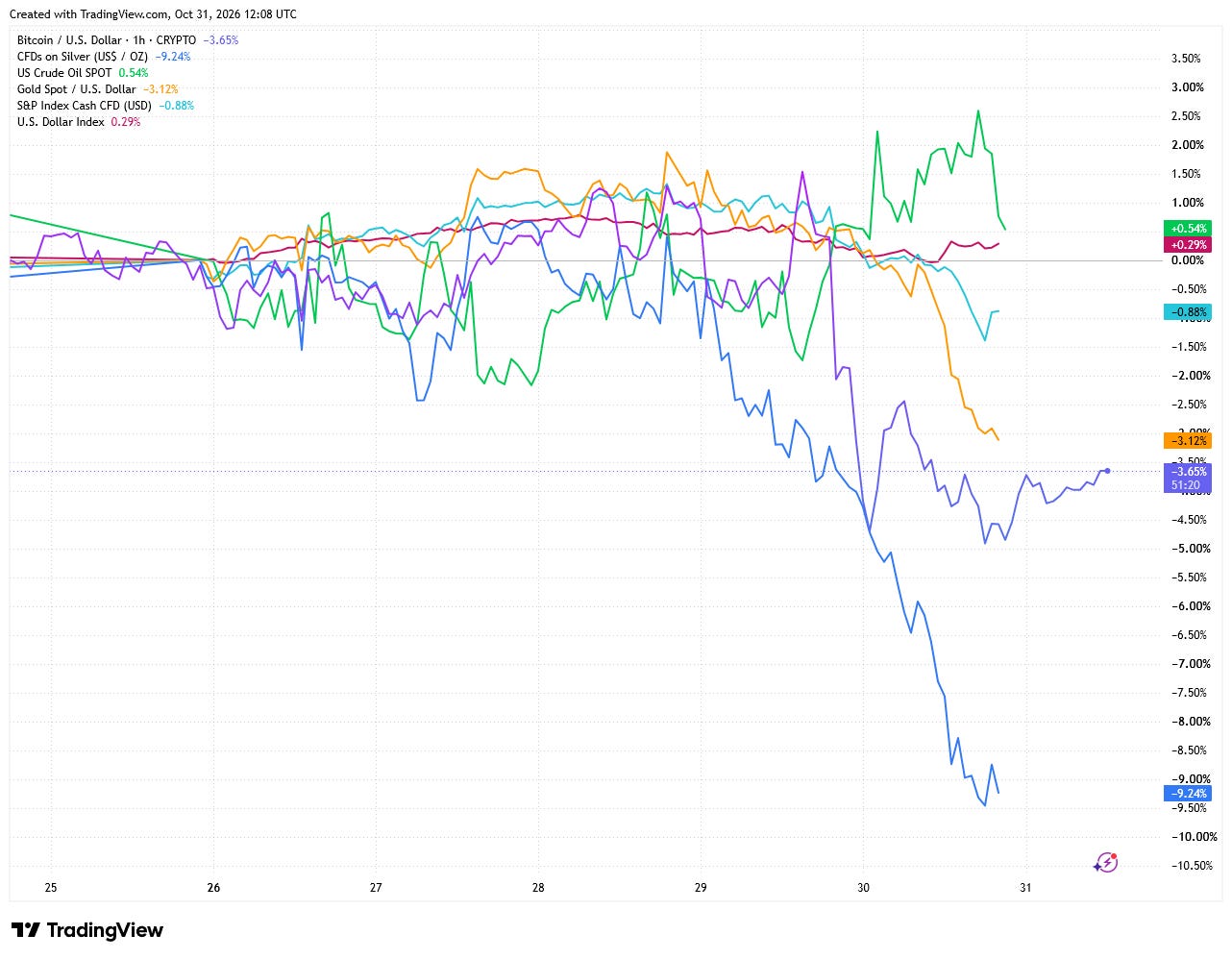
The sell-off worsened as investors questioned whether the returns from AI investment justify the cost. Intel fell 28.6% after its outlook disappointed, while Amazon’s results renewed scrutiny of the cash required to build AI infrastructure. The Nasdaq’s weekly decline was larger than the S&P 500’s, and small caps finished higher. That divergence suggests the pressure was concentrated in technology rather than spread evenly across the market.
The economic data gave the Federal Reserve little reason to relax.
The first estimate of US third-quarter GDP showed annualised growth of 3.4%, up from 2.2% in the second quarter. September’s PCE price index rose 3.6% year over year, while core PCE rose 3.1%. The Fed held its policy rate at 3.75%–4% in a 10–2 vote; the two dissenters preferred a quarter-point hike, and the statement said inflation remained elevated.
The message was that growth is holding up, but the inflation problem has not gone away.
Other central banks moved in different directions.
The Bank of Canada raised its policy rate by a quarter point to 2.5%, citing persistent energy-price pressure. The European Central Bank held its rates steady but warned that higher energy costs could raise inflation and weigh on growth. The Bank of Japan also held the rate at 1.25%, while signalling that further increases remain possible.
Geopolitics kept that energy pressure alive.
Brent futures rose 2.4% on Friday to $117.64 a barrel after the UK Maritime Trade Operations agency reported that a tanker had been hit by explosive devices in the Strait of Hormuz. Iran separately claimed that several tankers had caught fire after hitting mines; Reuters said it could not immediately verify that account. Qatar presented Iran with a proposed framework to end the US-Israeli war, but an Iranian official called the ideas unacceptable.
Crypto’s biggest story was Binance’s reported security breach.
The exchange estimated the impact at about $6.3 billion and said roughly $3 billion had been frozen with help from blockchain partners; it also said user funds were safe. Binance’s initial account pointed to a compromised engineer’s laptop, while blockchain-analysis firms attributed the attack to North Korea-linked actors. That attribution remains an assessment as the investigation continues. Bitcoin fell below $79,000 after the news, and crypto-futures liquidations rose sharply.
What We Covered This Week
At The Token Dispatch, we followed a common question: what makes an asset or an AI service useful in practice, and who provides the trust, liquidity or infrastructure that lets it work?
In Turn a Ticker Into a Financial Product, Vaidik wrote on how tokenised assets can gain attention, access and financial uses in a different order from traditional markets. Memecoin trading helped create liquidity for stock tokens, while institutional products still rely on trusted intermediaries.
In Stocks Will Borrow Where Brokers Can’t, I looked at what changes when tokenised shares can back loans. Borrowers may gain access to credit beyond a broker’s usual hours or reach, but stale weekend prices leave both lenders and borrowers exposed.
I then examined Aave’s new lending structure in Marrying DeFi Funds with RWA Collateral. Its Hub-and-Spoke model lets specialists such as Sentora assess tokenised real-world assets as collateral, while Aave retains control over shared liquidity and the ability to switch a lending desk off.
Thejaswini explored two less visible inputs behind AI.
In Life-Coach the Robots, she followed businesses that collect people’s physical actions to train robots, and asked whether contributors receive fair compensation or retain meaningful control over their data.
In AI Inference 2, she examined how buyers can tell whether an AI provider has served the model it claims to offer.
We have got more lined up for you in the coming weeks. Until then, we’ve got some recommendations that will keep you in good company.
On to this week’s reading list.
Regulation & Policy
Criminal: Scott Galloway argues that political corruption weakens the rule of law and institutions that help make the US attractive to entrepreneurs, and calls for voters to hold leaders accountable.
Crypto & Tech
North Korea gets away with $3 billion from Binance: Molly White examines the reported Binance wallet theft, efforts to freeze the stolen assets and the unanswered questions around user reimbursement.
Not Your Keys, Not Your DAT: Matt Levine looks at Datavault’s reported inability to withdraw Bitcoin held through an exchange account, and what the episode says about custody and digital-asset treasury companies.
From Exposure to Claim: The Formation of Frontier Financial Markets and ISDA: Lauris argues that a market can lack a workable financial instrument even when buyers, sellers and demand exist, and explores how ISDA-style contracts could help create one.
The Biggest Opportunity In Crypto: Marlon makes the case for on-chain options as a major growth opportunity, pointing to expanding options demand and crypto’s still-small market.
Finance & Economy
When banking could be a capital offence: Byron Gilliam recounts how Sweden’s first bank created paper credit, overextended its lending and brought its founder close to execution.
The Heisenberg principle of investing: Byron Gilliam argues that precise measures, such as near-term earnings forecasts, can be less useful to judge a company’s long-term value.
AI & Innovation
Verification Is Not Knowledge: Cosmos Institute and Jessica Hullman argue that formal verification cannot replace human understanding, judgment and accountability in science.
The AI Boom Has a Power Problem: Delphi Digital examines the electricity demands of AI data centres and the companies that may benefit as the race to supply power accelerates.
Charts of the Week: Attention is All You Need: A collection of charts looks at competition for viewers’ limited attention, the continued demand for GPUs and the growing pressure on SaaS companies to prove their security.
Culture & Beyond
In praise of the dilettante: Jay Miller makes the case for the curious amateur, whose wide-ranging interests counter an age organised around specialisation and optimisation.
An Afghan woman recalls how her country’s devastation led to her own: In a short documentary, an Afghan woman recounts how war and social upheaval reshaped her childhood and family life.
What Is Special About Human Beings?: Using Frankenstein, The Culturist asks what makes human life valuable and how that should guide technological progress.
Thoughts on Humanity in the Age of the Machine: Priyanka Desai reflects on humanity’s place in an era shaped by machines.
That’s all for this week. I’ll be back next Saturday.
Until then, happy reading!
Prathik
P.S.: Read, watched or listened to something worth sharing? Send it my way for a future edition.
Token Dispatch is a daily crypto newsletter handpicked and crafted with love by human bots. If you want to reach out to 165,000+ subscriber community of the Token Dispatch, you can explore the partnership opportunities with us 🙌
📩 Fill out this form to submit your details and book a meeting with us directly.
Disclaimer: This newsletter contains analysis and opinions of the author. Content is for informational purposes only, not financial advice. Trading crypto involves substantial risk - your capital is at risk. Do your own research.
Thanks for reading! Subscribe for free to receive new posts and support my work.