


Hello,
For almost a century, we handed our money to a professional and trusted them with it. We wired our assets into a fund and received a receipt establishing our claim on a pool of funds. We didn’t own the company’s shares directly.
These fund houses charged a fee to hold our assets and rebalance them whenever asset weights drifted.
This packaged deal of ownership and management had a few problems. First, the investors couldn’t split them apart and claim custody of underlying assets. Second, the fund houses rebalanced them at set intervals and placed constraints on how investors could use them as collateral.
Blockchains make unbundling the fund possible and change how people hold their assets, while still letting fund houses rebalance the investor portfolios, albeit differently.
In today’s piece, I will explain how this works and who captures value in this unbundled work of fund management.
On to the story…

TOKEN2049: The Largest Crypto Event
For two days, Singapore’s premier waterfront district will turn into a pop-up capital of all things finance. Rooftop conversations, harbour views, deals over dinners and more!
TOKEN2049 will host one of the highest concentrations of financial decision-makers - all at one venue. Over 25,000 attendees, 300 speakers, 500+ exhibitors and 1,000+ side events will light up Singapore’s Marina Bay Sands for a week.
This October, everyone you follow in crypto will be at TOKEN2049. Will you?

If payments, settlement, custody, or yield is the language you speak, then there’s no better place for you to be than here!
October 7-8. Marina Bay Sands. Singapore. All you need to do is show up.
To sweeten the deal: an exclusive 10% discount for you!
The Fault in Our System
Consider an investor in Mumbai who wants exposure to the Magnificent 7 stocks. Because these are among the most liquid on Earth, it may seem like an easy thing to do. But reality is complicated.
The investor would need a US brokerage account that allows Indians to participate, or a local broker that charges a commission on every trade, plus a currency spread each time she converts her Indian rupee to US dollar. The real challenge is accessibility.
Most fund management houses take custody of your funds and manage your portfolio. But some let you keep your assets in a separately managed account, where the manager trades using the account without taking custody of your funds. But this option is gated behind minimum thresholds.
So an average investor picked a managed fund that came with a surrendered ownership model. That brought with it two constraints.
The first is how the fund rebalances the investor portfolios. When the market moves and holdings drift from their target weights, the fund trades the whole pool on its schedule. Some rebalance quarterly, others do it semi-annually. You don’t get to choose the cadence, see the trades or hold a position for a little longer - if you wanted to. Some funds rebalance daily, but those tend to have a problem (more on that later).
The second constraint in this model is the utility of what you hold. These funds let you borrow against your portfolio, but the loan runs through the broker or bank that custodies your shares. The rate and terms depend on their approval. Open-end fund units that are rebalanced daily are often refused as collateral or heavily discounted.
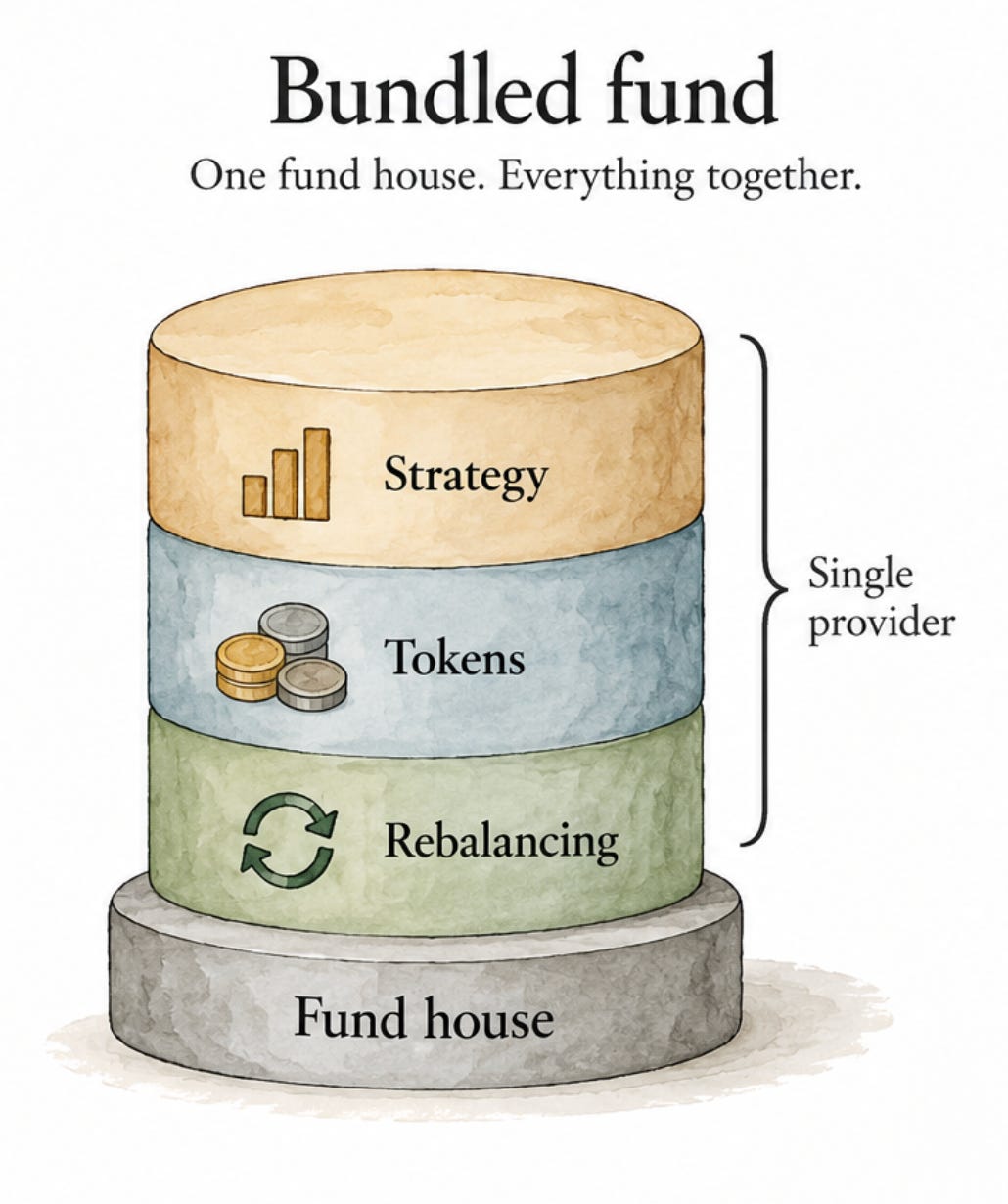
The bundled fund was a reasonable equilibrium in a world where custody remained expensive and specialised funds had high entry barriers. Paying extra fees to access an exclusively managed fund for self-custody might not be affordable to everyone.
But blockchains let you unbundle the entire model.
Unbundling the Fund
Blockchains cut the incremental cost of holding your assets in your wallet. So, irrespective of how much a wallet holds, $50 or $5 million, the cost of holding that wallet remains the same. That is why fund management is being unbundled at this layer of the stack.
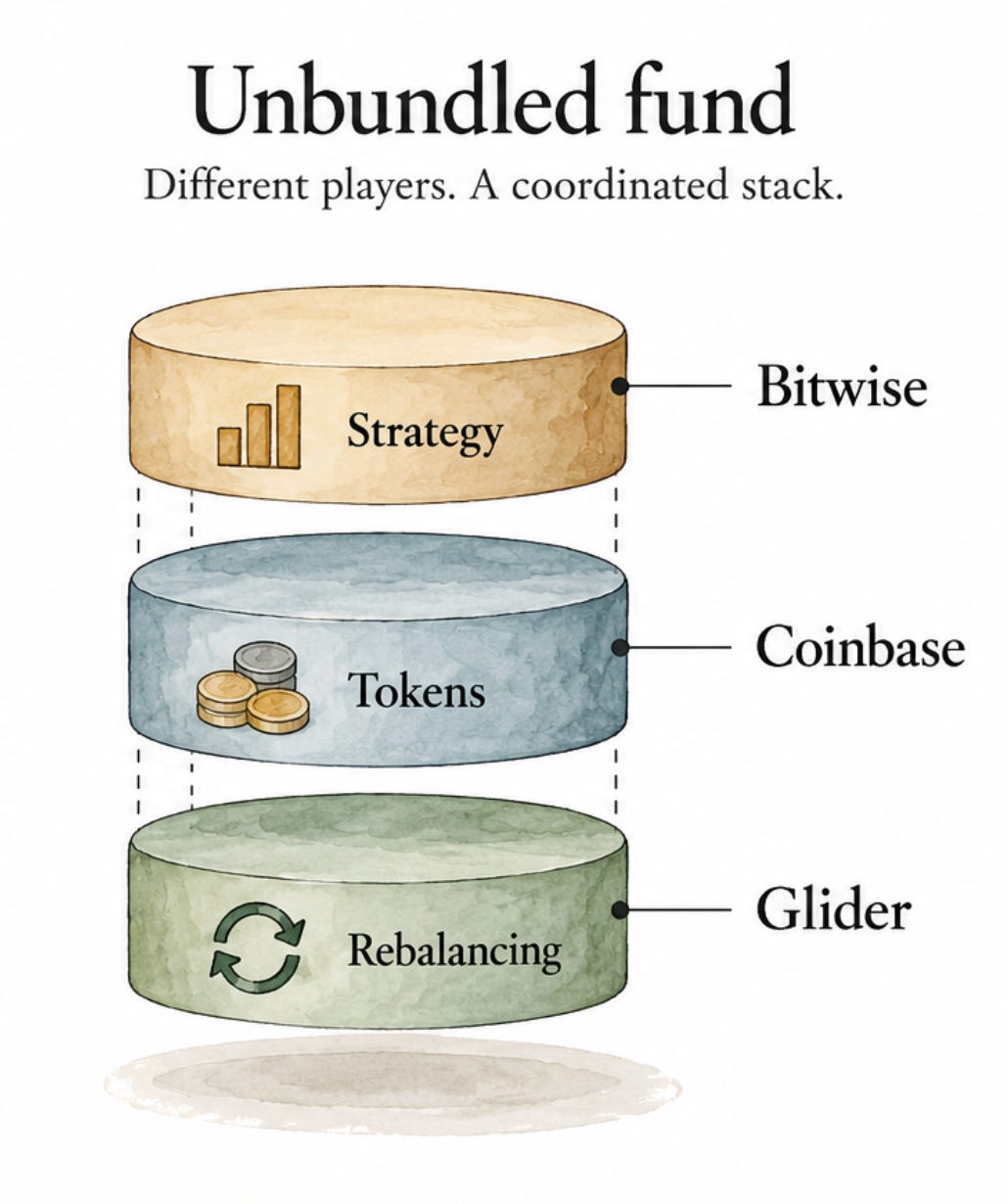
Two weeks ago, Bitwise, Coinbase and Glider came together to do just this.
As part of this partnership, Bitwise would design the strategy and set the weights. Coinbase would issue each holding as a tokenised US stock, backed 1:1 by a real share.
Meanwhile, Glider’s automated on-chain tool rebalances your holdings back to Bitwise’s weights. They do this by buying and selling every time the prices drift, even as your tokens stay in your wallet all the time. The startup, backed by a16z, Coinbase Ventures, and Uniswap Ventures, calls this tool Automated Token Portfolio (ATP). It recently launched its first one that holds the Magnificent 7 plus SpaceX.
Unlike the traditional fund houses, Glider doesn’t rebalance your wallet using a fixed ratio. It rebalances daily toward the target weights whenever prices pull the portfolio away. Using a pre-approved session key, the ATP trades only when needed and charges 0.30% on the volume of those trades.
Investors can hand over the pre-approved session key as a limited-time authority signature that Glider can use to trade inside your wallet. The key is programmed to prevent Glider from withdrawing any funds from the wallet. This retains custody. The key is also programmed to act like a switch that can be revoked at any time by turning it off. This stops all future rebalancing instantly.
The flexibility such an automated platform affords is what sets it apart from a traditional fund house, which charges a premium for the same or similar features.
Rebalancing bots are not new in crypto. We have had them for years; think Stoic and Shrimpy. But these bots run through API keys on our exchange account. The exchange still holds the assets. Glider rebalances tokenised stocks held in your self-custodied wallet. The assets don’t have to move.
But why care so much about custody?
Since you hold the tokens rather than a claim on a pool of assets, Glider also changes the way you use your portfolio. When you had to borrow against your traditional fund, the broker had to approve your collateral, set terms, and, worse, could refuse your units if they were priced once a day because of liquidation fears. Tokenised stock in the wallet doesn’t need a fund house to approve any of this. You can post your position as collateral in any lending protocol directly, or even sell one position to set off a loss against gains elsewhere.
The Effect of Unbundling
The traditional fund bundled asset selection, holding, and investor retention. It offered all of this in a single wrapped product. Now this bundle is being split into a token, a rebalancing engine, and a strategy, with each layer handled by a different player.
The payoff from unbundling the fund mirrors unbundling many other stacks in the financial system. We explained how each layer got cheaper and more contestable when the IPO stack and private-company cap table unbundled.
In each case, value migrated to the layer that was hardest to replace. The same logic turned integrated brokerages like BlackRock and Fidelity into interchangeable parts. But now, with blockchains bringing universal accessibility and flexible rebalancing, this value is migrating again.
Giving investors the flexibility to manage their portfolios at the click of a button seems like the hardest part. So, that’s where the value is now accruing.
But there are no free lunches.
Consider establishing a $10,000 position using the unbundled model. You’d pay between $45 and $60 in fees, depending on whether you use Glider’s 0.30% or Bitwise’s 0.15%. Compare that with Vanguard’s S&P 500 ETF, which charges 0.03% a year. That’d come up to just $3, 1/15th of the new approach.
So why care about the unbundled model?
The unbundled model isn’t a utopian fix to replace the traditional funds. It brings accessibility and flexibility to those who value these features, albeit at a higher cost. An investor with a good brokerage account and simple index needs should still opt for a traditional ETF bundle.
The unbundled model is a better alternative compared with the balance-based fees of robo-advisors and licensed managers. Some investment platforms still charge 0.15% to 0.60% a year, every year, whether or not anything trades.
Even those who want to manage their portfolios without giving up their keys would adopt an unbundled model.
Glider can benefit from this adoption in two ways. It has already built the consumer layer that lets users grant revocable permission and make rebalancing discretionary. But the bigger takeaway is that it doubles down as a B2B interface for any wallet, exchange or fintech that wants to plug into it.
That’s it for today. I will be back with the next one.
Until next time, stay curious,
Prathik
Token Dispatch is a daily crypto newsletter handpicked and crafted with love by human bots. If you want to reach out to 165,000+ subscriber community of the Token Dispatch, you can explore the partnership opportunities with us 🙌
📩 Fill out this form to submit your details and book a meeting with us directly.
Disclaimer: This newsletter contains analysis and opinions of the author. Content is for informational purposes only, not financial advice. Trading crypto involves substantial risk - your capital is at risk. Do your own research.