


Hello,
Every Friday afternoon, treasury teams at large companies pull off a silly act out of helplessness. They sell part of their money market funds, which pay close to 4%, and move the cash into a bank account that pays nothing. All this so that they could pay the bills that are due over the weekend. Since the funds don’t trade on weekends, the money there could stay blocked until Monday.
When this habit recurs across corporate America, the number turns big. US companies hold over $2.5 trillion in checking accounts and cash. US banks hold over $4 trillion in non-interest-bearing deposits.
The issue is that someone is earning interest on all of this, just not the person whose money it is. Financial infrastructure being shut and moving cash being a hassle are two avoidable reasons that can keep money idle and unproductive. The good news is that both those reasons are going away.
As money compounds every hour, the profit from the arising value accrues to those who move the money. In today’s story, I explain how that’s happening.
On to the story…

StablesReward: Your AI Agent Spends, You Earn
AI agents can surf the web, read reviews, and book hotels for you. All these tasks cost money. But what if these tasks could earn you back something?
StablesReward does just that. Once you connect your agent to an MCP endpoint, it gives your agent a menu of paid tools. Every call your agent pays for earns you miles or stocks. And this is in addition to the rewards you earn anyway on your own spending across 800+ merchants.

Every purchase pays you back. The best part is that you can choose how you’d like to be rewarded. Transfer miles to airlines and hotels, or let your stocks build a portfolio from the spend you were making anyway.
Launching soon. Free to join.
Money’s Weekend Trail
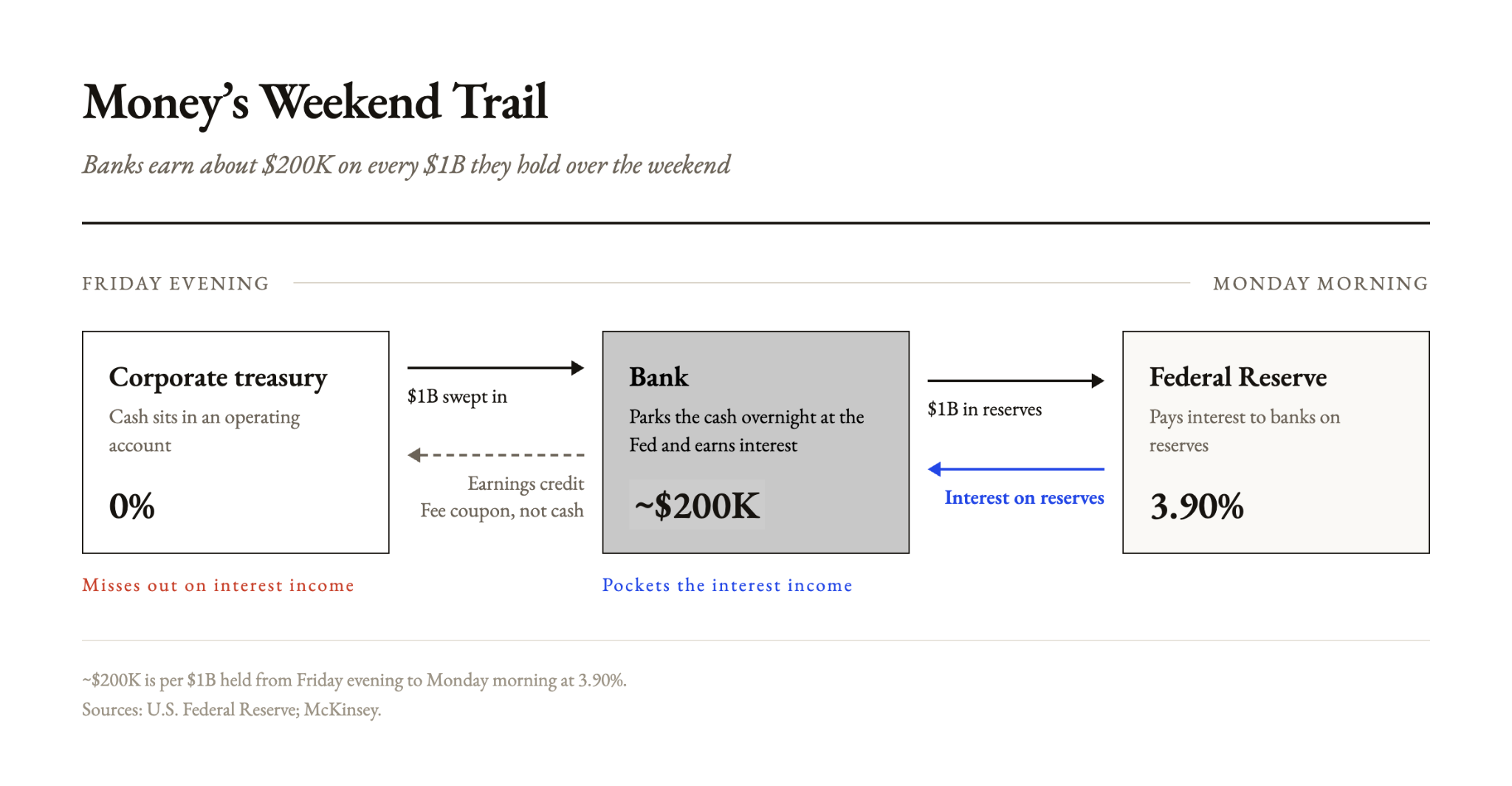
On a Friday evening, corporate treasuries move cash back to the company’s operating account and earn no interest. But the bank does. Banks can park this cash at the U.S. Federal Reserve, which pays banks 3.90% on reserves since it raised rates in September.
On a billion dollars, that rate fetches a little over $200,000. By Monday morning, the bank pockets all this money that isn’t its own. What does the treasurer get in return? An earnings credit that the companies can use to claim a rebate or eliminate their monthly commercial banking service fees. Except that this works as a coupon and cannot be withdrawn in cash. So, the bank also decides what the idle cash is worth.
Weekends and public holidays in the U.S. add up to almost a third of the year. Consider every company that pre-funds payroll and supplier payments in this approach. McKinsey estimates interest income from this approach accounts for 40-45% of transaction-banking revenue, or $500-550 billion globally.
On the roughly $4 trillion worth of non-interest-bearing deposits, depositors give up about $160 billion a year in interest. Although not all of it goes to banks’ coffers, the earnings credits still is a minor dent in what is one of the biggest income streams for banking.
Even the commission-free brokerage, Charles Schwab, holds about $485 billion worth of client “sweep” cash at the end of August. That’s the money left in a brokerage account after you sell a stock, which Schwab puts in a bank account and pockets the interest.
It’s a similar pattern that repeats in multiple places. Money is never really unproductive. When it stays idle at a place, it’s more often than not the bearer who pockets the compounding growth and not the owner.
Last week, one bank gave up on this cash cow and threw away its own lunch.
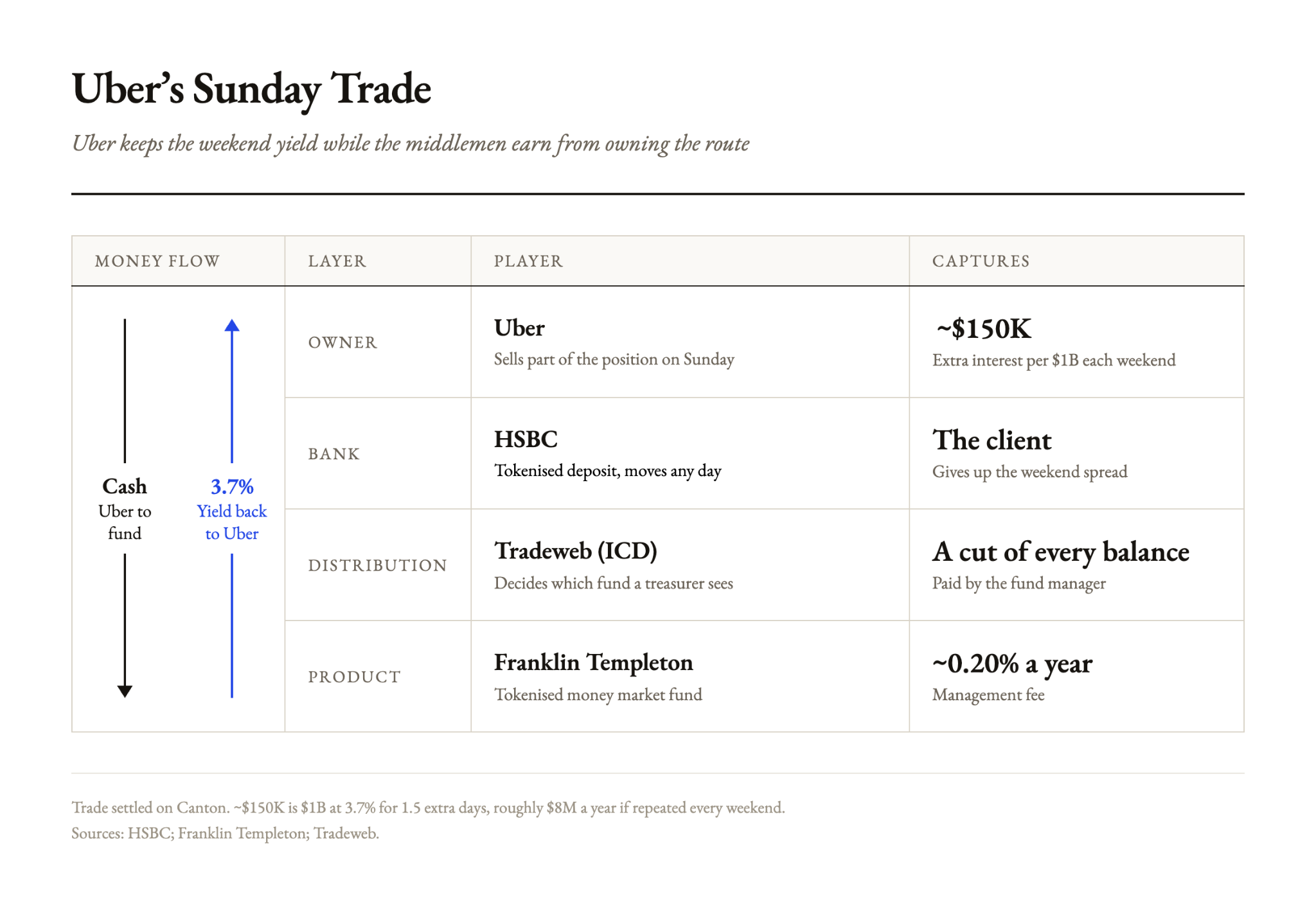
On a Thursday, Uber used HSBC’s tokenised deposits to buy Franklin Templeton’s tokenised money market fund through Tradeweb. A tokenised deposit is an ordinary HSBC deposit recorded on a blockchain, so it can move at any hour, including Sunday. The trade settled on Canton’s chain. On Sunday, with banks shut, Uber sold part of the position via blockchain and earned about 1.5 extra days of interest compared with selling on Friday.
HSBC said it would offer the same service to its other U.S. clients.
For one trade, Uber’s gain is small. At 3.7%, keeping $1 billion invested for an extra day and a half earns about $150,000. But doing it every weekend compounds that prize to roughly $8 million annually. Any company that pays its suppliers, gig workers, or drivers over the weekend will be the biggest beneficiary of no longer having to lose interest on holding idle cash.
So why would HSBC give up that money? Because the alternative poses existential risk to the banks.
In July, Tradeweb ran its first on-chain Treasury trade on Canton. The cash side of that trade was USDCx, a stablecoin. If a company can settle its weekend trades with a stablecoin, it doesn’t need its bank on Sunday. Perhaps it may not need its bank deposit either. HSBC chose to lose the weekend spread rather than the client altogether.
Read: Defending the Deposit
The weekend business is going away anyway, whether banks like it or not. DTCC, which settles almost every US securities trade, turned on its tokenisation service on October 28, with 20 firms and about $30 trillion of eligible securities. On October 19, JPMorgan put its deposit token on Ethereum. DBS moves group cash across borders in seconds for clients like Ant International. Even the Federal Reserve will open Fedwire, its main payment system, on Sundays from 2028 or 2029.
Once the central bank works weekends, the industry loses its main excuse to keep the cash idle and pocket the interest.
But fixing money movement on weekends is an easier problem. Most idle money stays stuck because nobody bothers to move it. Code and blockchains have started solving that problem.
In April, Schwab’s shares fell 7.6% in a day on reports that JPMorgan was building an AI tool to manage cash. By October, Schwab was blocking outside AI agents from moving client money and steering customers to its own assistant.
Treasury teams are further along than retail investors. In Tradeweb’s 2026 survey, 22% said they already use AI for cash forecasting and liquidity. A treasurer can’t check every balance every hour. But software can. And once it does, frictions that a client faces stop adding free money to the bank’s coffers.
Who Keeps the Money?
You’d expect the yield to go back to the owner once idle cash starts earning. But not all of it does. In fact, in some cases, none of it goes back to the owner of the money. Like we see it happen with stablecoins.
Circle, which issues USDC, earned ~$1.4 billion in the first half of 2026, almost all of it interest on reserves. Out of this, it paid ~$819 million, about 60%, to the platforms that distribute USDC to users. Coinbase alone got ~$655 million. Eventually, Circle retained about 7 cents of profit per dollar of revenue. It holds the reserves and handles the regulators, yet retains the smallest share.
The one who owns the customer via the distribution takes the biggest cut.
Read: Who Captures Value in Web 2.5
The value flows similarly in corporate treasuries, too. Tradeweb paid $785 million for ICD, a portal where treasurers buy money market funds. It now serves 600+ clients, including about a fifth of the S&P 100. Fund managers pay ICD a small cut of every balance. Franklin Templeton charges about 0.20% a year on its on-chain fund. The funds compete for the cash. Meanwhile, it’s the portal that decides what funds a treasurer can see on Sunday.
All this explains HSBC’s move.
A bank that tokenises its deposits becomes the default route for the client to park their cash. Although the bank ends up earning less per dollar, it still stays part of every trade and retains the client. JPMorgan and DBS are also making the same bet. Even the banks that aren’t making this bet are busy lobbying. They fought hard against stablecoins paying interest, and the CLARITY Act stalled on a 49–50 Senate vote in September.
But this fight will just buy the banks some time, not a different outcome. Although the change won’t happen overnight, it will happen inevitably. Currently, only 1% of US treasurers say they use or pilot stablecoins or tokenised funds, per the 2026 AFP Liquidity Survey. But 86% of the respondents said they’d use real-time money market funds. Tokenised Treasury and money market products hold about $15 billion, or 0.2% of a $7.9 trillion money fund market. Zero-interest deposits hit a new high in the second quarter.
Corporate treasurers are continuously seeking cash that can earn every hour. But it’s not as easy. Some of the board policies are selective and sign off only on products they recognise. Auditors also need to consider if a tokenised fund in a digital wallet still counts as cash. But none of this is a technology problem. It’s got to do with paperwork.
There’s also a catch in the weekend trade. The U.S. Treasuries don’t trade on Sundays. When a fund lets Uber cash out on a Sunday, someone else is holding that redemption on their books until Monday, when the underlying bonds can actually be sold. On a weekend with low activity, that’s not a problem. But on days when many treasurers are panicking to cash out at the same time, it needs someone to have a lot of spare cash on a Sunday. That entity will charge for the extra liquidity they provide. This makes providing weekend liquidity a business arm in its own right. Not all the interest that used to accrue to banks on idle money will reach the corporate treasurer. A big slice of it could go to those who provide liquidity on the weekends.
Read: Making Funds Move at Internet Speed
There’s a behavioural study that explains the corporate treasurer’s phenomenon.
In 1952, an economist named William Baumol asked a question: why does anyone hold cash that earns nothing?
He rationalised that every trip to the bank costs money, time, and effort. If converting investments into cash were free, you’d keep everything invested and cash out the minute a bill was due to be paid. Because it isn’t free, you keep a pile of idle cash so you don’t have to make that trip too often or pay in the form of other costs. Baumol’s maths said the right amount of idle cash rises with the cost of each trip and falls as interest rates rise. Economists call these “shoe-leather costs,” after the shoes you wear out walking to the bank.
The weekend is that stretch of the week that allows no trips to the bank. So the treasurer makes one big trip on Friday, pulls out everything the company might need until Monday, and lets it stay idle.
As per Baumol’s model, the ~4% interest rate makes every idle dollar expensive. Infrastructure that never switches off removes the time cost of the trip, while software that moves money removes the effort cost. So when the trip costs almost nothing and holding cash costs 4%, it’s a no-brainer to hold almost no cash as idle money.
This forces the banks to eat their own lunch, because the alternative costs them more. HSBC gives up its weekend spread so that it can retain Uber as its client. By doing so, the client continues to do business with the bank for other products, where the margin is higher.
That’s it for today. I will be back with the next one.
Until next time, stay curious,
Prathik
Token Dispatch is a daily crypto newsletter handpicked and crafted with love by human bots. If you want to reach out to 165,000+ subscriber community of the Token Dispatch, you can explore the partnership opportunities with us 🙌
📩 Fill out this form to submit your details and book a meeting with us directly.
Disclaimer: This newsletter contains analysis and opinions of the author. Content is for informational purposes only, not financial advice. Trading crypto involves substantial risk - your capital is at risk. Do your own research.