


Hello,
Last week, I spent half a dozen hours across two days staring at quarterly earnings of two similar, yet so different companies. The first, Robinhood, inspired confidence in how it was offering all that any trader or investor would want to do in the world of finance. The second, Coinbase, made me contemplate what lay ahead for it in a not-so-optimistic sense.
Coinbase’s Q2 earnings disclosed two sets of numbers that give you mixed feelings about its trajectory. Coinbase captured an all-time high 10.3% market share of global crypto trading volume, its third straight quarter of a record share. That’s precisely what the “everything exchange” vision was expected to produce. Yet, the overall business recorded a net loss for the third straight quarter.
This is where the art of curating an earnings deck comes into play: emphasising favourable data and downplaying unfavourable numbers. Management would like its stakeholders to focus on the first set of numbers and that 88% of its revenue no longer comes from the highly cyclical Bitcoin-related spot trading. But when you dig deeper, you understand that Coinbase hasn’t escaped its dependence on market cycles. It is still heavily dependent on two market-driven businesses — the Federal Reserve and altcoin prices.
In today’s piece, I’ll explain why the machines the company is betting on don’t inspire enough confidence and why the customer Coinbase was designed for may be the wrong one for the world crypto is becoming.
On to the story…


The Warning Bells
Coinbase’s legacy business of letting retail people buy and sell crypto on the app is going through a structural decline. Revenue from consumer transactions fell over 30% year-on-year (YoY) to about $452 million. Consumer spot volume shrank from $41.5 billion to $25.8 billion. The record-high market share of 10.3% conceals the fact that Coinbase is winning a bigger slice of a shrinking pie.
Overall, the company made a net loss of $359 million in Q2 2026, its third straight quarter in the red. In the same period last year, Coinbase recorded $1.4 billion in net profit, its second-best quarter ever.
The deeper problem is when you look one line below the net loss this quarter. Coinbase attributes most of its net loss to unrealised mark-to-market on-paper losses on the crypto it holds. Although that’s a valid explanation, there’s still a problem. The company’s adjusted EBITDA (earnings before interest, depreciation and amortisation), which excludes non-cash items, isn’t reflecting a healthy trend either. This quarter the company’s adjusted EBITDA stood at $208 million.
Coinbase said the metric recorded its 14th consecutive positive quarter. But what the company doesn’t disclose is that this quarter’s performance was also the worst in the last 11 quarters.
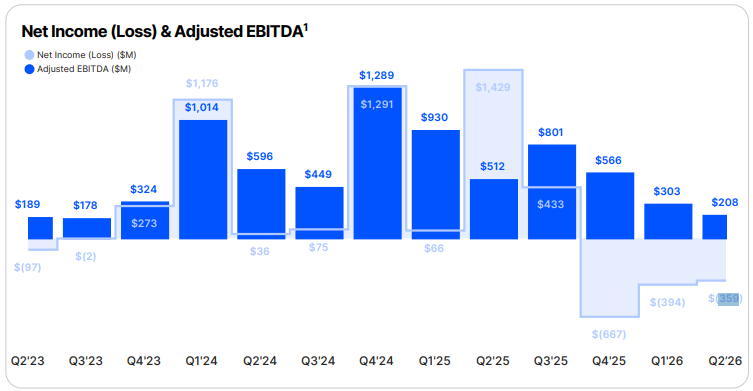
The company’s operating profit, which reflects the health of the business before a single cryptocurrency was marked down, has also been in the red for the second straight quarter. Coinbase’s operating income dropped from $481 million in Q3 2025 to an operating loss of $114 million in Q2 2026. Even on a year-on-year performance, the company’s performance was 4.5 times worse than the same period last year (Q2 2025).
When you piece together the above trends, you see that Coinbase’s shrinking top-line numbers in its core business are biting into its bottom line. One reason is the cost base built for a bigger company. Through the 2025 market rally, Coinbase scaled up with its headcount climbing to nearly 5,000. But those costs didn’t shrink as fast as revenue did once the market turned down later last year. In Q2, operating expenses of $1.33 billion exceeded net revenue of $1.15 billion. The company spent more running the business than the business brought in, before a single coin was marked down.
In May, Coinbase responded by announcing it would cut about 700 jobs or 14% of its global workforce.
Coinbase also claims to be tackling the problem of overdependence on its core business by growing its other businesses that are not linked to market cycles. It said more than 88% of its revenue is now decoupled from BTC spot trading. It also cited the increasing share of Subscriptions and Services (S&S) revenue, which accounted for almost half (48%) of the company’s total revenue. That’s the highest share the segment has recorded in the last 11 quarters. But the good news lasts only until you start dissecting the S&S revenue across the past few quarters. Coinbase’s $555 million in S&S revenue this quarter is the second-lowest in eight quarters.
S&S revenue comprises blockchain rewards, stablecoin revenue, interest & finance fee income, and other residual revenue. Among these, the float business on stablecoins held by Coinbase accounts for more than half of the total S&S revenue. This item is still heavily linked to the macro environment and is at the mercy of how the Fed moves the rates. This is reflected in the irony that despite Coinbase holding an all-time high record of $20 billion in USDC on its platform this quarter, the stablecoin revenue still fell to $292 million from $309 million in the same period last year.
More float, yet less money made.
In November last year, I had flagged that a one-point rate cut could shave around $70 million off quarterly stablecoin revenue. Coinbase is living through that reality today.
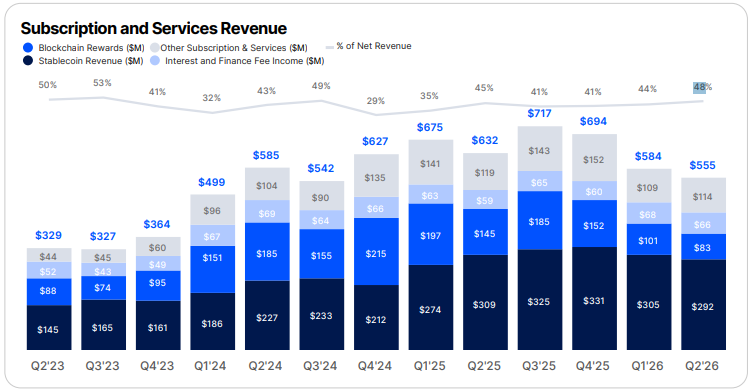
Even the second largest single line item in S&S revenue shows similar vulnerable dependencies.
Blockchain rewards, which represent the income earned by staking cryptocurrencies, have shrunk over 40% from $145 million in Q2 2025 to $83 million in Q2 2026. This revenue also rises and falls with cryptocurrency market prices.
Between stablecoin revenue and blockchain rewards, more than two-thirds of the “diversified, non-trading” business is still linked to the macro environment and altcoin prices. Only a fifth of S&S services includes Coinbase One and custody fees, which resembles a genuine, recurring product income.
So, the revenue mix has changed, but not in the direction that inspires confidence. What has diversified is its dependence on a single crypto trading market, which is now linked to a US Fed that seems uninterested in hiking rates in the near future.
The Silver Linings
Despite all these warnings, Coinbase earnings revealed some green shoots.
The first takeaway from Q2 2026 for the company must be the performance of its prediction markets business. It crossed $100 million in annualised revenue rate (ARR) in Q2 2026, more than double what it did the preceding quarter.
The demand in this business is incremental and is only expected to go further up with the momentum prediction markets are enjoying. Sports did the heavy lifting, through the NBA playoffs and the football World Cup.
In mid June, Coinbase launched a new crypto-binaries product that allows traders to trade predictions on the price outcomes of assets like BTC, ETH and SOL, across 15-minute, hourly, daily, monthly, and annual intervals. This drove three times the daily traders and four times the daily revenue by the end of the quarter. Coinbase had built this on top of its existing funded-account base without cannibalising spot trading.
The second is the surge in its institutional and infrastructure-led business. Coinbase still custodies more crypto than any other platform on the earth. It has consistently held over 11% of the world’s total crypto assets in terms of market cap.
It also custodies the majority of the underlying crypto assets of the US spot ETFs.
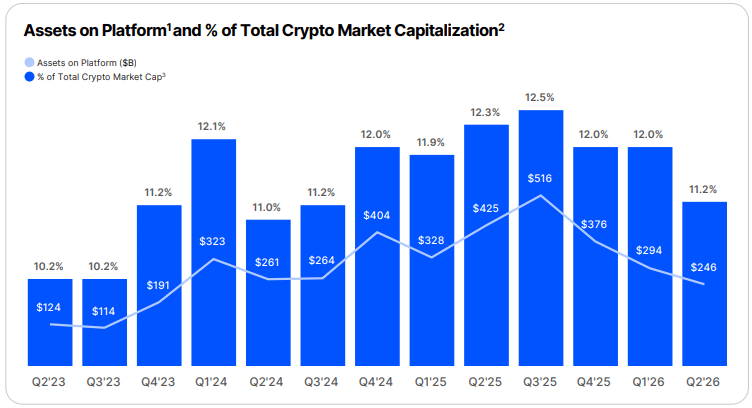
The company also posted an all-time-high derivatives market share, where its volume held roughly flat even when the broader market fell 12%. Its Deribit acquisition gave it a bridge into global options that no other US-listed exchange can boast of.
I find this the biggest advantage that Coinbase should leverage moving forward, given the growing interest that institutions are showing in using crypto as a backend infrastructure rather than as a mere speculative tool.
Read: Crypto as the Backend
But there are still aspects of these silver linings that Coinbase needs to be concerned about.
Prediction markets are booming, but Coinbase is merely providing a distribution platform to sell Kalshi’s event contracts. It shares the economics with Kalshi. Compare this to Robinhood, where the company owns its prediction markets exchange outright and can mint its own contracts year-round. Coinbase has no in-house exchange licence. Its volumes and the money it makes off those contracts are heavily dependent and constrained by the contracts that Kalshi launches.
Even the two biggest bets Coinbase is excited about are still in their early stages.
Coinbase’s x402 payment protocol for agentic finance just recorded another all-time high month in agent-to-agent transaction volume.


Yet, by Coinbase CFO Aleia Haas’ own admission, it’s still “very early days” for Coinbase to think about monetising its agentic finance business via x402 protocol. Despite the protocol having processed more than 100 million transactions, nearly all in USDC, it currently earns zero protocol fees from them.
The USDC demand it generates and the ability to cross-sell Coinbase’s other products can lead to indirect revenue. But this has not been committed to a fixed timeline yet.
The Shaky Road Ahead
When you zoom out from these metrics and look at how the crypto space this company aspired to conquer has evolved, it exposes structural concerns that Coinbase needs to address.
Coinbase was built for crypto natives in a world where crypto was envisioned to become a separate, parallel financial universe with its own citizens. I still remember how Base launched Onchain Summer to bring together artists, engineers and all others interested in creating using blockchain. Today, that idea of crypto is being left behind by the broader world of finance. Financial institutions, including legacy giants and relatively new fintechs, are warming up to the idea of using crypto as a backend infrastructure. Think stablecoin transfers and sub-minute settlements on blockchains moving the ordinary, decades- and century-old financial products. In that world, a company with the most-crypto native identity will be left behind. Those with an edge are the businesses that already own mainstream customers and can route crypto underneath them without them ever having to think about it.
We saw Robinhood do this with their retail distribution base of almost 30 million funded accounts. The distribution positions such companies to run away with the riches in the new world of Web 2.5.
Read: Who Captures Value in Web 2.5?
Robinhood’s position helps it hold on to the same funded customer across a dozen businesses it owns and make higher average revenue per user. For Coinbase, the crypto-native identity that gave the company an edge in the last cycle is now turning into a liability.
That leaves Coinbase with institutional opportunity. That is the ground it can hold on to and build on fast. Coinbase’s “everything exchange” vision may still give an impression that it can sell every financial product there is. But it needs to ensure that when it does so, it can make enough margins across those products to help its business thrive.
That’s it for today. I will be back with the next one.
Until next time, stay curious,
Prathik
Token Dispatch is a daily crypto newsletter handpicked and crafted with love by human bots. If you want to reach out to 170,000+ subscriber community of the Token Dispatch, you can explore the partnership opportunities with us 🙌
📩 Fill out this form to submit your details and book a meeting with us directly.
Disclaimer: This newsletter contains analysis and opinions of the author. Content is for informational purposes only, not financial advice. Trading crypto involves substantial risk - your capital is at risk. Do your own research.
There is a huge opportunity in supply chain certification, product origin, transportation, customs, and so on. Europe’s digital product passport is the perfect example. These are billions of non-speculative transactions( with loyal customers). A shared ledger with tiered access controls is the perfect medium for this.