


Hello,
Welcome to Edition 5 of The Friday Reading List — your fortnightly antidote to the noise. Every two weeks, I share my favourite literature across crypto, finance, technology, culture, and beyond. I also share what I’m watching and reading, because if this newsletter were only about charts and tokens, I’d have bored myself out of writing it by now.
Four editions in, and the reading list keeps growing, the recap keeps getting meatier, and the puzzle from the last edition seems to have stumped a few of you. The right answer was: ‘MINER, AGENT, CREDIT, NODES → MINTED’.
With that out of the way, let’s get started with this edition.
The Fortnight That Was
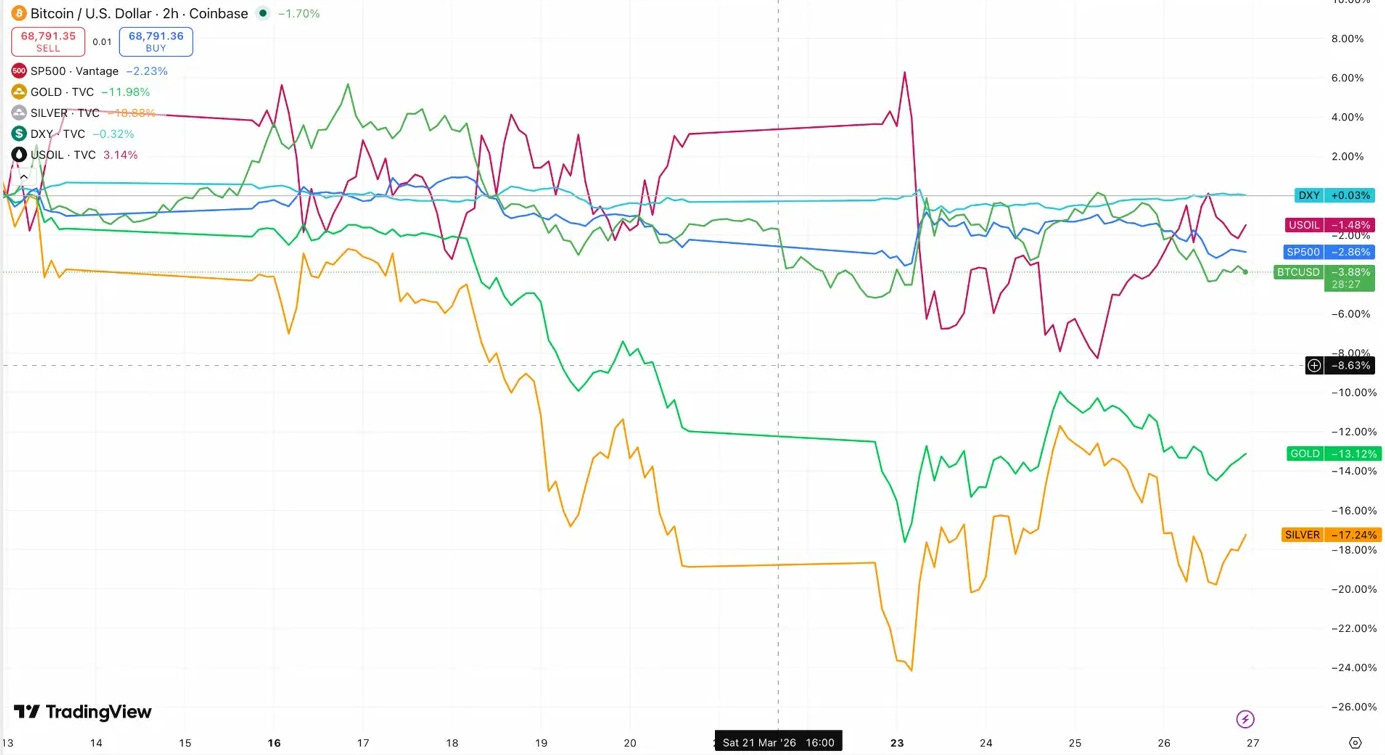
The US-Israel-Iran war that dominated the last edition continued to impact markets over the last two weeks, but with a different story this time.
With tension simmering in the Strait of Hormuz, uncertainty remains in the markets. Oil, which had spiked over 60% in the first week of March, gave away half of those gains in the fortnight. USOIL slipped 1.5% in the last two weeks, yet it is up 30% since the war started.
Gold and silver continued to slip further, worsening their reputation as commodities expected to thrive in uncertainty. Gold dropped over 13% this fortnight, while Silver fell even harder, losing 17%. Whether that’s profit-taking after the record rally until January end, or margin calls forcing liquidations, or the market deciding the conflict is priced in, the move is striking. Since the war started on February 27-28, silver is down over 26% and gold 17%.
Bitcoin slipped about 4% in the past fortnight, despite touching $76,000 for the first time since February 4. For the full month, it moved almost sideways with just 2% gains. The S&P 500 continued its slide, losing about 3% over the last two weeks and nearly 5% for the month. The dollar stayed flat.
At Token Dispatch, our team covered broader shifts in the ecosystem beyond the price charts.
We focused on regulation, execution quality, payment rails, privacy, and AI pricing — five separate stories that paint a dynamic picture of an industry that speaks about how fast it’s growing, failing and learning, contrary to how dull the price charts may make it look.
The fortnight opened with me asking if and when a system should slow you down. In Finance Needs Speed and Brakes, I dived deep into the Aave–CoW swap fiasco, where a user lost nearly $50 million in a single transaction because no meaningful brake existed between intent and execution. I traced this by recounting the history of strategic friction, from seatbelt reminders in cars to Pay.UK’s Confirmation of Payee. The piece argues that in finance, safeguards aren’t something you build after product-market fit.
My colleague, TJ, followed with AI Agents Are Coming for Visa’s Lunch, in which she contextualised recent events in the AI Agentic economy, including Tempo’s mainnet launch, Visa’s CLI tool for agent payments, Mastercard’s BVNK acquisition, and Circle’s testing of Nanopayments for agents. The piece maps out how x402, Tempo, and the Machine Payments Protocol are building the rails for a customer that doesn’t need what made Visa great.
Vaidik then explained why the $33 trillion stablecoin market still struggles to keep salaries private in Crypto’s Open Secret. Researchers have extracted spending habits, peak sales times, and average order values from businesses that accept crypto, all straight off the public ledger. The piece walks through how Aleo, a Layer 1 blockchain where privacy is the default rather than a bolt-on, is building the infrastructure to fix this.
While the Crypto Twitter (CT) was busy resharing Bittensor’s $TAO price charts (and making me regret missing the trade, yet again), I wrote about why Bittensor’s public pricing of AI can be a game-changer. AI valuation today is decided by a select few in closed-door meetings. In Bittensor and the Public Price of AI, I explained how the model lets AI stakeholders finance, build, validate, and price AI projects in public, in real time.
TJ brought the fortnight home with “What Took So Long,” in which she questions the long-pending regulatory clarity that finally arrived on March 17. The SEC and CFTC published a joint framework that categorises every token into one of five buckets: digital commodity, digital security, stablecoin, digital collectibles, or digital tool. The clarity might still not do its job if the CLARITY Act, which sets these definitions in stone, gets stuck in the Senate.

Stop Switching Tabs. Switch to Velo.
Tab 1: Charts. Tab 2: News. Tab 3: Trading Terminal. Tab 4: Why are you living like this?
You’re tracking a chart, something moves, and you switch to check the news. By the time you take a call and make a trade on your terminal, the moment’s gone. You’ve missed the valuable few seconds.
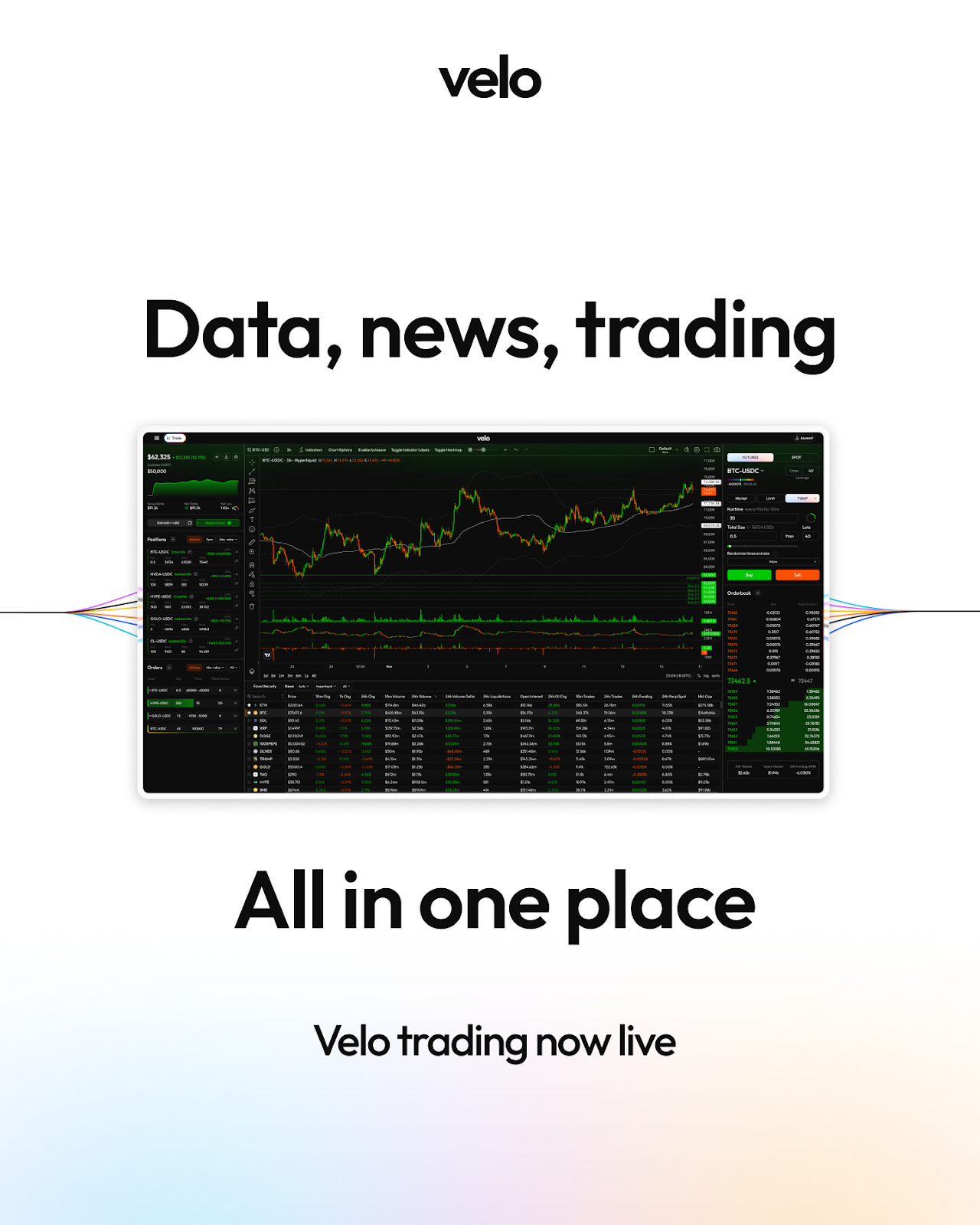
I didn’t know what to expect when I opened Velo. Maybe a different version of a zillion other trading platforms I’ve seen before. Instead, it welcomed me with a clean interface. With one click, I could connect my Hyperliquid and Bybit wallets and start trading.
Velo gives you everything you need, all at once
Real-time price charts and on-chain data, built for speed
Funding rates, open interest, and CVD — all without the extra tabs
Crypto news integrated directly into your chart workflow
Trading is live; analyse and execute without changing screens
The trading terminal lets you move between spot and futures trading with a click of a button on the same screen. You can even set customised news alerts from a feed populated by outlets like Bloomberg, Reuters, Financial Times, and WSJ, and track the price of any asset from the same screen. Try it here.
Start here 👇🏾
We have a lot more coming over the next two weeks. Before we get there, here’s some literature that will keep you in good company. Some of these could be behind a paywall. (Sorry!)
Regulation & Policy
Prediction Markets vs Sports Betting: A bipartisan Senate push to stop CFTC-regulated prediction venues from listing sports and casino-style contracts.
Grayscale’s HYPE Filing: The S-1 for Grayscale’s HYPE ETF shows Hyperliquid is already being translated into familiar TradFi wrapper language.
Crypto & Tech
State of Crypto Design: A useful argument that crypto’s bottleneck is no longer core infra but the human layer, including UX, brand, and design talent.
Everyday App Framework: A framework for why crypto still hasn’t shipped a true everyday consumer app, and which products come closest.
Why Drift, Why Now: Our partners at Decentralised.co lay out the case for Drift as a discounted bet on Solana’s perpetuals and future internet capital markets.
Hyperliquid’s Big Year: A year-in-review framing Hyperliquid as something larger than a perps venue, as it approximates a full on-chain exchange stack.
Meteora’s Holder Report: An investor-relations-style token-holder report built around cash flows, treasury, and buybacks.
Digital Dollar Ramps: A clean explainer on how Bridge-style virtual accounts compress the fiat-to-stablecoin conversion stack.
x402 vs MPP: A sharp breakdown of the emerging standards war in agent payments, per-request on-chain payments versus session-based, rail-agnostic settlement.
RWAs Are Different: Multicoin’s latest on why RWAs behave differently from earlier DeFi markets because they bring exogenous assets on-chain.
Nasdaq Meets Talos: A bridge story that explains why tokenised collateral is interesting only when it plugs into existing risk, surveillance, and collateral workflows.
S&P, But 24/7: A thread around trade[XYZ] bringing S&P-linked exposure into continuous, Hyperliquid-powered markets.
Argentina’s 8% Problem: A concise remittance wedge: sending money to Argentina is costly, and most of that drag appears to come from everything except FX itself.
Perps by 2030: A piece on how decentralised perpetual exchanges can take a material slice of options, futures, and CFD volume over time.
What Happens After TGE: Thoughts on the post-launch problem - when the product works, but price, liquidity, and community decay when there’s no durable value sink.
Micropayments Without Friction: A thread on continuous micropayments, batch settlement, and protocol-level abstraction across stablecoins and cards.
Finance & Economy
Debasement in Three Acts: A Rome-to-dollar-to-crypto essay on how empires use monetary resets to buy time, often at the expense of trust.
We Learned Nothing: Jerry Neumann’s attack on startup orthodoxy — once everyone follows the same playbook, differentiation disappears.
Collapse of Terminal Value: Chamath’s thought experiment on what happens to equity valuation if AI makes moats temporary and terminal value stops carrying the model.
Ozempicization of Everything: Kyla Scanlon on optimisation culture, quick fixes, and the economic psychology underneath gambling, health, and control.
Costless Sacrifice: Packy on why AI cheapens output and floods the zone, making effort itself a scarcer signal.
Post-Employment Era: A thread introducing the idea that the prestige and security once attached to employment are decaying.
Hitting the Battery Wall: An excellent systems piece on why humanoid robots may be constrained less by software ambition than by battery physics and replacement economics.
Kalshi at $22B: The funding headline matters less for the number itself than for how quickly prediction markets are being repriced as core market infrastructure.
24/7 Markets, Finally: A framing of how Trump-era headline risk and Hyperliquid-style perps are nudging always-on markets into the mainstream.
Oil, War, and Fragility: Balaji’s thread argues about how attacks on Middle Eastern oil infrastructure would spill over into the global economy.
Digital Finance in 2030: Artemis sketches a world where neobanks, lending, agentic payments, prediction markets, and trading are the five enduring pillars of blockchain-enabled finance.
AI & Innovation
Selling Yourself to AI: The Guardian writes on a new data-labour market where people sell voice, video, chats, and ambient life data to train models.
Your Agents Are Cheap: A piece that correlates agent quality with token spend, context, and compute budget more than prompt cleverness.
Agentic Utilities: Citrini’s read on the shift from AI as chatbot to AI as always-on service, and what that means for incumbents and losers.
AI Is a Stack: A thread arguing that the AI money is still flowing through the stack of power, chips, data centres, cloud, followed by models and apps.
ARK’s 2026 Big Ideas: ARK’s annual thematic deck spanning AI, robotics, biotech, space, and blockchain/fintech.
NVIDIA x Nebius: A large-scale infra story: NVIDIA is investing $2 billion in Nebius and backing a plan to deploy more than 5GW of systems by 2030.
Meta Pulls Back on VR Social: A telling metaverse retreat as Meta’s centre of gravity shifts away from the earlier bets.
Culture & Beyond
Be Seen Anyway: A punchy essay on how invisibility is becoming economically expensive in a world where trust, work, and reputation are increasingly public-facing.
Reading Socrates in Silicon Valley: An FT critique of tech-bro stoicism that uses philosophy to push back on shallow self-mythology.
Don’t Block the Archive: EFF’s case that shutting out the Internet Archive won’t stop AI scraping, but will destroy the web’s public memory.
The Forgotten Organ: A neat science read on why the thymus may matter more for long-term health and ageing than researchers assumed.
Look to Artists: A short philosophical video on attention and why art offers a counterweight to purely instrumental ways of seeing the world.
What I Am Watching & Reading
I finished Not Without My Daughter last week. Betty Mahmoody’s descriptions of 1980s Tehran, the crumbling streets, the checkpoints, the constant vigilance, stayed with me throughout this fortnight as the Iran conflict dominated the news. As I read the book, I felt a constant, humanitarian, relatability to the women and civilians living through what’s unfolding now that I hadn’t felt before.
It’s hard not to imagine what it’d be like for the civilians living through something equally tragic, if not worse, right now, with unexpected and sudden bombings and airstrikes rattling through the city.
A difficult but important read.
This fortnight, I’m looking forward to watching Project Hail Mary. A space sci-fi genre with Ryan Gosling starring in an Andy Weir adaptation is hard to pass up.

It’ll likely be an exciting first week of April.
Write back to us with any recommendations through the next fortnight that you think we should include in the upcoming edition.👇🏾
That’s all for this fortnight. Catch you in the next edition.
Until then, happy reading!
Prathik

Token Dispatch is a daily crypto newsletter handpicked and crafted with love by human bots. If you want to reach out to 170,000+ subscriber community of the Token Dispatch, you can explore the partnership opportunities with us 🙌
📩 Fill out this form to submit your details and book a meeting with us directly.
Disclaimer: This newsletter contains analysis and opinions of the author. Content is for informational purposes only, not financial advice. Trading crypto involves substantial risk - your capital is at risk. Do your own research.