


Hello,
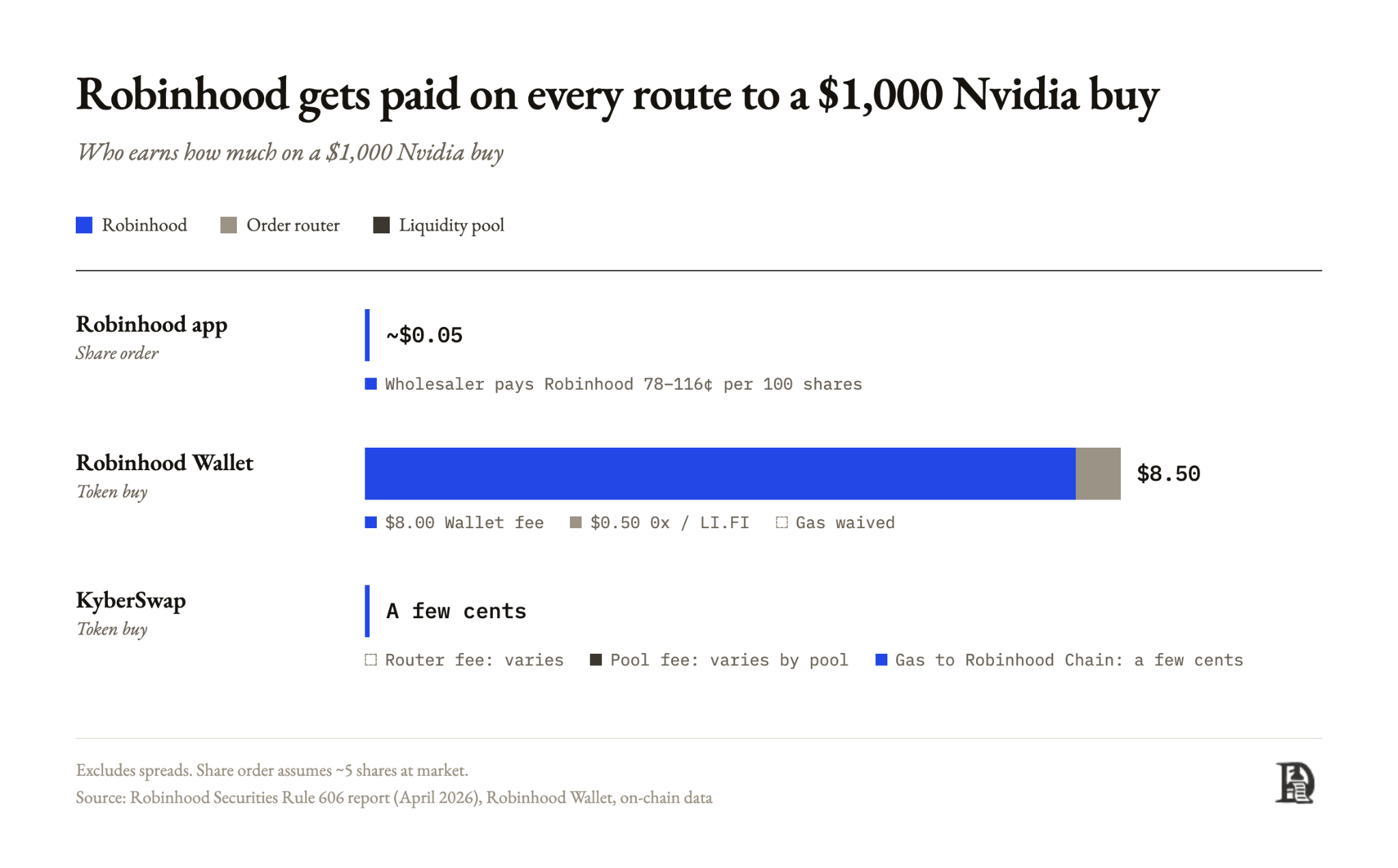
When we buy $1,000 of Nvidia stock tokens on the Robinhood app, Robinhood’s entity keeps $8. Meanwhile, 0x - the company whose software does the RFQ (request-for-quote) price finding, earns only 50 cents.
When you buy the same tokens through KyberSwap, a rival price-finder, then the Robinhood app ideally shouldn’t get involved. Yet, Robinhood gets paid. Here, the trade settles on Robinhood Chain, in a token that Robinhood’s subsidiary alone can create.
For over a decade, Robinhood collected a toll from its customers for using its wallet and other products. Now, on its chain, the company is charging an expanded user base. Although a chain earns far less per trade, the bigger idea is to charge all the order aggregators on Robinhood Chain. This lets Robinhood amass a bigger pot of toll revenue by charging the companies that would compete with Robinhood’s off-chain business for its order flow.
On to the story…

Hermes Business: One Budget for Your Team’s AI Needs
Most teams pay for AI across different platforms. A few seats here, some tokens there, and a few API keys from multiple vendors that the company can no longer track. You may still be able to track the spending bill at the end of the month, but you will not know whether it’s paying off.
Hermes Business puts your whole team on one tab. Every member gets their own AI agent, reachable on Slack, Telegram, WhatsApp, or Discord. You can set how much each person can spend and track every dollar in one place.
Your team can pick from every model on Nous’s platform or bring their own keys.
The longer your team uses it, the more it knows your team members.
Need the agent to run on your own servers? Hermes Enterprise runs on infrastructure you control.
The Traditional Aggregator
When you buy any stock on a brokerage app, the order doesn’t go directly to Nasdaq. It instead goes to a wholesale trading firm like Citadel Securities, Virtu, or Jane Street. The firm then fills the order itself by selling you shares from its inventory and squaring its position a fraction of a second later.
Two parties make money by routing this trade. Although you pay no commission directly, the wholesaler earns the spread between the price at which it buys and the price at which it sells you the share. Robinhood gets paid by the wholesaler for sending the order its way. That payment is for the order flow.
But why should a wholesale firm pay a brokerage firm to fill your order? Retail orders are among the safest to trade against. A Robinhood customer buying $1,000 of Nvidia is rarely acting on information the market hasn’t already priced in. The wholesaler can fill the order, keep the spread, and not worry about price moving against it.
Orders from hedge funds and professional traders are the opposite. They are often placed before the price moves since they act upon richer pricing information than the retail investors.
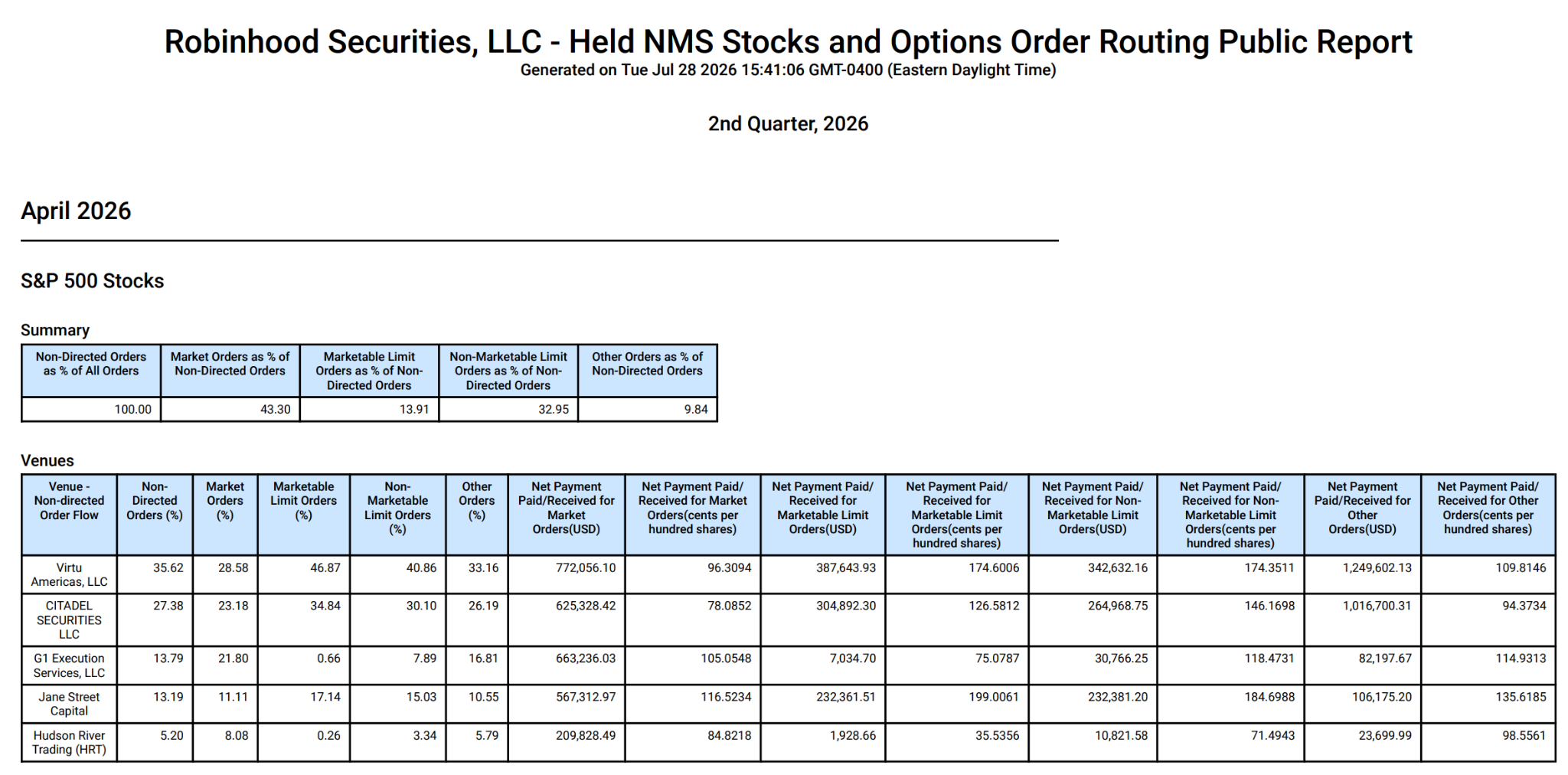
Robinhood built its entire business model on this strategy. In 2013, it scrapped trading commissions and made money from wholesale trading firms by routing its customers’ orders to them. Its April 2026 Rule 606 report shows wholesalers paying between 78 and 116 cents for every 100 shares of S&P 500 stocks bought with a market order. That might not add up to much on a $1,000 Nvidia order: a few cents. But it adds up across millions of orders, and the customer never sees it.
On the Robinhood app, every same-chain swap carries a 0.80% Robinhood Wallet swap fee. This is additional to what the price-finder charges. 0x and LI.FI, the two companies that power the Wallet’s swaps, charge 0.05% each. That makes Robinhood’s take rate 16 times that of the order router.
Robinhood’s brokerage is a closed system. It can route its customers’ orders wherever it wants to. But Robinhood’s chain is open by design. Anyone with a crypto wallet can buy the same Nvidia token through any of the aggregators, like 1inch, KyberSwap, or Rialto, and avoid paying the 0.80%.
KyberSwap’s aggregator has been live on Robinhood Chain since launch, and on-chain records show it routing stock-token orders into Uniswap’s pools. The wallet’s in-app swap path made up only 1–2% of the chain’s daily transactions at its peak.
A broker whose customers can walk to a cheaper aggregator is normally losing. But Robinhood is not, because it owns the ecosystem where these cheaper aggregators operate.
Read: Building a Financial Supermarket
The On-Chain Aggregator
Order aggregators compete to route the trade that earns them their revenue. KyberSwap, 1inch, LI.FI and Rialto each split an order across the chain’s venues to find the best execution.
How they route these trades is what determines the value they capture.
Some of them don’t route orders based on price alone. 1inch says it skips some Uniswap v4 pools that run custom code for safety reasons. A router’s risk policy can decide whether a venue gets an order flow or not, irrespective of the price it quotes.
Rialto runs its own pricing engine, called Rivo Altus, alongside its aggregator, and prices each order by where it came from. Routes that carry clean retail flow get tighter quotes. The ones that professional arbitrageurs use get wider spreads.
Rialto also invites apps to send it stock-token orders and get compensated for order flow. It’s exactly how wholesaler trading firms, like Jane Street, bargain for order flows from brokerages like Robinhood. Except this one is built in code and made available for everyone. The scale is still small, but the directional message is strong.
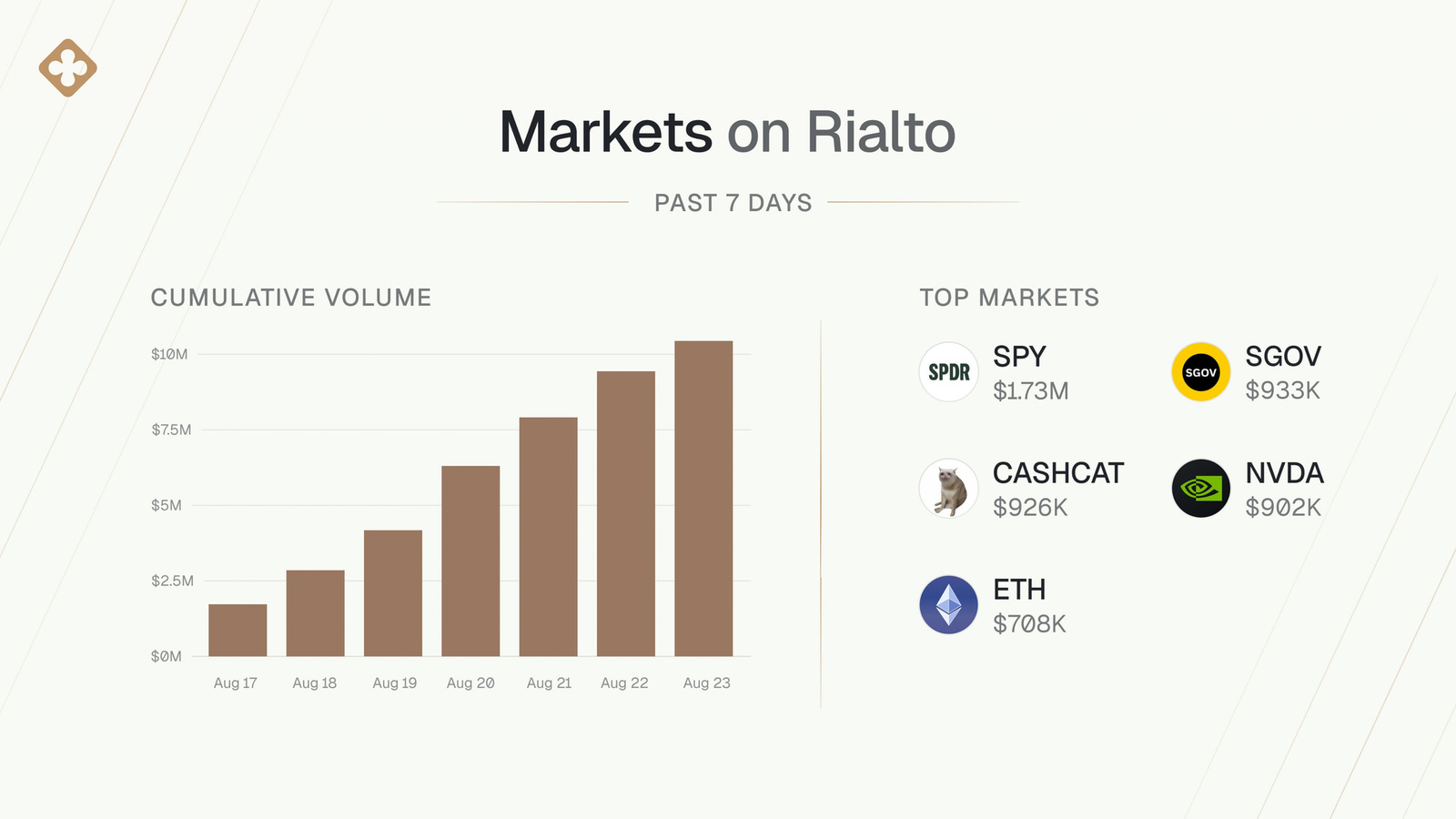
Rialto’s seven-day volume reached $10.48 million, up 16% week over week, including $8.21 million in stock-token volume, up 26%.
On Robinhood Chain, 0x also supplies RFQ quotes for stock tokens from market makers. These trades skip the middle layer entirely by avoiding router contracts, pools, and LP fees. They settle trades via a direct swap between the customer and a market maker.
It is the leanest trade the chain allows, with the fewest hands in it. Yet it still settles on Robinhood’s chain, in a token Robinhood’s issuer created. And because this is the lane the Robinhood Wallet uses, Robinhood takes its 0.80% on top. You can cut out every middleman on Robinhood Chain except Robinhood.
Uniswap deployed a dedicated AMM for Robinhood Chain at launch, which now handles 80% of stock-token volume on the network. The chain has become Uniswap’s biggest market for v4, its newest market version.
In early September, Robinhood Chain accounted for 51% of all Uniswap v4 volume across every network Uniswap runs on. Most of that was memecoin trading.
Arcus, built by the dYdX team with an investment from Robinhood Crypto, charges zero commission on 95 stock tokens. The protocol makes its money on leveraged perp futures that let traders post their stock tokens as collateral.
Pleiades runs a proprietary AMM for prop trading and has not said who operates it. Lighter, which raised money from Robinhood Ventures, offers perpetuals inside the Robinhood Wallet.
The middle layer here is populated, and nobody controls it.
Uniswap takes orders from every router. Rialto routes mostly to itself. Arcus quotes its own book. But the best seat in the house is with Robinhood. Through its stakes in Arcus and Lighter, it owns a slice of two venues. But it doesn’t need either to win. Whichever venue fills the order, Robinhood collects at both ends: it issued the token, and it runs the chain the trade settles on. Buying $HOOD gets you exposure to the entire ecosystem, albeit indirectly. It gets you a bite in the pie of the token factory, the sequencer, and a toll on every trade that settles on Robinhood Chain, irrespective of which aggregator routes it and which venue fills it. That’s the one asset in this story that pays whoever wins.
Every stock token is issued by Robinhood Assets (Jersey) Limited. Legally, they are debt securities, not shares.
Read: Who Actually Owns Your Stocks?
Only one firm can create new tokens or cash them in against real shares: Bitstamp Global Ltd., part of the Bitstamp exchange Robinhood bought last year. But creating tokens doesn’t bring a lot of value.
Like I wrote earlier this week, creating new tokens is free and redeeming them is subsidised, too, in the first 90 days.
“Merely creating tokenised versions of stocks doesn’t create much value. Robinhood’s issuer charges almost nothing to create a token. Redeeming one is free for the first 90 days and costs 0.05% after that. Enabling the crossing of shares off-chain to on-chain is more of a free utility. So bridges earn most of their money from what they build around the crossing.”
But the value adds up because of volume. Irrespective of which router wins the order, the token still comes from Robinhood’s token factory.
There is another toll that Robinhood earns from: charges for the ecosystem. Every trade, whoever routes it, settles on Robinhood Chain and pays gas to the sequencer Robinhood runs.
Since the chain is built on Arbitrum’s technology under the Arbitrum Expansion Program, 10% of the chain’s net revenue goes to the Arbitrum ecosystem. The rest of it still accrues to Robinhood.
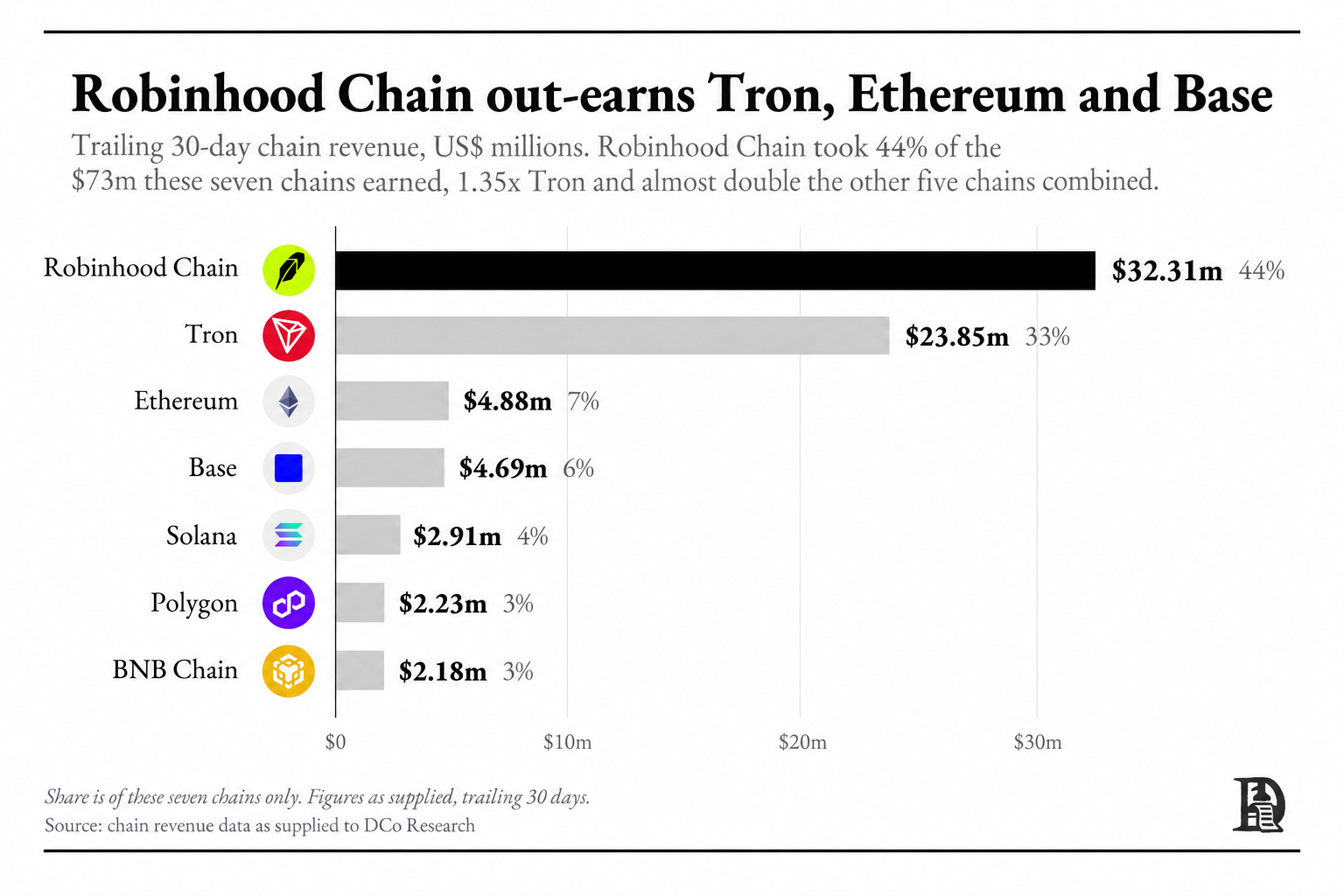
On September 3, at the height of the memecoin frenzy, Robinhood Chain collected about $4.5 million in fees and paid $398 to post its data to Ethereum. Over the next 30 days to September, it collected over $32 million in chain revenue, the highest by any blockchain and more than three times the collective chain revenue of Base and Ethereum. Most of that came in the first half of the month, and the fees have fallen sharply since. Yet, the cost side hasn’t changed. Whatever the chain earns, nearly all of it is Robinhood’s to keep.
Since Robinhood owns the ecosystem in which these routers operate, it can afford to subsidise the fees without significantly hurting its revenue. Robinhood recently extended the fee waiver on swaps above $0.50 until December 31.
By doing this, Robinhood is building a wider distribution base that keeps paying the company a gas fee for every trade routed through its chain. It’s the same playbook that the brokerage firm applied to build its 30 million funded user base.
Building A Wider Road
Robinhood Chain charged almost every trade on the network, but took very little from each. A stock-token trade pays a few cents in gas. So the chain’s revenue depends less on what people trade than on how frequently they trade.
Stock buyers on the chain don’t fill Robinhood’s coffers as fast as the off-chain retail traders do. But that’s where the speculative arm on the chain helped initially. In the week leading to September 3, the chain averaged $3.5 million a day in revenue. But such speculation-driven revenues are cyclical. Once the initial activity cooled, the average revenue in the last two weeks of September dropped to roughly $1.6 million a week.
But I wouldn’t blame Robinhood for its direction. Owning the road is not a new idea in crypto. Coinbase runs Base and the app that sends users to it. Hyperliquid owns its chain and the exchange that sits on top of it. Both are capitalising on their chains to win the flow.
Robinhood’s version is only slightly different. It is letting the venues and routers fight, while it takes stakes in a few of them and collects money from each of them, irrespective of who wins.
Read: Every Exchange Is an Everything Exchange
It’s a repeat of what we saw in 2013. Back when Robinhood made trading free for retailers, the company let Citadel Securities pay for it in the form of order flow compensation. Now it makes gas free for its own users and lets everyone else’s traders compensate it. The only thing that’s changed is that in 2013, the payment was hidden inside a spread and disclosed only in a Rule 606 report. The current one is written onto a public ledger every time a trade settles. That makes it more transparent and much harder to route around.
Aggregators like KyberSwap, 1inch, and Rialto can keep winning orders. But the consistent winner will remain Robinhood, for it already owns the road these aggregators will route the orders on.
That’s it for today. I will be back with the next one.
Until next time, stay curious,
Prathik
Token Dispatch is a daily crypto newsletter handpicked and crafted with love by human bots. If you want to reach out to 165,000+ subscriber community of the Token Dispatch, you can explore the partnership opportunities with us 🙌
📩 Fill out this form to submit your details and book a meeting with us directly.
Disclaimer: This newsletter contains analysis and opinions of the author. Content is for informational purposes only, not financial advice. Trading crypto involves substantial risk - your capital is at risk. Do your own research.