


Hello,
On June 9, London-based Janus Henderson signed a four-part deal with Ethena, the crypto company behind USDe stablecoin. As part of the agreement, the $480-billion asset manager agreed to place one of its own funds inside the reserves backing the digital dollar, whose circulating supply is $5.5 billion. It also agreed to package and sell Ethena’s products to its clients and park its corporate cash in USDe.
Janus is not alone. In the last four months, BlackRock and Apollo, two of the largest asset managers on earth, each made similar moves across different crypto protocols. Collectively, these three companies manage over $15 trillion in assets.
In today’s piece, I explain why Wall Street’s biggest names are buying stakes in the crypto rails and what the quid pro quo is for the crypto companies.
On to the story…

The TradFi-Crypto Deal
Let’s start with what Ethena and Janus will walk away with from the latest deal. Ethena took Janus Henderson’s tokenised credit fund into the reserves that back its USDe. This move strengthens Ethena’s latest attempt to revamp its collateral mix backing the USDe reserves.
In When the Yield Runs Out, I explained how Ethena is diversifying its collateral across traditional and crypto assets. Its earlier reserve strategy, which relied solely on capturing yield from crypto-backed basis trades and treasury bills, unwound amid the market downturn.
Janus’s AAA-rated fund is one of the safest slices of pooled corporate loans. These carry the lowest risk of default and the highest priority for receiving interest and principal payments. Ethena’s risk committee has already approved the fund as an eligible component of the collateral mix. This will be the first time USDe will be backed by a real-world corporate credit instrument.
Janus also did three more things as part of the deal. It bought ENA, Ethena’s governance token, through its blockchain venture ANTIK. It agreed to jointly build regulated exchange-traded products (ETP/ETFs) for USDe in the second half of 2026. This would allow ordinary investors to buy exposure to Ethena’s dollar from a normal brokerage account, without ever opening a crypto wallet. Lastly, it said it would hold USDe, and its yield-bearing version, sUSDe, as its own treasury cash.
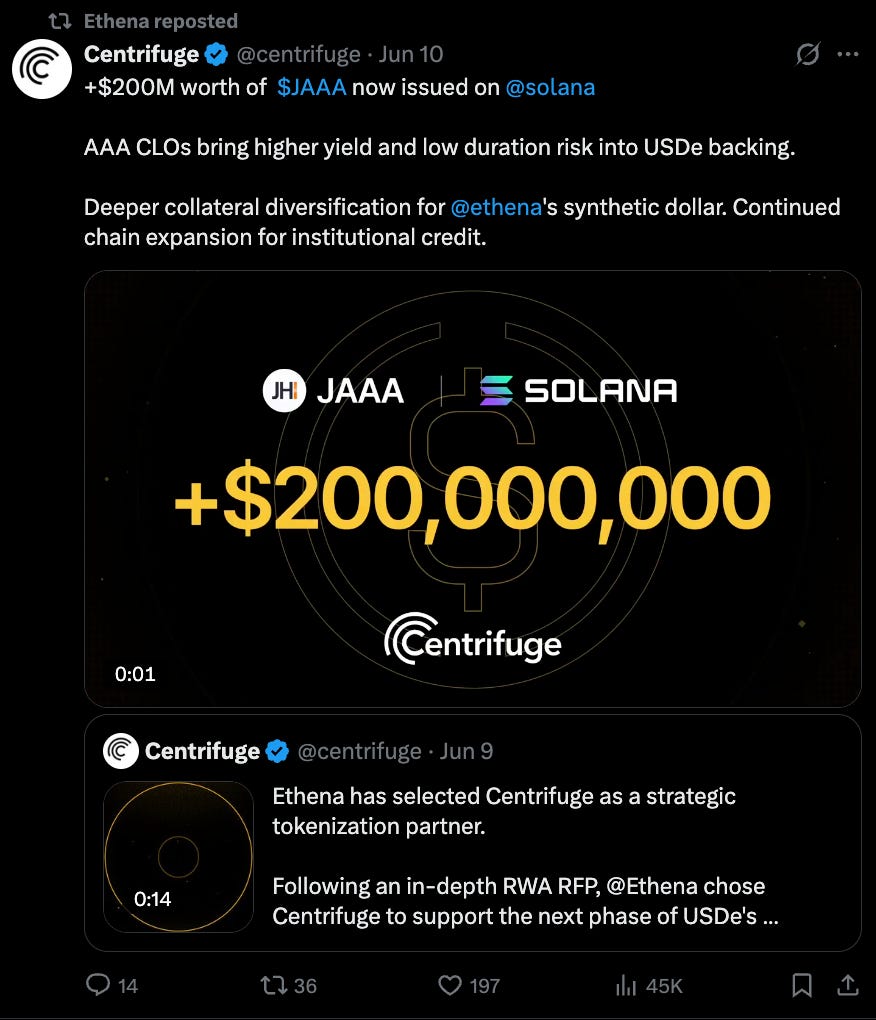
For Janus, there’s now a consistent, captive demand from Ethena for its tokenised credit fund. Since Janus’ credit fund now sits in the reserves backing USDe, every dollar of new USDe minted forces Ethena to buy more reserve assets, including JAAA. This excess flow into Janus’s credit fund now happens without the asset manager having to market it.
In return, the asset manager became a customer of the protocol’s dollar, gained a share in its governance by buying the ENA token, and doubled down as a distributor of both products to its traditional clientele.
The other two managers had similar deals four months back. BlackRock bought an undisclosed amount of Uniswap’s token, UNI, while listing its tokenised Treasury fund, BUIDL, on Uniswap’s rails. However, access for BUIDL is gated and open only to large, qualified investors and approved market makers. Apollo signed an agreement to buy up to 90 million MORPHO tokens, nearly a tenth of the supply, while building lending markets on Morpho and using its own credit fund as collateral there.
One asset manager making a small investment toward a crypto protocol could be dismissed as “testing the waters”. But we are now talking about three of the most established money managers buying a protocol’s token and plugging their products into the blockchain-enabled ecosystem.
But why are they governance tokens? Two reasons.
The perspective of traditional finance towards crypto exposure has taken a 180-degree turn. A few years ago, the instinct was to get crypto exposure without touching the infrastructure. They opted to either hold crypto through a tokenised fund, a custodian, or an ETP wrapper.
But the evolving use case for crypto infrastructure has significantly redefined where value now lies. The rise of stablecoins and the tokenisation of real-world assets have shown traditional players that finance can be made much cheaper to operate on-chain. Settling a trade, holding the asset, and keeping the record of who owns what were all hard, expensive jobs that someone charged an expensive fee for. On-chain, they collapse toward the cost of running software.
When the plumbing commoditises, value moves to the layer that decides what flows through it, who sets the rules and who distributes the product. Those who control this layer get to capture the value flowing through it. Right now, the simplest way for traditional finance giants to do that is to buy a stake in these crypto infrastructure protocols that already control this layer. Since Uniswap or Ethena don’t have equity to purchase in the ordinary sense, their governance token offers Wall Street the closest way to own a share of the company.
The other reason is that an ownership stake brings a captive demand for its product. When someone demands USDe, they must pledge equivalent dollars to Ethena as collateral against which it issues the stablecoin. Ethena then has to park the incoming collateral in reserve assets to back the dollar it just minted. JAAA is now one of the assets it is approved to hold, so as USDe’s supply grows, a share of that fresh collateral flows into Janus’s fund. This excess demand arises as a by-product of USDe’s expansion, without Janush having to market it.
Both Apollo and BlackRock did the same with Morpho and Uniswap. In each case, the manager owns the token, supplies the product, and can then drive deposits into the protocol. Deeper deposits mean more demand for the fund that the asset manager just integrated.
For Wall Street, owning the crypto rail gives them control over the reserve, captures the distribution and lets them feed its products using the blockchain at a fraction of the cost.
What’s in It for Protocols?
Two words: Scaled distribution.
For Ethena, Janus opens its distribution network to people who would otherwise never open a crypto wallet or access a crypto protocol. The ETPs and ETFs that Janus and Ethena agreed to build together will allow advisors to buy into Ethena’s products without needing to understand blockchain. Janus’ $480-billion client book dwarfs the few billion Ethena manages by almost 100 times.
This adds on to the distribution boost Ethena got from another such deal it entered into with Coinbase two weeks back.
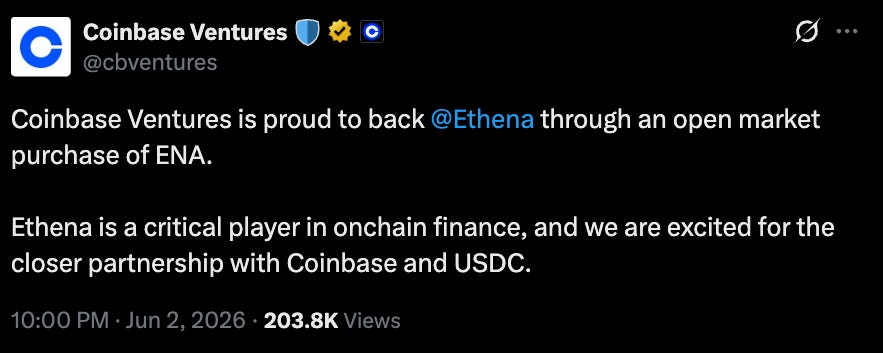
On June 2, Coinbase Ventures bought ENA and agreed to launch a savings product for Coinbase’s 100 million-plus users.
Coinbase already holds roughly $19 billion in its USDC ecosystem. If Ethena’s yield even marginally outperforms USDC, then Coinbase can route some of its idle USDC balance into Ethena’s product, offer users a better yield, and, in return, Ethena gets deeper funding and broader circulation.
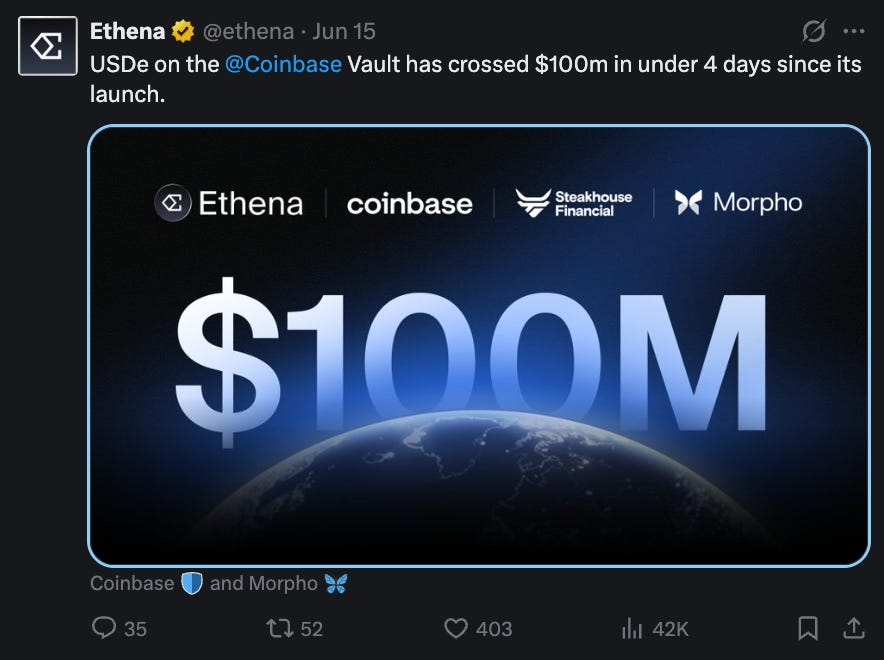
In just four days since its launch, USDe circulation in Coinbase Vaults crossed $100 million.
Distribution also helps source cheaper funding to run its yield machine. By pulling in a slice of a $19 billion exchange balance, or a $480 billion manager’s client base, Ethena can lower the marginal cost of expanding its circulation. For a protocol with $5.5 billion in circulating supply today, even a 1% conversion rate of Janus’ $480 billion in AUM can almost double Ethena’s base.
But why should a Wall Street company hold a stablecoin over an ordinary money market fund?
With Janus’ AAA-rated loan funds now part of Ethena’s reserve strategy, USDe’s backing now looks like a conventional cash portfolio. The reserve now has short-duration, high-grade collateral along with more stable basis trades around commodities like gold. This makes the reserve look familiar to a money market fund that a corporate treasurer has been managing for decades.
That Janus took the extra step of holding the dollar itself as treasury cash shows the asset manager’s belief in Ethena’s ability to defend its dollar with the new collateral mix. It’s something which even BlackRock and Apollo didn’t do with Uniswap and Morpho.
But there are some points to note with caution.
First, a staked USDe still doesn’t guarantee returns. The yield depends on a set of trades on exchanges and market conditions. AAA credit is low-risk but not risk-free altogether, as 2008 showed.
Second, the governance token that the Wall Street companies are buying in crypto protocols pays its holders nothing yet. Ethena’s fee switch, which would route protocol revenue to ENA holders, met its conditions in September 2025 and has yet to be implemented.
So Janus, BlackRock and Apollo are not entitled to any cash flow. But what they are indeed buying is a claim to prospective income once the protocol decides to pay them. The fee switch is off at Morpho, too, and only half-resolved at Uniswap.
But these companies still have two big wins right now.
First is the captive demand they can generate for their products through the partnership with the protocols. Second is being early to position themselves where the value emerges. By buying a stake in blockchain-enabled products, these companies are also buying a share of the prospective income they generate once they become widely adopted across the broader financial markets.
BlackRock, Apollo and Janus are not the first set of institutions to recognise the value that a prospective infrastructure can generate.
We have been discussing this pattern in our last few pieces.
Banks operated as mere deposit-taking businesses until Merrill Lynch unbundled the account and paid savers a market yield. The banks then followed suit.
Read: Defending the Deposit
Exchanges were equivalent to the trading business until vertical integration forced them into price discovery platforms. All exchanges have now become (or are becoming) venues that offer perpetual contracts, pre-IPO markets, and prediction markets, all under one roof.
Read: Every Exchange is an ‘Everything Exchange’
A synthetic dollar is the latest chokepoint to come loose. The dollar, the rail it moves on, and the reserve that backs it are separating into layers, each claimed by whoever runs it best. While Ethena is rebuilding its reserve, players like BlackRock and Janus are offering distribution. Wall Street, having watched the fee on the infrastructure shrink toward zero, has decided to gain control over how the digital dollar is issued.
When you strip this entire phenomenon down to first principles, these asset managers are buying a stake in a crypto protocol that’s doing exactly what the BlackRocks and Apollos of the world have been doing all these years. They are buying a stake in a blockchain-enabled platform that still holds and moves assets (here, stablecoins) and seeks to maximise the return on those assets for its holders. Classical asset management stuff, isn’t it?
That’s it for today. I will be back with the next one.
Until next time, stay curious,
Prathik
Token Dispatch is a daily crypto newsletter handpicked and crafted with love by human bots. If you want to reach out to 170,000+ subscriber community of the Token Dispatch, you can explore the partnership opportunities with us 🙌
📩 Fill out this form to submit your details and book a meeting with us directly.
Disclaimer: This newsletter contains analysis and opinions of the author. Content is for informational purposes only, not financial advice. Trading crypto involves substantial risk - your capital is at risk. Do your own research.