


Hello,
A company that wants to borrow $200 million can either tap into a commercial paper programme or use a slice of its medium-term note (MTN) shelf. The former helps fund immediate cash needs through a continuous, revolving issuance facility. The MTN route allows corporates to utilise a “shelf registration” filed with regulators once, to sell tranches of notes on demand when market conditions look favourable. But if the same company wants to raise $200 million by selling its own shares, it must hire bankers, tour fund managers for weeks, and pay up to 7% of the proceeds to cover the costs of the process.
This is one of the oldest problems in corporate finance. Raising debt is routine, but issuing equity involves a ceremony.
Paperwork or regulation are not the only reasons for this asymmetry. The bigger problem is demand. A company’s shares trade in one pool on an exchange during the market hours. When it wants to sell more shares than that pool can absorb, a bank or a fund manager has to go out and find new buyers through a roadshow.
Blockchains can address this asymmetry by broadening the geographic market from which demand for fresh equity flows.
In today’s piece, I explore how tokenised rails can let equity behave like debt and who captures the value in this process.
On to the story…

Stripping the Ceremony
While IPOs involve a roadshow and 5-7% processing cost in the form of bank commissions, raising follow-on equity has become relatively easier over the past few decades. In 1982, the US SEC adopted Rule 415 that created “shelf registration,” allowing qualifying companies to register securities they plan to issue over the next two years and sell them piecemeal later.
The at-the-market (ATM) programme took this one step further. In this, the company issues new shares to an appointed broker-dealer in the secondary market. The broker then drips these shares into the primary public markets in small amounts to avoid a sudden supply glut. Often, the market notices this only after the company files its quarterly report.
An ATM could cost the issuer only 1-3% in commissions, half of what IPOs cost.
Still, a problem persists with these ATMs. If the company’s broker-dealer pushes one too many shares into a thin order book, then it manufactures its own price drop. This is why the route is only ideal for those seeking to raise modest sums. For higher raises, companies still prefer to go for the roadshow. That’s what the IPO fees buy from the company’s partner bank - the ability to find buyers for their new shares.
Blockchains can fix this problem.
Widening the Pipe
Last week, Cantor Fitzgerald partnered with Securitize to let companies issue shares directly on a blockchain. It is different from other tokenised versions of stocks that have emerged on the blockchain. Vaidik and I wrote about how ownership works across these versions. Some of these tokenised versions are merely wrappers that give price exposure without voting and ownership rights.
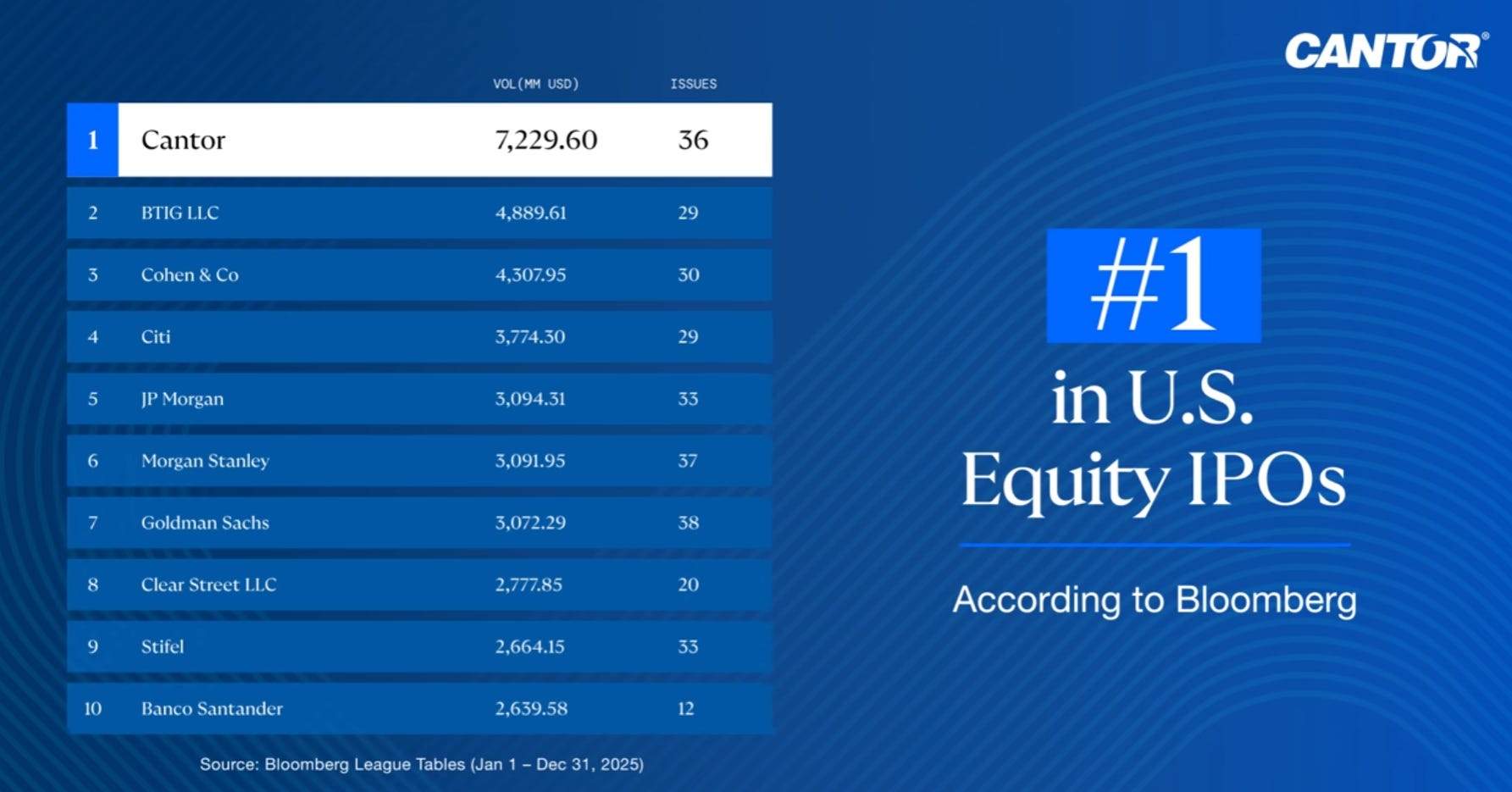
But Securitize isn’t wrapping the stocks. Cantor, the bank that topped the US IPO table in 2025 for funds raised through Equity, SPAC, and ATM placements, understands well that there is value to be captured in widening the surface area over which demand accumulates for US public companies.
On July 2, Securitize became the first US company to go public and on-chain on the same day. About $270 million of its common stock (SECZ) went live on Solana and Avalanche on the same morning it was listed on the NYSE.
Two weeks later, Securitize joined hands with Cantor to take the proof of concept as a product and sell it to other companies. Cantor will contribute with its equity capital markets desk and trading relationships. Securitize offers the tokenisation infrastructure around issuance, distribution and settlement through its SEC-registered broker-dealer - Securitize Markets. Together, they will offer companies IPOs and follow-ons in which some portion of the shares are born on-chain.
On-chain issuance, in principle, can let investors across the globe access and own US securities in the same way a US-domiciled investor does. A token issued through Securitize carries the same voting rights and dividend claim as the underlying share that is recorded on the official share register.
But whether this parity reaches non-US investors depends on the regulatory landscape. The issuing company must issue a parallel Reg S tranche alongside the US-registered offering. While the shares issued under this tranche carry similar voting rights and dividend claims, Securitize’s own SECZ tokens today are restricted to eligible US investors.
If this parity can be ensured, then a company issuing on-chain is no longer capped by the depth of its own listed order book. The drip of new shares gets wider demand.
The tokenisation of the issuance layer of stocks has also coincided with the tokenisation of the settlement layer.
DTCC, the institution that clears almost every US stock trade, settled its first live tokenised trades of SPY, QQQ and Treasuries with more than 50 institutions, ahead of a full launch scheduled for October this year.
Streamlining the Demand
Setting up the infrastructure alone isn’t enough to get adoption. Only crypto-native investors straightaway understand the ease and value in preferring tokenised stocks. For the majority of investors who are not crypto-native, tokenisation and blockchain are foreign concepts.
This is where companies are assembling a market in a language best understood by their retail, traditional investors. Robinhood has spent the past year making tokenised stocks a key offering for their 28 million funded accounts. It recently launched stock tokens on its native Robinhood chain for retail users who want to hold on-chain instruments without knowing or caring what chain they sit on.
Read: Building a Financial Supermarket
Although Robinhood’s wrappers raise no capital for anyone, they help the issuance side by addressing one of its pressing needs. Retail platforms like Robinhood train an audience to hold a tokenised share through a familiar app without touching a seed phrase. Such an investor is more likely to become a future buyer of a directly issued tokenised stock from the pipeline being built by Cantor and Securtize.
This pipeline removes complications from a follow-on offering and makes it as easy as a treasury operation. Raising debt is easier for companies because it lets them raise funds on an ongoing basis, offers a deep pool of buyers, including money market funds, insurers, and bond desks, and has a relatively lower impact on the company’s share price. While the ‘shelf registration’ rule introduced in 1982 allows companies to raise equity on a continuous basis, it remains less effective because a fresh issue of shares in a shallow order book can lead to large price swings. Tokenised share issuance closes these gaps and makes equity behave like debt.
What’s at Stake?
US companies raised approximately $207 billion of new equity in 2024 and $219 billion in 2025 through IPOs and follow-on offerings, per SEC data. When you include SPACs and other blank-check vehicles, the number goes up to $216 billion and $246 billion, respectively. Follow-ons alone brought in $175 billion each year, spread across 1,000 deals annually.
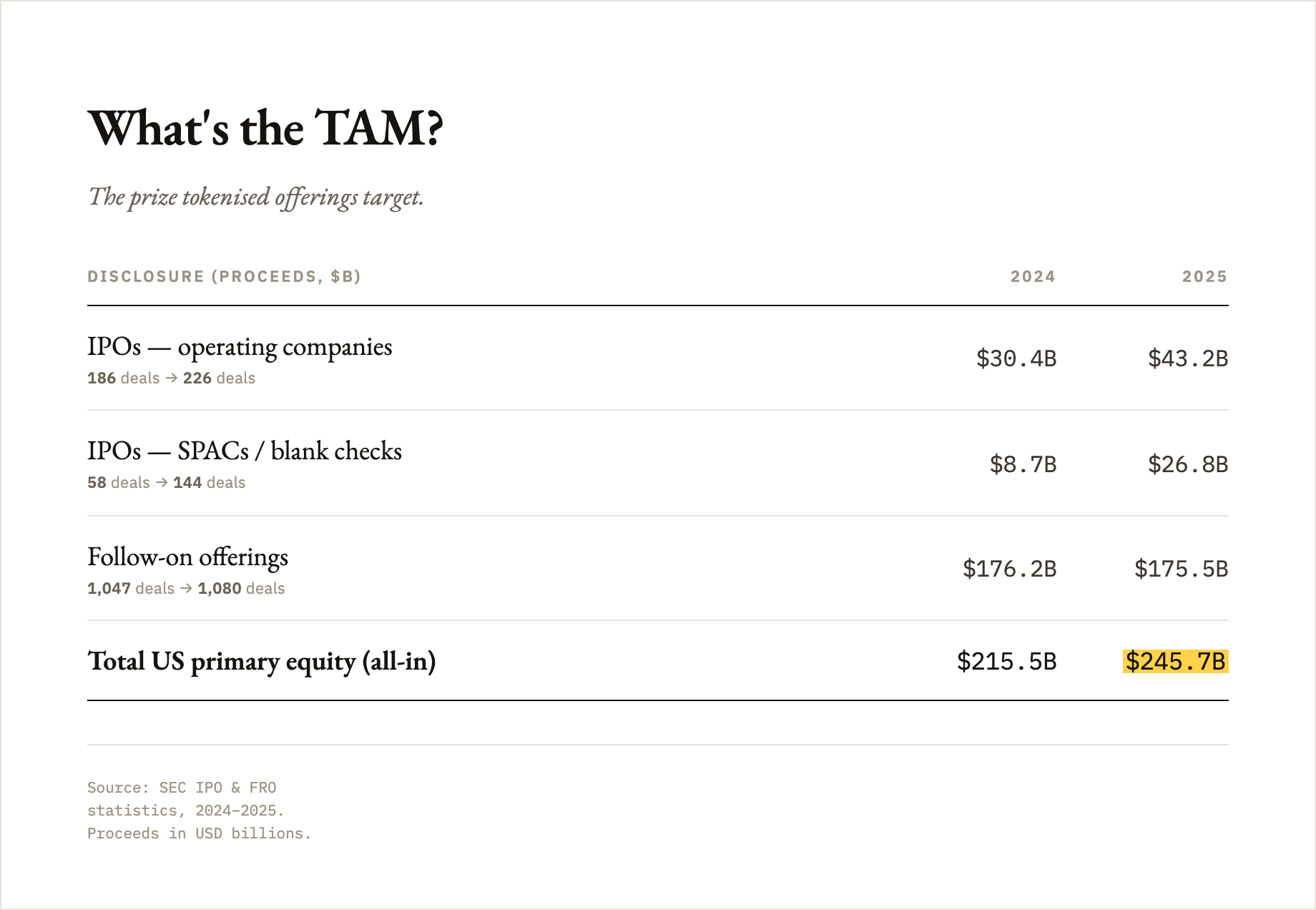
2026 has kept up the pace. Companies raised about $115 billion through IPOs alone in the first half, driven largely by SpaceX’s $75 billion debut in the second quarter. Follow-on issuance is holding steady at a $175-180 billion annual run rate, per the SEC.
Cantor’s own equities desk expects issuers to test tokenisation with 5-10% of an offering. Even with a conservative starting range of 1 to 2%, earnings could reach $220 million, depending on the fee percentage.
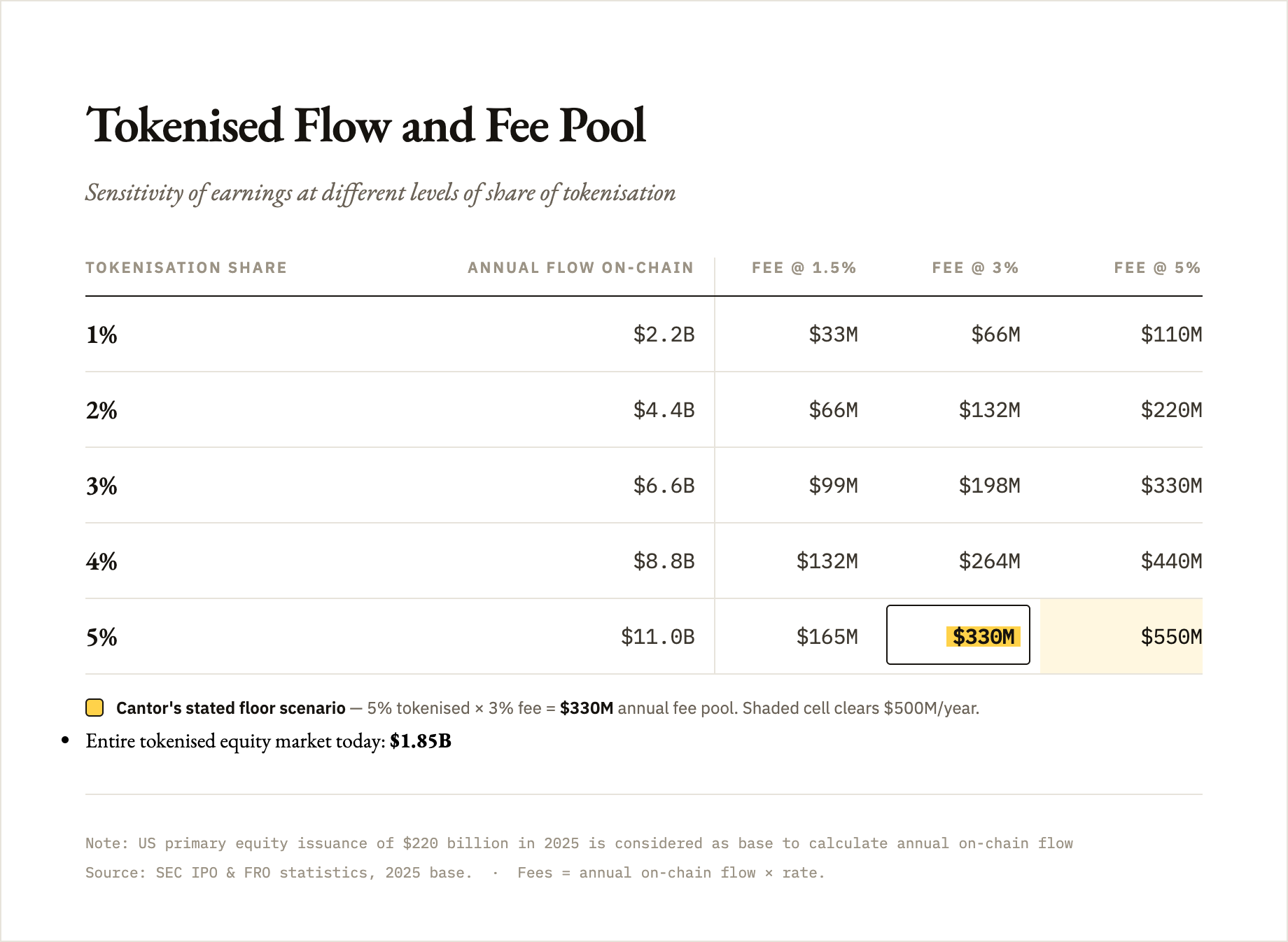
At 1% adoption, roughly $2.2 billion flows through on-chain rails every year, larger than the entire current stock of tokenised equity. At 5%, the fee pool approaches $330 million a year, or a fifth of JPMorgan’s 2025 equity underwriting revenue.
The tokenised layer is a market opportunity for whoever owns the rails. As the fee for underwriting IPOs compresses due to the unbundling of IPOs (Read: The Unbundled IPO), tokenised stock issuance works like a hedge for underwriters like Cantor that are trying to capture value at this new layer.
A Bet on Incremental Demand
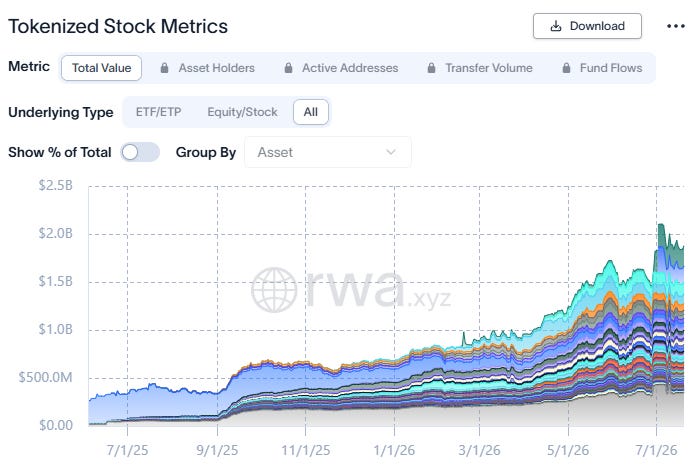
Today, tokenised versions of major stocks trade less than 1% of the volume of their primary listings. In its current form, the adoption looks like capital being largely rerouted from existing crypto users. But there is an incremental pool that tokenised stock issuance taps into. A retail investor in Bangalore or Lagos with stablecoins and no path to a US brokerage account can still own a share in the same way a US resident does. The size of this pool hasn’t been counted yet. But the growth of tokenised stocks (four times in the last 12 months) signals what is possible.
The Art of Capturing Value
Cantor’s positioned to capture the utmost value here. Its number-one IPO ranking is built heavily on SPAC underwriting. A lot of other banks charge 5-7% of IPO proceeds to tour institutional investors and find demand that exceeds what the company can supply. It’s this business that the on-chain issuance would erode. Cantor’s business is not heavily reliant on roadshows. In fact, it was Cantor’s SPAC that took Securitize to debut at the NYSE at a $1.25 billion valuation. If tokenised issuance scales, Cantor profits through its stake regardless of who runs the offerings.
You can see Cantor’s value-capturing strategy across its other deals. Cantor custodies Tether’s Treasury holdings. It also co-founded the bitcoin treasury vehicle Twenty One Capital with Tether and SoftBank. The template is to take equity in the crypto counterparties it serves, so it can own a piece of any value that accrues in the future layer.
When a function commoditises in this industry, the fee moves to the adjacent layer that is not yet overpopulated with competitors.
In the corporate world, we saw pricing commoditise first through blockchain-enabled trading tools like perp contracts, prediction markets and tokenised stock wrappers. Markets now signal a company’s IPO price level before bankers open their books. Settlement is commoditising as we speak, with DTCC racing to tokenise. The Cantor-Securitize deal is an attempt to commoditise demand-manufacturing and make a banker’s job redundant for every round of fresh stock issuance.
Although I believe the bet on incremental demand is premature, its direction is right. Today’s on-chain buyer pool would not fund a mid-cap follow-on. But over time, those demand pools will be built with the help of centralised platforms like Robinhood that onboard millions of retail users and offer them these tokenised stocks. They will not need to know that there is an underlying chain powering all this. The more that happens, the higher the likelihood that companies will choose the tokenised issuance route.
Roadshows and ceremonies might still not die. They will perhaps retreat to where demand still has to be manufactured. For companies and sectors that don’t enjoy liquidity as deep as SpaceX’s and OpenAI’s on the blockchain, roadshows and ceremonies will remain relevant. But for cost efficiency and ease of raising funds, most companies prefer raising equity to borrowing.
That’s it for today. I will be back with the next one.
Until next time, stay curious,
Prathik
Token Dispatch is a daily crypto newsletter handpicked and crafted with love by human bots. If you want to reach out to 170,000+ subscriber community of the Token Dispatch, you can explore the partnership opportunities with us 🙌
📩 Fill out this form to submit your details and book a meeting with us directly.
Disclaimer: This newsletter contains analysis and opinions of the author. Content is for informational purposes only, not financial advice. Trading crypto involves substantial risk - your capital is at risk. Do your own research.