


Hello,
Containerisation was a watershed moment in global trade. I’d call it one of the most underrated, world-altering milestones in human history, right up there with humans learning to make fire and inventing the wheel. All three are force multipliers that changed what humans could do.
By putting the freight in a corrugated steel box, loading costs dropped 97%, from $5.86 to $0.16 per ton. Standardised boxes and cranes made it possible to optimise ship space and cut freight costs and loading time.
A fourth force-multiplier is emerging in the 21st century, and it’s related to how we move and use our money.
Money is worth more, at least implicitly, when it can be easily stored, earned and moved across systems to optimise its utility. We call this composable money. Composability is the containerisation of money. The centralised banking system isn’t the most conducive ecosystem for making money composable; blockchains are.
Many of those operating in decentralised finance are now moving from offering one of the three functions of money - store, earn and move - to owning all of them. That’s because the value to capture in a space where money is made composable is a lot more than where the money can only perform one of its many functions.
Ether.fi, a staking protocol that held $12.4 billion in staked ETH a year ago, is the latest to pivot into a full financial services platform that wants to replace traditional banks. In today’s piece, we explore the reason behind such pivots.
On to the story…

For years, many in the crypto industry have built products around beating traditional money systems like banks. They created alternative internet money, then built new systems to move and compound such money. That gave them ideological loyalists who created communities and echo chambers. But that’s not how you build mass adoption and successful businesses.
The best way to beat banks is to offer the same services banks offer, plus a few more, but more efficiently. You could achieve that efficiency by making money more composable, moving it faster, and at a lower cost.
A Shrinking Asset-Class
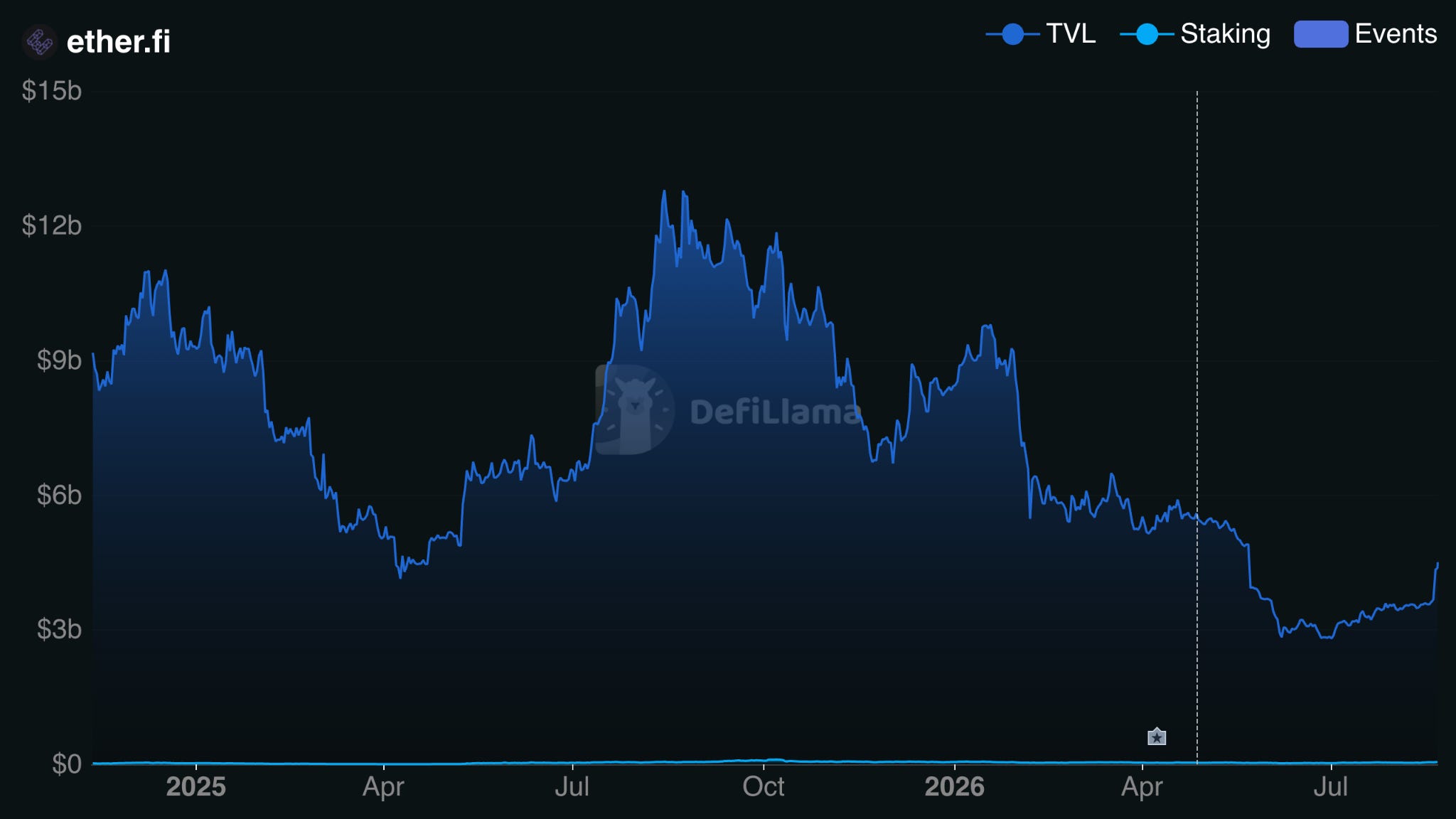
Ether.fi started as a restaking business where users deposited ETH, and the protocol staked it. The same ETH was then pledged again to secure other networks through EigenLayer for extra yield. Ether.fi rode the crypto market rally through 2024 to become the largest liquid staking protocol, with $12.8 billion in deposits in August 2025.
But as the crypto market turned down in the last 12 months, the staking business came crashing down.
The networks that the restaked-ETH was supposed to secure didn’t generate meaningful fees. When the incentives dried up, so did the deposits. Ether.fi’s staking assets fell over 65% in a year, to about $4.3 billion now.
Things got worse in April 2026 when a $292-million bridge exploit at rival Kelp DAO cascaded into ~$200 million of bad debt on Aave. The event shook up how the entire market priced risk in restaking.
Less than 1% of Ether.fi’s assets now sit on EigenLayer, and the protocol’s documentation expects it to turn zero this quarter.
Last week, Ether.fi signalled its pivot away from the staking business by becoming a full-fledged neobank with its “Summer” release.
The Distribution Game
On August 13, Ether.fi CEO Mike Silagadze announced a bundle of financial services to “replace traditional banks for most users”. The “Summer” release bundles tokenised stocks and metals, a credit line, fiat rails in more than 30 currencies, and a Visa card paying 3% cashback, on top of the staking and yield products it already runs.
Although the company has no bank charter, it wants to offer all the functions of a retail bank.
The tokenised stocks will be backed by xStocks, issued by Backed and distributed on Kraken’s platform. The credit line runs on Aave’s market. Settlement happens on Optimism. Ether.fi’s contribution is the account it opens for users, the app interface that hosts these functions, and the card that enables spending and reward earning.
It is the same relationship we saw Robinhood build with its 30 million funded users.
Read: Building a Financial Supermarket
You might argue that tokenised stocks aren’t really equivalent to real shares. Some might treat tokenised stocks as synthetic wrappers that carry economic exposure and creditor rights without voting and direct ownership privileges. They are right, but it doesn’t matter because these tokenised stocks are for a specific audience that doesn’t care about the purity of these wrappers.
Read: Who Actually Owns Your Stocks?
Non-U.S. investors interested in getting exposure to American companies can only choose between these wrappers or nothing. They can’t access Schwab accounts.
Now add 24/7 trading, and the fact that the app lets you lend your tokenised stocks, metals and crypto assets. It also lets you borrow against your full portfolio at ~4%. You can currently borrow on Aave’s market against select tokenised stocks and gold, ETH, BTC, HYPE, and ETHFI - Ether.fi’s native governance token. But soon the company will also support other assets as collateral, said CEO Silagadze.
This creates composability that no traditional bank offers.
Although Ether.fi launched its Cash Card almost two years ago, the spending feature takes on a more meaningful role as it combines with the new bundle of summer releases.
Ether.fi’s Cash Card revenue growth coincides with the fall in its staking revenue.
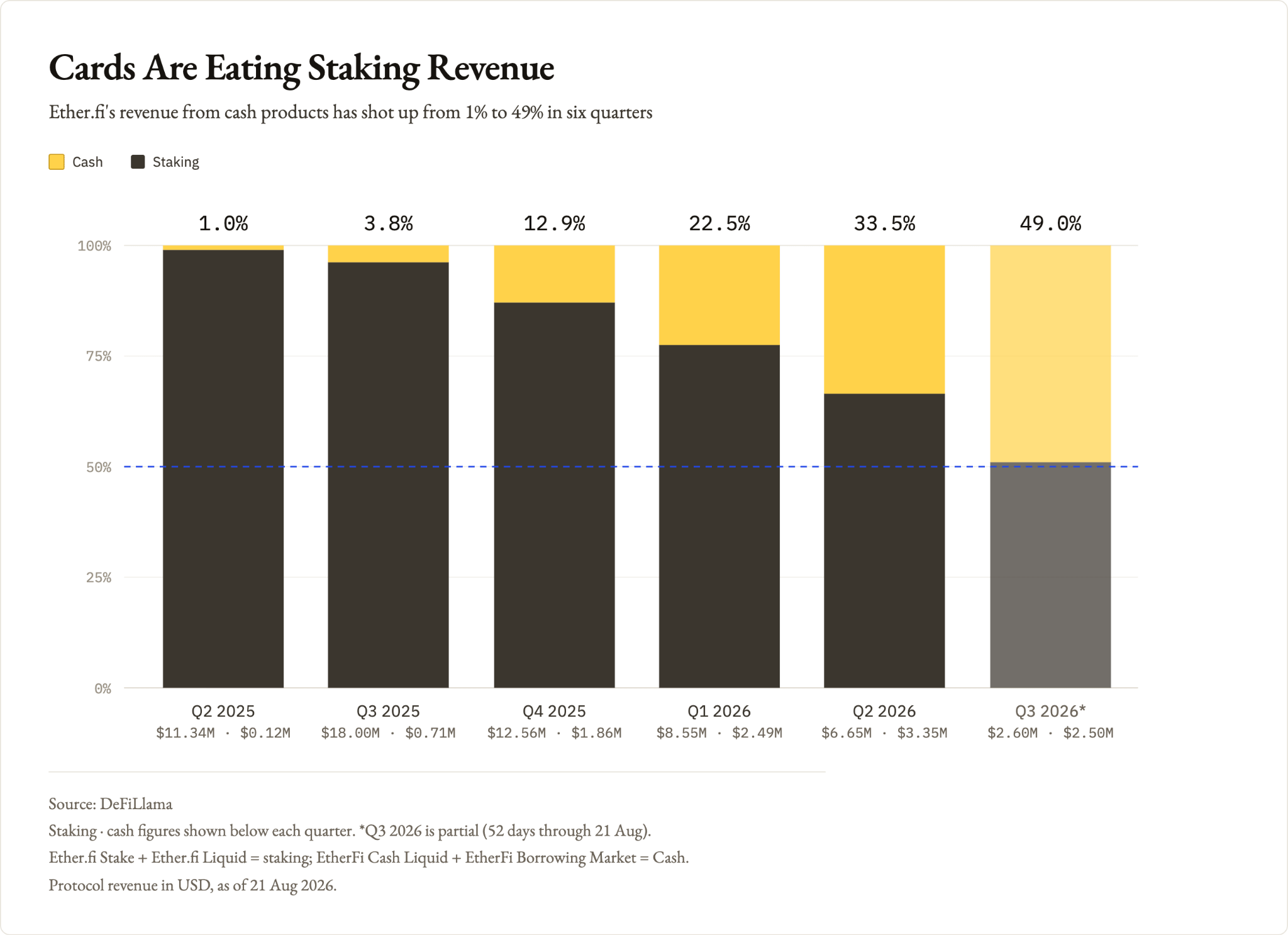
Staking revenue still accounts for a little over 50% of Ether.fi’s total revenue. But consumer products, including card and borrowing, have snapped up almost half of the revenue share, up from a mere 1% last year. There are 150,000 cards now, across 500,000 members, spending at an annualised rate of almost $1 billion.
But Ether.fi isn’t making money composable on its own.
The Distribution Game
Behind Ether.fi’s neobank play is Aave’s credit ecosystem. Both of them already have an old relationship, where Ether.fi’s liquid staking token (weETH) has been among the largest collateral assets on Aave. Under the new arrangement, Ether.fi runs a dedicated Aave instance on Optimism, with Aave’s DAO taking 20% of its revenue and targeting $500 million in lending capacity by year-end.
It’s a win-win for both Aave and Ether.fi. The arrangement helps Aave gain distribution across 500,000 consumer accounts without acquiring them separately, while Ether.fi inherits a credit engine.
For its Cash card, Optimism provides the settlement. Ether.fi migrated its entire card stack there in April this year, with Optimism now settling roughly 29% of all crypto-card spending. Ether.fi alone accounts for over a quarter of the category’s volume.
A chain that spent more than two years courting developers has now found its growth engine in card swipes.
The most interesting aspect of this collaboration is that nobody in this stack is vertically integrated.
Aave doesn’t issue cards, Optimism is not where loans originate, and Kraken is selling its stock inventory through a competitor’s app. This is happening because each player has realised that they can capture the highest value by becoming the best component in an existing bundle. But the one running that bundle gets the biggest share of the revenue pie.
I discussed here how value concentrates with those who hold the accounts and distribution edge in the world of Web 2.5.
One constraint Ether.fi faces is that the tokenised stocks and the card don’t work in the United States. It acts as a ceiling on its growth, but Ether.fi’s business model is still larger than it appears. A neobank offering a financial supermarket to everyone that couldn’t access these asset classes before, including retail non-U.S. investors, is still a large business. It is larger than the DeFi market for a business that depends solely on staking income.
The Subtle Art of Building Composability
The importance of making revenue across the breadth of financial services - crypto or traditional - is evident across many businesses lately.
Robinhood launched its own chain this summer to move tokenised stocks. The chain, launched by a traditional finance platform, now contributes more to Uniswap’s revenue than any other major crypto-native chain. I wrote about how businesses are decoupling revenue from asset classes here. Hyperliquid makes most of its revenue by facilitating trading in non-crypto perp contracts.
Coinbase, Kraken, Binance and OKX are all adding banking features onto their exchanges. Each started with either an exchange, a wallet or a staking pool. But now they’re all converging around the distribution play. That’s because they have learnt that once you marry the distribution you have with the ability to spend the money with cards, earn through savings products and integrated vaults, invest via tokenised stocks and lend through credit products, the platform you run becomes a champion of composable money. That freedom makes financial infrastructure feel like Lego blocks that can connect to move money across them.
This possibility is waking up crypto protocols to the idea of building flourishing businesses, rather than setting up ideology-driven niche products that serve a select few and are far removed from the fundamentals of running profitable businesses.
That’s it for today. I will be back with the next one.
Until next time, stay curious,
Prathik
Token Dispatch is a daily crypto newsletter handpicked and crafted with love by human bots. If you want to reach out to 170,000+ subscriber community of the Token Dispatch, you can explore the partnership opportunities with us 🙌
📩 Fill out this form to submit your details and book a meeting with us directly.
Disclaimer: This newsletter contains analysis and opinions of the author. Content is for informational purposes only, not financial advice. Trading crypto involves substantial risk - your capital is at risk. Do your own research.