


Welcome to Edition 6 of The Friday Reading List — your fortnightly antidote to the noise. Every two weeks, I share my favourite literature across crypto, finance, technology, culture, and beyond. I also share what I’m watching and reading, because if this newsletter were only about charts and tokens, I’d have bored myself out of writing it by now.
Hello,
“There are no winners in war.” The events happening around us are the perfect testimony to this quote.
Just two days ago, the world was rejoicing over a two-week ceasefire agreement that the U.S. and Iran had managed to reach. Those on the ground, in the line of fire, celebrated the lives and property that the deal could save. Others, like me, living thousands of miles away, didn’t know what that felt like. But we still celebrated. Ironically, not just the lives that could be spared, but the recovery capital markets and portfolios witnessed.
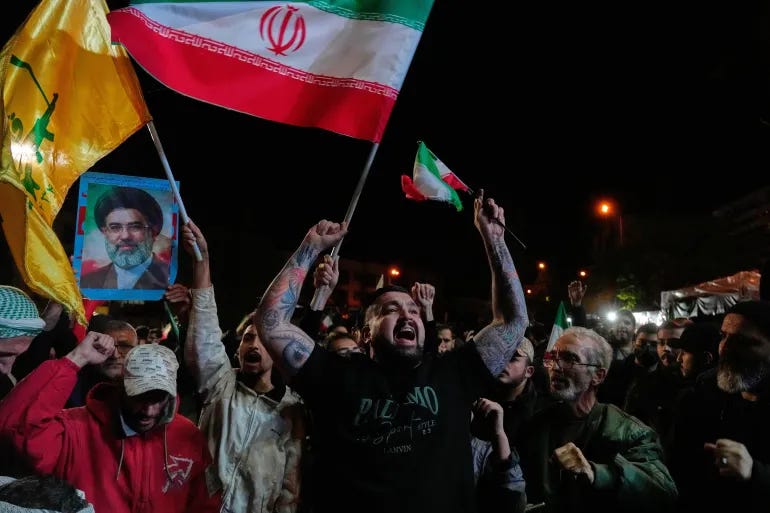
Within 48 hours of signing the ceasefire, both countries were back to threatening withdrawal from the truce. The reason? Israel continued its strike in Lebanon. Markets responded by paring some of the gains made after the ceasefire was announced. They processed everything in real-time, and they had to. Whether the ceasefire holds or lives are saved, the trades must be settled. That’s how the global economy expresses itself - through pricing the events.
This tension drove many developments in the past fortnight across crypto and finance. Let’s get started.
The Fortnight That Was
Over the last two weeks, the traditional markets (S&P 500), Bitcoin and commodities (Gold and Silver) moved in strict alignment. Both BTC and S&P 500 closed the fortnight with modest single-digit gains. BTC crossed $71,000 for the first time in two weeks on April 7 as the U.S. and Iran struck a ceasefire agreement.
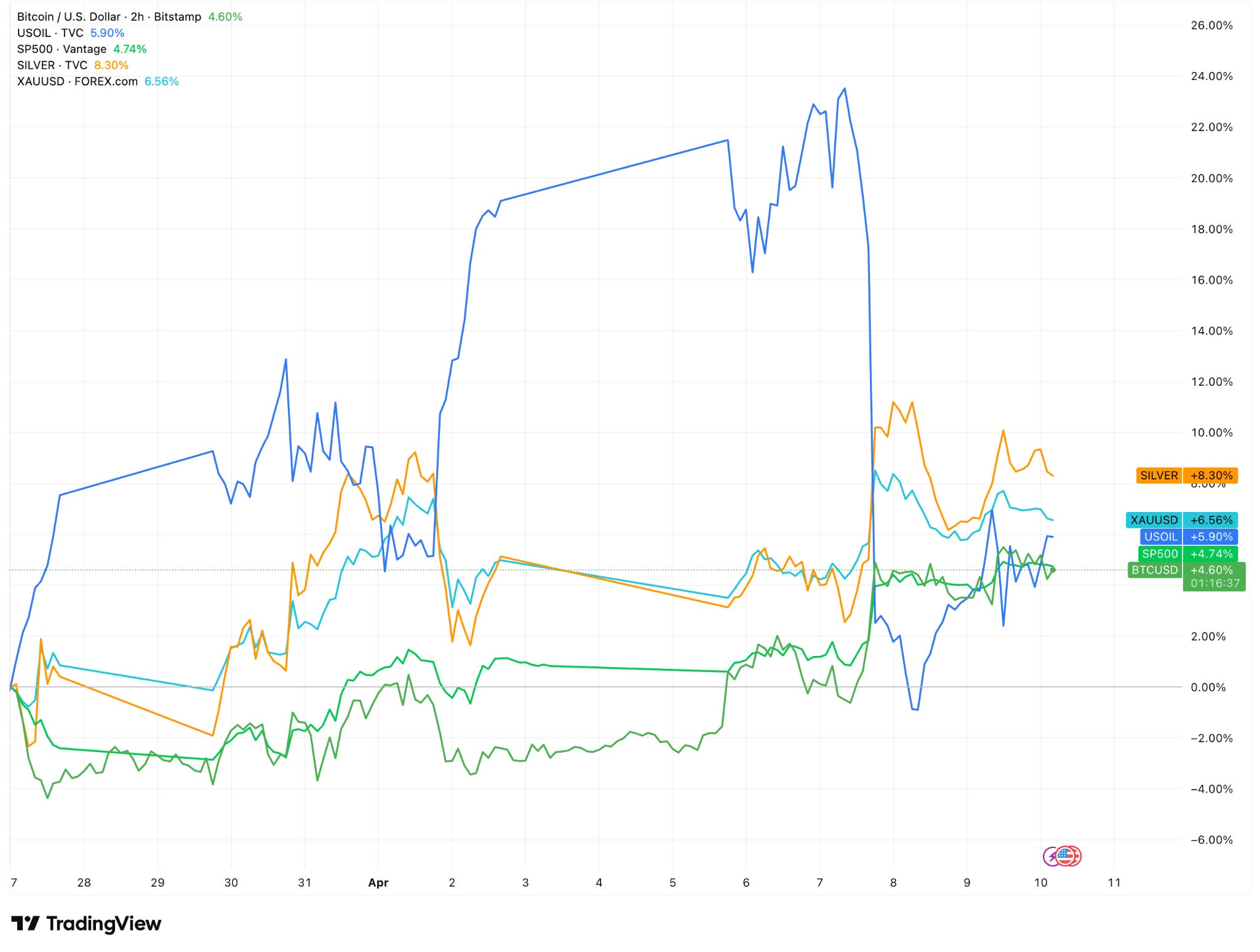
Crude oil was the most volatile asset, driven by uncertainty about the resumption of shipping in the Strait of Hormuz. After rising 24% between March 27 and April 7, the oil price gave up all those gains in just one day when the ceasefire agreement was struck. But it rose by 6% in the next two days as nations continued to threaten withdrawal from the truce.
There’s still a lot more noise that went around in the markets, but we focused on writing about the things underneath the geopolitical crisis.
I started the fortnight by discussing the unbundling of financial markets, drawing on events such as the U.S.-Israel-Iran war. In this piece, we discussed how the old system that bundled the market across venue, wrapper, and time is now unbundling due to more efficient markets elsewhere.
Thejaswini wrote about why Canton has stopped playing defence and started lobbying regulators about the risks posed by zero-knowledge proofs to institutional finance.
Vaidik unpacked the Coinbase-Better-Fannie Mae mortgage product that lets Bitcoin holders borrow against their holdings to purchase a home without triggering a taxable event. He also wrote about why the structural design makes it different from the 2021-era crypto lending collapses.
In a quantitative analysis earlier this week, I deconstructed Polymarket’s fee overhaul and wrote about how its bell-curve pricing model could improve execution quality rather than just extract fees from traders.
Thejaswini followed up with a piece on why the U.S. Department of Labour is exploring the option of investing Americans’ 401(k) retirement savings in crypto.
We have got a lot more in store for you in the coming weeks. But here are some readings to keep you company until then.
Regulation & Policy
An Interactive Guide to GENIUS Implementation: A useful map of the implementation phase of the GENIUS Act after legislation.
Is Everything a Swap?: A note on how the Dodd-Frank Wall Street Reform and Consumer Protection Act (2010) was enacted to catch both old derivatives and clever new wrappers that try to dodge the same rules.
How Prediction Markets Turned the World Into a Casino: A mainstream framing of the Kalshi-Polymarket moment, where the line between trading and gambling looks less principled.
Crypto & Tech
Lessons from Six Months in Agentic Payments: A note on what actually starts to matter once you spend time close to agentic payments instead of just appreciating the demo.
The CT Ceiling: A good reminder that crypto-native distribution is not the same thing as product-market fit; if you market only within CT, you eventually run out of room.
TAO and the Free Rider Problem: A bear case on Bittensor: what if TAO finances the upside, but the upside never accrues back to TAO?
Which Blockchain Will AI Choose?: A practical question that asks not what humans want to use, but what rational agents would choose for payments, discovery and trust.
Future of Onchain Liquidity Routing: As DeFi liquidity fragments further, routing starts to look less like a convenience layer and more like core market infrastructure.
When Risk Engines Become Moats: Our partners at Decentralised.Co explain why Hyperliquid’s risk engine that lets new markets scale without blowing up the venue is its biggest moat.
Trade’s Markets Thesis: A bigger-picture perspective on how perps turn into technological infrastructure by spreading across asset classes
USDe Backing Diversification: This explains why Ethena wants USDe to have a more diversified backing mix if it wants to survive more than one type of market regime.
Hunt for Satoshi Raises Existential Risks: Less about identity porn, more about why crypto still seems desperate for a breakthrough founder myth. (paywall)
Our Quest Not to Solve Bitcoin’s Great Mystery: FT leans into the absurdity of the endless Satoshi-candidate industry. (paywall)
Why I Think Satoshi Is No Longer With Us: Nic Carter presents an interesting counterpoint to the latest wave of Satoshi sleuthing.
Finance & Economy
How Private Equity Became Hooked on Second-Hand Deals: A timely look at how secondaries have become a liquidity machine for private capital when traditional exits do not quite show up. (paywall)
Strait of Hormuz: A Citrini Field Trip: Probably the most literal macro research here: go to the choke point itself and ask what the market is getting wrong. (paywall)
Inside the Funnel: What reviewing 2,000 funds teaches you about how crowded, filtered and power-law-driven venture really is.
A Stablecoin-Native U.S. Bank for the Innovation Economy: One of the clearest tests yet of whether a US bank can be built stablecoin-native from day one rather than retrofit crypto later.
Stablecoins for Neobanks: An operating thesis for why stablecoins matter to neobanks. It explains how they compress cross-border payments, yield products and market expansion into one stack.
Prediction Market Leverage Landscape: A useful map of the leverage models being built around prediction markets, and the structural places where they can break.
The Anxiety Economy: Why Trading Explodes: Explains why trading booms: less greed, more the feeling that passive compounding will not get people where they need to go.
Buy Bitcoin at Night: Matt Levine’s commentary on the overnight anomaly and the strange appeal of packaging Bitcoin’s after-hours edge into a product.
Bad Analogies: An important rebuttal to the lazy habit of calling every cash-burning AI company “the next Amazon.”
AI & Innovation
From Hierarchy to Intelligence: Jack Dorsey’s provocation that AI does not just change productivity, it may change the org chart itself.
Agents Will Become Companies — Thread: Sreeram’s thesis in short form: crypto plus AI can create internet-native firms with agents, assets and capital of their own.
Agents Will Become Companies: The fuller version of that thesis, and a more convincing case than most AI x crypto fluff for why agents might become actual business entities.
AI as a Transaction-Cost Shock: A sharp Coasean idea: if AI crushes transaction costs, the shape of the firm itself starts to change.
Infinite Midwit: One of the better essays on why better AI has made some people calmer, not more terrified; the machine is tireless and informed, but still weirdly mid at the center.
AI Captured 80% of Global Venture Funding: A sobering reminder that venture is starting to look less like a broad market and more like a giant capital-allocation machine for frontier AI.
Culture & Beyond
Principles: A dense list on speed, risk, writing, integrity and output that reads better as craft advice than life-hack content.
Giggles: The most 2026 startup origin story imaginable: a fake app joke, a Minecraft YouTuber, a meme prediction market, and somehow real money.
Catastrophe Markets: A serious ethical essay on what it means when disaster itself becomes a tradable spectacle.
What I Am Watching & Reading
Last week, I picked up another non-fiction on geopolitical crisis after completing Betty Mahmoody’s Not Without My Daughter.
Amira Hass’ Reporting from Ramallah is a collection of short stories from the reportage of an Israeli journalist in the occupied land.
I am only 30 pages into this collection, but there’s one thing that Amira doesn’t let me forget through the book. It’s the multidimensional crisis that contrasts with how popular media often portrays civil war. There are accounts of Israel as a state versus the Israeli people; Palestine versus the Palestinian people; each against the other, and each against themselves.
It shows you how a crisis is never binary, but layered.

I also watched Project Hail Mary a couple of weeks back. There’s so much to argue for expert reviewers in terms of the validity of science and logic. I will leave that to them.
What stood out most to me was how it portrayed the human-alien relationship. In that regard, it does what Interstellar tried to do with love across dimensions, except it’s even better here. Less metaphysics, more conversation. All that an average human relates to - love, compassion, and companionship.
That’s all for this fortnight. Catch you in the next edition.
Write back to us with any recommendations through the next fortnight that you think we should include in the upcoming edition.👇🏾
That’s all for this fortnight. Catch you in the next edition.
Until then, happy reading!
Prathik

Token Dispatch is a daily crypto newsletter handpicked and crafted with love by human bots. If you want to reach out to 170,000+ subscriber community of the Token Dispatch, you can explore the partnership opportunities with us 🙌
📩 Fill out this form to submit your details and book a meeting with us directly.
Disclaimer: This newsletter contains analysis and opinions of the author. Content is for informational purposes only, not financial advice. Trading crypto involves substantial risk - your capital is at risk. Do your own research.